
A latent image is the pattern of exposure-induced changes in a photographic emulsion before photographic processing makes it visible. A missing visible mark before development therefore says nothing about whether a charged particle passed through the coating.
A particle number counts the particles of a specified kind in a system. For a fixed collection, is a nonnegative integer. In a variable-number quantum system, distinguish a measured particle number, the particle number operator, and its expected value.
Choose the beam as the direction. A particle's transverse momentum is its momentum projected onto the perpendicular plane; . A Lorentz boost along the beam changes energy and longitudinal momentum, while leaving transverse momentum unchanged. Large transverse momentum identifies motion substantially across the beam rather than merely along it.
A W boson decay can leave one visible charged lepton and a large missing transverse momentum; a Z boson decay can instead supply two visible leptons whose four-momenta determine an invariant mass. The two signatures answer the same existence question with different missing information. The electroweak unification history recognized by the 1979 Nobel Prize in Physics predates these 1983 observations: the W boson and Z boson were predictions to test, rather than particles first proposed in 1983.
The Super Proton-Antiproton Synchrotron stored counterrotating proton and antiproton beams; stochastic cooling made accumulation of the scarce antiprotons practical. Carlo Rubbia's 1984 lecture describes track reconstruction in a large drift chamber inside a magnetic field, surrounded by segmented particle calorimeters. Their nearly complete angular coverage allowed an imbalance test for unobserved neutrinos.[ref]
A particle range is the distance a charged particle travels through a specified material before stopping; it depends on kinetic energy, particle identity, and the material.
In 1974, Samuel Chao Chung Ting's Brookhaven team and Burton Richter's SPEAR team independently found the narrow state now called the J/psi meson. Each discovery paper notes learning of the other result during manuscript preparation.[ref]
Experimental Observation of a Heavy Particle J by J. J. Aubert. Aubert and others, p. 1406, note 5: independent SPEAR result
[ref]Discovery of a Narrow Resonance in e+e- Annihilation by J.-E. Augustin. Augustin and others, p. 1408, note 3: independent Brookhaven result
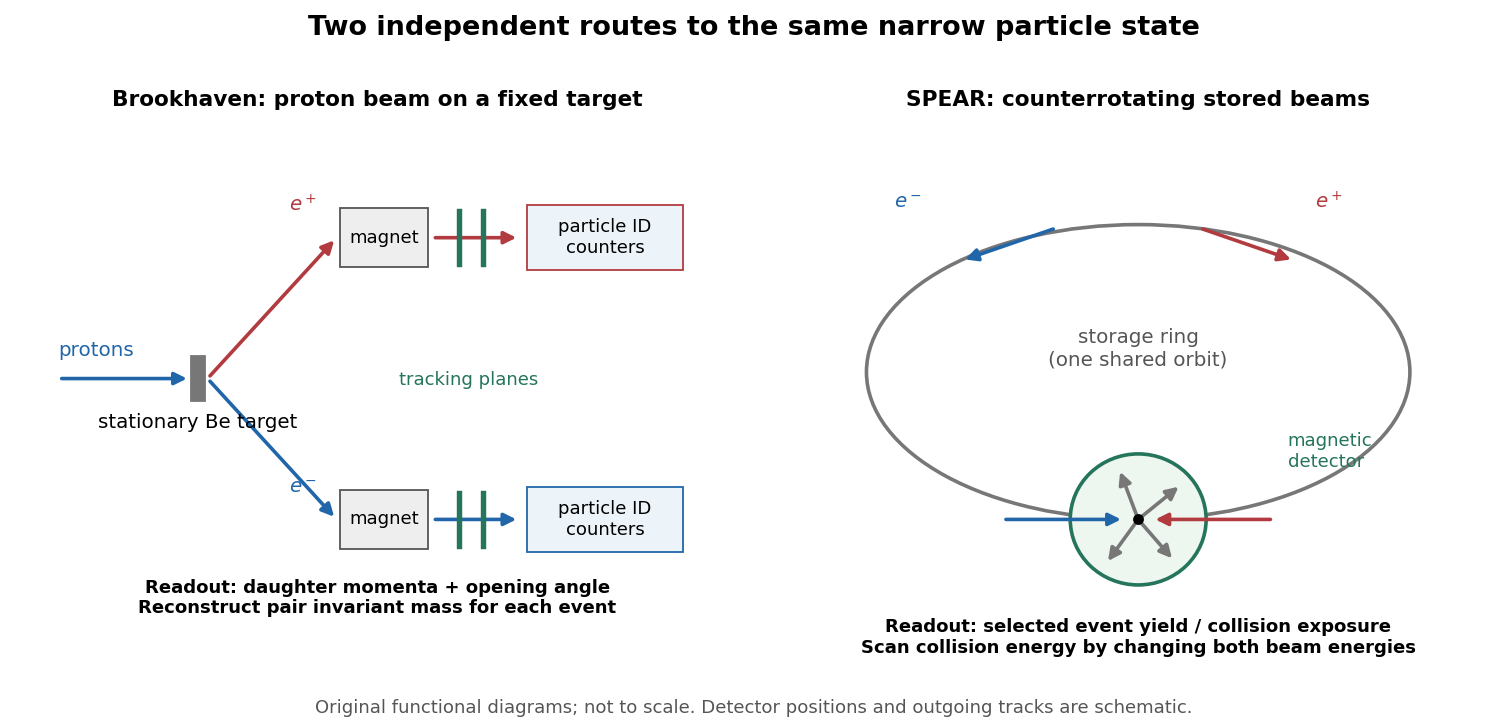

The common question was whether the observed excess represented a new particle resonance, rather than a peculiarity of particle identification, acceptance or calibration. The important difference was the horizontal coordinate of the search: Brookhaven reconstructed a final-state invariant mass; SPEAR scanned an initial-state center-of-mass energy. The invariant-mass selection of bubble-chamber events uses the first kind of reasoning, despite a very different recording medium.
A cascade producing multiple secondary particles from an initial energetic interaction. Its observed multiplicity depends on which particles reach the detector and on detection efficiency.
Inferring a particle trajectory from recorded detector positions or a continuous trail. The inferred trajectory depends on spatial resolution, detector geometry and the assumed particle-motion model; it is not a direct picture of the particle itself.
Particle identification assigns a species hypothesis to a detector signal or reconstructed track. Curvature in a magnetic field supplies magnetic rigidity; additional responses, such as those of a Cherenkov detector or a particle shower, help distinguish an electron from a hadron. The identity hypothesis enters the energy–momentum relation and therefore the reconstructed invariant mass. An apparatus can observe a peak before it can identify every decay channel, as the SPEAR psi energy-scan experiment illustrates.
The reconstructed location at which a particle decays, inferred from the trajectories of its decay products. Comparing two decay vertices can determine a decay-time difference when the motion of the parent system is known.
Inferring a quark flavor from the charges and identities of observed decay products. A mistaken assignment dilutes a flavour-dependent decay rate difference.
A transition-edge sensor detects deposited energy using the strong change in electrical resistance near a superconducting transition temperature.
A microorganism is an organism too small to study in ordinary detail without magnification. The category includes members of different evolutionary lineages, including bacteria and many members of the fungus group; it describes scale rather than one natural taxonomic group.
Nuclear fission splits an atomic nucleus into two major fragments, usually accompanied by emitted neutrons and gamma rays. It can follow neutron absorption or occur spontaneously in some heavy nuclides. When the products have greater total nuclear binding energy, the decrease in rest energy supplies fragment kinetic energy and radiation.
The fragments are often neutron-rich and undergo subsequent beta decay, producing an evolving inventory of fission products. Some emitted neutrons can cause further nuclear fission, enabling a nuclear chain reaction; others are absorbed without fission or escape.
The discovery combined chemical and physical evidence. Otto Hahn and Fritz Strassmann identified barium among products of neutron-irradiated uranium, rather than merely an adjacent heavy element. Lise Meitner and Otto Robert Frisch interpreted this as division of the atomic nucleus and estimated the large released energy from mass differences. Chemical separation identified the unexpected product: the same procedure could separate a radium isotope from barium, whereas the new radioactive activity followed barium. This chemical comparison did not by itself measure every fragment's motion.[ref]
Disintegration of Uranium by Neutrons: a New Type of Nuclear Reaction by Lise Meitner and Otto Robert Frisch. Opening barium discussion and mass-defect interpretation, Nature 143, pp. 239–240
The mean orientation of nuclear spin angular momentum in a chosen direction. For nuclei with nonzero spin quantum number , the vector-polarization component is and lies between and . Equal populations of all projections give ; complete alignment gives .
Nuclear symmetry energy is the energy cost associated with proton-neutron imbalance in nuclear matter or finite nuclei. A finite-nucleus semi-empirical mass formula includes the positive asymmetry term . The Pauli exclusion principle and strong-interaction dynamics both contribute.
There are unlisted articles, also show them or only show them.