A valid buffered device block with modifications still owed to its backing location. Until successful buffer cache writeback, simply reassigning its buffer cache key would lose those modifications. “Dirty” records a write obligation; a write of identical contents can still mark the structure dirty. Repeated buffered writes can leave only the latest contents to be transferred.
Whether a buffered device block's contents are ready for the requested use. Reserving a buffer cache key does not make its previous occupant's contents valid. A read fills the reserved structure before exposing its contents. A second caller finding an unfinished fill must wait; finding the identity is not yet a data cache hit under the convention used here. A failed fill must not expose the stale contents as valid.
A buffered partial write first needs the untouched bytes: read the old contents on a cache miss, change the requested range, and retain the result as a dirty buffer. A complete overwrite can initialize every byte without reading the old contents if the interface permits that path. The buffer cache access trace deliberately uses partial writes, so every cache miss reads the old block.
The identity used to find a buffered device block. In the fixed-block-size model, identifies the device and its block number; and are different keys if . A file's pathname or its logical block offset alone is insufficient for this device-indexed model. Interfaces supporting different transfer sizes need to specify the size and overlap rules too.
Maintain at most one logical buffered device block for each buffer cache key within this buffer cache. Otherwise two callers could modify different copies and later overwrite one another's changes. Lookup and reservation must therefore be coordinated by synchronization: even before contents are ready, a reserved key directs a second caller to the same structure. This invariant concerns the participating cache, not every copy of those bytes anywhere in the machine.
Let be three distinct buffer cache keys on one device. Use two initially empty slots, LRU replacement refreshed at each completed request, and synchronous successful buffer cache writeback of a dirty victim. Each request acquires its target, finishes any fill, reads or partially modifies it, and releases the client reference. An explicit pin on remains after request 2 through request 7; pin and unpin do not refresh recency. No other references, invalidations, background writes or durability operations occur. Initial backing contents are represented by the integers ; partial writes change the tracked value of to 11 and then 12 while preserving the unshown remainder.
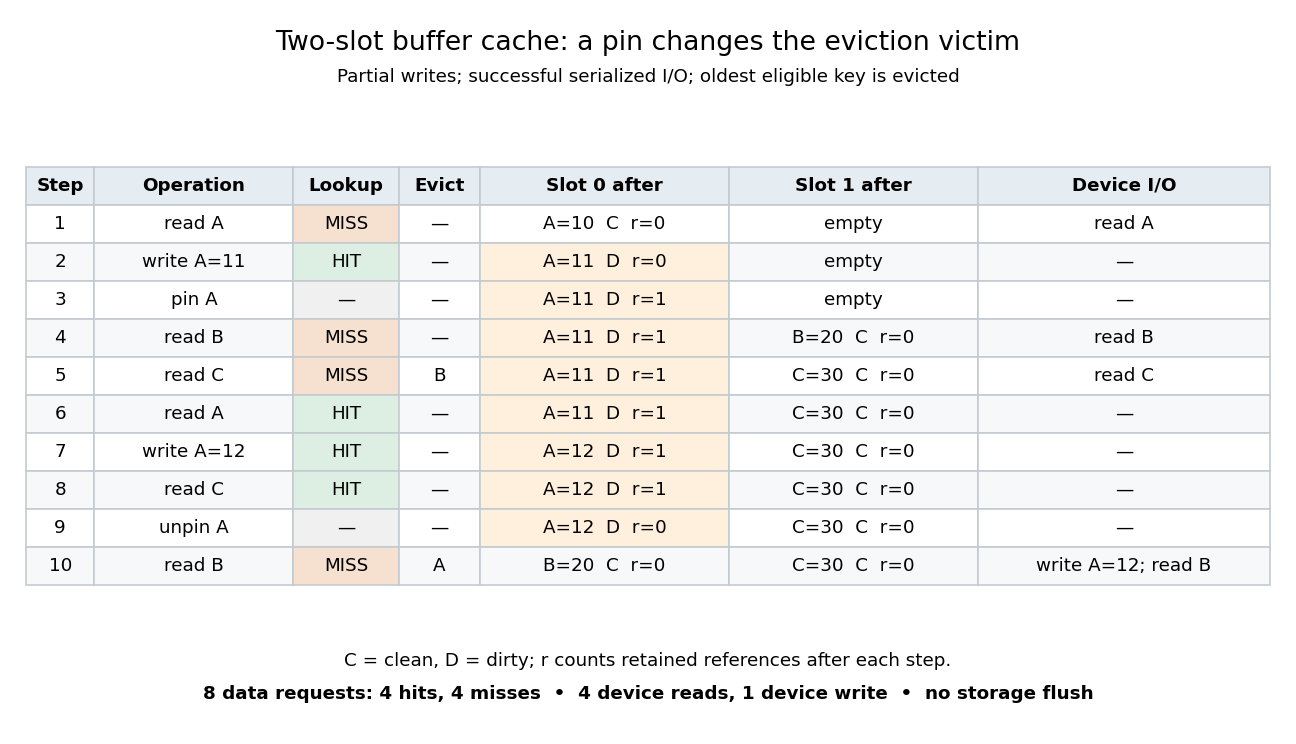
Exact cache hits, cache misses, retained references and buffer cache evictions in a two-slot buffer cache
. Details. The eight data requests are read , write , read , read , read , write , read , and read after unpinning . They yield four cache hits, four cache misses, four device reads and one device write. The pin and unpin are lifetime operations, excluded from the data-request count. At the read of , is older than but pinned, so the clean buffer for is evicted instead. Reading then returns 11 without device access even though its backing value is still 10. The second write supersedes 11; reading makes the older entry again. After unpinning, the final read of writes back 12 before evicting . After that request, backing contains 12, while the resident keys are .
This example exposes the value of retaining modified contents: a cache hit can return a newer value than a device read would. It also exposes the cost of reference counting constraints: a pinned older entry forces a different victim. An independent capacity sweep gives two cache hits, six cache misses and two device writes with one slot and no pin, but three cache hits, five cache misses and two device writes with two slots and no pin. With one slot and the stipulated pin, the read of cannot proceed. With three slots, both pin choices give five cache hits, three cache misses and no eviction-triggered write; remains dirty with value 12, so the absence of a device write does not establish file-system transaction durability.
When a productive stock pays before trading at ex-dividend price , an investor entering with shares receives and sells or buys shares to leave with . The displayed budget constraint accounts for the available consumption and the cost of the new holding. Here is known before date , while and may depend on the information revealed at that date.
For the nonrotating BTZ black hole family with and angular period , the circumference of a small circle divided by its proper radius tends to . A smooth axis requires this ratio to be , so only gives regular Anti-de Sitter spacetime. Other values have a conical singularity, with deficit angle or an angular excess when . The lapse is strictly positive, so outward radial null geodesics escape from arbitrarily near the axis: the defect is a naked singularity, despite finite local curvature away from it.
Positive matrix eigenvector from simplex normalization by  Codex 0 Created 2026-10-14 Updated 2026-10-31
For a strictly positive real matrix , the map is a continuous self-map of the probability simplex. A Brouwer fixed-point theorem fixed point satisfies with . The image lies in the interior of the simplex, so every entry of this eigenvector is strictly positive. Nonnegative entries and nonzero columns alone do not imply this strict conclusion.
Freezing can increase the mass density of neighbouring seawater because brine rejection leaves much of the salt in the liquid. If salt mass is approximately conserved in a liquid reservoir while fresh ice mass is removed, its salinity rises as the remaining liquid mass decreases.
For a small change at fixed temperature and pressure, . The coefficient depends on the equation of state and the units chosen for salinity. A heat loss that freezes water removes latent heat and concentrates salt; the density change therefore differs from the change obtained by spending the same heat loss on sensible cooling alone.
If a fraction of initial liquid mass freezes into salt-free ice, all original salt remains in a liquid mass fraction . Writing salinity as salt concentration per mass gives , hence . For equal initial cooling and subsequent freezing heat extraction, . The liquid specific heat capacity, rather than the ice value, determines the initial heat removal. If ice retains salt, the mass balance instead reads .
Dense saline liquid in connected pore space can drain from sea ice while fresher seawater enters. The process is controlled by buoyancy, permeability of a porous medium and network connectivity, and is a major means of growing-ice desalination.
// Target: geophysics.bigb
Freezing within a brine inclusion expands the solid fraction and can force concentrated liquid into neighboring pores or channels. Expulsion redistributes salt internally; net desalination requires a path crossing the ice boundary.
// Target: geophysics.bigb
A temperature gradient can move a brine inclusion by melting its warmer wall and freezing its colder wall. This slow process can redistribute salt, but is generally much less effective at net desalination than gravity drainage of sea-ice brine or meltwater flushing of sea ice.
// Target: geophysics.bigb
Galilean boost of a nonlinear Schrödinger soliton by Codex 0 Created 2026-10-14 Updated 2026-11-05
Codex 0 Created 2026-10-14 Updated 2026-11-05For , translation of a solution at velocity must be accompanied by the displayed phase. Direct differentiation cancels the terms proportional to , leaving the original equation. A standing profile of frequency thus gives . Its centre travels uniformly, while its L2 norm is unchanged.
Let a real localized profile satisfy . Then solves the cubic focusing nonlinear Schrodinger equation in the potential with the displayed phase and any harmonic-oscillator trajectory . Imaginary terms require ; real terms require and the remaining time-dependent phase. The translation is exact and causes no profile deformation, unlike a generic collective-coordinate effective Lagrangian approximation.
At an algebraic branch point, a local solution becomes meromorphic after the finite substitution . The displayed convergent expansion has only finitely many negative terms. A square-root branch point corresponds to ; an essential singularity or logarithmic singularity need not become meromorphic under any such finite substitution.
For minimization, best-bound search expands the active branch and bound node with smallest lower bound. A feasible completed assignment supplies an incumbent upper bound. Nodes with lower bound at least that incumbent can be discarded when only one optimum is needed. Search ends with an optimality certificate when no active node can improve the incumbent.
// Target: combinatorics.bigb
An incumbent solution is the best feasible solution found so far by an optimization search. Its objective value is an upper bound on a minimization optimum and a lower bound on a maximization optimum; bounds on unexplored subproblems can be compared with it to prune the search.
// Target: combinatorics.bigb
The bisection method finds a zero of a function by repeatedly halving a root bracket. Let be a real-valued continuous function on the closed interval , with . First check for endpoint zeros of a function; otherwise require strictly opposite signs at the endpoints. Evaluate the midpoint and retain the half with strictly opposite endpoint signs, stopping immediately if the midpoint is a zero of a function. The intermediate value theorem ensures that every retained root bracket still contains a zero of a function. This is the construction in MIT's root-finding notes.[ref]
https://ocw.mit.edu/courses/18-330-introduction-to-numerical-analysis-spring-2012/5b325bfa56a599794c7196de926844b0_MIT18_330S12_Chapter4.pdf. Laurent Demanet, MIT 18.330, Chapter 4, §4.1, pp. 1–2, 2012
For a worked square root calculation, use the polynomial on . Write for the root bracket after halvings, with . The candidate evaluated during update is the old midpoint :The initial midpoint is . After four halvings the new midpoint is , and the bisection error bound is . Its actual error is approximately . The last tested candidate and the reported midpoint are different points.
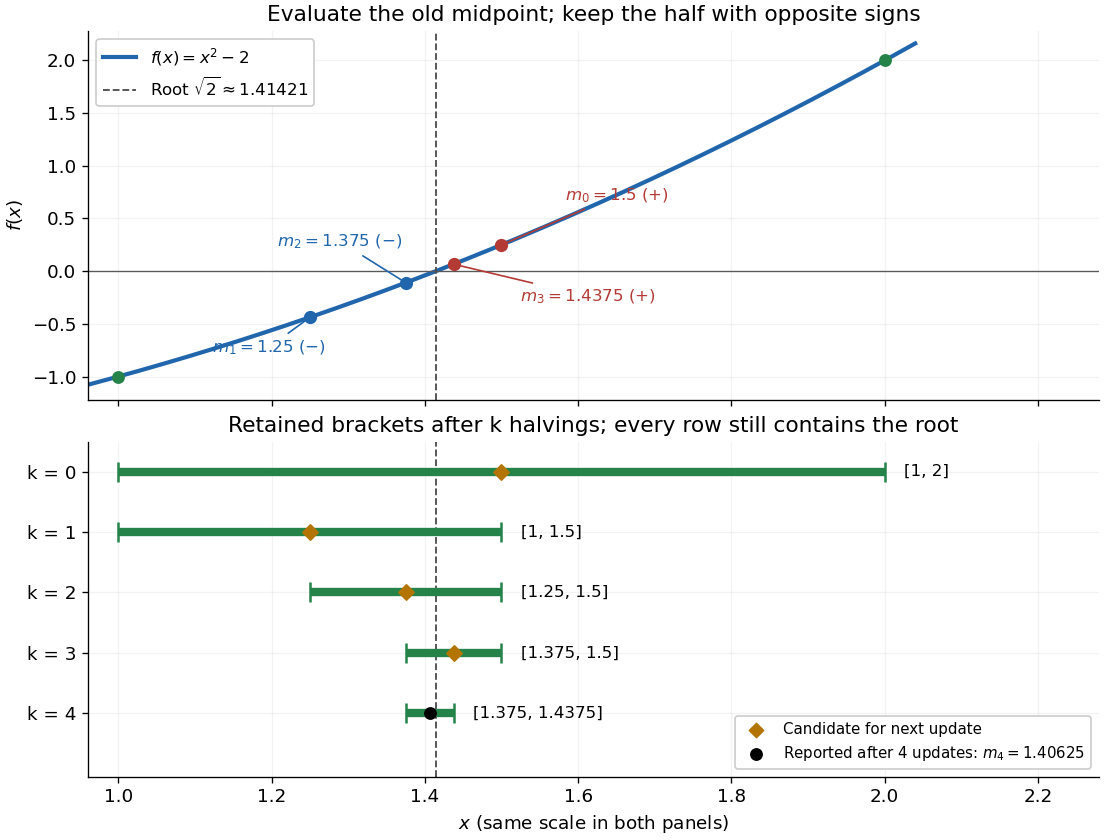


The useful feature of the bisection method is that the retained width halves on every update, independently of the shape of the function graph. The bisection error bound therefore supplies an accuracy guarantee before the zero of a function is known. No derivative is needed, and a valid initial root bracket gives convergence without a close initial guess. This makes the bisection method a dependable fallback for the faster Newton root-finding iteration.
A root bracket is a closed interval known to contain at least one zero of a function. For a real-valued continuous function on , a strict change of sign between and certifies such an enclosure by the intermediate value theorem. An endpoint with value zero already supplies a zero of a function. For example, is a root bracket for the polynomial , since and . A root bracket need not contain a unique zero of a function.
There are unlisted articles, also show them or only show them.