
Coalescence of a binary containing two neutron stars can eject neutron-rich material and power a kilonova. Rapid neutron-capture process reactions in the ejecta produce heavy elements. This connects compact-binary dynamics to chemical enrichment.
An X-ray binary has a compact mass-gaining star or black hole accreting from a companion, so that much of its emitted power appears as X-rays. Gravitational binding energy supplies an accretion luminosity of order when there is a surface or an appropriate inner disk radius. The donor star may feed an accretion disk through Roche-lobe overflow or a stellar wind.
This convention composes paths in their written order; some sources instead reverse that convention. Composition of relations is associative. Taking inverse relations reverses the order: .
// Target: foundations-of-mathematics.bigb
A weak preference relation records that one alternative is at least as desirable as another. Rational preferences are complete and transitive. Their strict preference and indifference relation are the asymmetric and symmetric parts. On a consumption space, continuity is expressed by a closed set of weakly ranked pairs.
Represent a binary relation on an -element finite set by its zero-one incidence matrix. If no column may be empty, each column has choices. Apply the inclusion-exclusion principle to empty rows: fixing empty rows leaves allowed matrices. Summing over those row sets with alternating signs yields the displayed count.
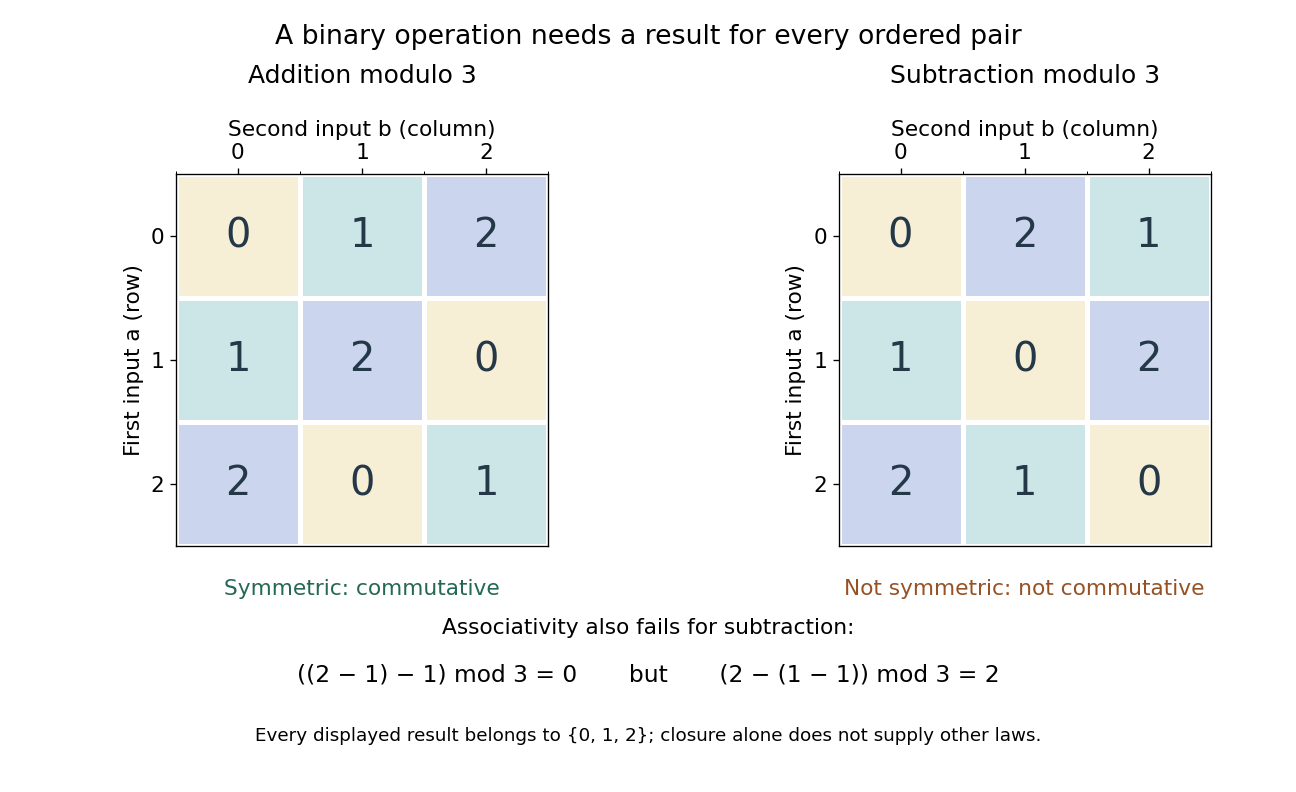
The associative property says that regrouping three inputs does not change the result of a binary operation: for every in its domain of a function. It changes parentheses while keeping the order of the inputs. Commutativity instead exchanges two inputs; the two properties are different.
For addition modulo three, . For subtraction modulo three,so the second binary operation fails the associative property. One failed triple disproves associativity; checking a few successful triples does not establish it for all inputs.
The useful consequence is that a finite ordered sequence can be combined in chunks. For an associative operation, has the same value as . Intermediate results can therefore summarize parts of a computation without retaining their internal parentheses. The order must still be preserved when the binary operation is not commutative. Function composition and concatenation provide examples where grouping is harmless but exchanging entries changes the result.
For a binary operation, idempotence means repeating an input does not change it: . An associative commutative idempotent operation defines a join order by .
For two binary operations, multiplication distributes over addition on the left or right when the respective displayed identity holds. If multiplication is commutative, either law gives the other. Repeated distribution expands expressions in an incline into finite sums of monomials. This property is distinct from associativity of either operation.
A Cayley table records a binary operation on a finite set: the cell at row , column contains . Every cell must contain an element of the specified set. With the same ordering of row and column labels, the table is symmetric across its main diagonal exactly when the binary operation is commutative. Checking the associative property instead requires comparing with for every triple; symmetry alone cannot establish it.[ref]
A subset is closed under a binary operation on when the result of combining any two elements of is again in . The even integers are closed under addition, but the odd integers are not: is even. Closure permits restricting the binary operation to . It is different from being a closed set in topology.
An algebraic magma is a set equipped with a binary operation. No associative property, commutativity, or identity element is required. A semigroup adds the associative property; a monoid also adds an identity element.
An error exponent is the limiting exponential decay rate of an error probability as sample size grows. Different constraints on the type I error and type II error give different optimal rates. The Chernoff information describes the optimal average-error rate for simple Bayesian hypotheses; Stein's lemma gives the optimal type-II rate when type-I error is held below a fixed nontrivial bound.
A coordination game rewards compatible choices. Players can have a common interest in coordinating while having different preferred coordinated outcomes, so their interests need not be opposite as in a zero-sum game.
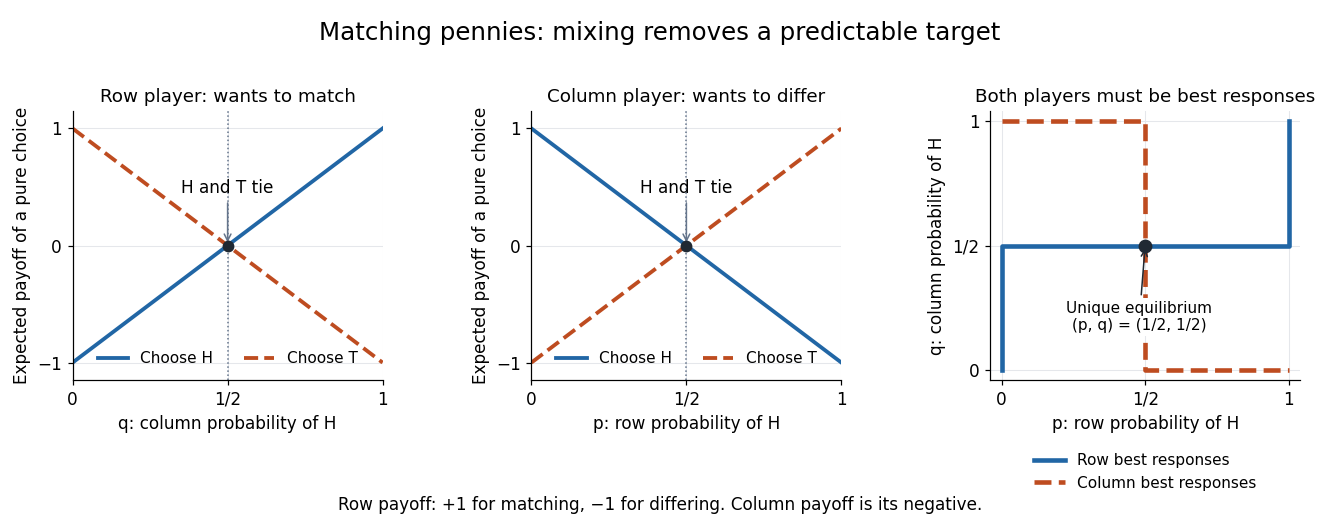
Both players choose heads or tails without seeing the other's choice. The row player receives when the choices match and when they differ; the column player receives the opposite payoff. Thus matching pennies is a zero-sum game, with ordered payoff pairs:
| Row choice / column choice | ||
|---|---|---|
At the column player improves by switching to ; at the row player improves by switching to ; at the row player improves by switching to ; at the column player improves by switching to . Every pure strategy strategy profile therefore has a profitable unilateral deviation, so none is a Nash equilibrium.
Let be the row player's probability of heads and the column player's probability of heads. Their random choices are independent. Against fixed , the row player's pure-choice expected payoffs areAgainst fixed , the column player's pure-choice expected payoffs areConsequently the best responses, expressed as allowed heads probabilities, areHere means every mixture is a best response, including both pure strategies. If , the row player must choose , which makes the column player's best response , a contradiction. If , the row player must choose , which forces , also a contradiction. Hence ; for the column player to mix at this , the two column payoffs must tie, forcing . The unique Nash equilibrium is thereforeIndeed, for any , and . Holding gives the row player zero for every deviation ; holding gives the column player zero for every deviation . A player is indifferent against the equilibrium mixture, but choosing an arbitrary best response to it need not preserve the opponent's best response. This is why that indifference does not produce additional Nash equilibria.
For a teaching treatment with the same payoff convention, see MIT 17.810, lecture 3, slides 29–38, on mixed strategies and matching pennies.
If is an integer interval inside , discrete Fourier inversion gives the displayed identity. The exponential geometric sum bound gives a common envelope , whose integral is . At each frequency, is a bounded coefficient depending only on , while depends only on . A uniform bounded-coefficient Type II sum estimate therefore survives an -dependent interval cutoff at a cost of one logarithm. This is particularly useful for the condition .
This method uses cancellation in Type I sums and Type II sums to control a sum weighted by the Von Mangoldt function. The Vaughan identity separates the short-factor contributions from bilinear ones. Fourier separation of interval cutoffs permits a hyperbolic product cutoff. Ben Green's 2007 notes, Sections 2.3–2.4 give a version adapted to binary digit sums.
A linear bijection between spaces carrying compatible bilinear forms, Hermitian forms or quadratic forms is an isometry of a space with a form when it preserves the specified form. Preserving the polar form alone need not preserve a quadratic form in characteristic two. Subspaces may have degenerate restricted forms even when the ambient form is nonsingular.
For a bilinear form on a finite-dimensional vector space , the right bilinear orthogonal complement of a vector subspace isIt is a vector subspace by linearity in the second argument. For a general nonsymmetric bilinear form, left and right complements must be distinguished.
If is a nondegenerate bilinear form, the map is a linear isomorphism from to its dual space. It identifies with the annihilator of a vector subspace , givingIf is also a symmetric bilinear form or an alternating bilinear form, reversing a zero pairing preserves zero. Hence , and the dimension formula gives equality. Nondegeneracy of the ambient form is required for this double-complement conclusion. For the zero bilinear form, every complement is all of , so a proper cannot be recovered that way.
Even in a nondegenerate ambient space, the restricted form can be degenerate. For on , the line equals . In general, for a symmetric bilinear form or an alternating bilinear form, the restricted radical of a bilinear form is ; quotienting by this radical of a bilinear form gives a nondegenerate bilinear form.
Over a field whose characteristic is not two, a bilinear form has a unique decomposition into a symmetric bilinear form and an alternating bilinear form :Adding and subtracting the equations and both proves uniqueness and gives these formulas. In matrix notation, has matrix and has skew-symmetric matrix .[ref]
The diagonal values alone do not determine a general bilinear form, because for every vector. For the matrix of a bilinear form in the example above,Thus two different bilinear forms, represented by and its symmetric matrix part, have exactly the same quadratic form. To recover a bilinear form from its diagonal, one needs extra information such as the hypothesis that it is a symmetric bilinear form.
Choose an ordered basis of a finite-dimensional vector space. The matrix of a bilinear form records all pairings of basis vectors, with . Writing and , separate linearity giveswhere the last expression uses the coordinate vectors of . Conversely, every matrix defines a bilinear form by this formula.[ref]
For a concrete bilinear form on , takeThen but : a bilinear form need not be a symmetric bilinear form. For and , first compute , then . Reversing the inputs gives and .
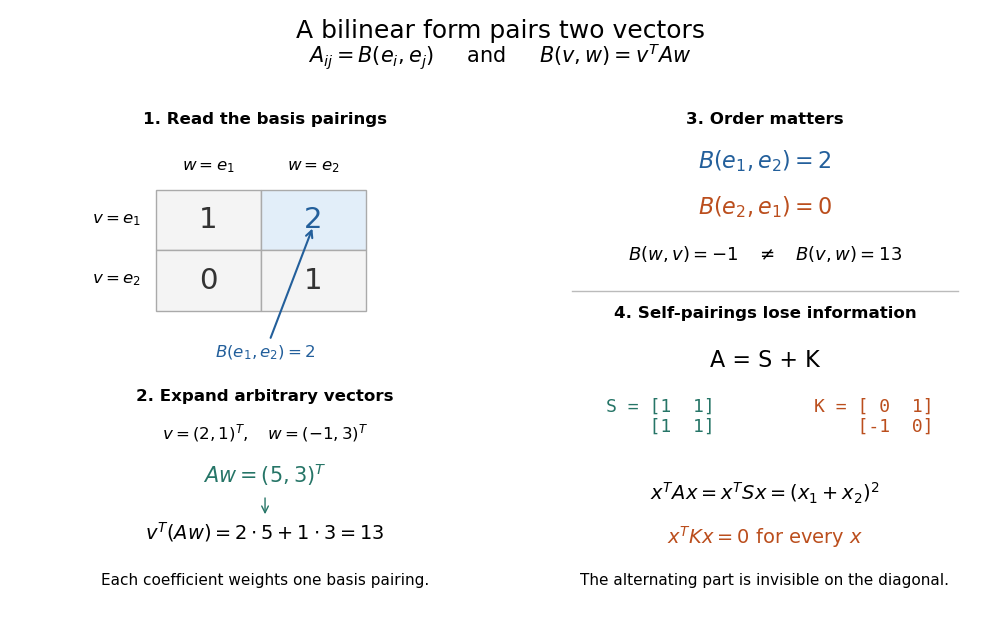


Under change of basis, let the columns of an invertible matrix be the new basis vectors in old coordinates. Thus and , soThis is matrix congruence, rather than the matrix similarity for an endomorphism. Both inputs have changed coordinates, which explains the two factors of . For the displayed and , direct multiplication gives ; its entry is .[ref]
There are unlisted articles, also show them or only show them.