
For a reduced fraction with , , and coprime integers, its decimal representation repeats immediately after the decimal point. The shortest repeating block has lengthHere denotes multiplicative order, and denotes Euler's totient function. Changing the numerator preserves the decimal period as long as the fraction remains reduced.[ref]
For example, long division of gives the remainders , with emitted digits . ConsequentlyEach remainder determines both the next digit and the next remainder; returning to one restarts the same six steps.
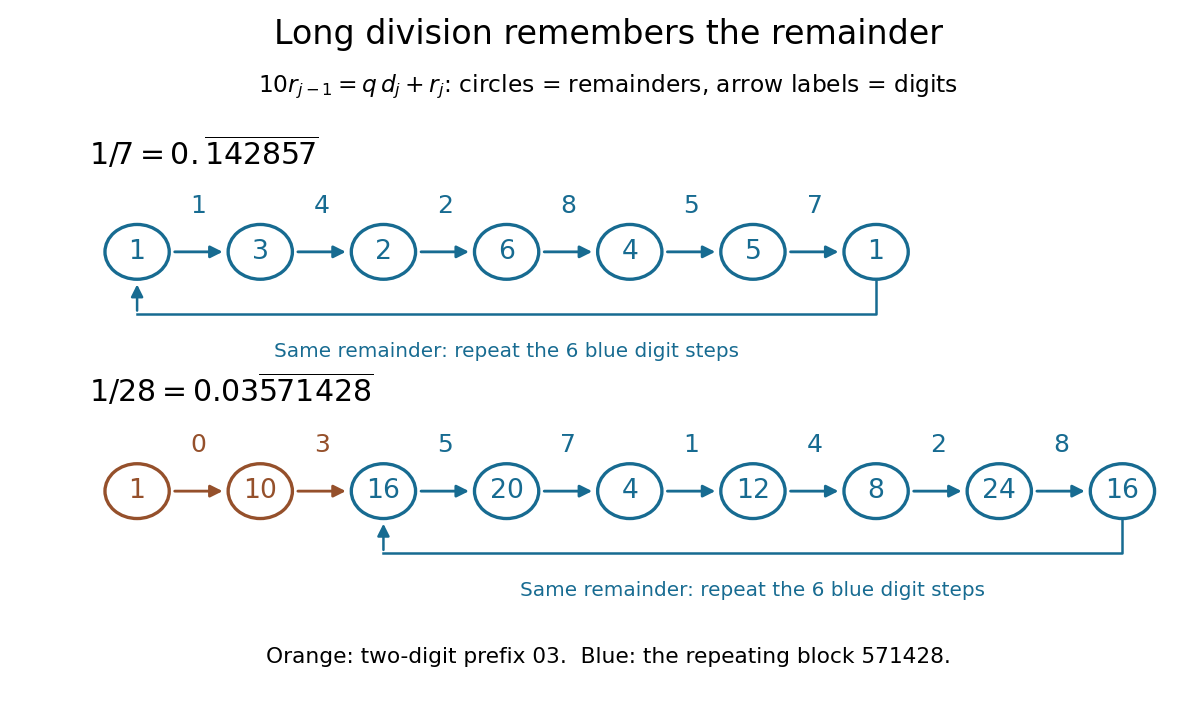
Long-division remainders explain the six-digit repeat of one seventh and the two-digit prefix of one twenty-eighth
. Details. More generally, initialize long division with . At each step, division with remainder givesso . Since are coprime integers, the modular inverse of shows that exactly when . To see why the digit block cannot repeat sooner than the remainders, a purely repeating decimal with a block of digits represents for an integer . A reduced fraction with that value forces . Hence the shortest digit repeat and the multiplicative order coincide.
Knowing the decimal period predicts how many digits must be computed and stored: one block determines the whole repeating decimal. It also constructs the block directly. With , the integeris the block, padded on the left with zeros to digits. For , and , so the block is and . Reduction matters: has decimal period one, whereas .
If the reduced denominator contains prime factors two or five, ten has no multiplicative order modulo that whole denominator. WriteThe decimal preperiod has exactly digits. If , the remaining repeating decimal has decimal period . For instance, gives : two prefix digits, then six repeating digits. If , the decimal representation is a terminating decimal with exactly fractional places. We use the representation ending in zeros, rather than its alternative ending in nines; for example terminates after three places.
A short derivation explains both cases. After digits, multiplying the reduced fraction by and discarding its integer part leaves a reduced fraction whose denominator is . This denominator first becomes coprime to ten at . It then equals , giving an immediate repeat when , or an integer when . The same long division argument works for positional notation in any base : for a reduced denominator coprime to , the shortest repeating block has length .
The product of numbers is the result of their iterated multiplication. The empty product is , the multiplicative identity. For positive factors, , turning a multiplicative conservation law into an additive derivative identity.
Electron affinity measures how strongly an isolated neutral species binds an additional electron. In the spectroscopic convention used here, it is the positive energy required to detach that electron from a bound anion. With the free electron at rest assigned zero energy,The quantum states of and must be specified, usually their ground states. Positive means that attachment lowers the energy; a signed attachment energy is then negative. This convention agrees with the IUPAC definition and with the atomic tables used for Mulliken electronegativity.[ref]
For chlorine, a published photodetachment threshold is , approximately per chemical atom. Here is the Planck constant, the speed of light, and the inverse-length unit expresses an energy through a spectroscopic wavenumber. The parentheses give the reported uncertainty in the last digits, not a range of possible sign conventions.[ref]
Isotope shift in the electron affinity of chlorine by U. Berzinsh and others. §2.3, printed pp. 6–7: reported threshold 29138.59(22) inverse centimetres
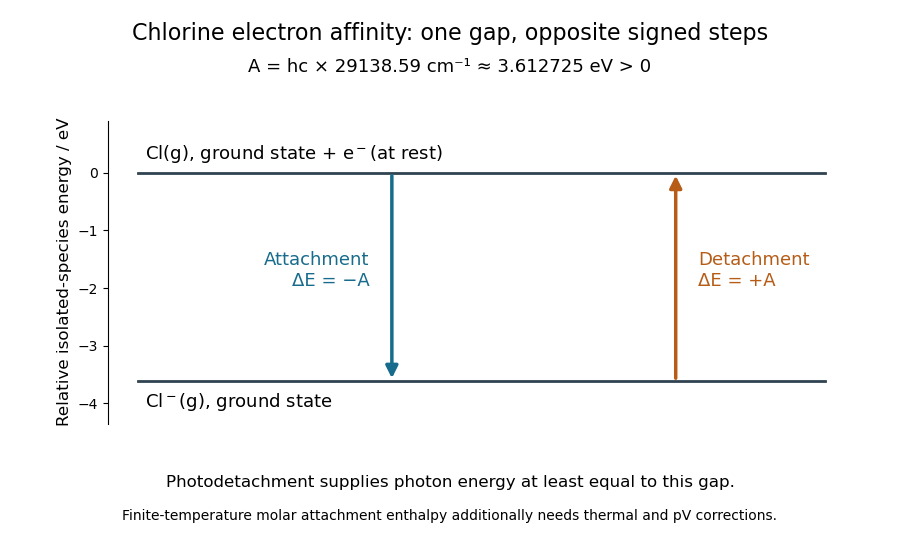
Electron affinity of chlorine: positive detachment energy and negative attachment energy connect the same isolated-species levels; a finite-temperature electron attachment enthalpy needs additional corrections
. Details. An electron affinity is neither an electronegativity nor a lattice energy. The first describes a specified isolated-species energy difference, electronegativity compares attraction for electron density in a chemical bond, and lattice energy refers to an entire ionic crystal and separated gaseous ions. A stable anion can therefore help explain ionic bonding without describing the full energy balance for making a salt.
To calculate , generate independent with density and average . Integrability gives convergence by the strong law of large numbers; finite variance gives an unbiased estimate with variance . Applying this to indicators estimates probabilities. Correlated Markov chain Monte Carlo samples can also approximate the integral, but their error is determined by the chain's dependence rather than the independent-sample variance formula.
A pseudorandom number generator is a deterministic state-update algorithm producing numbers intended to imitate an independent sequence from a prescribed probability distribution. For Monte Carlo integration, desirable features include good one-dimensional and multidimensional uniformity, a period far longer than the calculation, negligible detectable dependence, reproducible seeds, sufficient numerical precision and fast generation. Uniform marginal distributions alone do not provide independent draws.
The specific growth rate is biomass production per unit existing biomass per unit time. For biomass concentration with growth alone, and . A constant positive specific growth rate produces exponential growth, , with doubling time . In a chemostat, removal makes the net rate , rather than itself.
Occupying an antibonding molecular orbital opposes a chemical bond. For equivalent atomic orbitals of the hydrogen atom, the difference vanishes on the plane halfway between the protons: every point there is equally far from both centres, so the amplitudes cancel. This nodal plane removes the contribution of this molecular orbital to electron density on that plane; it does not make an entire finite region empty. The -derived antibonding molecular orbital lies above its bonding molecular orbital partner in energy. See Field, MIT 5.61, lecture 25, pp. 1–2.
In the minimal model, adds and cancels the bond order contribution of . Opposite signs on the two lobes describe probability amplitudes, while both lobes have nonnegative probability density after squaring. The star is an orbital label, not an extra electron or an electric charge.
Occupying a bonding molecular orbital favours a chemical bond. For the two equivalent atomic orbitals of the hydrogen atom, the sum has constructive interference between the protons. The resulting electron density in that region helps stabilize the combined system. Its lower energy in this model follows from the Quantum Hamiltonian, not from the plus sign alone; see Field, MIT 5.61, lecture 25, pp. 1–2.
For example, in molecular hydrogen supplies , hence bond order one when . The sum in the molecular orbital theory toy has midpoint probability density , whereas the difference has zero there. The normalization factors must be included in this comparison.
The punctured torus retracts onto two circles, so its flat gauge-orbit space is under simultaneous conjugation. Write unit quaternions as and . Complete orbit invariants are with . Adding to the third coordinate identifies this space with the compact convex set of positive-semidefinite real correlation matrices, a closed three-ball. The dense open subset is a closed disk times an open interval; its complement is two disjoint intervals.
// Destination: geometry-and-topology.bigb
The nonzero even theta constants and the Jacobi abstruse identity give and . It is invariant under the principal congruence subgroup of level two. This parameter puts the associated complex elliptic curve in Legendre form ; its Klein j-invariant is .
The congruence class of modulo a positive integer is . Two integers have the same class exactly when their difference is divisible by . Addition and multiplication of representatives descend to well-defined operations on , because replacing a representative by a multiple-of- translate changes the result by a multiple of .
For an integer , Wilson's theorem characterizes prime numbers by a factorial:The right side is an integer congruence, so the least nonnegative remainder is . For example, certifies that five is a prime number, whereas rules out six. [ref]
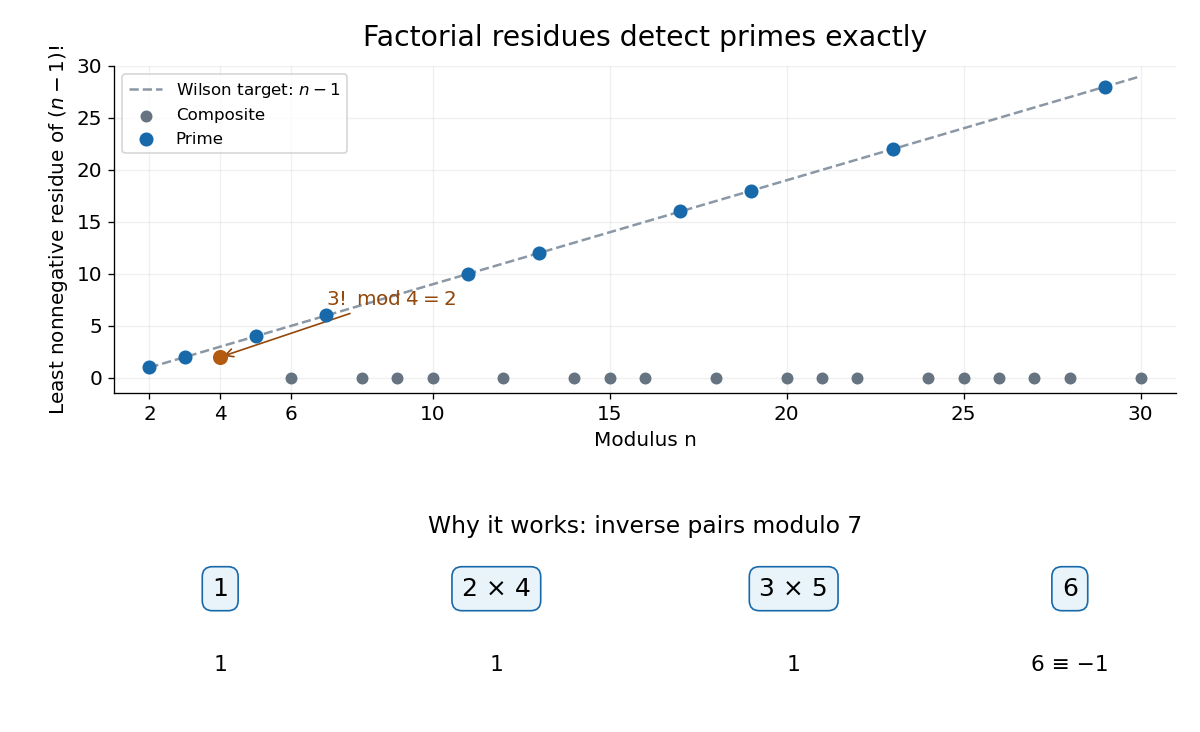


For an odd prime number , each nonzero congruence class has a unique modular multiplicative inverse. Pair each class with its inverse: each distinct pair contributes one. A class is its own inverse exactly when ; since , Euclid's lemma leaves only . Their product is . The prime number two needs a separate check: . Conversely, a proper divisor divides both and , so the displayed integer congruence would force , a contradiction. [ref]
The composite numbers have an even sharper pattern: for every composite number , but . To check the zero claim, write with . If , both occur as different factors in the factorial. If , the different factors and both occur since , and their product is divisible by . The only excluded case is . Thus four is an exception to the zero pattern, but still fails Wilson's theorem: its required remainder would be three.
This is an exact primality testing criterion, but direct evaluation is expensive: even reducing modulo after every multiplication still takes a number of multiplications proportional to , which grows exponentially with the number of binary digits of . The problem is not merely storing a huge factorial. The more useful role of Wilson's theorem is simplifying factorial expressions in modular arithmetic. For instance, if is a prime number, then gives by a modular multiplicative inverse.
For a positive modulus , integers are congruent when their difference is divisible by . This is an equivalence relation: zero is divisible by , changing sign preserves divisibility, and adding two divisible differences proves transitivity. Addition and multiplication respect it, because and . Its equivalence classes are the residue classes used in modular arithmetic.
The least nonnegative residue of an integer modulo a positive integer modulus is the unique representative of its congruence class in . Euclidean division gives . For example, , so ; the integer congruence does not assert equality of those two integers.
The positive integer in is the modulus. It specifies which differences are ignored: exactly the integer multiples of . It is distinct from the modulus of a complex number, which measures magnitude.
The diagram of is the set of atomic and negated atomic sentences true in the expansion by constants naming every element of . Its elementary diagram contains every sentence true in that expansion. Models of these diagrams correspond respectively to embeddings and elementary embeddings of .
Finite model theory studies first-order structures restricted to finite domains, and asks which properties can be expressed in specified formal languages. The restriction changes the available tools: ordinary first-order compactness does not hold when only finite models are admitted.
For example, the sentences saying there are at least distinct elements, one for every positive integer , have a finite model for each finite subset but no common finite model. This is a direct failure of finite compactness. Logical games, locality, and bounded-variable fragments then compare the expressive power of formulas on finite databases and graphs, linking definability with computational complexity theory.
Item nonresponse leaves a particular measurement unobserved while retaining other measurements on that individual. Unit nonresponse leaves all survey measurements unavailable. Adjusting for an observed auxiliary variable can address item nonresponse under missing at random, but does not identify the auxiliary-variable distribution among unit nonresponders. Extrapolation to them needs further assumptions or external information.
The right Rindler wedge is the open region of Minkowski spacetime. Coordinates , , , give metric . The wedge extends into Minkowski spacetime and is geodesically incomplete, while its constant- slices are Cauchy surfaces for the wedge itself.
There are unlisted articles, also show them or only show them.