
Allow the four affine Minkowski coordinates to take independent complex values, obtaining with the holomorphic extension of the flat conformal metric. In two-spinor coordinates , the metric is proportional to . The twistor incidence relation associates a complex projective line to each affine point; compactification adds the points at conformal infinity.
For positive lapse , this time reparametrization gives a local Minkowski metric. If the new time coordinate ranges over the entire real line, it is a global isometry to Minkowski space. In particular gives and complete nonperiodic timelike geodesics. A lapse depending on the spatial coordinate instead can describe a different curved geometry; exchanging the arguments is not a harmless relabeling of the same metric.
With hypercharge normalized by , the renormalizable R-parity-conserving MSSM superpotential is , with . Additional renormalizable R-parity violation allows . The two antisymmetries are and . The first, second and fourth additional terms violate lepton number; the third violates baryon number.
A microkernel using security capabilities to control access to operating-system kernel objects, including IPC endpoints and software threads. An IPC endpoint connects cooperating user-space services; its security capabilities are distinct from the service-defined handle
9 in the microkernel file-read example. [ref]Capabilities tutorial by seL4 Project. Capabilities tutorial, Background: What is a capability?
For the microkernel file-read example, distinguish system call entry/exit, security capability lookup, payload transfer, process scheduling and context switches from the service's actual file lookup and read work. Entering a privileged processor privilege level and switching to a different address space are different events. A change of address space can affect the translation lookaside buffer; running different code and touching different computer memory can cause cache misses. Neither event implies that every translation lookaside buffer entry or cache line must be discarded.
A larger copied payload requires more transfer work; sharing memory pages can avoid copying that bulk data but introduces mapping and synchronization work. A service that requests another service adds another IPC exchange. If the cached file data were absent, communication with a device driver and the input-output wait would also matter. Blocking behind other requests affects observed response time even when the individual IPC operations are cheap.
These are cost sources, not timings or a universal ranking against a monolithic kernel. Implementation and CPU details matter: the construction analysis separates protected entry costs, address space switching, translation lookaside buffer effects and memory cache effects. [ref]
On micro-kernel construction by Jochen Liedtke. Liedtke, On micro-kernel construction, section 4.1, pp. 241–244: kernel-user switches, address-space switches, and discussion of hardware-dependent cache and TLB effects
Suppose the user-space service stops after receiving request
7, before replying. Assume that its private memory pages are not writable mappings of the client's or an unrelated service's computer memory, and that it lacks security capabilities to change their software threads. A failed store in the service cannot directly overwrite that private state through ordinary CPU address translation. Those assumptions establish a particular isolation boundary, not a successful read.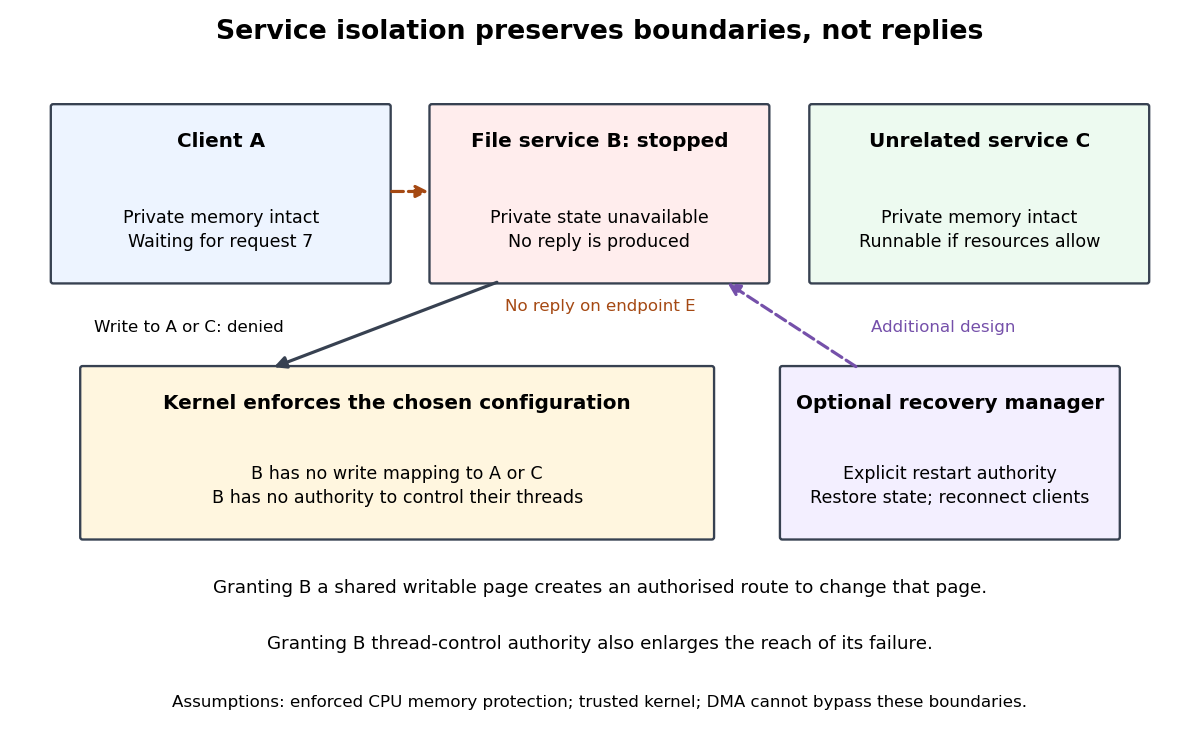
Memory protection and security capabilities limit a stopped service's reach; recovery needs an additional design
. Details. 
The client can remain blocked waiting for request
7. An unrelated runnable service may continue if process scheduling and resources permit, but clients that depend on the stopped service still lose access to its service. A separately authorized recovery manager would need to detect the failure, rebuild the service's state and arrange communication with its replacement. The microkernel architecture by itself supplies none of those application-specific recovery decisions.A missing reply also does not reveal whether a service crashed, is delayed by process scheduling, or entered an infinite computation. For a read, retrying after recovery may be straightforward; for a modifying operation, absence of a reply does not prove that the modification never happened. Recovery must account for ambiguous completed operations and any required file-system crash consistency.
The boundary changes with authority. A deliberately shared writable memory page allows the service to change its shared contents; a security capability controlling another software thread permits the corresponding control operations. A device driver with uncontrolled DMA can bypass ordinary CPU memory protection. Thus service placement and actual permissions must be considered together. [ref]
What the Proofs Assume by seL4 Project. What the Proofs Assume, The Assumptions: DMA and memory-mapped device registers
Consider an original toy file system service in address space B and a client in address space A, on one CPU. The service holds a five-byte cached file containing
LIME followed by a newline. The client already has service handle 9, permission to read that file, and a security capability to send requests to IPC endpoint E. Handle 9 is interpreted by the service; it is neither a virtual address nor an operating-system kernel object identifier. All relevant memory pages are resident, and this read needs no device driver.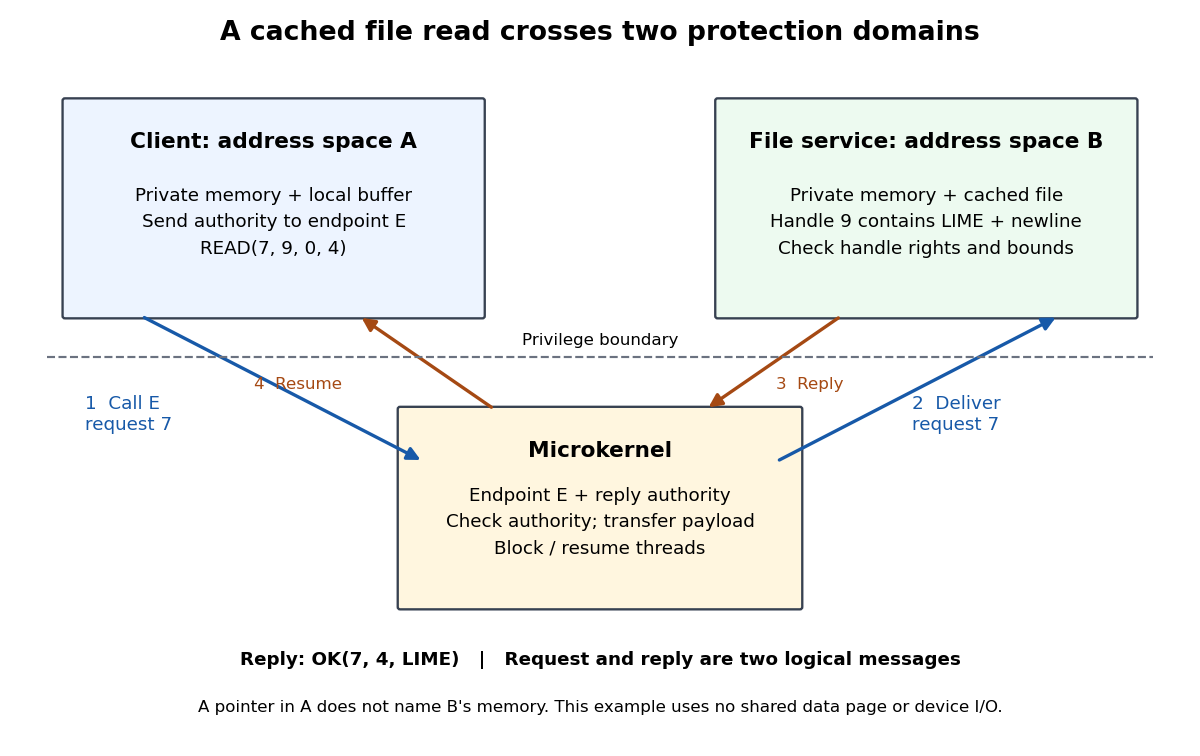
A cached file read uses IPC between separate address spaces, with authority checked by the microkernel
. Details. 
- The client submits
READ(7, 9, 0, 4): request identifier7, handle9, byte offset0, and requested length4. A system call enters the microkernel; the security capability is checked before delivery on IPC endpoint E. The client waits for a reply. - A waiting service software thread receives the request. The service checks the handle's read permission and the requested range, then obtains the first four bytes from its cached file. The microkernel transports the request; the service supplies its file system meaning.
- The service uses reply capability authority to return
OK(7, 4, LIME). The client resumes, checks the request identifier and returned length, and copies those four bytes into its own local buffer. There were two logical IPC messages: request and reply. The four arrows show delivery stages, not four separate requests.
This protocol is an illustrative design, not an actual seL4 file system interface. Its call/reply structure follows seL4's documented IPC:
seL4_Call waits using reply authority, and small payloads can travel in processor registers. [ref]An ordinary pointer in A refers to A's address space. Sending its numeric value does not make B's private computer memory appear there. This example explicitly transfers bytes. Sharing a mapped memory page instead would require intentional memory protection permissions and a protocol for ownership and synchronization; passing a pointer alone establishes neither.
The same IPC mechanism could carry
WRITE, but this client could still be refused by the service's read-only handle policy. Conversely, possession of an IPC endpoint security capability permits communication without automatically granting access to every file the service manages. The separation of mechanism and policy appears twice: endpoint authority gates delivery, and the service's handle policy gates the requested operation.Differentiating and multiplying by the inverse gives the displayed variation. It is the matrix inverse derivative, expressed with the covariant and contravariant components of a metric tensor.
For a nondegenerate metric tensor whose signature is fixed during the variation, the Jacobi formula gives . Differentiating the square root of the absolute determinant proves the displayed identity. Expressed through the variation of inverse metric, the formula is . Absolute values accommodate either Riemannian or Lorentzian signature.
Weather forecasting estimates future meteorological conditions from observations and physical models. Numerical models use an approximate initial condition and equations of fluid mechanics to simulate future conditions; forecasters also compare model outputs and apply experience and research.[ref]
https://www.weather.gov/rah/virtualtourforecast. National Weather Service, The forecast process
The forecast horizon describes how far ahead a prediction remains useful at a specified accuracy; sensitive dependence on initial conditions can limit detailed predictions under deterministic evolution.This model couples deterministic underdominant allele-frequency dynamics in equal-sized habitats by global migration. Starting with pure habitats of one allele and of the other preserves two within-class frequencies , reducing the system to , with . Migration is conservative in the mean, but selection need not conserve global allele frequency.
A G protein-coupled receptor is a cell-surface receptor that relays activation through a G protein on the intracellular side of the cell membrane. The activated G protein can regulate an enzyme or ion channel, so a GPCR supplies a concrete metabotropic receptor example: ligand recognition and the eventual response are connected through distinct components. Different G proteins couple to different targets. See Alberts et al., Molecular Biology of the Cell, 4th edition: signaling through G-protein-linked cell-surface receptors.
Combine a secret randomly selected almost strongly universal hash family member with a fresh secret output mask. An observed message authentication code tag leaves the hash-selection key hidden, and the conditional hash bound controls substitution forgery probability. The message itself need not be encrypted. Mask reuse can reveal hash differences; repeated-use guarantees require fresh masks and an appropriate analysis of verification information. A one-use polynomial construction needs only two secret field elements, even for a much longer message.
A meson with total angular momentum one and negative parity. In the ordinary quark model, a quark-antiquark pair with orbital angular momentum zero and total spin one has these quantum numbers; its neutral self-conjugate states have charge conjugation . The light-flavour tensor product gives an octet and a singlet, forming a vector nonet, just as spin-zero negative-parity pairs form a pseudoscalar meson nonet. Nonzero orbital excitations can also produce vector states.
The omega meson is an isospin-zero vector meson with charge conjugation value minus one and consequently G parity minus one. Three-pion decay is compatible with the isospin-symmetric strong interaction, whereas two-pion decay violates its G-parity rule.
For an ordinary quark-antiquark meson, opposite intrinsic parities and orbital parity give . For a self-conjugate flavor state, charge conjugation exchanges the two constituents. Reversal of their relative momentum gives , spin exchange gives , and reordering the two fermionic creation operators gives one extra minus sign. Their product is . Electrical neutrality alone does not imply that a state is an eigenstate of charge conjugation; charged mesons have no individual C eigenvalue.
An isospin-zero quark paired with or gives a meson isospin doublet of charges . Spin addition at zero orbital angular momentum gives both pseudoscalar mesons and vector mesons. Pairing the new antiquark with gives the charge-conjugate doublets. For strange or charm flavour these are the kaon or D-meson families and their vector partners.
There are two distinct questions: whether another operating-system process can observe shared contents, and whether those contents survive a crash. In the timeline, persistent storage deliberately remains while the shared page cache contains . No background page writeback occurs in this toy interval. Real page writeback may persist some contents earlier; shared visibility alone cannot tell the reader which contents are durable.
For the covered shared range,
msync(base, length, MS_SYNC) requests page writeback and waits for completion; check its return value. MS_ASYNC is not a durable completion acknowledgment, and on modern Linux kernel versions it is a no-op because dirty contents are already tracked. The address must be aligned, so synchronizing our changed second page uses base + 4096, length 4096, rather than base + 4133. Unmapping alone is not a guarantee of completed writeback.[ref]msync(2) — Linux manual page by Linux man-pages project. DESCRIPTION, RETURN VALUE, ERRORS and VERSIONS: covered range, MS_SYNC versus MS_ASYNC, page-aligned address, and Linux MS_ASYNC behavior since 2.6.19
For persistence of the file and associated file metadata, fsync on an open file descriptor is a broader interface; a new directory entry needs separate synchronization of its file-system directory. Retain a suitable file descriptor if the persistence protocol needs it after mapping. Successful storage completion still relies on the file system and device honoring their persistence contracts.[ref]
fsync(2) — Linux manual page by Linux man-pages project. DESCRIPTION, RETURN VALUE and ERRORS: file data and metadata, directory entry, completion and reported failures
Neither fsync nor msync supplies mutual exclusion, an atomic storage write for several memory pages, or an application-wide file-system transaction. Stop or coordinate writers before deciding which update a completion acknowledges. A crash during page writeback can leave a mixture of old and new contents unless a separate recovery protocol provides file-system crash consistency. The last timeline row assumes successful synchronous completion, honored storage flush semantics and no subsequent writer; it illustrates a persistence boundary, not a promise about arbitrary hardware failures.
There are unlisted articles, also show them or only show them.