
A nuclear pore complex is an assembly of proteins spanning the nuclear envelope and regulating passage between the cell nucleus and cytosol. It is a selective gateway, not simply an unregulated hole: messenger RNA export and import of nuclear proteins require appropriate transport machinery. See Alberts et al.: nuclear pore complexes.
The nuclear pore complex occupies a junction of both nuclear envelope membranes. Its protein scaffold surrounds an aqueous passage connecting cytosol to the cell nucleus, rather than the intermembrane space. Diffusion permits small soluble cargo to pass; selective receptors transport other cargo. Molecular mass alone is not a universal cutoff.[ref]
Molecular Biology of the Cell, 4th edition by Bruce Alberts and others. Nuclear Pore Complexes Perforate the Nuclear Envelope, Figures 12-10–12-11; Nuclear Localization Signals Direct Nuclear Proteins to the Nucleus
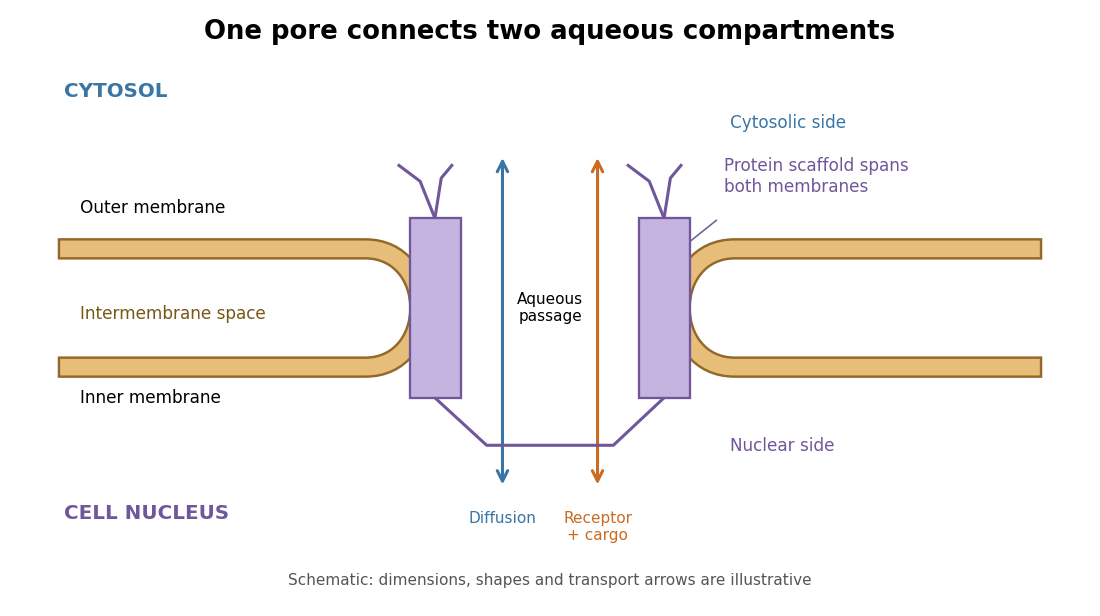
The nuclear pore complex bridges both membranes of the nuclear envelope
. Original topology schematic, not a measured structure. The central passage connects cytosol and cell nucleus; cargo does not enter the intermembrane space. Shapes, distances and arrows are illustrative. Details.
Form Champernowne constant by using concatenation to join the decimal representations of the positive integers after the decimal point. Champernowne proved in 1933 that this particular real number is a normal number in base ten. The construction is striking because its rule is completely explicit, while all finite words have the prescribed limiting digit block frequencies. [ref]
https://doi.org/10.1112/jlms/s1-8.4.254. D. G. Champernowne, The Construction of Decimals Normal in the Scale of Ten, Journal of the London Mathematical Society 8, 254–260, 1933
Copeland and Erdős explicitly recall this result at the start of their own paper. [ref]https://users.renyi.hu/~p_erdos/1946-01.pdf. Copeland and Erdős, Note on Normal Numbers, 1946, first paragraph
The first digits of Champernowne constant have the following exact counts, in digit order :For the adjacent pairs fully inside that prefix, the words occur times respectively. Thus, for example, , which is about , rather than . The prefix ends partway through the decimal representation of ; the many leading ones in earlier positive integers help explain the visible imbalance.
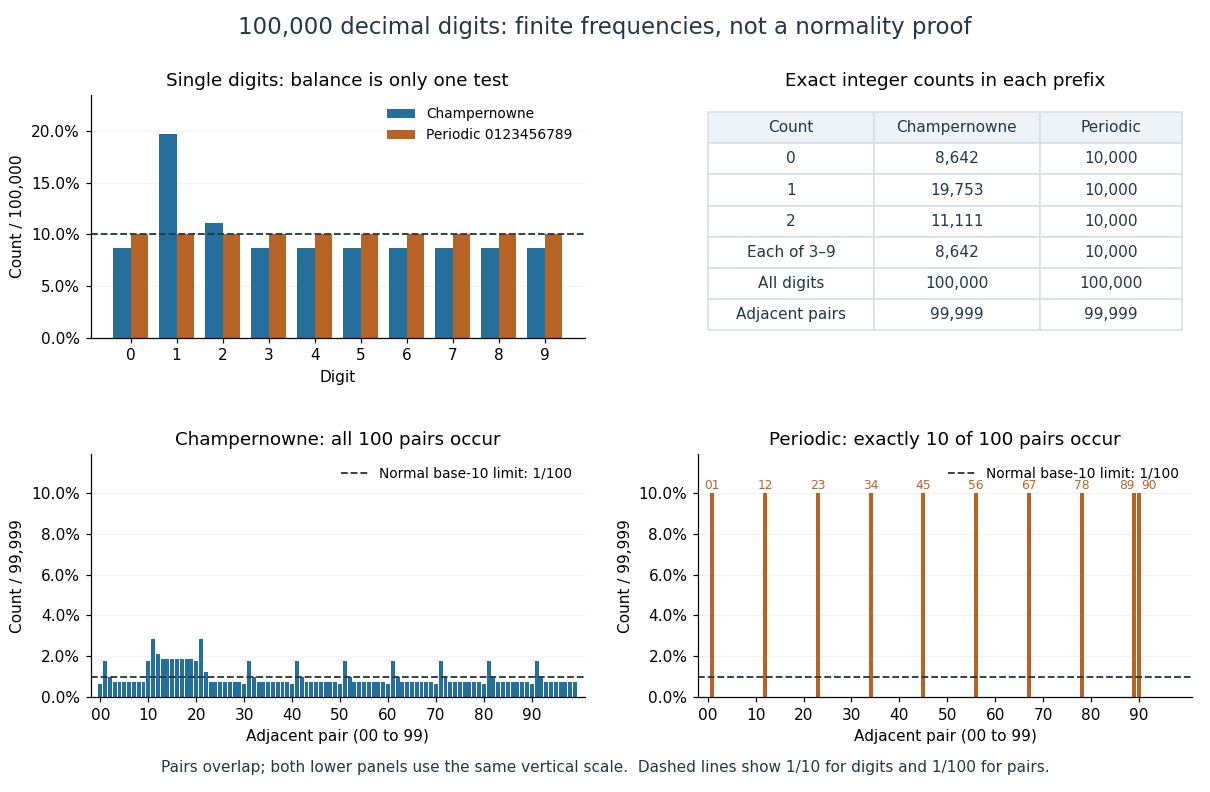

These are finite counts, not a proof of the normal number theorem: a finite prefix can be followed by an all-zero tail. The theorem for Champernowne constant concerns the infinite limit, and establishes base-ten normality, rather than absolute normality. Nor do computations prove normality for familiar constants: the normality of Pi and Euler's number remains unproved, as discussed by Bailey and Borwein. [ref]
https://www.davidhbailey.com/dhbpapers/normal-pseudo.pdf. David H. Bailey and Jonathan M. Borwein, Normal Numbers and Pseudorandom Generators, author manuscript, 2011, introduction
A real number is simply normal in base if each individual digit in its positional notation has limiting digit block frequency . This is the length-one part of the definition of a normal number. It places no equal-frequency requirement on longer words.
For example, is a simply normal number in base two: each binary digit has frequency . But and never occur, and and each have frequency . Thus is not a normal number in base two. Even a sequence that looks more complicated, such as the deterministic Thue–Morse sequence, must be tested against the actual digit block frequency definition; visual complexity is no substitute for it.
The decimal representation makes the same point in base ten. Every digit has frequency , yet the only adjacent pairs areEach has limiting digit block frequency ; the other ninety pairs have frequency zero. A normal number in base ten requires for every one of the hundred pairs. This rational number is a simply normal number in base ten, but it is not a normal number in that base.
For a finite prefix of digits in positional notation, the digit block frequency of a length- word is its number of overlapping occurrences divided by , the number of available starting positions. All such digit block frequencies sum to one. The infinite limit used for a normal number can instead divide counts by : the factor tends to one for fixed .
For the six binary digits , the single-digit counts are three zeros and three ones. Its five adjacent pairs are , givingThis example explains both the overlapping convention and the end correction in a finite sample. The corresponding infinite binary expansion has pair frequencies , rather than the four values required of a normal number in base two.
Fermi coordinates transport a local frame along a timelike worldline. Along a timelike geodesic, a parallel-transported orthonormal frame defines Fermi normal coordinates in which the metric tensor is Minkowskian and the Christoffel symbols vanish on the worldline. Curvature first appears in terms quadratic in the spatial distance from it, so finite laboratories retain tidal forces.
For a weak, nearly static conformal factor in Nordstrom theory of gravitation, the trace of the dust stress-energy tensor is negative in signature , so its scalar field equation reduces to the Poisson equation for the Newtonian gravitational potential. The geodesic equation for a conformally flat metric gives at small speeds. The constant one in has no effect on the force.
An affected-sib-pair analysis examines marker identity by descent between affected full siblings. Without genetic linkage to the disease locus, the probabilities of sharing zero, one and two copies are . Excess sharing supplies evidence for linkage under disease models that preferentially transmit a common risk allele to both siblings.
// Target: biology.bigb
For independent pairs of affected full siblings with unrelated, noninbred parents and a fully informative genetic marker, the no-linkage null gives shared identity by descent count . Therefore and . An excess-sharing test uses the displayed approximately standard normal statistic and an upper-tail critical value. Pairs sharing family members are dependent, so their variance needs separate treatment. This targeted test differs from an omnibus test of all three sharing probabilities.
Set the dimension of the zero module to . A nonzero module has dimension zero exactly when it is an Artinian module. Inductively, dimension at most means that in every descending chain the successive quotients eventually have dimension less than . The least such ordinal is the Krull dimension; the ordinal definition also covers dimensions beyond finite integers. The left dimension of a ring is that of its left regular module. In noncommutative rings this is not defined simply as the length of a chain of two-sided prime ideals.
For a ring , an automorphism and central , adjoin with , , and . This construction includes Weyl algebras and rank-one universal enveloping algebras.
A ring is semilocal when its quotient by the Jacobson radical is a semisimple ring that is Artinian. Equivalently, that quotient is a right Artinian ring: it has zero Jacobson radical, and the Artinian structure theorem makes it semisimple. A commutative ring is semilocal exactly when it has finitely many maximal ideals.
A regular element of a ring is a two-sided non-zero-divisor. The two cancellation conditions must both hold in a noncommutative ring. Products of regular elements remain regular.
A ring is right Goldie if it has finite right uniform dimension and satisfies the ascending chain condition on right annihilators. The left-sided definition reverses the multiplication. These two definitions need not be equivalent.
A Hahn series over a field with exponents in an ordered abelian group is a formal sum whose nonzero exponents form a well-ordered set. Such series form the Hahn series field.
An absolute value on a field is a nonnegative multiplicative function that vanishes only at zero and satisfies the triangle inequality.
A commutative Noetherian ring is Cohen-Macaulay when every localization at a prime ideal has depth of a Noetherian local ring equal to its Krull dimension. A regular local ring is Cohen-Macaulay. If is a Cohen-Macaulay local ring and is a non-zero-divisor, then is Cohen-Macaulay and both its depth of a Noetherian local ring and Krull dimension are one less than those of .
The requirement excludes units, whose quotient would be the zero ring. In particular, a hypersurface in a regular ambient variety satisfies the depth condition in the Serre criterion for normality.
NADPH is the reduced form of nicotinamide adenine dinucleotide phosphate. It carries electrons used in synthesis; in the Calvin cycle it becomes the oxidized form NADP+, available for reuse by light-dependent reactions. NADPH and ATP serve different roles even though both connect light capture to carbon fixation.
NADP+ is the oxidized form of nicotinamide adenine dinucleotide phosphate. It can accept electrons to form NADPH; the light-dependent reactions supply this conversion during oxygenic photosynthesis.
There are unlisted articles, also show them or only show them.