
An optical gradient force arises from spatial variation in illumination. In a usual optical trap for a suitable transparent particle with higher refractive index than its surroundings, it draws the particle towards high light intensity. It supplies a restoring force near a stable trap, but three-dimensional confinement also depends on the optical scattering force. The direction and size depend on the particle and field; attraction to the brightest point is not universal. [ref]
Observation of a single-beam gradient force optical trap for dielectric particles by Arthur Ashkin and others. Ashkin and colleagues, single-beam gradient optical trap, 1986
.Silver chloride is a chemical compound with formula . Its darkening under illumination supplied the chemical readout in the historical ultraviolet discovery described above. That response depends on the incident optical spectrum and the sample's condition; it does not provide an uncalibrated direct measurement of incident power. [ref]
https://coolcosmos.ipac.caltech.edu/page/lesson_ritter_experiment. Caltech/IPAC, Ritter's silver-chloride detector
.Recoil energy is the kinetic energy gained by an initially stationary atom absorbing a photon of momentum . In a standing-wave optical lattice of spacing , the photon wavenumber is , giving .
Here is average number density and the ground-state chemical potential. This commonly used condensate response has units of inverse energy; thermodynamic isothermal compressibility is instead . In a weakly interacting repulsive condensate, the normalized one-cell ground state , with average , gives , . Localization raises and reduces at fixed . In deep harmonic wells , hence . This is a ground-band, repulsive-superfluid statement with the held variables specified, not a theorem for arbitrary signs of the interaction or arbitrary excited branches.
An optical power meter measures collected radiant flux using a calibrated detector and readout. With a photodiode, its conversion to watts depends on spectral responsivity, as in calibrated radiant-flux measurement.
A monochromator selects a narrow, adjustable wavelength interval from an optical spectrum. Its finite spectral bandwidth matters when calibrating a photodetector's spectral responsivity in calibrated radiant-flux measurement.
An optical attenuator reduces the transmitted radiant power of a beam. It can use optical absorption, partial reflection, or controlled coupling into a different path. Its transmission must be specified for the relevant wavelength and polarization.
A variable pair of polarizers provides a simple example: for ideal linearly polarized input and a rotated analyzer, Malus's law gives relative to aligned transmission. This permits adjustment before a photodetector saturates. A power series measured with several attenuations also tests detector linearity, provided the attenuator itself has been calibrated.
A Ronchi ruling is a grating of alternating transparent and opaque parallel bands. A known band spacing can calibrate the scale of an optical microscope image.
An optical microscope uses light and optical lens assemblies to reveal small structures, such as the boundaries of biological cells or defects in a manufactured surface. In a compound optical microscope, the microscope objective supplies an enlarged real image; the microscope eyepiece makes that intermediate microscope image subtend a larger viewing angle. The transverse magnification of the first stage and the angular magnification of the second answer different questions.[ref]
2.8 Microscopes and Telescopes. University Physics Volume 3, §2.8 Microscopes, image formation and Eqs. 2.35–2.37
Consider an original ideal finite-conjugate microscope in air, with both optical lens assemblies treated as converging thin lens elements in the paraxial approximation. Choose objective focal length and object distance . The thin lens equation and signed transverse magnification givePlace a microscope eyepiece of focal length a further beyond the intermediate microscope image. The objective-to-eyepiece separation is therefore . Each object point then supplies a parallel outgoing bundle of light rays, appropriate to a relaxed eye focused at infinity. Define the unaided reference as the same object viewed at distance ; this is a rating convention, not a universal property of eyesight. The eyepiece angular magnification and total signed angular magnification areFor instance, a hypothetical object height becomes at the intermediate microscope image. The signed viewing angles are approximately with the instrument and unaided. Their ratio is : enlarged and inverted. These are stipulated model dimensions, not measurements or specifications of a modern commercial optical microscope.
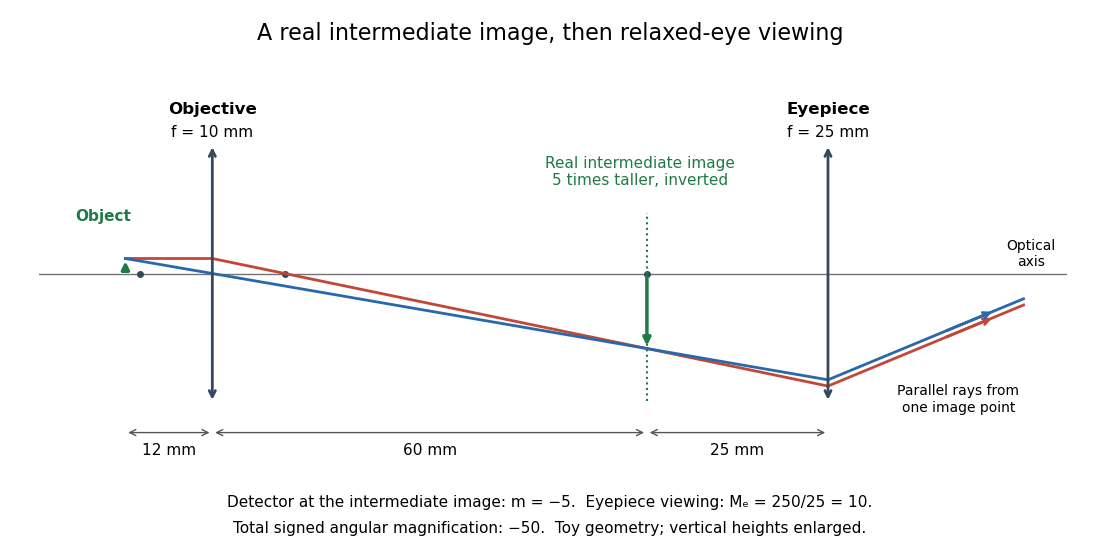

The attraction of an optical microscope is that seeing can become measuring: a stage micrometer supplies a known object-space length, and microscope scale calibration converts an image readout into a specimen length. This also separates a large-looking image from a trustworthy size estimate. Meanwhile, diffraction-limited resolution depends on numerical aperture and wavelength; empty magnification enlarges an existing blur without revealing additional structure.
A convective chimney is a localized deeply mixed region formed when surface buoyancy loss overcomes ocean density stratification. Small plumes, compensating flow, rotation and lateral exchange maintain its structure; it need not be a permanently uniform descending column. Brine rejection can increase its surface density forcing. A fresh summer cap can isolate a deep homogeneous core until winter forcing renews contact with the surface, so a surviving core need not imply continuous active convection.
A polar body is a small product of the unequal divisions of oogenesis. The divisions separate chromosomes while retaining most cytoplasm in the developing ovum. Producing several chromosome-containing products therefore need not mean producing several equivalent eggs.
In the standard human account, the first polar body follows the first meiotic division; completion of the second division produces another. Their formation illustrates the difference between chromosome segregation and equal partition of cellular resources.[ref]
If a buoyant plume of diameter supplies oil at volume rate to an ice floe moving at speed , the plume sweeps area per unit time. Retaining a layer of depth over that area would require volume rate , so conservation of mass gives the painted fraction . Discontinuous painting starts when . This estimate assumes all arriving oil is retained and a constant track width equal to the plume diameter; the plume's circular cross-sectional area does not enter the swept-area rate.
Two eye-specific afferent populations compete under Hebbian learning and synaptic normalization. In a simplified symmetric two-eye model, the eye-difference mode evolves with a linear operator containing . Dominant spatial modes can produce alternating eye preference, while saturation sets finite contrast. The interaction width, arbor constraints and correlation structure influence the column scale. This is a mechanistic hypothesis whose predictions can be tested, not a unique inference from the existence of columns.
An isophote is a contour of equal surface brightness in an astronomical image. Deviations from fitted ellipses encode additional information about a galaxy's projected stellar structure.
Surface brightness is received flux per unit solid angle on the sky. It describes the brightness of an extended source independently of a particular aperture's area. An isophote is a contour of constant surface brightness; central surface brightness sets the available photons for resolved galaxy spectroscopy.
Angular resolution describes the smallest angular separation or structure an observation can distinguish. A physical scale at distance subtends approximately radians when . Resolving a black-hole sphere of influence therefore involves distance as well as its physical radius, and useful kinematics also require adequate surface brightness.
For a nearby Euclidean survey with limiting flux , a galaxy of luminosity is detectable out to . Its accessible volume is therefore proportional to . With a Schechter function , counts per logarithmic interval are proportional to and peak at when . This selection suppresses faint objects relative to a volume-limited census; finite survey boundaries and cosmological evolution modify the simple law.
The Arnowitt-Deser-Misner formalism expresses general relativity as constrained Hamiltonian evolution of a spatial metric and its conjugate momentum after a 3+1 decomposition of spacetime. Lapse and shift enforce the Hamiltonian and momentum constraints. For an asymptotically flat spacetime its boundary Hamiltonian gives the Arnowitt-Deser-Misner energy.
An iterative method approximates a solution by repeatedly updating an initial guess. In numerical linear algebra, a stationary iterative method for a linear system uses a fixed iteration map; other iterations can change their update rule or search space at each step.
There are unlisted articles, also show them or only show them.