
A mutation rate measures the frequency of mutation events per specified unit, such as per chromosome segment per generation. Its units and the population-size convention must be specified. If time is measured in generations and , each ancestral lineage has mutation intensity per unit of coalescent time.
A gene deletion removes a chosen gene sequence from a genome. An experimental gene deletion tests the consequences of that removal in a specified genetic background and environment; lack of an observed phenotype does not prove that the gene has no function under other conditions.
Developmental integration here means coordination of cellular growth, organization and function into a developing whole. It describes what the parts do together, whereas clonal development describes how they descend from founders. Interactions through signal transduction can help coordinate cell differentiation; see the Alberts et al. development chapter cited under multicellular organism.
Clonal development builds a group through successive divisions of founding biological cells, rather than by gathering previously separate lineages. In snowflake yeast, daughter biological cells remain attached after budding. Common ancestry does not imply that every descendant remains genetically identical forever: new mutations can arise. See the 2015 study cited under multicellular organism.
Ethene, also called ethylene, is , the simplest alkene. Its two carbons and four hydrogens form a planar framework around a carbon-carbon double bond.
In addition polymerization, opening that double bond connects successive ethene-derived units into polyethylene. Each consumed monomer contributes two carbon atoms, whereas the smallest constitutional repeating unit of the ideal chain contains only one carbon.[ref]
An individual molecule capable of contributing structural units through polymerization. See IUPAC: monomer molecule.
An incorporated monomeric unit is the largest constitutional unit identifiable as derived from one monomer molecule. It need not be a whole unreacted molecule or the smallest constitutional repeating unit. See IUPAC: monomeric unit.
Rotational spectroscopy measures transitions between molecular rotation quantum states, usually in low-pressure gaseous molecules. The measured spectral lines become a molecular fingerprint only after rotational spectral line assignment: identify which transitions belong together, determine their quantum numbers, fit a rotational Hamiltonian, and test additional predictions. Line positions constrain moments of inertia, while rotational state populations and transition coupling determine which lines can be detected.
The simplest ordinary microwave absorption ladder belongs to a polar linear molecule obeying pure rotational electric-dipole selection rules. A homonuclear diatomic molecule has no permanent electric dipole moment in its symmetric internal state, but rotational Raman spectroscopy can probe its rotation through anisotropic electric polarizability. The coupling mechanism must therefore be specified before interpreting a missing spectrum.
The existing linear rigid rotor, rotational constant, isotope shift of a linear rotor, and centrifugal distortion explain the forward model. Molecular structure from rotational constants asks the reverse question: which arrangements of chemical atoms could produce the fitted constants? The NIST trace-gas FTMW validation experiment makes the measurement chain concrete and separates identifying a species from measuring its concentration.
A rigid rotor models rotational motion with fixed internal separations. Its use in the synthetic Stark effect figure omits vibrational motion and additional interactions in real molecules.
Rigidity fixes the molecular geometry, not the orientation, and does not require a spherical mass distribution. Remove motion of the centre of mass, choose principal axes of the inertia tensor, and write the classical rotational kinetic energy asHere are the principal moments of inertia, components of angular velocity, and components of angular momentum. Quantization replaces these last components by angular momentum operators. Different principal moments of inertia produce different spectra: the single-constant linear rigid rotor is a special case, not a formula for every molecule.[ref]
Lecture 24 Supplement: Energy levels of a Rigid Rotor by Dudley Herschbach. printed p. 1: principal-axis energy and classification; pp. 4–5: asymmetric rotors
In the elementary molecular orbital theory count, bond order is half the excess of electrons in bonding molecular orbitals over those in antibonding molecular orbitals. Thus adding one electron to a bonding molecular orbital raises by , while adding one to an antibonding molecular orbital lowers it by . The configurations drawn above give , , and . This count summarizes net covalent bond occupancy; it is neither a measured energy nor a universal test for every kind of binding. See Chemistry 2e, 8.4: molecular orbital bond order.
The LCAO approximation builds a molecular orbital as a linear combination of single-centre atomic orbitals. For two equivalent normalized real functions and , choose their signs positive and define their orbital overlap . At nonzero separation, , and the normalized combinations areHere and . Equal coefficients use the equivalence of the two centres; a general LCAO need not have equal coefficients. See Field, MIT 5.61, lecture 24, pp. 3–6: LCAO coefficients and overlap integrals.
For the Gaussian function toy's , the two denominators are and . To check wavefunction normalization, expand the square: . Dividing by gives one. The local probability density isThe cross term is the interference; adding the separate densities first would lose it. These formulas normalize the chosen linear combination exactly, while the restricted choice of atomic orbitals remains an approximation to an actual molecular orbital.
A molecular orbital is a one-electron spatial wavefunction for the combined atomic nuclei of a molecule. For a normalized molecular orbital, the Born rule gives the position probability density , with . The molecular orbital is the amplitude, rather than its squared modulus or a classical trajectory.
In the independent-orbital approximation, a doubly occupied molecular orbital contributes to the electron number density, whose integral is two. An empty molecular orbital contributes zero, even though its shape is still part of the model. The molecular hydrogen example therefore uses one occupied spatial molecular orbital for two electrons, distinguished by their spins. A negative real probability amplitude means a relative quantum phase of , not positive electric charge; multiplying the whole wavefunction by changes only its global phase.
Gas electron diffraction infers molecular geometry from the diffraction of electrons by a gaseous sample. It makes a useful experimental test of shape: distances between both bonded and nonbonded atomic nuclei affect the signal, so a proposed straight arrangement and a bent arrangement can be distinguished through their pair separations.
A concrete modern apparatus is the Bielefeld instrument described by [ref]
https://doi.org/10.1515/znb-2015-0186. Reuter, Vishnevskiy, Blomeyer and Mitzel (2016), Gas electron diffraction of increased performance, §§1, 3 and 12
. A hot cathode supplies electrons; apertures and magnetic lenses shape the beam. A temperature-controlled nozzle injects sample vapour across it inside a vacuum chamber. Pumps and a cold trap reduce unwanted residual gas. A central beam stop catches the strong unscattered beam; off-axis scattered electrons expose imaging plates. A rotating sector can attenuate the intense small-angle region to accommodate detector range. The authors checked both the spatial scale of the plate scanner and its response to electron dose. These checks matter because an error in detector position or intensity calibration can masquerade as a structural difference.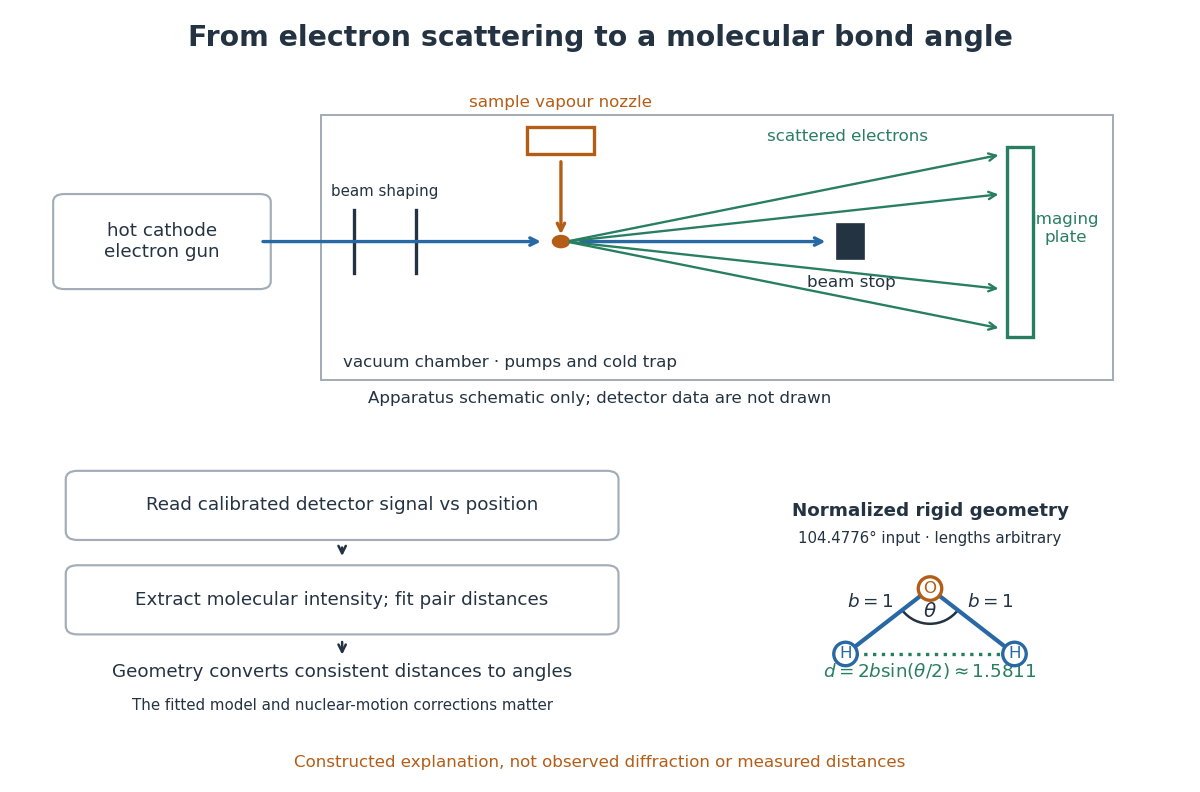

What is measured is detector signal as a function of position, converted to scattering angle using the sample-to-detector distance. Randomly oriented molecules give radial information. After extracting the molecular intensity, compare it with predictions from a candidate arrangement and adjust the bond lengths and bond angles to improve the fit. The Wann Electron Diffraction Group's account of time-averaged GED, experiment and theory describes radial averaging and this refinement. The apparatus does not photograph one molecule with labelled atomic nuclei.
Why can distances survive random orientation? In a simplified rigid pair model with separation , write for the magnitude of the difference between incident and scattered wave vectors. Averaging the interference factor over uniformly distributed directions giveswith limiting value one at . This follows by integrating the cosine; is the cosine of the angle between the pair and the scattering direction. The oscillations depend on , although the orientation has disappeared. A real calculation weights many pairs by their scattering amplitudes and includes nuclear motion. The wave interference explanation and superposed pair-distance contributions are discussed in the same [ref].
Once a consistent structural model supplies two equal bond lengths and an outer-atom separation , the law of cosines converts these to a bond angle. For example, the illustrative corresponds to approximately , while is straight. This geometric step explains what a shape measurement is trying to establish; it is not a new water measurement.
There are two essential limits. First, recovering labelled three-dimensional positions from a summed radial signal is an inverse problem: composition, candidate connectivity, and other structural information can be needed to distinguish competing fits. Karle's authored review Structure determination of gaseous and amorphous substances by diffraction methods (1977), abstract explains why too few independent observations make supplementary structural information indispensable. A good fit alone does not prove that the proposed arrangement is unique. Second, atomic nuclei are moving. Distances inferred by gas electron diffraction are motion-dependent averages; corrections are required before identifying them with a minimum-potential energy arrangement. For experimental distance conventions, see the IUPAC Gold Book: bond length. These limitations explain why model assumptions and the averaging convention must accompany a precise bond angle.
In bent molecular geometry, two neighbours and their central chemical atom form a noncollinear triangle, with an interior bond angle strictly between and . Water, , is the standard example. The NIST CCCBDB experimental water entry, internal coordinates, citing Hoy and Bunker (1979) gives the equilibrium H–O–H bond angle as with quoted uncertainty , usually rounded to .
The oxygen in water has two bonding electron domains and two lone pairs. Its ideal electron pair geometry is tetrahedral, while the three atomic nuclei give bent molecular geometry. Three points always lie in a plane; this does not make the four-domain scaffold planar. Nor does the word bent by itself determine an electron domain count: the same atomic shape can arise from other domain arrangements.
In an illustrative model with two equal bond-dipole contributions of magnitude separated by bond angle , their sum of vectors points along the bisector and has magnitude . At it vanishes; at it is approximately . This ratio is a geometric calculation, not a prediction of water's measured electric dipole moment. The entire electron density, including contributions represented by lone pairs, matters. Water is a polar molecule; chemical polarity helps explain its interactions with other polar molecules. See McMurry, Organic Chemistry, §2.2: water, lone-pair contributions, and polarity.
In trigonal pyramidal molecular geometry, three neighbouring chemical atoms form a triangular base and the central chemical atom lies outside its plane. The pyramid has four atomic nuclei; its central chemical atom is the apex, not the centre of the base. Ammonia, , has this arrangement. The [ref]
https://cccbdb.nist.gov/exp2x.asp?casno=7664417&charge=0. NIST CCCBDB experimental ammonia entry, geometric data, citing Herzberg (1966)
lists an H–N–H bond angle of , commonly rounded to or about .The Lewis structure of Ammonia allocates eight valence electrons as three bond pairs and one lone pair. Four electron domains therefore suggest tetrahedral electron pair geometry; removing the lone pair marker leaves three hydrogen chemical atoms below nitrogen. The VSEPR model treats the lone pair as more space-demanding and predicts compression relative to , but it does not calculate the precise value. See Chemistry 2e, §7.6: lone-pair effects.
Three equal bond-dipole contributions in this pyramid cancel sideways, but retain a component along its axis. By contrast, three equal contributions lying in one plane at would cancel completely. This shows how a small change in molecular geometry can permit a permanent electric dipole moment. Ammonia is a polar molecule; NIST lists a measured magnitude of about debye in the same [ref]
https://cccbdb.nist.gov/exp2x.asp?casno=7664417&charge=0. experimental entry, electric dipole moment, citing Shimizu (1970)
. The vector argument predicts allowed direction and cancellation, not the full measured magnitude.In tetrahedral molecular geometry, four neighbouring chemical atoms surround a central chemical atom in the directions of the vertices of a tetrahedron. In the regular idealization, the central atomic nucleus lies at the centre of a regular tetrahedron, and every pair of chemical bonds makes the same bond angle. Methane, , provides the standard example: its carbon has four bonding electron domains and no lone pair. See Chemistry 2e, §7.6: tetrahedral methane.
The exact ideal bond angle follows from four directions proportional to , , , and . Each has squared Euclidean norm , and each distinct pair has dot product . HenceThis is a statement about a regular tetrahedron, rather than a universal exact value for every molecule labelled tetrahedral. It also explains why a cross-shaped flat drawing with gaps is misleading: four equal directions can spread out more evenly in three dimensions.
The same vectors sum to zero. Consequently, four equal bond-dipole contributions along those directions cancel. The symmetric methane molecule is nonpolar, but a tetrahedral shape alone does not imply a nonpolar molecule: replacing one neighbour can make the electronic distribution and bond contributions unequal. Chemical polarity depends on both molecular geometry and electron density. See McMurry, Organic Chemistry, §2.2: molecular dipoles and methane.
There are unlisted articles, also show them or only show them.