
An oil spill beneath sea ice is transported by a rising buoyant plume, lateral currents and the evolving ice--water interface. A slick can be spread, trapped in ridges, incorporated into growing ice or released through brine channels and melt ponds.
The Arctic Oscillation is a large-scale pattern of atmospheric variability involving pressure-related anomalies over the Arctic and middle latitudes. Its sign summarizes the projection of an observed field onto a chosen spatial pattern; it is not simply the mean temperature of the Arctic.
For the operational NOAA index, daily height anomalies on the -hPa pressure surface north of N are projected onto a loading pattern and standardized against a stated reference period.[ref]
Arctic Oscillation monitoring by National Oceanic and Atmospheric Administration. Current Conditions: 1000-mb height anomalies, poleward-of-20N projection and standardization
The resulting index helps describe changes in atmospheric circulation, especially in the cold season. Its relation to regional weather is statistical, and its definition differs from a regional North Atlantic Oscillation index.Ice-ocean albedo feedback is the ocean-surface case of ice-albedo feedback: loss of bright sea ice, often covered by snow, exposes darker water, lowers surface albedo and increases absorbed sunlight. The extra stored ocean heat content can promote further melting and delay refreezing. Reversing the sequence can amplify cooling. This is a positive climate feedback, meaning that it reinforces the initial change; the word positive does not mean beneficial, and it does not guarantee runaway warming.
For unchanged downward solar irradiance on a newly exposed opaque patch, the extra absorbed heat flux isFor illustrative local surface albedos and , and , the patch absorbs an additional . This is a local sunlight calculation, not a whole-planet radiative forcing: newly exposed area, illumination, clouds and season determine its global contribution. With no incident sunlight this particular heating pathway vanishes. NASA's notes describe the contrast between reflective ice and snow and darker water. [ref]
https://science.nasa.gov/learn/heat/resource/explore-albedo-activity/. NASA, Explore Albedo Activity
To isolate how a positive climate feedback competes with Planck feedback, retain the assumptions of the zero-dimensional planetary energy balance and prescribe the smooth broadband Bond albedoThe exponential function makes a smooth transition from a bright cold state near to a darker warm state near . The midpoint and width are chosen to illustrate the dynamics. They are not a seawater freezing law, an observed global relation, or a calibration of modern Earth. No evolving ice thickness or latent heat is represented.
An equilibrium satisfies . For a small perturbation , linear stability follows fromSince , gives an asymptotically stable equilibrium, while gives an unstable equilibrium. With , the derivative isThus the optical term is destabilizing, while the thermal radiation term is stabilizing. Their sum, not the optical term alone, decides the linear stability.
For the same and Stefan-Boltzmann constant used above, the bisection method on the intervals , and , with temperature in kelvins, gives:
| Equilibrium temperature () | Bond albedo | () | Behavior |
|---|---|---|---|
| Asymptotically stable cold equilibrium | |||
| Unstable equilibrium | |||
| Asymptotically stable warm equilibrium |
Unrounded numerical zeros of a function have ; the table rounds them for readability. In the positive-temperature domain the sign of alternates between heating, cooling, heating and cooling across these three equilibria. The middle equilibrium separates the basins of attraction of the two stable equilibria. For example, a starting temperature of cools toward the cold state, whereas warms toward the warm state: this is bistability at identical external illumination.
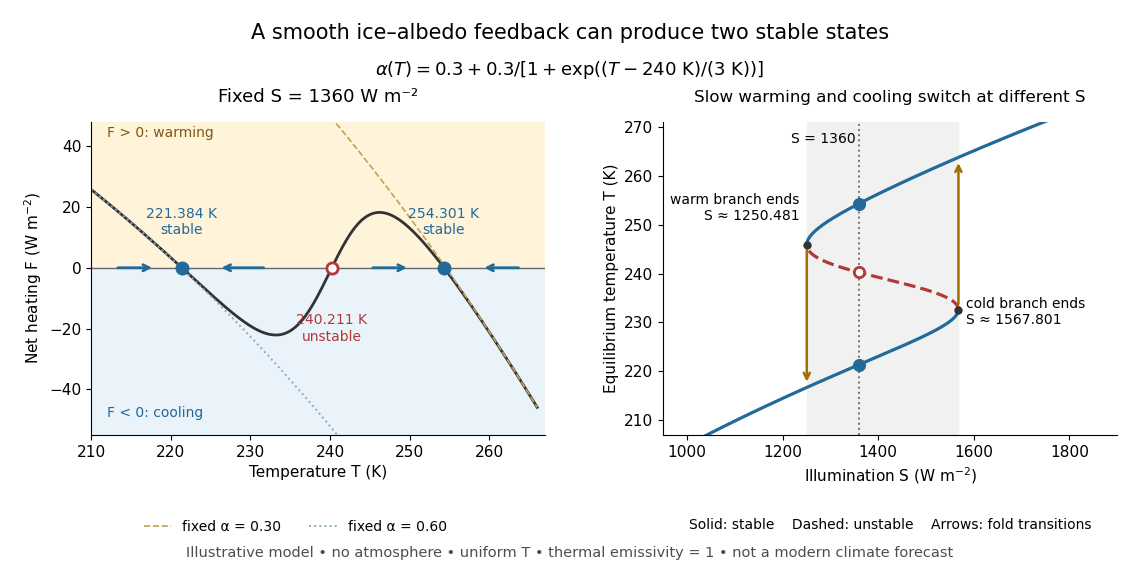

The same model illustrates hysteresis. Its equilibrium curve can be written as . The two turning points, where , are saddle-node bifurcations: approximately and . For illumination strictly between these thresholds there are two stable equilibria and one unstable equilibrium. Under sufficiently slow increase of , the cold branch ends at the upper threshold; under sufficiently slow decrease, the warm branch ends at the lower threshold. The ensuing warming and cooling transitions differ, so the state depends on its history. Finite sweep rates can delay the transitions; these thresholds describe this model's static equilibrium curve, not predicted tipping points for modern Earth.
The striking feature is that a smooth albedo law can produce distinct long-time states and abrupt transitions, although no discontinuity was inserted into the optical law. It is useful for understanding why positive climate feedback can amplify a response while stabilizing thermal radiation still limits it. Here bounds the incoming heating, whereas outgoing thermal radiation grows as ; high enough temperatures therefore cool rather than run away indefinitely.
Historically, M. I. Budyko's 1969 paper coupled changing albedo from expanding ice cover to a latitude-dependent temperature and heat transfer calculation, showing how that coupling amplified the effect of changed sunlight. [ref]
https://cdn.repub.ch/s3/republik-assets/assets/pdf/budyko_1969.pdf. M. I. Budyko, The effect of solar radiation variations on the climate of the Earth, Tellus 21(5), 611–619, 1969, pp. 614–616
William D. Sellers's 1969 paper constructed an annual energy-budget model in 10-degree latitude belts, including planetary albedo, atmospheric infrared transmission and atmospheric and oceanic exchange. [ref]https://acoustique.ec-lyon.fr/chaos/Sellers69.pdf. William D. Sellers, A Global Climatic Model Based on the Energy Balance of the Earth-Atmosphere System, Journal of Applied Meteorology 8, 392–400, 1969
These primary papers provide historical examples of ice-sensitive energy-budget modeling; the smooth single-temperature example above is a separate illustration, not a reproduction of either paper's equations or predictions.Open-ocean convection is vertical mixing driven when near-surface seawater becomes dense enough to overturn the existing density stratification. Surface heat loss can increase mass density, while salinity changes also matter: freshening can stabilize the upper layer, whereas salt enrichment can promote sinking. Deep mixing therefore depends on the prior state of the water column as well as the current surface forcing.
Profiles of temperature and salinity reveal the mixed layer and its renewal. Labrador Sea observations show why comparable winter cooling need not yield the same mixing depth when the upper ocean has different freshwater content.[ref]
2024 and 2025 Oceanographic Conditions in the Labrador Sea by Igor Yashayaev. Abstract, pp. 1-2: winter heat loss, preconditioning, upper-layer freshening and profiling observations
A convective chimney describes a localized deeply mixed region, rather than requiring a permanently uniform column sinking straight downward.An iceberg is a floating mass of freshwater ice detached from a land-based glacier or ice shelf. Archimedes' principle fixes its displaced-water volume from its mass; most of a typical iceberg lies below the surface because ice and seawater have comparable mass densities.
Currents act on the submerged part while winds act on the exposed part. Melting and fracture change both its mass and its drag geometry, so drift and survival cannot be predicted from the visible outline alone. An iceberg differs in origin and salt content from sea ice, which forms by freezing seawater.
Ice deformation changes the shape and arrangement of ice under stress. In a sea ice cover, convergence can pile broken blocks into sea-ice pressure ridges, while divergence opens leads and shear displaces neighbouring floes. These processes redistribute thickness even before freezing or melting changes the total ice volume.
An ocean heat flux is heat transferred per unit area per unit time, with a stated surface and sign convention. At the base of sea ice, an upward ocean flux supplies energy for basal melting or reduces the rate of freezing. Its units are .
Thermal conduction transfers heat through a stationary boundary layer, while turbulent motion can carry warmer water toward the interface. In a simple steady basal budget, the latent heat consumed by melting equals the difference between incoming ocean heat and heat conducted away through the ice. Measuring only the water temperature is insufficient: the transfer also depends on the boundary layer and motion.
Albedo is the fraction of incident electromagnetic radiation power reflected, summed over the outgoing directions included in the measurement. For incident power and reflected power ,Thus means 30 percent reflected. For an opaque surface the remaining 70 percent is absorbed; for a transmitting layer, transmission must also be accounted for. Specify the incident wavelengths and illumination geometry: a visible-band surface albedo and a sunlight-weighted broadband surface albedo need not agree. NASA's definition explicitly allows a specified spectral band. [ref]
For a whole planet, broadband Bond albedo sums reflected power over all outgoing directions and all incident wavelengths, weighted by the illuminating spectrum. It is the fraction needed for a whole-planet absorbed-sunlight budget. A local surface albedo describes one surface under specified illumination; it cannot simply replace the Bond albedo of Earth, whose clouds and terrestrial atmosphere also reflect and absorb sunlight. Nor is Bond albedo the same as geometric albedo, which compares brightness in a particular viewing geometry. NASA's account of Earth's budget separates reflection by clouds, particles and the surface from absorption within the terrestrial atmosphere and at the surface. [ref]
The usefulness of albedo is that it turns optical behavior into an energy budget. Bright snow and sea ice usually absorb less sunlight than exposed water under comparable illumination, but their actual surface albedos depend on the spectrum and surface conditions. The ice-ocean albedo feedback makes that optical property part of the dynamics, while the following zero-dimensional planetary energy balance isolates the geometry and competing thermal radiation.
The Atlantic meridional overturning circulation describes the depth-dependent north-south transport of Atlantic seawater. Warm upper waters carry heat northward; transformations involving surface cooling, salinity and mixing produce denser waters that return at depth. Winds, exchanges with other basins and the energy needed for mixing also enter the circulation.
Monitoring arrays combine observations across a latitude section to estimate transports at different depths. A temperature record at one point cannot determine the whole overturning strength. The circulation matters because water transport also moves heat and carbon, linking regional ocean conditions with climate.[ref]
Meridional Overturning Circulation by NOAA Atlantic Oceanographic and Meteorological Laboratory. Observing-program description: basin-spanning arrays and transported properties
The North Atlantic Oscillation is variability in the large-scale North Atlantic atmospheric pressure gradient, commonly summarized by an index comparing the subtropical high-pressure region with the subpolar low-pressure region. A stronger-than-usual contrast characterizes a positive phase and is associated with stronger Atlantic westerly winds; a weaker contrast changes the preferred paths of weather systems.[ref]
The North Atlantic Oscillation by Met Office. Definition, north-south pressure contrast and positive/negative circulation regimes
The index is useful because it connects a broad circulation pattern to regional temperature and rainfall variability. It does not imply one repeating fixed-period oscillation, nor does its sign uniquely determine the weather at every location. A station-based index and an index fitted to a spatial pattern need not be numerically identical.
Fram Strait is the deep ocean passage between Greenland and Svalbard connecting the Arctic with the northern Atlantic. Its opposing flows transport heat, freshwater and sea ice, so it is an important location for measuring exchanges that influence ocean circulation and sea ice thermodynamics.
A heat-transport estimate needs both flow and temperature: warmer water does not imply a larger heat transport if its volume flux decreases. Likewise, estimating freshwater transport requires salinity and a stated reference composition. Long-term observing systems combine fixed instruments with mobile platforms to resolve these transports rather than treating one cruise as a complete mean state.[ref]
Ocean: FRAM by Alfred Wegener Institute. Observatory description: long-term measurements in Fram Strait and complementary stationary/mobile observing systems
Snow is solid atmospheric precipitation made of ice crystals and their aggregates. Crystals grow in cold clouds through transfer of water vapor to ice; collisions and the collection of supercooled droplets can further change their form. Air temperature and moisture conditions influence the resulting particles.
A settled snowpack contains both ice and pore space, so its bulk mass density and thermal conductivity differ from those of solid glacier ice. Compaction and recrystallization can turn old snow into firn. Its high albedo also changes the absorbed solar energy, while its insulating effect alters heat exchange with the ground or underlying sea ice. These optical and thermal roles can act in different directions in a surface energy budget.
There are unlisted articles, also show them or only show them.