
Meteorology studies atmospheric structure, motion and the processes producing weather. Uneven heating generates pressure gradients, air motion transports heat and water vapor, and condensation or freezing releases latent heat. Rotation and surface friction help determine how that motion develops.
A weather station measures local conditions, while comparing observations over space reveals evolving atmospheric systems. Wind, temperature, relative humidity and pressure constrain different parts of the physical state; no one sensor completely describes it. Forecasts combine these observations with equations for fluid motion, energy and moisture. Climatology instead emphasizes statistics over longer periods, using many of the same physical mechanisms and observing systems.
The Chern-Weil homomorphism turns a polynomial in curvature into a topological cohomology class. For a principal bundle with Lie group , a degree- polynomial on its Lie algebra that is invariant under the adjoint action determineswhere is the curvature form of any principal connection. The Bianchi identity makes a closed differential form. Changing the principal connection changes it by an exact differential form, so the de Rham cohomology class depends on the principal bundle, not that choice. Products of polynomials become cup products.[ref]
Characteristic forms and geometric invariants by Shiing-Shen Chern and James Simons. Section 2, Theorem 2.12, page 51
For example, the trace-square polynomial produces , underlying the first Pontryagin class. This is the bridge between the locally measured curvature and a global topological invariant.
A point represents a position without spatial extent. In Euclidean space , choosing a coordinate system specifies a point by real numbers. The difference of two points is a displacement vector; a single point has no preferred origin. For example, and have displacement and Euclidean distance five. In axiomatic geometry, points can instead be primitive objects governed by incidence axioms.[ref]
Spherical geometry studies lengths and angles measured along the surface of a sphere, rather than through its interior. It is a useful model whenever travel is constrained to a round surface. Its straightest paths are great circle arcs: they are geodesics, even though they appear curved in the surrounding Euclidean space. Two distinct great circles meet at an antipodal pair, so the parallel-line picture of Euclidean geometry does not apply.
For a sphere of radius , write two positions as , with unit vectors. Their shorter surface route has great-circle distancewhere the dot product gives the central angle in radians. The straight chord through the surrounding Euclidean space instead has length . For a quarter-circle separation these are and : specifying which distance we mean has a measurable effect. On the unit sphere, and great-circle distance equals the central angle.
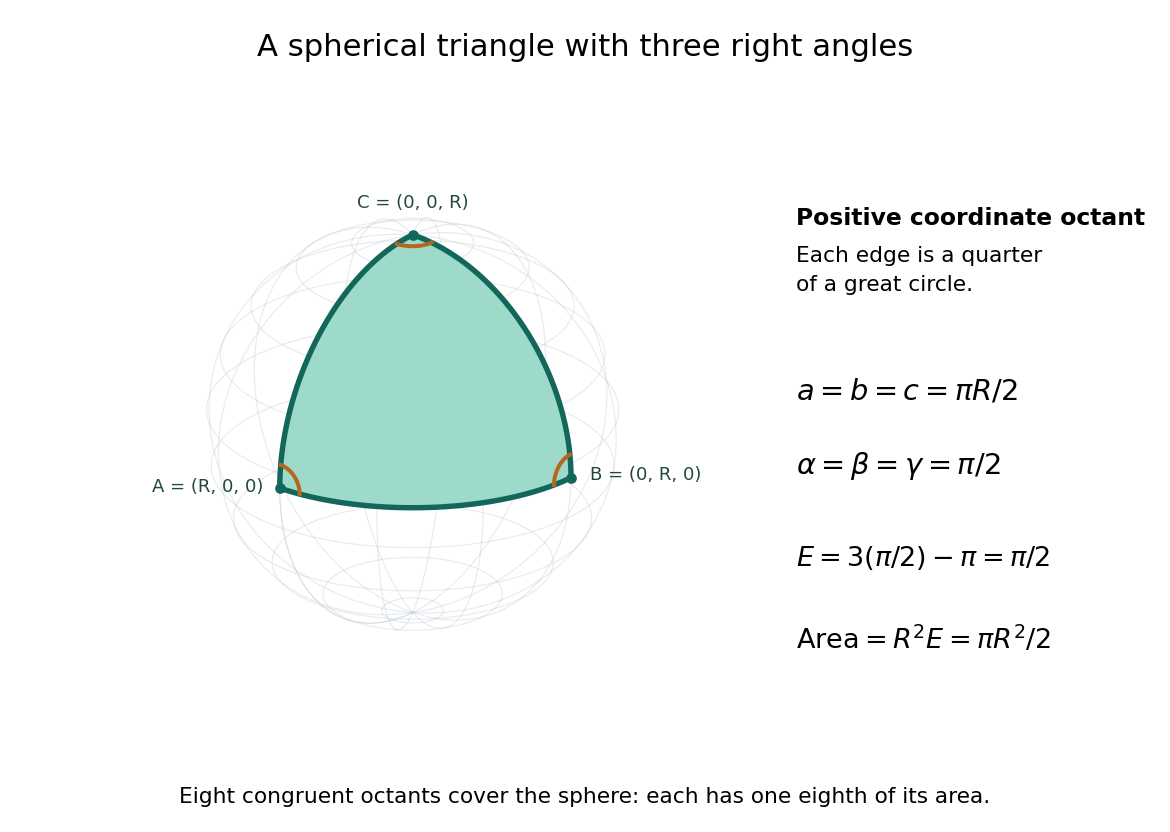
Consider the spherical triangle with vertices , and , joined by the shorter great circle arcs. Each side has length . At each vertex the two outgoing tangent vectors point along the other coordinate axes and are orthogonal, so all three interior angles are . This is the positive coordinate octant of the sphere, not a flat triangle drawn inside it.
For a convex minor spherical triangle with interior angles in radians, the spherical excess formula statesOur octant therefore has area . Independently, eight congruent octants partition the sphere, giving again. Thus angles alone determine area when is fixed, unlike Euclidean geometry, where similar triangles can have arbitrarily different areas. The Gauss-Bonnet theorem explains the connection: the sphere's constant Gaussian curvature times the area equals this excess. For spherical triangles whose area is small compared with , the excess is small, recovering the familiar flat picture.

A pencil is a one-parameter linear family of geometric objects. For linearly independent homogeneous polynomials of equal degree, , indexed by , is a pencil of plane curves or hypersurfaces. Lines through a fixed point give a simple example; a pencil of plane curves specializes the general construction.
An embedding identifies one mathematical structure with a structure-preserving copy inside another. In topology it is a homeomorphism onto its image with the subspace topology; an algebraic embedding is an injective homomorphism. A smooth embedding additionally has injective differential everywhere, so its image is an embedded submanifold.
A parametric equation expresses coordinates as functions of one or more independent parameters. For example, , describes a circle; multiple parameters describe surfaces. A smooth curve is a differentiable single-parameter realization. A reparametrization changes the parameter without changing the geometric image.
A cylinder is generated by translating a plane curve along parallel lines transverse to its plane. A circular cylinder uses a circle as its generating plane curve; it is right when the generators are perpendicular to that plane. The term can denote the lateral surface or, for a bounded portion with end caps, the enclosed solid. The circular cylinder curvature formulas describe the smooth lateral surface.
At several genetic loci, a phase-known genotype specifies which alleles occur together on each chromosome, hence its two haplotypes. An unphased multilocus genotype may be compatible with several haplotype pairs. For two heterozygous loci, and have identical unphased genotypes but different transmission probabilities when genetic linkage is present.
A haplotype is the set of alleles on one chromosome across specified genetic loci. Closely linked markers without intervening genetic recombination are transmitted as one haplotype; they are not independent observations of inheritance.
A homozygote carries two identical alleles at a locus; a heterozygote carries different alleles. Homozygosity of an observed haplotype is identity by state, and need not be identity by descent.
A heterozygote carries different alleles at a diploid locus. Under ordinary Mendelian segregation each is transmitted to an offspring with probability . Only heterozygous parents provide a comparison between alternative transmissions in the transmission disequilibrium test.
Homozygosity means that the two allele states at a diploid genetic locus are the same; an individual with that property is a homozygote. Observed homozygosity does not by itself establish identity by descent.
Heterozygosity means that the two allele states at a diploid genetic locus differ; an individual with that property is a heterozygote. Heterozygous parental genotypes provide alternative alleles for a transmission disequilibrium test.
A genotyping error is an incorrect observed allele or genotype call. A probabilistic observation model replaces the deterministic genetic marker factor by , allowing nonzero probability of an observed call inconsistent with the latent genotype. Such error can bias family transmission tests and linkage likelihoods.
Genotyping determines the alleles carried at chosen genetic loci. A diploid genotype call need not identify its two haplotypes; that additionally requires a phase-known genotype or haplotype estimation.
A single-nucleotide polymorphism is variation at one nucleotide position in sampled genomes. Under an infinite sites mutation model, the number of such variable positions in a sample equals the number of mutations on the genealogy below its most recent common ancestor.
The recombination fraction is the probability that a transmitted gamete carries a recombinant haplotype between two specified genetic loci, relative to the parent's known haplotype phase. Write it as here; the symbol is also common in genetic linkage analysis. In the ordinary symmetric two-locus model, , with for complete genetic linkage and for independent assortment.
For phase-known genotype , fair Mendelian segregation and equal reciprocal gamete probabilities giveFor example, 1,000 independent informative transmissions with observed counts in this order have empirical recombination fraction . Those illustrative counts match the expected values in the toy model, but actual counts fluctuate. The genetic linkage diagram shows both the parental and recombinant classes, so their separate probabilities are not confused with the total .
The recombination fraction measures the probability of an odd number of origin switches along the transmitted chromatid. It is neither the expected value of the exchange count nor the probability of at least one exchange: even positive counts can be invisible at the two endpoints. Converting an observed recombination fraction to a genetic map distance therefore needs an explicit model such as the Haldane mapping function. The distinction between transmitted-chromatid counts and four-chromatid exchange counts is discussed in Weeks, Tang and Kwon (2009), Casares' map function: No need for a 'corrected' Haldane's map function, Genetica 135, 305–307.
There are unlisted articles, also show them or only show them.