Two allele copies are identical by state when their observed states agree, regardless of whether they derive from one recent ancestral copy. Equal marker haplotypes can therefore reflect either identity by descent or matching founder haplotypes.
Autozygosity is homozygosity by descent: the maternal and paternal copies in one individual derive from the same ancestral copy. Unlike ordinary homozygosity, it concerns the ancestry of chromosome copies rather than only their observed states. In a pedigree with one ancestral disease-allele copy and fully penetrant recessive inheritance, every affected individual is autozygous for that copy.
In an outbred pedigree, the two full siblings receive the same paternal copy with probability , and independently the same maternal copy with probability . Thus the number of shared copies has a binomial distribution with probabilities , and .
// Target: biology.bigb
The kinship coefficient is the probability that one randomly selected allele copy from each of is identical by descent. For a noninbred individual, , and more generally . For distinct individuals with parents , Mendelian segregation gives . The offspring's inbreeding coefficient equals the parents' kinship coefficient.
// Target: biology.bigb
An identical-by-descent segment is a chromosomal tract inherited from the same ancestral chromosome without an intervening breakpoint in the tracked ancestry. With a specified total number of independent meioses and a uniform recombination map, the probability that a fixed tract of genetic length survives without genetic recombination is approximately . Recent common ancestry therefore tends to give longer shared tracts. Lengths of tracts selected by covering a random point are length-biased relative to tracts sampled by their boundaries.
For first cousins in an otherwise outbred pedigree, compare the copies transmitted from their related parents, who are full siblings. These transmissions trace to the same shared grandparent with probability and then to the same homologous copy of that grandparent with probability , giving . The unrelated parental contributions cannot match, so two shared copies have probability zero. Selecting one random copy from each cousin chooses those two potentially shared copies with probability , giving kinship coefficient .
For two individuals carrying labelled copies and , condensed identity coefficients give the probabilities of nine identity by descent patterns, identifying states that differ only by exchanging the two homologues within either individual. They retain within-individual autozygosity, which three ordinary outbred sharing coefficients omit. One convention isEach block consists of copies identical by descent, and different blocks have distinct ancestral origins. For siblings whose parents are otherwise outbred first cousins, these coefficients are . This follows by conditioning on whether the parents share one ancestral copy and enumerating the four independent Mendelian segregation choices to their two children. The kinship coefficient is , here . Weir's discussion of identity states uses this convention.
Sibling IBD ascertainment under multiplicative penetrance by  Codex 0 Created 2026-10-13 Updated 2026-11-05
For full siblings in an outbred pedigree, condition on both being affected under multiplicative diallelic penetrance and on residual disease outcomes being independent given their genotypes. The usual Mendelian IBD sharing of full siblings probabilities are weighted by , respectively, giving the displayed conditional sharing probabilities. Since , , strictly for a polymorphic locus with a nontrivial effect.
The hydrophobic effect is the solvent-mediated tendency of nonpolar regions to associate in water. Exposing a hydrocarbon region changes how surrounding water molecules can arrange and interact; reducing that exposure can lower the total free energy. Both water and lipids enter the accounting. The effect is not an additional covalent bond between chains. See IUPAC Gold Book: hydrophobic interaction.
At fixed temperature and pressure, compare two candidate organizations by the change in Gibbs free energy, , where is enthalpy, is absolute temperature, and is entropy. An organization with lower is favored in this comparison. Reducing exposed hydrocarbon area is one contribution; changes in chain packing and the entropy of the lipids also matter. This explains why hydrophobicity alone cannot predict every aggregate shape. See 16.4 Free Energy.
Saponification is hydrolysis of an ester under basic conditions. The conductometric saponification assay follows ethyl acetate consumption by hydroxide, producing ethanol and an acetate ion; its equal-starting-concentration case provides a practical second-order reaction example.
Saponification is ester hydrolysis promoted by a chemical base, with net consumption of hydroxide to form a carboxylate and an alcohol. For a carboxylic acid-derived ester, the net chemical equation isThe hydroxide is a reactant, rather than merely a regenerated catalyst.[ref]
21.6 Chemistry of Esters. Organic Chemistry by John McMurry; §21.6, Conversion of Esters into Carboxylic Acids: Hydrolysis; Figure 21.8 discussion of carboxylate formation
For ethyl acetate, the balanced chemical equation becomesBoth sides contain four carbon chemical atoms, nine hydrogen chemical atoms, three oxygen chemical atoms, and net electric charge . A sodium ion supplied by sodium hydroxide is a spectator ion; the net ionic equation omits it without losing electric charge conservation.
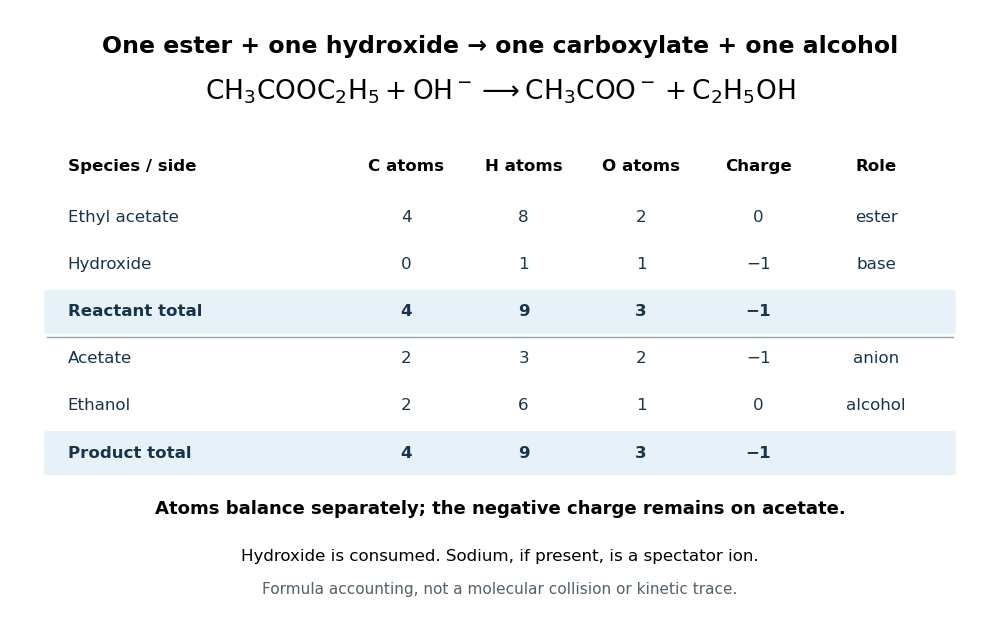

In the usual reaction mechanism, hydroxide adds to the carbonyl group, making a reaction intermediate. Departure of the alcohol's conjugate base gives a carboxylic acid; transfer of a proton then gives the carboxylate and the alcohol. Subsequent addition of a chemical acid gives the carboxylic acid by protonation:This separate acidification changes the reaction product's protonation state.[ref]
21.6 Chemistry of Esters. Organic Chemistry by John McMurry; §21.6, Figure 21.8 discussion: addition, elimination, deprotonation and subsequent aqueous HCl treatment
The conductometric saponification assay makes hydroxide consumption observable. A university procedure equilibrates separate ethyl acetate and sodium hydroxide stocks in constant-temperature baths, then mixes them in a rinsed conductivity cell. Two platinum electrodes and an alternating-voltage Wheatstone bridge supply an electrical resistance readout. A matched sodium hydroxide–water dilution checks the initial signal; potassium chloride calibrates the cell constant. Replacing hydroxide with less mobile acetate ions lowers electrical conductance, supporting an inference about changing concentration. The manual supplies a procedure rather than measured outcomes. Temperature drift or additional ions can change the signal; it cannot alone identify the full reaction mechanism.[ref]
Manual for Advanced Physical Chemistry Laboratory-II by Nasima Arshad. Unit 7, Experiment 1, printed p. 63: electrodes, bridge and ionic conductance; Experiment 2, printed pp. 66–67: preparation, resistance readout and controls
A hydrogen bond acceptor supplies the electron-rich atom or group interacting with the attached hydrogen of a hydrogen bond donor in . An oxygen lone pair in water is the familiar example. Acceptance describes the association, not necessarily acquisition of a proton. A single molecule, such as water or Ammonia, can offer both hydrogen bond donor and hydrogen bond acceptor sites. See Glasfeld: water and nitrogen-containing accepting sites.
A lone pair drawn in a Lewis structure is a useful clue, not a universal test. At an ordinary neutral amide nitrogen, the nominal lone pair participates in chemical resonance with the carbonyl group, so this nitrogen is ordinarily excluded from lists of hydrogen bond acceptors; the carbonyl group's oxygen remains an accepting site. Protonation changes the test again: has four N–H covalent bonds and no nitrogen lone pair, whereas Ammonia has three and one. These distinctions follow the actual chemical form, and accepting ability also depends on the partner and whether it can approach the site. See McMurry: amide resonance and protonation and Glasfeld: limitations of nitrogen accepting sites.
Conversely, an accepting group need not supply an atom-centred lone pair. The following phenol–benzene experiment probes an O–H donor interacting with the ring's distributed electron density.
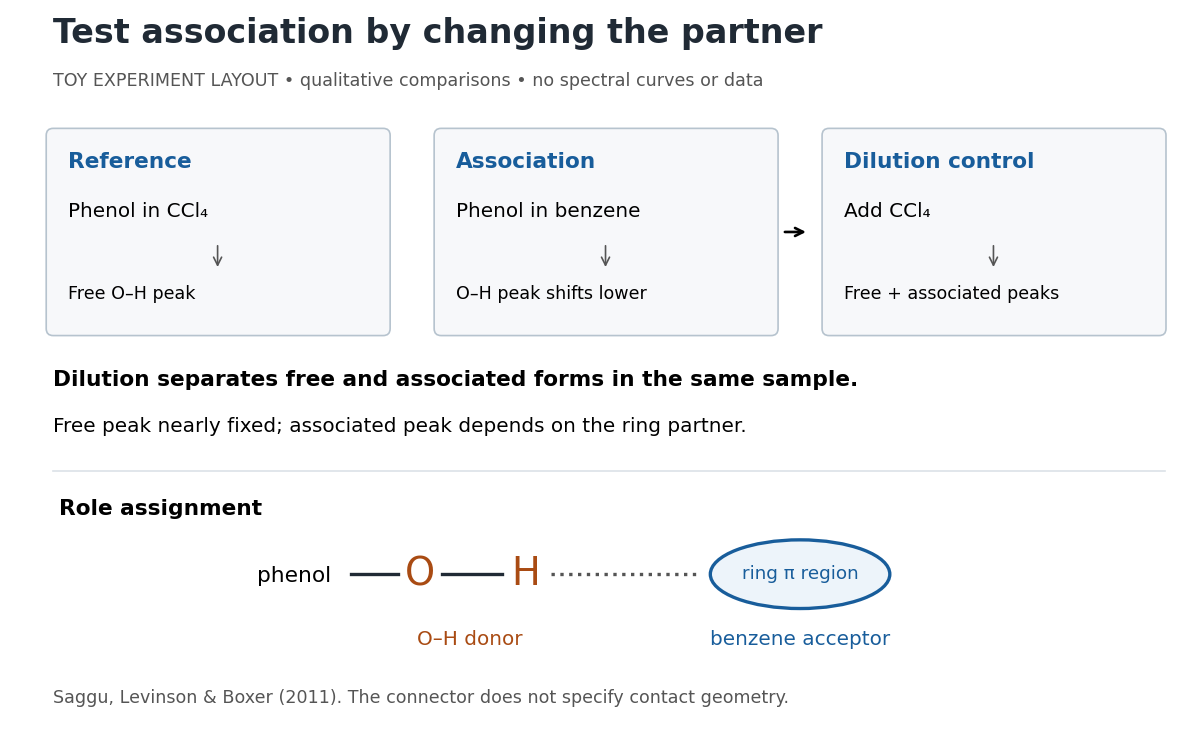
Infrared spectroscopy distinguishes free and associated phenol: schematic experimental logic, no plotted or simulated spectra
. Original toy layout of the comparisons reported by Saggu, Levinson and Boxer (2011). The connector identifies an O–H donor and a ring accepting region; it does not specify a measured bond length or the calculated contact geometry. Details.
Saggu, Levinson and Boxer (2011) used infrared spectroscopy to compare phenol in different solvents. The O–H stretching peak was at in and in benzene. To distinguish association from a general solvent effect, they diluted the ring-containing chemical solutions with : two peaks appeared, with the free peak nearly fixed while the associated peak depended on the partner. Replacing the O–H hydrogen with deuterium reproduced the ordering of shifts for different partners. Thus the perturbed O–H group identifies the hydrogen bond donor; the ring supplies the hydrogen bond acceptor. A peak shift alone does not specify a unique molecular geometry. [ref]
https://pmc.ncbi.nlm.nih.gov/articles/PMC3202663/. Saggu, Levinson and Boxer, Direct measurements of electric fields in weak OH···π hydrogen bonds, JACS 133 (2011), Figure 1, Table 1 and dilution controls
The roles make recognition between molecules intelligible: exposed hydrogen bond donors need compatible hydrogen bond acceptors in reachable positions. A count of sites is a starting description, not a prediction of binding strength. In water, forming a contact between two partners can also replace their existing hydrogen bonds to water; the Gibbs free energy of association concerns the whole change. See Glasfeld, pp. 15–16: competition with solvent interactions.
A hydrogen bond donor is the group supplying the attached hydrogen in a hydrogen bond . The donor atom , or the whole molecule containing it, may also be called the donor. The terminology does not imply transfer of a free proton: in the ordinary water pair, the O–H covalent bond remains. Familiar donors include O–H groups in water and N–H groups in Ammonia. See Andrew Glasfeld, Intermolecular Attraction, pp. 12–13: donor and acceptor roles.
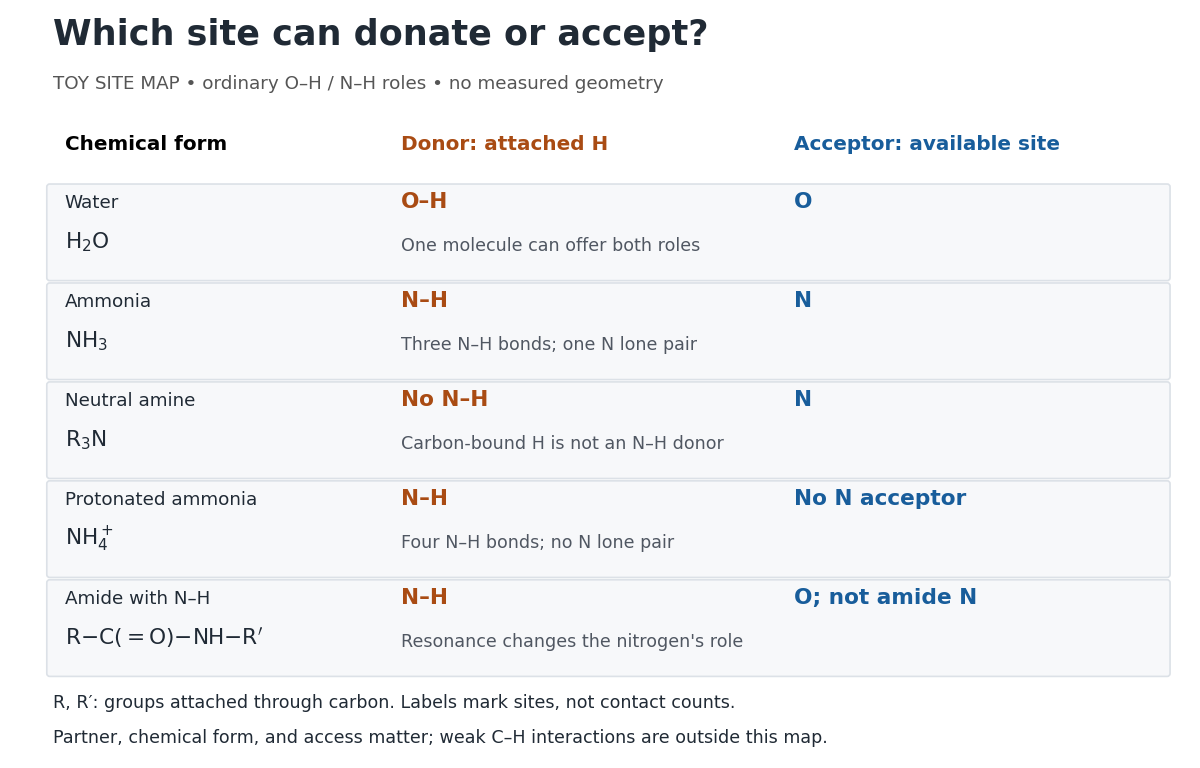
Hydrogen bond donor and hydrogen bond acceptor roles depend on attached hydrogen, protonation, and chemical resonance
. Toy site map for ordinary O–H and N–H associations, not measured geometry or an exhaustive list of hydrogen bonds. and denote groups attached through carbon. Coloured labels identify possible sites, rather than count the number of simultaneous contacts. Details.
The attached hydrogen is essential to this role. At the nitrogen site, an unprotonated amine can be a hydrogen bond acceptor, but has no N–H hydrogen bond donor. Protonation gives : the new N–H group can donate, while that nitrogen no longer has the accepting lone pair. This is a change of chemical form, not a permanent label attached to a chemical element. Here denotes a group attached through carbon; the statement concerns the nitrogen site and does not rule out weaker C–H associations elsewhere. See McMurry, Organic Chemistry, 24.3: amine protonation and Glasfeld: protonated amines as donors.
An amide with an N–H covalent bond can donate even though its nitrogen is ordinarily not an accepting site. For example, in , N–H is a hydrogen bond donor and the carbonyl group's oxygen is a hydrogen bond acceptor. Replacing the remaining N–H by another group attached through carbon removes this N–H donor without removing the accepting oxygen. The analogous division of roles in a peptide bond helps explain protein structure. See Glasfeld: amide roles and biological interactions. The useful question is therefore which site supplies the hydrogen, rather than whether the whole substance is simply “hydrogen bonding”.
The Lyman limit is the short-wavelength limit of transitions to the hydrogen atom ground state. Its photon energy, approximately , is the ground-state ionization energy.
There are unlisted articles, also show them or only show them.