How neural responses represent variables relevant to an organism. A coding claim specifies both which response features carry information and how a downstream system can use them.
Average the stimulus history preceding each observed spike, after removing the stimulus mean. With white Gaussian stimulation and a suitable one-filter encoding model, the result is proportional to the relevant linear filter. An even nonlinearity can make the average vanish despite strong stimulus dependence, so averaging alone is not universally sufficient.
A stimulus passes through a linear temporal or spatial filter, then a nonnegative nonlinear rate function. A conditionally Inhomogeneous Poisson process generates spikes at that rate. The filter and nonlinearity can be fitted from data and tested on held-out trials. Refractoriness and spike-history correlations require extensions beyond this basic cascade.
The symmetric two-neuron rate model has nonnegative activity and saturating recurrent input. Every equilibrium has : otherwise monotonicity of gives a contradiction. With positive parameters it has three distinct equilibria exactly when , namely zero and . The lower positive equilibrium is a saddle and the origin and upper equilibrium are stable nodes. The resulting two attracting activity levels model a persistent switch rather than a spiking waveform.
A conductance-based Hodgkin-Huxley model couples membrane potential to voltage-dependent channel-gating variables. It explains generation of action potentials through regenerative and opposing ionic electric currents, while its parameters and channel assumptions determine its biological domain of validity.
In the classical model, describes sodium activation, describes availability against sodium inactivation, and describes potassium activation. Each follows two-state ion-channel gating, with its own voltage-dependent rates. The available electrical conductances areThe barred quantities are maximum electrical conductances. The factors have the interpretation of independent permissive gates in an ion channel: three activation factors and a distinct inactivation-availability factor for sodium, and four identical activation factors for potassium. Large means availability; small means inactivation. These are model assumptions, not a literal structural description of every ion channel. See Gerstner, Kistler, Naud and Paninski, Neuronal Dynamics (2014), §2.2: model definition and stochastic opening.
With inward-positive electric current, a single-compartment form isHere is membrane capacitance, is imposed inward electric current, is leak electrical conductance, and each is a reversal potential. Use consistent units, and either whole-compartment quantities throughout or quantities per membrane area throughout. Opening changes electrical conductance; the reversal potential and present membrane potential determine the associated electric current. Coupling this equation to the voltage-dependent gates makes a generally nonlinear system of ordinary differential equations; a gate's fixed-voltage limit alone does not specify its evolving state during an action potential.
The original quantitative account is [ref]
https://pmc.ncbi.nlm.nih.gov/articles/PMC1392413/. Hodgkin and Huxley (1952), A quantitative description of membrane current and its application to conduction and excitation in nerve, Journal of Physiology 117, 500–544, doi:10.1113/jphysiol.1952.sp004764
. The contrast with the leaky integrate-and-fire model is useful: here an action potential emerges from evolving ionic electric currents, whereas the simpler model records a threshold event and imposes a reset.The leaky integrate-and-fire model combines a passive equation for membrane potential with a firing rule. Between events, inward-positive applied electric current obeyswhere is membrane capacitance, is the leak conductance, is the corresponding electrical resistance, and is the leak reversal potential. Here the leak conductance is constant. The time constant describes passive relaxation. When first reaches a threshold from below, record an action potential event and reset to . In the version used here, hold for a fixed neuronal refractory period , then resume integration. See 1.3 Integrate-And-Fire Models.
For constant , with at the start of an integration interval and , the exact subthreshold solution isThe equilibrium point of this passive equation is . Subtracting leaves , explaining the exponential function. This solution applies only until a threshold event or a change in . Starting below threshold, constant input produces repeated events if ; if , the threshold is approached asymptotically and never reached at finite time.
For a worked example, chooseThese imply and . All these parameters are illustrative model choices, not measurements from a particular neuron. With , Ohm's law gives and hence . ThusAt threshold, , so the first event occurs after . Each subsequent cycle includes the neuronal refractory period, givingThis is the ideal sustained firing rate; the first-event latency is , not .
With instead, and . From the same initial state, stays below : no events occur, however long this current is held. The critical sustained current is ; equality gives asymptotic approach rather than finite-time firing.
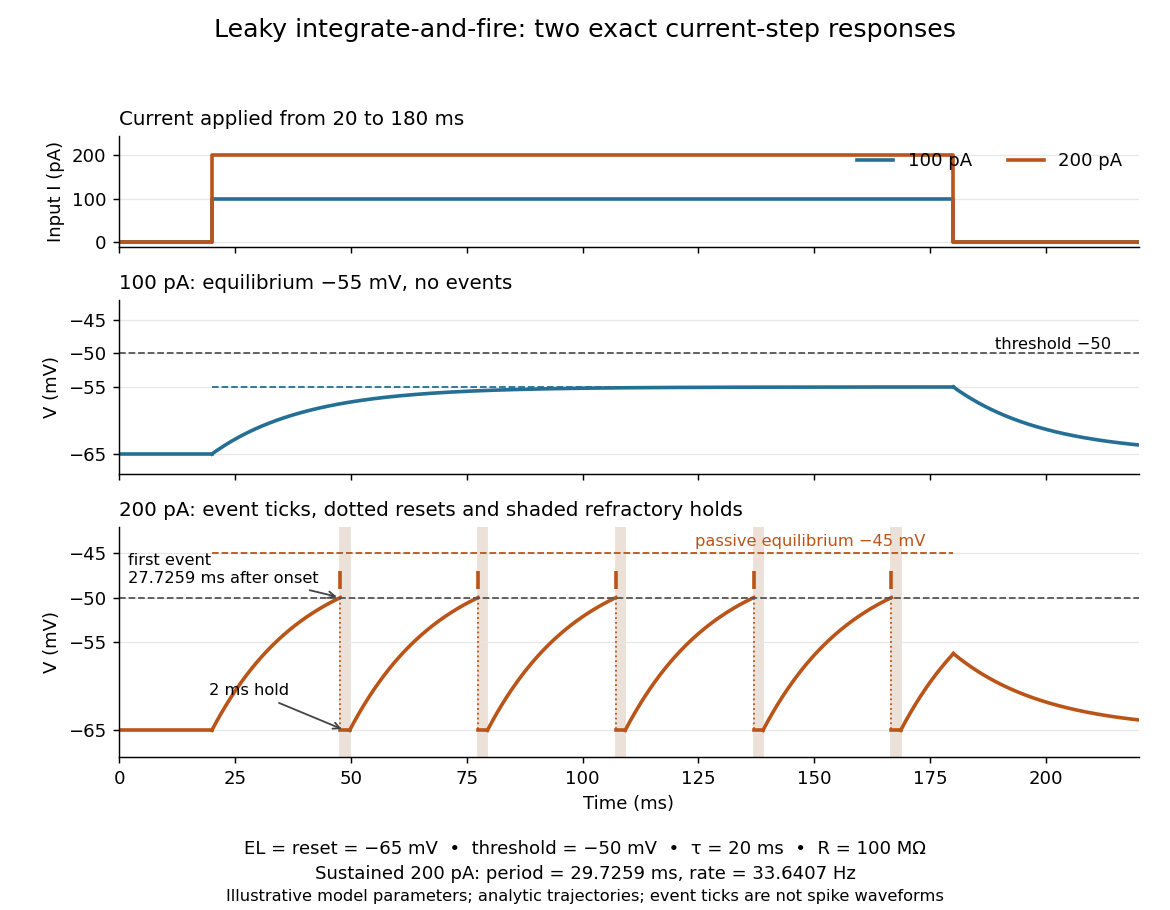
Exact leaky integrate-and-fire responses to two current steps
. Both inputs start at and end at . A step approaches without firing; a step produces threshold events separated by after the first. Orange ticks mark events, and shaded intervals mark the reset hold. The dashed level is the stronger input's passive equilibrium, which the reset trajectory never reaches. These are analytic model trajectories, not recordings or biological spike waveforms. Details.
The leak gives old inputs progressively less influence, while capacitance prevents an ordinary finite electric current step from changing instantly. This combination makes the leaky integrate-and-fire model useful for exploring input summation, event timing and network activity at low computational cost. Its fixed parameters and reset omit the evolving voltage-gated ion channels of the Hodgkin-Huxley model, spatial integration in dendrites and mechanisms of neural adaptation. Treating a synapse as a prescribed also omits its voltage-dependent driving force unless a conductance term is added. See 1.4 Limitations of the Leaky Integrate-and-Fire Model and constant-input firing rate of a leaky integrate-and-fire neuron.
For a directed three-neuron rate ring , the linearization has characteristic equation , where . Positive loop gain has strict linear asymptotic stability for . Negative loop gain has it for ; at a complex pair crosses the imaginary axis at frequency . The saturating cubic gives a supercritical Hopf bifurcation under an ordinary loop-gain variation. This directed system does not inherit the energy-descent property of a symmetric Hopfield network.
A dynamic clamp measures a real neuron's voltage, updates a conductance model in real time and injects the resulting current, for example . It implements a virtual conductance without holding the voltage fixed. It can add artificial synapses, couple real neurons into a hybrid network or test how a voltage-dependent conductance affects excitability. Sampling delay and the injection site limit fidelity to spatially distributed biological channels.
A Gabor filter has a kernel formed by multiplying a Gaussian function by a sinusoid or a complex oscillation. In two-dimensional image processing, its orientation and spatial frequency select local image structure; evaluating the kernel's translated dot product with an image is spatial filtering. The real even example under signed spatial filter model of a simple cell uses a cosine.
There is experimental motivation for this family without making every simple cell an exact Gabor filter. Jones and Palmer fitted two-dimensional Gabor filters to measured spatial and spectral response profiles of simple cells in cat cortex and compared independently estimated parameters as a test of spatial linearity. Their reported residuals supported the approximation in that dataset. The chosen parameters and orientation tuning curve in this article are not extracted from their measurements. [ref]
https://pubmed.ncbi.nlm.nih.gov/3437332/. Jones and Palmer, An evaluation of the two-dimensional Gabor filter model of simple receptive fields in cat striate cortex (1987), primary abstract
Communication complexity studies how much information distributed parties must exchange to compute a function of their separately held inputs. Local computation is free; the resource being counted is communicated bits or qubits, with the allowed shared randomness, quantum entanglement or other correlations specified separately. For a Boolean function , a one-way exact protocol has the receiver output correctly for every input after a single message. One-bit computation using Popescu–Rohrlich boxes shows that this resource measure changes drastically if ideal superquantum boxes are available.
Compilation is the translation process performed by a compiler, which may include checking and transforming an abstract syntax tree. Translation can finish before execution, or happen during execution through just-in-time compilation. Reusing the translated representation can avoid repeated parsing and repeated constant folding when only the inputs change. This does not guarantee a speedup: translation itself costs work, and the choice of representation and execution mechanism matters.
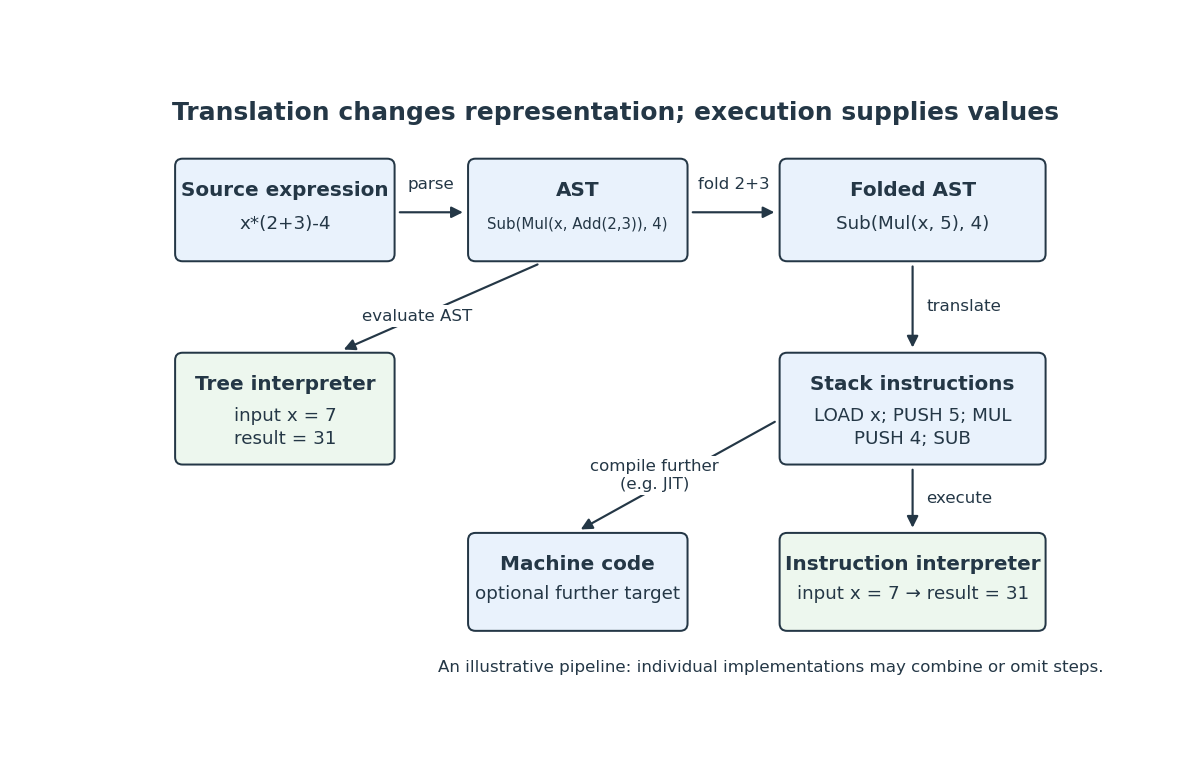
One possible compilation pipeline for
. Details. x*(2+3)-4, with execution from an abstract syntax tree, a stack machine instruction sequence, or machine code
Compendium of Chemical Terminology (Gold Book), second edition isotopic abundance by  Codex 0 2026-10-13
For a completely regular Hausdorff space, the Stone-Čech compactification is the weak-star closure of the evaluation functionals in the dual unit ball of . The Banach-Alaoglu theorem gives compactness; complete regularity makes evaluation a topological embedding. Every bounded real continuous function extends by , yielding an isometric isomorphism . For a continuous map into a compact Hausdorff space , the adjoint of pullback sends this closure into the closed evaluation copy of , yielding the unique continuous extension. Uniqueness follows from density. It is a universal compactification, not a homeomorphism between and the whole dual space.
Large-extra-dimension models lower the fundamental higher-dimensional gravitational scale while obtaining a large four-dimensional reduced Planck mass from compact volume . Ordinary matter can be localized on a brane while gravity propagates in the bulk. The Planck mass from compactification volume relation explains weak effective four-dimensional gravity but leaves volume stabilization and the origin of a large internal volume as separate problems.
// Target: physics.bigb
A warped five-dimensional geometry redshifts masses of fields localized on the distant brane: . For the usual doubled orbifold interval, integration of the Einstein-Hilbert action gives . Exponential redshift can generate a large separation of observable scales with a moderately sized dimensionless distance . Stabilizing the radion remains a dynamical requirement.
// Target: physics.bigb
A radion is a lower-dimensional scalar field describing the size or separation modulus of compact extra dimensions. In a two-brane Randall–Sundrum model, its expectation determines the inter-brane separation and the warp-generated hierarchy. A background size alone does not supply a radion potential or a stabilization mechanism.
// Target: supersymmetry.bigb
Kaluza-Klein theory obtains lower-dimensional fields from a higher-dimensional metric and other fields on compact dimensions. In the displayed fixed-radius circle ansatz, the off-diagonal metric supplies a vector. The coordinate change is compensated by , producing an Abelian gauge symmetry. Allowing the radius to vary adds a scalar modulus. Kaluza-Klein modes also include nonzero internal momenta, giving a tower of massive fields.
// Target: quantum-field-theory.bigb
In a brane-world model some fields, typically ordinary matter and gauge fields, are localized on a lower-dimensional brane, while gravity propagates through the higher-dimensional bulk. Compact volume or a warped metric can then separate the observed gravitational scale from local matter scales. A model must specify field localization, boundary conditions and stabilization rather than identifying a brane with an arbitrary compactification.
A coloring necklace is an equivalence class of colorings of cyclically arranged positions under rotation. Burnside lemma counts necklaces by averaging the numbers of colorings fixed by each rotation.
There are unlisted articles, also show them or only show them.