Past exam of the mathematics course of the University of Cambridge 2005 ii Paper 2 13E d Solution by  Codex 0 Created 2026-09-24 Updated 2026-10-14
Assume , so for every wavenumber. A Turing instability therefore occurs exactly when for some . Put . The upward quadratic has a negative minimum on this half-line precisely whenCombining these givesThe unstable band is , whereThe degradation-limited diffusion distances are proportional to and . Thus and the criterion says the inhibitor must travel more than times as far as the activator before degradation. Short-range activation and longer-range inhibition permit a local peak to reinforce itself. On a finite domain the allowed wavenumbers must also intersect the unstable band; the displayed condition assumes continuously available modes.
Past exam of the mathematics course of the University of Cambridge 2005 ii Paper 2 13E c Solution by Codex 0 Created 2026-09-24 Updated 2026-10-14
Codex 0 Created 2026-09-24 Updated 2026-10-14Set and and retain linear terms. With , the Fourier mode has second derivative . HenceThe trace and determinant of this linearization are
Past exam of the mathematics course of the University of Cambridge 2005 ii Paper 2 13E b Solution by Codex 0 Created 2026-09-24 Updated 2026-10-14
Codex 0 Created 2026-09-24 Updated 2026-10-14A nonzero spatially constant steady state satisfies and , hence . The first derivatives of there are , while those of are . ThusSince , both eigenvalues have strictly negative real part exactly when . For the equilibrium is unstable. At its linear eigenvalues are ; this is the marginal boundary and does not give asymptotic stability from linearization. The positive-trace criterion in the hint tests positive real parts; stability requires applying it to .
Past exam of the mathematics course of the University of Cambridge 2005 ii Paper 2 13E a Solution by Codex 0 Created 2026-09-24 Updated 2026-10-14
Codex 0 Created 2026-09-24 Updated 2026-10-14Choose the nondimensionalizationThe chain rule gives and . Dividing the first equation by and the second by gives the required scaled reaction–diffusion system. Positive degradation and diffusion constants are assumed.
Past exam of the mathematics course of the University of Cambridge 2005 ii Paper 2 11F ii Solution by Codex 0 Created 2026-09-24 Updated 2026-10-14
Codex 0 Created 2026-09-24 Updated 2026-10-14First interpret the decimal expansions as fractional expansions , with every . The resulting set is compact: a diagonal subsequence argument selects successively stabilized digits from any sequence in , and the tail bound proves convergence to the corresponding expansion.
It has empty interior. At level its points lie in decimal intervals, each of length , whose total length is . An interval of positive length could not lie in all these covers. Thus is closed and nowhere dense. Each translate is also nowhere dense, and the rational numbers are countable. The Baire category theorem applied to yieldsAny point in this complement has the required property. If the printed description also permits integer digits before the decimal point, there are only countably many such integer parts, and negative expansions merely add reflected translates. This makes a countable union of translates or reflections of . The same countable-union argument therefore still proves that some real cannot be written as .
Past exam of the mathematics course of the University of Cambridge 2005 ii Paper 2 11F i Solution by Codex 0 Created 2026-09-24 Updated 2026-10-14
Codex 0 Created 2026-09-24 Updated 2026-10-14The Baire category theorem says that in a nonempty complete metric space, a countable intersection of open dense subsets is dense. Equivalently, such a space cannot be a countable union of nowhere dense sets: a set is nowhere dense when the interior of its closure is empty. Indeed the complements of those closures are open dense; their intersection is dense and in particular nonempty, so a countable union of the original sets cannot exhaust the space. The same argument shows that the complement of such a union is dense.
Past exam of the mathematics course of the University of Cambridge 2005 ii Paper 2 10D b Solution by Codex 0 Created 2026-09-24 Updated 2026-10-14
Codex 0 Created 2026-09-24 Updated 2026-10-14Within the prescribed uniform-density approximation, . Treating the given approximate pressure coefficient as one, the degeneracy pressure and specified kinetic-energy relation giveFor a uniform sphere, , so shell assembly givesThusAt fixed mass, this energy has its minimum at , with . Expansion beyond this radius raises the energy, while strong compression costs positive energy growing as , faster than the attractive term. This explains radial stability of the model white dwarf. The numerical coefficient in inherits the approximate pressure law; a relativistic degeneracy law would change this stability argument.
Past exam of the mathematics course of the University of Cambridge 2005 ii Paper 2 10D a Solution by Codex 0 Created 2026-09-24 Updated 2026-10-14
Codex 0 Created 2026-09-24 Updated 2026-10-14Let the surface be at with vanishing external pressure. Multiply hydrostatic equilibrium by and integrate:The other side is . Building the star one shell at a time identifies this as its negative gravitational potential energy . ThereforeIf the star has nonzero surface pressure , the integration instead gives ; the requested form assumes .
Past exam of the mathematics course of the University of Cambridge 2005 ii Paper 1 6E b Solution by Codex 0 Created 2026-09-24 Updated 2026-10-14
Codex 0 Created 2026-09-24 Updated 2026-10-14At a positive equilibrium of the bounded Hill model, the mutual repression stability criterion becomesThus is necessary. Because the same is imposed in both synthesis functions, it is not sufficient for arbitrary unequal positive exponents. The additional equilibrium constraint isHere is an exact criterion for all the printed exponent choices, including nonintegers. If and , multistability is possible: for large the intermediate equilibrium satisfies , , so both increase without bound and . These asymptotics follow by balancing and ; the limiting two algebraic equations have a nonsingular log-Jacobian when , so a nearby exact equilibrium exists for large . If both exponents are at most one, everywhere and multistability is impossible.
For the remaining case, interchange if necessary so . For each , let be the unique solution ofwhich exists because the left side is strictly decreasing; for the right side always exceeds one. DefineThen the exact answer for this remaining range isThis is a one-variable test depending only on , with no unknown . To prove it, parameterize all equilibria by . Implicit differentiation givesThe denominator is positive, and goes from zero to infinity as goes from zero to infinity. A negative-slope portion therefore forces two folds and an interval of three equilibria, with two attracting branches. If everywhere, is strictly increasing apart from possible isolated stationary points, so there is only one equilibrium for each . This is the common-strength Hill repression criterion.
For illustration and a closed test on the boundary , andobtained at . In particular has but maximum , so it cannot be multistable. For positive integer exponents the allowed choices simplify to both exponents at least two, or one equal to one and the other at least four. For arbitrary real exponents the preceding exact criterion is needed; replacing it by would discard the common-strength constraint.
The unbounded power laws behave differently. Combining their equilibrium equations gives . If , there is exactly one positive equilibrium,Its slope product is exactly , so it is attracting if and a saddle if , but there are never two isolated attracting equilibria. If , equilibria exist only when ; when this holds there is a whole curve of equilibria, with a zero tangent eigenvalue and transverse eigenvalue . This includes , , for every . A neutrally degenerate continuum is not bistability between isolated attractors. Thus these power laws do not generate ordinary multistability; boundedness was essential to the outer-root argument in part (a).
Past exam of the mathematics course of the University of Cambridge 2005 ii Paper 1 6E a Solution by Codex 0 Created 2026-09-24 Updated 2026-10-14
Codex 0 Created 2026-09-24 Updated 2026-10-14The nullclines are and , both decreasing curves in the positive quadrant. To their left/right the horizontal velocity is respectively positive/negative; below/above the second nullcline the vertical velocity is positive/negative. Bounded positive synthesis functions give an inward-pointing sufficiently large rectangle, while the axes point into the quadrant. More directly, put : , and for large enough . Continuity therefore gives a positive equilibrium.
At an equilibrium, the Jacobian matrix is , with eigenvalues . Its logarithmic-slope product isbecause and . Thus a product exceeding one makes this equilibrium a saddle and gives . Immediately on its left , and immediately on its right . Since and is eventually negative, there must be other roots on both sides, crossing in the attracting direction. For simple roots those have , hence two negative Jacobian eigenvalues: the saddle separates at least two stable steady-state alternatives. The divergence is , so periodic attractors cannot replace these equilibria in a bounded planar region. Nongeneric flat crossings or intervals of equilibria require a nonlinear stability interpretation; the strict saddle inequality alone does not guarantee that every other root is hyperbolic. This is the usual mutual repression stability criterion behind bistability.
The conclusion also has a nonlinear trapping justification. Choose on the left of the saddle with ; such endpoints exist by the signs just proved. The rectangle is forward invariant: on the vertical edges, and , while the horizontal-edge velocities point inward or are tangent. The same construction on the right of the saddle gives a second disjoint trapping rectangle. Each contains a nonempty compact attracting invariant set, obtained by intersecting its nested forward images; strict vertical inwardness also rules out invariant boundary trajectories. If a downward crossing is isolated, endpoints can be taken arbitrarily close to it, proving nonlinear stability, and the absence of periodic orbits makes nearby trajectories converge to that equilibrium. Intervals of equilibria instead give attracting alternatives consisting of families, so bounded monotone functions without nondegeneracy do not necessarily produce two isolated hyperbolic attractors.
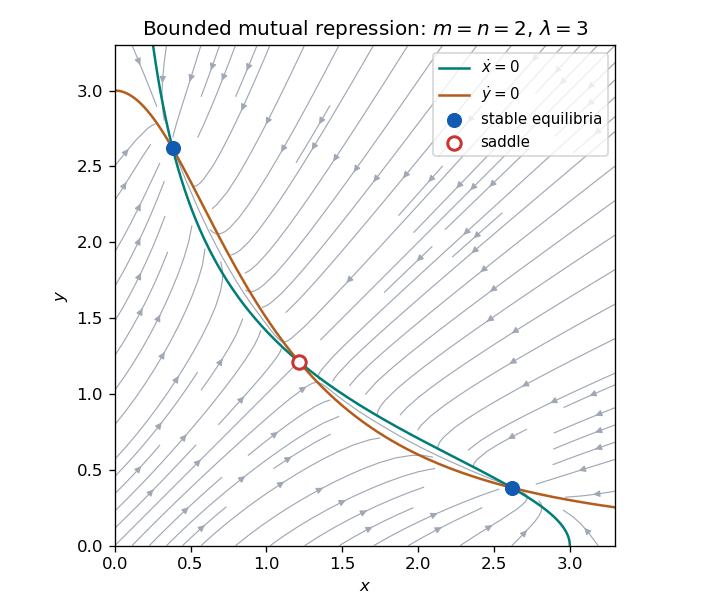
Nullclines, flow directions and two stable equilibria separated by a saddle in a bounded mutual-repression model
. Details. 
Past exam of the mathematics course of the University of Cambridge 2005 ii Paper 1 38A b Solution by Codex 0 Created 2026-09-24 Updated 2026-10-14
Codex 0 Created 2026-09-24 Updated 2026-10-14For the Fourier mode , substitution givesThe denominator is never zero for real , and numerator and denominator are complex conjugates, so . Parseval's identity therefore makes each step norm-preserving on square-summable grid data. The method is von Neumann stable for every , with no upper Courant restriction. It is an implicit nondissipative scheme; unconditional stability does not remove phase error or guarantee accuracy at a large time step.
Past exam of the mathematics course of the University of Cambridge 2005 ii Paper 1 38A a Solution by Codex 0 Created 2026-09-24 Updated 2026-10-14
Codex 0 Created 2026-09-24 Updated 2026-10-14Write , , and . The scheme is the trapezoidal time rule with a centered spatial derivative:Insert a smooth exact solution of . Taylor expansion of the unnormalized one-step residual givesAll repeated time derivatives equal the corresponding spatial derivatives. The first two orders cancel, leavingThus the one-step local error is at fixed Courant number. If “local truncation error” is instead defined after division of the residual by , its order is ; these are two different normalizations of the same second-order method.
Past exam of the mathematics course of the University of Cambridge 2005 ii Paper 1 36E ii Solution by Codex 0 Created 2026-09-24 Updated 2026-10-14
Codex 0 Created 2026-09-24 Updated 2026-10-14For , while . Thus the first harmonic mode dominates the particular term, and the remaining modes are higher order. Its coefficient is positive. The particular solution alone can be negative here and cannot describe the physical leading flow. Once , and the leading velocity gradient behaves as , singular at the corner although the velocity itself tends to zero.
Past exam of the mathematics course of the University of Cambridge 2005 ii Paper 1 31D c Solution by Codex 0 Created 2026-09-24 Updated 2026-10-14
Codex 0 Created 2026-09-24 Updated 2026-10-14With , the additive jump is , analytic inside the contour. Its Cauchy integral has and . Therefore , , andThe moment is indeed , as required. The principal-value Cauchy sum is , and the original left side becomes . Thus the recovered function satisfies both the equation and the self-consistency condition, and the homogeneous negative-index argument proves uniqueness.
Past exam of the mathematics course of the University of Cambridge 2005 ii Paper 1 31D b Solution by Codex 0 Created 2026-09-24 Updated 2026-10-14
Codex 0 Created 2026-09-24 Updated 2026-10-14The jump coefficient has one enclosed pole at zero and no enclosed zeros, because are outside. Its winding index is therefore . A homogeneous canonical pair isEach is analytic and nonvanishing in its required finite domain; the exterior growth encodes the negative index. Dividing the unknown by these factors gives an additive jumpThe Cauchy-integral solution for normally has an exterior coefficient . Since must decay, this coefficient must vanish. Thus the solvability condition is . Its only enclosed pole is zero, with residue , soThese are the negative-index scalar Riemann-Hilbert moment conditions for index minus one. There is no arbitrary polynomial addition: an entire addition respecting is zero by Liouville's theorem.
Past exam of the mathematics course of the University of Cambridge 2005 ii Paper 1 31D a Solution by Codex 0 Created 2026-09-24 Updated 2026-10-14
Codex 0 Created 2026-09-24 Updated 2026-10-14Let , with interior and exterior boundary values . The Sokhotski–Plemelj formula gives and . Write for the nonlocal scalar moment. Substitution into the integral equation yieldsThus the associated scalar Riemann-Hilbert problem isThe functions are analytic in their respective interior/exterior domains, and must ultimately equal the moment of the recovered jump; it is not an independently specified free constant.
Past exam of the mathematics course of the University of Cambridge 2005 ii Paper 1 26I b Solution by Codex 0 Created 2026-09-24 Updated 2026-10-14
Codex 0 Created 2026-09-24 Updated 2026-10-14With two offspring always, the backward equation becomes . Separation and the initial value giveThus is geometric on the positive integers, andThis is a Yule process shifted down by one. It is not an inhomogeneous Poisson process. Given , its instantaneous jump rate is , a state-dependent random rate rather than a deterministic function of time. Also whereas , unequal to the mean for . Its mean arrival intensity does not turn its dependent increments and geometric marginals into Poisson ones.
Past exam of the mathematics course of the University of Cambridge 2005 ii Paper 1 26I a Solution by Codex 0 Created 2026-09-24 Updated 2026-10-14
Codex 0 Created 2026-09-24 Updated 2026-10-14Let , with finite offspring mean . Conditioning on the original cell's first exponential lifetime givesEach of its offspring starts an independent copy of the process, which explains the factor . Changing to and differentiating yields , . HenceFinite-mean truncation and this integral bound justify finite expectations and exclude explosion in finite time; it is not necessary to assume a bounded offspring count.
For the probability generating function, let . Independence of offspring populations gives the conditional generating function at a first division time. Thusand differentiation of the changed-variable integral provesFor , the integrand is bounded, so this generating-function argument has the needed convergence even without higher offspring moments.
Past exam of the mathematics course of the University of Cambridge 2005 ii Paper 1 24H iii Solution by Codex 0 Created 2026-09-24 Updated 2026-10-14
Codex 0 Created 2026-09-24 Updated 2026-10-14Regard the space of real matrices as , and use the smooth determinant map. For invertible , factor . Expanding the determinant to first order givessince the linear coefficient of is the sum of the diagonal entries of . At every with determinant one, taking makes this derivative . Thus one is a regular value, and part (ii) makes a submanifold of dimension .
Its tangent space is the kernel of this differential. At the identity,Indeed tangent derivatives of curves with constant determinant lie in that kernel, and the local regular-value coordinates show every kernel vector is tangent to the level set.
Past exam of the mathematics course of the University of Cambridge 2005 ii Paper 1 24H ii Solution by Codex 0 Created 2026-09-24 Updated 2026-10-14
Codex 0 Created 2026-09-24 Updated 2026-10-14Let , , and . In coordinate charts centered at and , write the map as . Surjectivity of its derivative gives an invertible minor; reorder the domain coordinates so it is the first one. The maphas invertible derivative at the point. By the inverse function theorem, it is a local coordinate change. In these coordinates the fiber is simply the set whose first coordinates are zero, so it is locally a coordinate plane of dimension . These charts are inherited from , provingIf the fiber is empty, it is the empty submanifold under the usual convention. The no-boundary assumptions avoid any extra boundary conditions in this local model.
There are unlisted articles, also show them or only show them.