A deterministic finite automaton has exactly one automaton transition for every automaton state and input symbol. Formally, a DFA is a tuple : is a nonempty finite set of automaton states, a finite alphabet, a function, the initial automaton state, and the accepting automaton states. Its unique path on a word accepts if it ends in after consuming the entire input. Visiting earlier does not suffice.
For a concrete binary divisibility automaton, recognize the words whose values in the binary numeral system are divisible by three. Choose , , , and . Each automaton state names the congruence class of the integer read so far. Appending a binary digit changes its value to , so the automaton transition isThe modular arithmetic therefore needs only three automaton states, whatever the input length. The full function is , , , , , and .
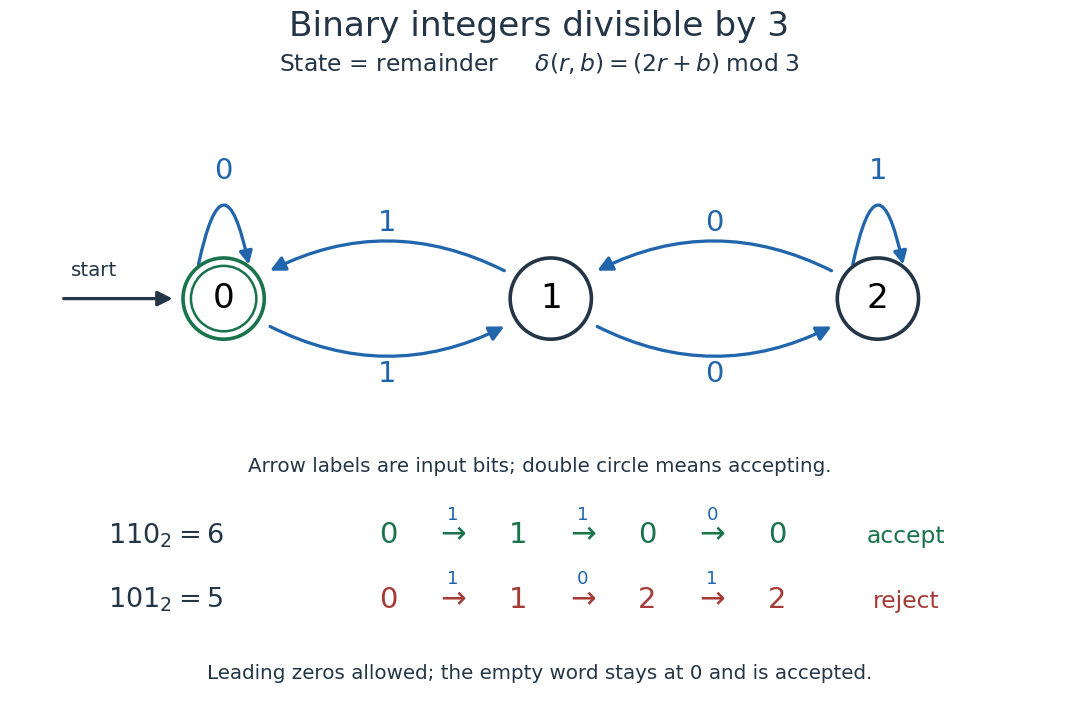
A three-state DFA for binary digits representing integers divisible by three, with accepted and rejected traces
. Details. 
For , the successive automaton states are , so the word is accepted. For , they are , so it is rejected. Leading zeros are allowed: they leave the initial automaton state unchanged. We explicitly assign value zero to the empty word, which is accepted because the initial automaton state is accepting. This is a convention for a formal language, rather than a claim that ordinary written numerals include a blank numeral.
The generator checks every word of up to eight binary digits, comparing the final automaton state with the integer value modulo three. Each length includes all words, preserving leading zeros as distinct inputs:
All 511 checks agree. They are useful for catching a reversed arrow or mistaken label, but the reason the DFA works at every length is its invariant: after reading any word of value , its automaton state is . The update preserves that statement by mathematical induction. Through the extended transition function of a deterministic finite automaton, this becomes .
For some , every sufficiently long in a context-free language has with , , and in the language for all .
A regular expression is built from alphabet symbols, the empty language and the empty word using finite union, concatenation and Kleene star.
For a damped linear oscillator driven periodically, the steady-state response is the periodic particular solution left after homogeneous transients decay.
A normal force is a contact force perpendicular to the constraining surface. It supplies support without being identical to gravitational weight: its magnitude depends on the other forces and the body's acceleration. For a body at rest on a horizontal scale with no other vertical forces, it equals . A freely falling body has no supporting normal force, despite its nonzero gravitational weight; this distinction defines the scale's apparent weight.
In the pair-interaction model of Newtonian mechanics, two bodies exert equal and opposite forces on each other:Both vectors are expressed in the same inertial frame at the same time. The subscripts name the agent and the recipient: acts on , and acts on . These are forces on different bodies, so they cannot cancel in the net force on either body. Newton's second law still uses all the forces on the particular body whose acceleration is sought. Identifying this third-law interaction pair does not require the bodies to be isolated: additional external forces can act at the same time.
The distinction makes Newton's third law useful both for drawing a free-body diagram and for deriving momentum conservation. A body-by-body calculation retains one member of each third-law interaction pair; a calculation for a collection containing both bodies cancels that pair in the total momentum balance. Equal interaction forces consequently coexist with nonzero, generally unequal accelerations.
Isaac Newton stated the equality and opposition of mutual actions in Law III of his 1687 Philosophiae Naturalis Principia Mathematica. The explanation distinguishes equal opposite changes of momentum from changes of velocity, which are inversely proportional to the bodies' masses when other influences are absent. Corollary III then explains why mutual interactions preserve the signed total momentum. The equations here are modern notation for that distinction. [ref]
Axiomata sive leges motus. Isaac Newton, Philosophiae Naturalis Principia Mathematica (1687), Axiomata sive leges motus, printed p. 13, Lex III and its explanation; pp. 16–17, Corollarium III
The instantaneous body-pair equation has a scope: use it for the mechanical interactions assumed by this Newtonian mechanics model. In electromagnetism, bodies can exchange momentum with an electromagnetic field; their instantaneous mutual forces need not sum to zero. Momentum conservation then accounts for electromagnetic field momentum as well as matter, and for momentum crossing the chosen boundary. This complication occurs in classical electromagnetism, without invoking quantum mechanics.[ref]
In an inertial frame, a point mass of constant mass obeysThe net force is the sum of all forces acting on that body; momentum, velocity and acceleration refer to the same reference frame. A force changes velocity, rather than sustaining it: zero net force implies constant velocity, including a nonzero one. Doubling the net force at fixed mass doubles acceleration; doubling mass at fixed net force halves it. [ref]
https://ocw.mit.edu/courses/8-01sc-classical-mechanics-fall-2016/mit8_01scs22_chapter7.pdf. MIT mechanics, Chapter 7, section 7.3
For example, an otherwise balanced block of mass receives a constant horizontal net force for . Its acceleration is , so its velocity changes by . Equivalently, the impulse is , and . Starting from rest, its displacement during the pulse is . After the pulse, zero net force leaves it moving at constant velocity.
Applying the law therefore requires both a specification of the net force and initial conditions. In the harmonic oscillator example, the force is , so Newton's second law becomes a differential equation for position. In an accelerating reference frame, the measured relative acceleration includes a contribution from the frame's own motion; the equation of motion in a rotating frame illustrates the extra terms required.
Constant mass is essential to the displayed form. A variable-mass system exchanging matter also exchanges momentum; its balance includes the entering or leaving matter's velocity. Simply differentiating and equating it to external force on that open body can omit this flux. The existing variable-mass system equation specifies the needed correction.
In the 1687 Principia, Newton's second law was stated in terms of change of motion proportional to impressed force, directed along that force. Its original statement is verbal; the derivative equation above is modern notation. [ref]
Axiomata sive leges motus. Philosophiae Naturalis Principia Mathematica by Isaac Newton; Newton, Axiomata sive leges motus (1687), Lex II
Bright standing soliton of the focusing nonlinear Schrodinger equation by  Codex 0 Created 2026-09-24 Updated 2026-09-24
Codex 0 Created 2026-09-24 Updated 2026-09-24For a planar periodic orbit of period , its nontrivial Floquet multiplier isThe orbit is asymptotically stable when the integral is negative and unstable when it is positive.
A contraction mapping on a nonempty complete metric space has exactly one fixed point , and the sequence converges to from every . The same constant must satisfy for all . The statement applies to metric spaces, including closed subsets of a Banach space; neither linearity nor a vector space structure is required.[ref]
https://maths.dur.ac.uk/users/norbert.peyerimhoff/analysis0708/dirknotes.pdf. Dirk Schütz, Analysis III/IV, page 13: contraction mapping theorem
The force of the result is that existence, uniqueness, and a practical approximation procedure arrive together. Repeated application produces corrections bounded by a geometric series, hence a Cauchy sequence; completeness supplies its limit. The Lipschitz continuity of makes that limit a fixed point. Two different fixed points would have their positive distance multiplied by at most while remaining unchanged, which is impossible.
Every monotone self-map of a complete lattice has a complete lattice of fixed points. Its least fixed point is the meet of its prefixed points, and its greatest fixed point is the join of its postfixed points.
Let be a compact continuous self-map of a Banach space. If the set of solutions of for is bounded, then has a fixed point. The theorem converts a priori estimates for a homotopy of equations into existence.
An imaginary-time-ordered correlation function orders operators along the Euclidean thermal circle. Bosonic correlators are periodic with period .
For a bosonic operator , the retarded Green function is . Causality makes its Fourier transform analytic in the upper half frequency plane.
The nonzero elements of every finite field form a cyclic group. For a field with elements, combine elements realizing each prime-power factor of the group exponent to obtain an element of exponent order; the root bound for then forces that order to be .
Primordial non-Gaussianity is any departure of the primordial perturbations from Gaussian random fields. Cubic interactions generate a nonzero three-point correlation function at leading order.
This is non-Gaussianity of primordial cosmological perturbations rather than non-Gaussian statistics of an arbitrary physical measurement.
A scalar theory has Lagrangian density depending on the field and . It includes canonical scalar theory and models with noncanonical kinetic interactions.
A k-essence model uses noncanonical kinetic terms for cosmological acceleration; a general P(X, phi) scalar field theory need not have that application.
There are unlisted articles, also show them or only show them.