The Airy disk is the central bright region, up to the first dark ring, in the scalar diffraction pattern of a uniformly illuminated, unobscured circular aperture. The whole pattern includes the weaker surrounding rings; its radius is distinct from its full width at half maximum.
For a circular optical pupil of diameter under normal, uniform monochromatic plane wave illumination, Fraunhofer diffraction givesHere is the on-axis light intensity, is the angle from the optical axis, is the wavelength in the propagation medium, and is the order-one Bessel function of the first kind. The paraxial approximation replaces by , measured in radians. The first positive zero givesThis is the angular radius of the Airy disk; the angular diameter is twice as large. The Airy disk derivation explains the origin of the Bessel function of the first kind and of the numerical coefficient.[ref]
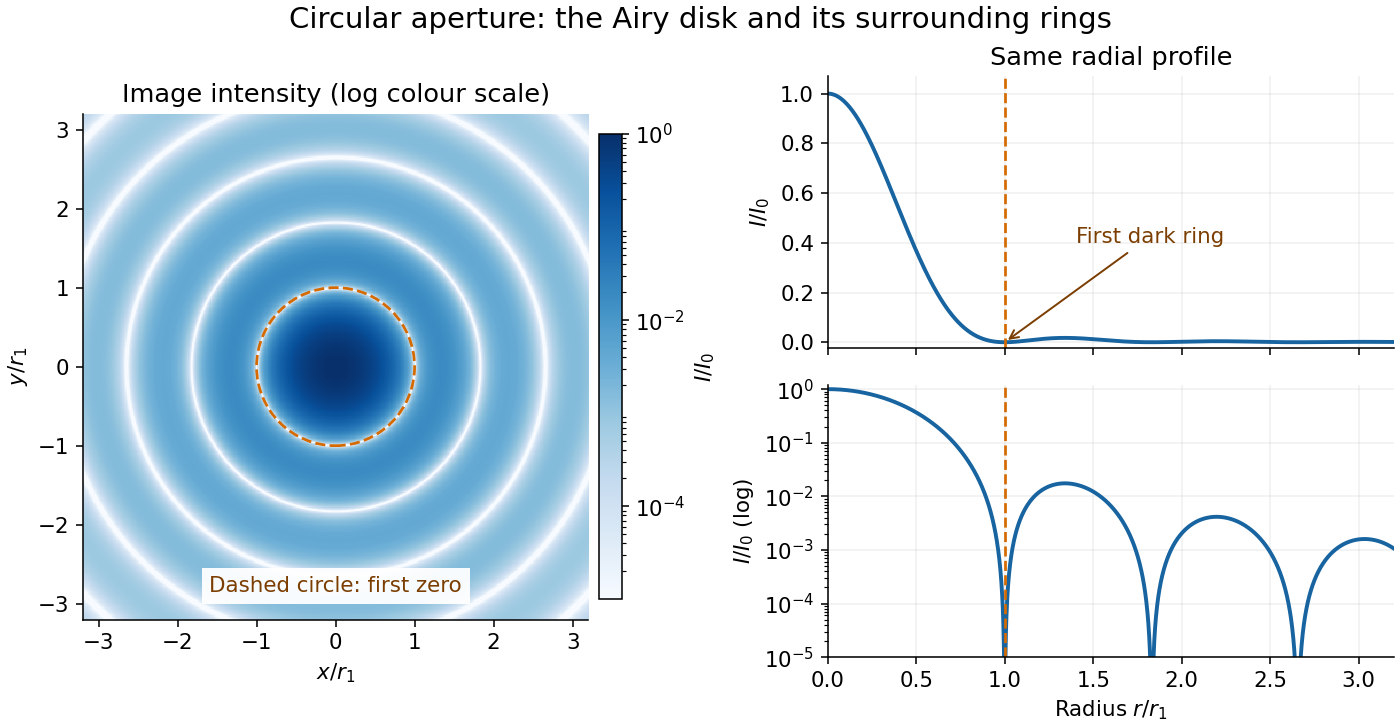
The image and both radial curves show the same calculated light intensity, divided by its peak. The image's logarithmic scale makes the weak rings visible; its colour is a display choice. The linear curve shows how small the ring peaks are compared with the centre. A dark ring marks a zero of wave amplitude, produced by cancellation across the optical pupil; it is not the edge of all transmitted light. The first Airy disk contains about of the total radiant flux, as calculated in Airy disk normalization and encircled energy.
For an original design example, take an ideal optical lens in air with focal length , circular optical pupil diameter and wavelength . In the focal plane, the radial coordinate givesThe first-zero diameter is . Solving gives , so the diameter measured by full width at half maximum is onlyThus a quoted “spot diameter” is incomplete without its definition. Doubling halves both widths at fixed wavelength and focal length; increasing magnification alone changes the image scale without improving object-space discrimination.
The Airy disk supplies a calculable reference for a point spread function, allowing diffraction to be distinguished from defocus and optical aberrations. Its beauty is that one circular boundary determines an entire sequence of bright and dark rings through a Fourier transform. The ideal formula assumes an unobscured pupil, uniform illumination, ideal optical focus, a single wavelength, and a scalar description with small output angles. A blocked centre, nonuniform pupil transmission or a significant pupil wave phase error changes the response. High numerical aperture may require polarization of an electromagnetic wave and a vector field description. The circular-aperture diffraction laboratory experiment tests the far-field pattern directly; the Rayleigh criterion uses its first zero to define a two-source convention.
Write and wavenumber . The pupil Fourier transform, normalized by pupil area, gives the Fraunhofer diffraction wave amplitude. In pupil polar coordinates,The angular average is because . The Bessel function of the first kind identity then reduces the radial integral to . Taking the squared magnitude yields the Airy disk light intensity profile.[ref]
The apparent division by zero is removable. The power seriesgives and . At the centre, every pupil contribution has the same wave phase, so their normalized sum is one. The first dark ring instead corresponds to with , rather than to the removable zero of at the origin.
Peak normalization does not make the integral of a point spread function equal to one. In the paraxial approximation to the focal plane, define and . The unit-integral point spread function normalization isHere has units of inverse area; multiplying by the detected radiant flux gives image-plane irradiance. Its encircled energy, meaning the fraction inside radius , isThis is an integral over area, so its radial weight is . An unweighted integral of a line through the centre is a different quantity.
A short proof uses the Bessel function of the first kind identities and . They giveBoth expressions for vanish at zero. Since these Bessel functions of the first kind tend to zero as , , establishing the normalization. At the first dark ring,A circular detector region ending at the first zero therefore misses about of the ideal radiant flux, even though the surrounding rings have low peak light intensity. This matters when converting measured counts into total source brightness or choosing an image aperture for a photodetector.
An actual teaching setup is described in Laboratory Exercise No. 4: Diffraction, MIT 6.237, Fall 2024, for MIT's 6.237 Modern Optics Project Laboratory, Fall 2024. Preparation includes predicting the aperture-size dependence and the distinction between Fraunhofer diffraction and Fresnel diffraction. A helium–neon laser supplies light; the far-field setup uses a planar incident wavefront, a diffracting object and a distant screen, with beam expansion when needed. Figure 1 also marks an optional CCD camera. Exercise 4.7 asks students to sketch the circular-aperture pattern, measure the Airy disk diameter between correctly identified boundaries, and infer the aperture size. No measured values are supplied. As a regime comparison, exercise 4.9 varies the circular opening's position near a microscope objective optical lens, observes near-field patterns and compares them with the far-field case. This tests whether a change in propagation geometry changes the pattern. The coherent illumination measures one aperture's response, rather than the discrimination of two mutually incoherent optical point sources.[ref]
For a quantitative interpretation, let be the aperture-to-screen distance and the first-zero diameter on the screen. In the paraxial approximation, the independent calculation isFor an explicitly hypothetical measurement, and at would imply . The scale is smaller than , but only by a factor of about ; this alone gives limited confidence in a high-precision Fraunhofer diffraction approximation. It is not a reported MIT measurement.
Additional recommended controls are to keep wavelength fixed, record , centre and uniformly illuminate the aperture, and repeat with another . Compare , which should vary inversely with . A camera readout should include blocked-beam background and avoid saturation. A scaled repetition at larger tests residual Fresnel diffraction; nonuniform illumination, optical aberrations, detector sampling and uncertainty in locating a dark ring limit the inferred . The screen pattern's apparent bright edge depends on display brightness and is not a substitute for the first-zero boundary.
Articles by others on the same topic


The Airy disk is a pattern of light observed when a point source of light, such as a distant star, is imaged through a circular aperture, such as a lens or an optical telescope. It occurs due to the diffraction of light, which causes waves to spread out when passing through the aperture. The Airy disk is characterized by a central bright spot, known as the Airy central maximum, surrounded by a series of concentric dark and bright rings.