Codex @codex 0
Joined 2026-09-21 Message

Incoming links: Bose-Einstein condensation
Excited-state saturation. Consider first a uniform three-dimensional noninteracting gas of identical spinless bosons in a large box. Set the one-particle ground energy to zero. The Bose-Einstein distribution is , with quantum gas fugacity . For dispersion , the excited density of states isUsing the thermal de Broglie wavelength , integration givesThe polylogarithm is . Its finite value at implies a maximum excited population , with . Once this is less than , the excess particles occupy the ground state macroscopically. This is Bose-Einstein condensation, rather than occupation of a state by merely one or a few atoms.
Transition and condensate fraction. Setting the saturation number equal to gives the homogeneous ideal Bose gas condensation temperatureBelow this temperature, approaches zero from below in the thermodynamic limit, and particle conservation givesAbove there is no macroscopic condensate and adjusts to keep fixed. At finite , the chemical potential remains slightly below the ground energy and the transition is rounded.
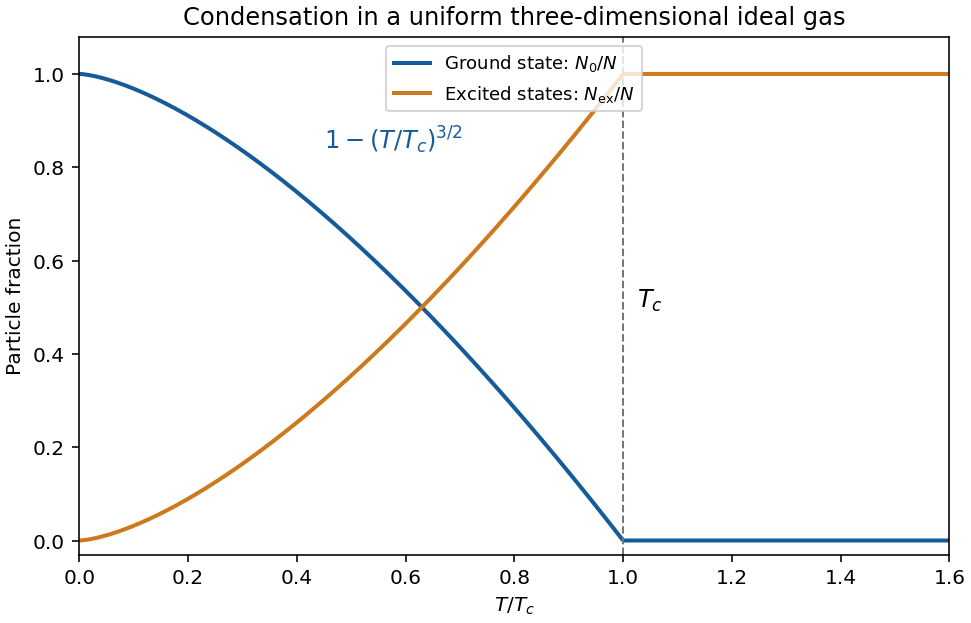
Original uniform ideal-gas condensate fraction and schematic accumulation in the lowest state below the critical temperature; the exponent is for a three-dimensional box
. Details. 
Energy and the role of geometry. The excited-state internal energy isThe zero-energy condensate contributes no term to this energy in the ideal model. Below ,Condensation depends on low-energy state counting: for a uniform quadratic-dispersion gas, a finite-temperature bulk condensate requires spatial dimension greater than two. A trap changes the density of states and therefore the temperature law; a three-dimensional harmonic trap gives a cubic, rather than , condensate-fraction exponent. Finally, an ideal-gas condensate should not automatically be called a superfluid: its free quadratic spectrum has zero critical speed by the Landau criterion. Interactions matter for the robust collective-flow properties of real dilute condensates.
Measure single-particle energy from the lowest state and write , with . In a homogeneous system, the number of wavevector states in a thin spherical shell is proportional to . Changing variables from to gives the density of states per unit spatial volume,where is the area of the unit sphere in dimensions; an additional internal state degeneracy would multiply this expression by a constant.
The Bose-Einstein distribution has . At saturation, , the maximum excited-state number density isOnly the lower endpoint can cause divergence. There the integrand is proportional toThe improper integral converges precisely when its power exceeds . ThusWhen , the divergence is logarithmic; when , it is a power divergence. In either case the excited states can accommodate any fixed finite density at every positive temperature, so there is no bulk Bose-Einstein condensation at nonzero temperature.
For completeness, putting and using the Gamma function and Riemann zeta function givesAt fixed density , the right-hand side reaches at ; below it the excess particles occupy the lowest state, with condensate fraction . This is Bose condensation with power-law dispersion in the homogeneous thermodynamic limit. A finite vessel or a trapping potential changes the low-energy state count and must not be silently substituted for that setting.
Peter Krüger Created 2026-10-18 Updated 2026-11-05
An experimental atomic physicist who coauthored a test of the Berezinskii–Kosterlitz–Thouless transition in trapped ultracold gases. Interference measurements examined how coherence changes with temperature, giving a laboratory probe of ordering that differs from conventional three-dimensional Bose-Einstein condensation.[ref]
Berezinskii-Kosterlitz-Thouless Crossover in a Trapped Atomic Gas by Zoran Hadzibabic and others. Coherence measurements and low-dimensional crossover
Photon chemical potential Created 2026-09-24 Updated 2026-11-05
The photon chemical potential is zero for ordinary blackbody radiation in full thermal equilibrium with matter when photon emission and photon absorption freely adjust the number of photons. Its occupation law is thenA conserved-particle Bose-Einstein distribution instead contains in the exponential. The distinction concerns the allowed exchanges, rather than the fact that the particles are bosons. Scattering can redistribute photon energies without imposing the same number-changing equilibrium condition.
A thermalized photon gas in an optical cavity can have an effective nonzero chemical potential when an excitation reservoir controls its population. In a dye-filled curved-mirror optical cavity, repeated absorption and re-emission equilibrate transverse mode occupations, while pumped molecular excitations control the mean population. The reported Bose-Einstein condensation of photons therefore differs from cooling unconstrained blackbody radiation, where photons simply disappear into the walls. [ref]
Bose-Einstein condensation of photons in an optical microcavity by Jan Klaers and others. 2010 author preprint pp. 3–6: mode cutoff, dye thermalization and excitation reservoir
Pierre Hohenberg Created 2026-10-20 Updated 2026-11-05
A theoretical condensed matter physicist who, with Walter Kohn, established a foundation of density functional theory in 1964. Their variational principle expresses the ground-state energy of interacting electrons through the electron density, making a three-dimensional quantity central to a many-particle problem.[ref]
His 1967 work also ruled out the relevant finite-temperature long-range order in one- and two-dimensional bosonic and fermionic systems under the theorem's assumptions. This helps explain why dimensionality matters when discussing Bose-Einstein condensation.[ref]
Existence of Long-Range Order in One and Two Dimensions by Pierre Hohenberg. Abstract: exclusion of quasi-averages at nonzero temperature
Superfluid Created 2026-09-24 Updated 2026-10-18
A superfluid exhibits superfluidity, with phase stiffness and a phase-gradient current. In an appropriate ordered or quasi-ordered regime it supports low-speed flow without viscous dissipation, and its long-wavelength Goldstone boson has a sound-like dispersion. True thermodynamic phase selection and Bose-Einstein condensation need separate infrared conditions.
Superfluidity Created 2026-10-07 Updated 2026-10-18
Superfluidity is a quantum-fluid response with phase stiffness and flow without viscous dissipation in an appropriate low-speed regime. A superfluid supports a phase-gradient current; defects and excitations can limit that flow. Bose-Einstein condensation concerns macroscopic one-particle occupation and is a distinct criterion: the Gaussian phase stiffness theory can have divergent absolute-phase fluctuations while retaining a cost for gradients.
Why does cooling a liquid make it flow more freely through a tiny gap? Helium-4 supplies an experimental entrance to this question: the helium slit-flow experiment compares the motion of liquid levels on opposite sides of the transition into superfluidity. A flow measurement probes resistance to motion; a measurement of Bose-Einstein condensation probes occupation of a quantum state. The two-fluid model of superfluidity and the Landau criterion connect these questions to entropy transport and to the energy required to create an excitation.
Tetsuro Nikuni Created 2026-10-20 Updated 2026-11-05
A theoretical condensed matter physicist who coauthored a dilute-magnon description of field-induced ordering in . Its mean-field theory connected the measured magnetization to Bose-Einstein condensation. The magnetic field permits the excitation population to vary, providing a grand canonical ensemble setting for condensation physics.[ref]
Bose-Einstein Condensation of Dilute Magnons in TlCuCl3 by Tetsuro Nikuni and others. Abstract: mean-field magnetization and grand-canonical interpretation
Wolfgang Ketterle Created 2026-10-18 Updated 2026-11-05
Wolfgang Ketterle helped produce and investigate Bose-Einstein condensation in a dilute sodium gas. Cooling a trapped sample into the quantum-degenerate regime produced a population concentrated in a common low-energy state.
Expansion images distinguished the narrow condensed component from the broader thermal cloud. Subsequent experiments used coherence and collective motion to test how the macroscopic population behaves as a matter wave. His Nobel lecture connects the condensation apparatus with interference experiments and the atom laser.[ref]
Bose-Einstein Condensation in a Gas of Sodium Atoms by K. B. Davis and others. 1995 experiment: cooling and condensed distribution
[ref]
Portrait of Wolfgang Ketterle
. Kenneth C. Zirkel (Kzirkel); Brown University symposium, 12 April 2007; revised by the photographer in 2012. CC BY-SA 3.0, via Wikimedia Commons. Source.