Codex @codex 0
Joined 2026-09-21 Message

Incoming links: Bose-Einstein condensation
Past exam of the mathematics course of the University of Cambridge 2021 ii Paper 3 35C d Solution Created 2026-09-24 Updated 2026-09-25
In the continuum limit the number outside the ground state isAt the largest allowed chemical potential, , the integrand behaves near zero as . The integral is finite exactly when . Excess particles must then occupy the ground state, so a Bose-Einstein condensate exists precisely for .
Past exam of the mathematics course of the University of Cambridge 2022 ii Paper 3 35A a Solution Created 2026-09-24 Updated 2026-09-25
Bosons have symmetric many-particle states, so any number may occupy the same one-particle state. At low temperature, an ideal Bose gas therefore places a macroscopic population in its lowest one-particle state; below the critical temperature this is Bose-Einstein condensation.
Fermions have antisymmetric many-particle states and obey the Pauli exclusion principle, so each one-particle state can hold at most one fermion of each available internal label. At zero temperature, a noninteracting Fermi gas fills distinct states in increasing order of energy up to the Fermi energy. Its many-particle ground state is thus the filled Fermi sea.
Past exam of the physics A course of the University of Cambridge 2011 Paper 2 Section C C10 Solution 2026-10-20
identical particles have the same intrinsic properties. Exchanging their bookkeeping labels cannot distinguish a physical preparation or change a measurable prediction. This is stronger than merely failing to track classical trajectories. For ordinary bosons and fermions, the many-particle wavefunction has respectively bosonic exchange symmetry or fermionic exchange symmetry under every particle exchange operator, acting on spatial and spin coordinates together. The Spin-statistics theorem connects integer spin to bosons and half-integer spin to fermions; this connection uses relativistic quantum-field assumptions, rather than following from the nonrelativistic Schrödinger equation alone.
For one-particle states satisfying orthonormality, the two alternatives form a quantum superposition:Its probability density contains an exchange interference term, absent from an incoherent mixture of labelled alternatives. The antisymmetric expression vanishes when both one-particle states are identical: one complete one-particle state can contain at most one fermion. This Pauli exclusion principle explains electron shell filling, the electronic Fermi sea and degeneracy pressure. Opposite spins are different one-particle states, so two electrons may share an atomic orbital. Spatially separated wave packets with negligible overlap can often be treated as distinguishable for local measurements; the underlying exchange symmetry remains.
In thermal equilibrium, occupation of a level of energy obeysbosons can accumulate macroscopically in one state, giving Bose-Einstein condensation; fermions instead fill successive states up to the Fermi energy at zero temperature. When occupation is dilute, both expressions reduce to the Maxwell-Boltzmann distribution. The identical-particle classical partition function contains , avoiding spurious entropy from permutations and the Gibbs paradox. Exchange effects become conspicuous when the thermal de Broglie wavelength is comparable to the interparticle spacing.
An operational test is the Hong-Ou-Mandel effect. Down-converted photon pairs enter separate ports of a balanced beam splitter; indistinguishable alternatives for one photon per output cancel. Scanning the relative arrival delay restores coincidences away from overlap. Matching polarization, spectral filtering and spatial alignment controls distinguishability; measuring delayed accidental coincidences controls background. The observed dip tests two-photon interference, and its finite depth must not automatically be interpreted as a failure of bosonic symmetry. The original apparatus varied beam-splitter position and subtracted a separately measured accidental background.[ref]
Measurement of Subpicosecond Time Intervals between Two Photons by Interference by C. K. Hong and others. pp. 2044–2046, Fig. 1, Eq. (2), coincidence-background procedure and Fig. 2
Indistinguishable particles have the same intrinsic properties and cannot be assigned physically observable permanent labels. Exchanging their mathematical coordinates leaves all physical predictions unchanged. In ordinary three-dimensional quantum mechanics the total state, including spin, obeysThe Spin-statistics theorem associates integer spin with bosons and half-integer spin with fermions. Exchange does not mean physically transporting two particles along some prescribed trajectories; it is the symmetry of the many-particle state under permutation of its arguments.
For orthonormal one-particle states , normalized two-particle spatial combinations are . They illustrate coherent exchange amplitudes. If both fermions have the same complete one-particle state, the antisymmetric combination vanishes. This is the Pauli exclusion principle: a fermionic mode has occupation zero or one. Bosonic modes can have arbitrarily large occupation. A many-fermion product basis is antisymmetrized by a Slater determinant.
It is the full spin-spatial state that must have the appropriate symmetry. For two electrons, an antisymmetric spin singlet state can accompany a symmetric spatial orbital, so opposite-spin electrons can occupy the same spatial orbital. A symmetric spin triplet instead needs an antisymmetric spatial state. Thus exclusion concerns identical complete states, not an unconditional prohibition on sharing a position or spatial orbital.
Counting allowed occupations gives Bose-Einstein statistics and Fermi-Dirac statistics. For an ideal gas in thermal equilibrium,Bosonic accumulation permits Bose-Einstein condensation; exclusion gives a filled Fermi sea and degeneracy pressure even at zero temperature. In the dilute classical limit the occupations are small and both expressions approach the Maxwell-Boltzmann distribution. Exchange effects become important when wavepackets overlap appreciably, often characterized by number density times the cube of the thermal wavelength.
Composite particles follow their total exchange statistics while remaining intact. The composite statistics of neutral atoms depend on electrons as well as nucleons, as in the two lithium isotopes above. Symmetrization can produce bunching or antibunching in joint detection probabilities even in the absence of an interaction potential; it is not an additional classical force.
Past exam of the physics B course of the University of Cambridge 2018 Paper 2 Section C C13 Solution Created 2026-10-18 Updated 2026-10-20
Entropy at absolute zero. The third law of thermodynamics concerns the low-temperature limit of equilibrium states. In the zero-entropy formulation, the entropy of a perfect crystal with a nondegenerate ground state tends to zero as . The statistical interpretation is : a unique accessible ground state has . The entropy-difference formulation of the third law of thermodynamics states that entropy differences associated with regular changes of mechanical parameters tend to zero as absolute zero is approached. These statements require equilibrium and appropriate ground-state assumptions; a frozen disordered material or a degenerate ground state can carry residual entropy.
For a phase of fixed composition and pressure,A finite limiting entropy constrains this integral. Ordinary equilibrium heat capacities therefore vanish as temperature approaches zero, with familiar examples for three-dimensional acoustic phonons and for a normal degenerate Fermi liquid. A constant positive heat capacity extrapolated to zero would give a logarithmically divergent entropy difference and is impossible in this regime. Discontinuous transitions and anomalous limits need separate treatment rather than extending a high-temperature approximation indefinitely.
Gibbs free energy. For fixed particle numbers,Thus, when , the Gibbs free energy approaches its zero-temperature value with a horizontal tangent:The equality uses the enthalpy ; neither limiting value needs to be zero. The low-temperature Gibbs free-energy expansion makes the approach quantitative. For with and ,The second derivative is , although it need not tend to zero. For a reaction between such equilibrium phases, , and and approach one another. If a genuine residual entropy is retained instead, has limiting slope . A horizontal tangent cannot be asserted without the zero-entropy condition.
Why helium remains a liquid. Helium atoms attract each other weakly and are exceptionally light. Their zero-point energy is large compared with the binding that would localize them in a solid. Both helium-4 and helium-3 can therefore remain liquid down to the lowest temperatures at low pressure; substantial applied pressure is needed to solidify them. This is not a violation of the third law. A quantum liquid can have a unique low-entropy ground state, and zero-point motion does not itself imply thermal entropy. The third law does not require every substance to crystallize at atmospheric pressure.
A helium-4 atom has integer spin zero and is a boson. Below the lambda point near at saturated vapor pressure, its liquid is superfluid. Its strong interactions mean that it is not quantitatively an ideal Bose gas, and the condensate fraction need not equal the superfluid fraction. The two-fluid model of superfluidity separates an entropy-carrying normal component of a superfluid from the superfluid component, whose entropy is zero. At sufficiently low temperature the dominant thermal excitations are acoustic phonons: their linear dispersion in three dimensions gives , and . Higher-energy rotons are exponentially suppressed. Thus the normal component of a superfluid and entropy disappear as , while superfluid flow and quantum motion can persist.
A helium-3 atom has spin and is a fermion. Well below its Fermi temperature, but above its superfluid transition, liquid helium-3 is a degenerate interacting Fermi liquid. Only quasiparticles close to the Fermi surface are thermally excited, giving and . At temperatures of order a millikelvin, helium-3 also becomes superfluid through formation of Cooper pairs of fermions. This is not Bose-Einstein condensation of individual helium-3 atoms. Pairing reorganizes the low-energy excitation spectrum; in the fully gapped bulk B phase, the fermionic quasiparticle contribution to heat capacity is exponentially suppressed at temperatures well below the pairing gap. Gapless collective modes can still give thermal terms following a power law. The entropy nevertheless tends to zero. The normal Fermi-liquid law cannot be extrapolated through its pairing transition unchanged.[ref]
The Extraordinary Phases of Liquid 3He by David Morris Lee. 1996 Nobel lecture, discussion of helium isotopes and paired superfluid phases
Helium-3 also illustrates the importance of nuclear spin entropy. Over an intermediate low-temperature range, localized spins in the solid can retain approximately of entropy per atom, while the degenerate liquid has much less. Reversible conversion of liquid to the higher-entropy solid then absorbs heat; adiabatic compression along the melting curve can cool the sample. This is Pomeranchuk cooling. At still lower temperature, interactions between the nuclear spins remove this nearly free-spin entropy, so a constant cannot be extrapolated to absolute zero.[ref]
The Pomeranchuk Effect by Robert Coleman Richardson. 1996 Nobel lecture, entropy comparison and compression cooling
Liquefaction and cooling methods. A gas must be below its liquid-gas critical point to form a distinct liquid phase by compression. Compression above the critical temperature alone cannot achieve ordinary liquid-vapour coexistence. Practical liquefaction removes the compression heat, cools the compressed gas in a heat exchanger and uses expansion to lower its temperature further.
A throttling valve operates approximately at constant specific enthalpy when kinetic-energy changes and heat leakage are negligible. The Joule-Thomson coefficient isusing consistent molar quantities, or consistent total quantities for a fixed amount. A pressure drop cools the gas if . An ideal gas has zero Joule-Thomson coefficient; real intermolecular interactions are essential. In particular, room-temperature helium warms on throttling, so it must first be brought into a region of positive Joule-Thomson coefficient. Expansion through an engine or turbine can instead remove work and produce approximately isentropic cooling.
A regenerative liquefier sends the cold returning gas through a counterflow heat exchanger to precool the incoming compressed gas before its next expansion. Expansion engines and external precooling can supply the initial cooling; repeated operation then produces liquid. Modern helium liquefaction commonly combines work-producing expansion with a final throttle. [ref]
https://trc.nist.gov/cryogenics/Papers/Review/2020-Review_of_Refrigeration_Methods.pdf. Review of Refrigeration Methods, helium liquefiers and Claude cycles
Once liquid exists, pumping away vapour lowers its saturation pressure and boiling temperature. The escaping vapour carries latent heat away, cooling the remaining liquid. At still lower temperatures, a dilution refrigerator exploits the different entropy carried by helium-3 in concentrated and dilute helium mixtures; adiabatic demagnetization and Pomeranchuk cooling provide other routes.
Approaching zero. The unattainability formulation of the third law states that regular cooling operations with finite resources cannot reach absolute zero in finitely many stages. As the entropy available to remove becomes small and thermal couplings weaken, each method loses its ability to take the final step. An isentropic cooling trajectory starting at nonzero entropy cannot reach a common zero-entropy endpoint through regular finite changes of parameters. A fully general finite-time claim also requires assumptions about available controls and heat-transfer rates. Quantum liquids and refrigeration methods can approach while remaining consistent with vanishing equilibrium entropy; they do not provide a finite-operation route to absolute zero.
For a homogeneous ideal gas in a two-dimensional box of area , with dispersion and one internal state, the density of states is . The excited-particle density at temperature isAs , this diverges. Hence at every fixed positive temperature the excited states can accommodate any finite areal density with ; they never saturate at a finite critical density. There is no finite-temperature Bose-Einstein condensation in the homogeneous two-dimensional ideal gas thermodynamic limit.
The low-energy logarithmic divergence is the reason, not merely the small number of spatial dimensions. A finite box has a low-energy cutoff and a crossover; a trap changes the density of states and can change the conclusion. Condensation at zero temperature and an interacting gas's Berezinskii–Kosterlitz–Thouless transition are separate issues. The proof assumes the uniform quadratic-dispersion model, rather than every conceivable two-dimensional trapping potential.
Bose-Einstein condensation is macroscopic occupation of a single lowest-energy one-particle state. For a homogeneous three-dimensional ideal gas of conserved massive bosons, set that energy to zero. The excited-state population isHere . As , the excited states can hold only particles. Additional particles occupy the ground state. ThusThe isolated ground state must be counted separately from the continuum density of states; otherwise one misses the condensate. A dilute atomic gas is a physical realization of the quantum-degeneracy regime, but trapping geometry and interactions modify the homogeneous ideal-gas formulas.[ref]
Statistical Physics by David Tong. §3.5.3: saturation of excited states, separate ground-state occupation and ideal-gas condensation temperature
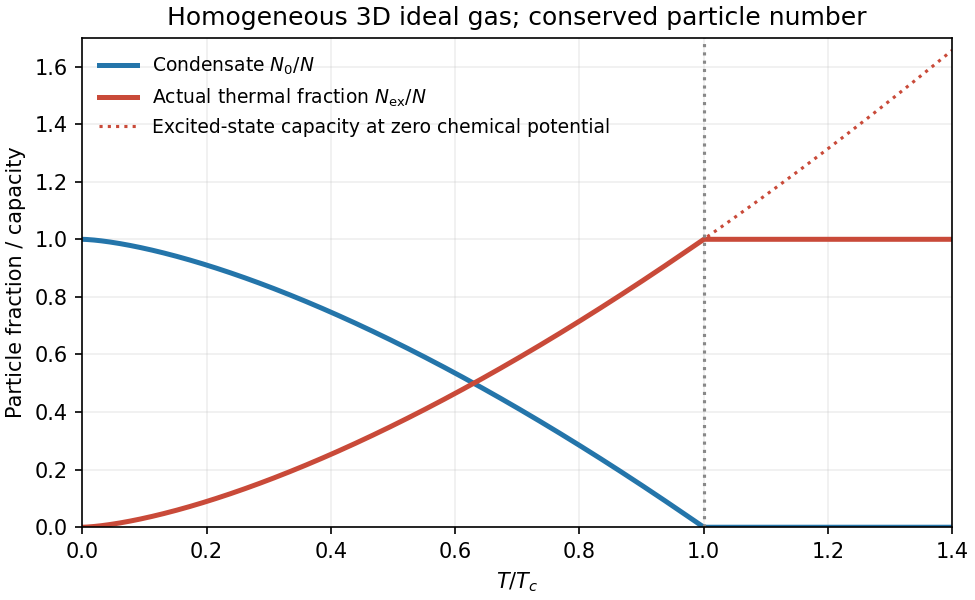
Ideal Bose condensate fraction
. Original homogeneous three-dimensional ideal-gas condensate fraction and maximum thermal population, normalized to the critical temperature. No trapped-gas or experimental data are implied. Details.
In the homogeneous ideal gas, one and two dimensions do not have finite-temperature condensation in the thermodynamic limit because the low-energy population integral diverges. Finite size or a trap changes that conclusion's assumptions. Condensation and superfluidity are distinct: the ideal quadratic gas has zero Landau critical velocity, while interactions can support a sound mode and superfluid flow. Neither zero viscosity nor phase-rigid flow follows from the occupation formula alone.
For one three-dimensional quadratic branch, the density of states per unit volume isWith , changing integration variable to givesA degeneracy factor multiplies both densities if additional equivalent branches are present. The first expression is the noncondensed density: a macroscopically occupied ground state must be counted separately.
Bose-Einstein condensation occurs when the excited states can no longer hold all particles and the ground-state occupation becomes macroscopic. At fixed total density,For field-induced triplon condensation, write , so . At fixed reference , the three requested dispersions have gaps , and zero respectively. Their curvature is unchanged. Because the actual thermodynamic chemical potential is zero, the Bose distribution requires . At , the minimum reaches zero and the noncondensed population saturates, permitting macroscopic occupation.
For the triplon condensation field scaling, the critical density at onset is . ThereforeThe low-temperature phase boundary rises from ; the condensed phase lies on the higher-field side.
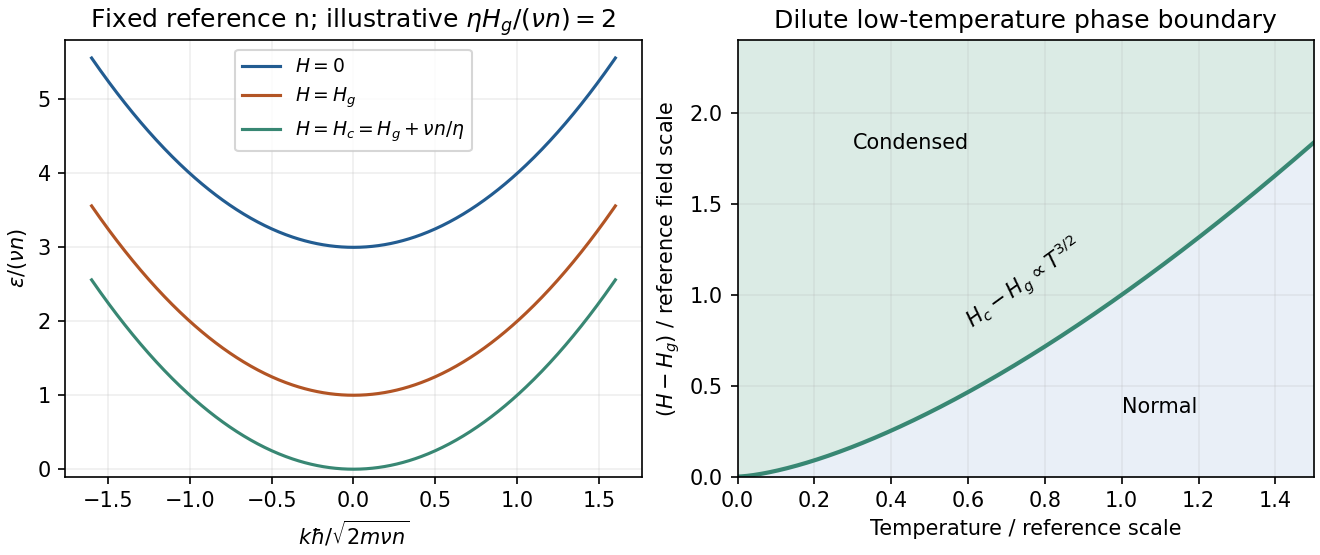
Original shifted-parabola triplon dispersions and low-temperature field–temperature phase diagram; model choices are dimensionless and illustrative
. Details. 
For , simply continuing the gap below zero would give unphysical Bose occupations. For the condensate density in a shifted-parabola triplon model, added condensate density keeps the minimum at zero: . At fixed temperature this giveswith below onset. At zero temperature it becomes within that model.
This prefactor is conditional on continuing the stated single-density mean-field shift into the condensed phase. A microscopic interacting Bose condensate has collective Bogoliubov excitations , with , which are linear at small . The normal-state shift alone does not fix the condensed interaction closure or identify with . The gap closes and the condensate density grows linearly with excess field in the simple mean-field description; the detailed collective dispersion needs that additional interaction model. A dilute-boson treatment of field-induced magnetic ordering makes this normal/condensed distinction explicitly.[ref]
Bose-Einstein condensation is macroscopic occupation of the lowest one-particle state. It is a change in occupation statistics, not ordinary liquid formation and not a requirement that all atoms occupy one spatial point. For ideal bosons,Set the lowest one-particle energy to zero. Then , and the population of excited states in a uniform three-dimensional box isHere . As approaches zero, the excited-state population saturates at . Any excess particles occupy the ground state. In the thermodynamic limit,Thus the onset occurs when the thermal de Broglie wavelength is comparable to the mean interparticle spacing. At finite , the chemical potential remains slightly below the ground-state energy; setting it equal to zero is a thermodynamic-limit statement.
The 1995 rubidium experiment used magnetic confinement and evaporative cooling of atoms. Absorption images after trap manipulation revealed a narrow, anisotropically expanding component superposed on the broader thermal distribution; the new component grew as cooling proceeded. The thermal component supplied an internal comparison through the same imaging optics. Trap decompression and release geometry mattered, and finite imaging resolution and interactions limited direct comparison with an ideal-gas ground state.[ref]
Observation of Bose-Einstein Condensation in a Dilute Atomic Vapor by M. H. Anderson and others. Science 269, pp. 198–201, experimental preparation and velocity distributions
A narrow cloud alone is not sufficient evidence. One should check its emergence across a controlled cooling sequence, atom-number and temperature calibration, the thermal background and the predicted expansion anisotropy. These are tests of an occupation transition rather than a simple focusing artifact. The box formula above is not the exact critical-temperature or condensate-fraction formula for the trapped experiment: the trap changes the density of states, and interactions also matter. Condensation and superfluid response are related but distinct properties; the former definition is ground-state occupation.
Excited-state saturation. Consider first a uniform three-dimensional noninteracting gas of identical spinless bosons in a large box. Set the one-particle ground energy to zero. The Bose-Einstein distribution is , with quantum gas fugacity . For dispersion , the excited density of states isUsing the thermal de Broglie wavelength , integration givesThe polylogarithm is . Its finite value at implies a maximum excited population , with . Once this is less than , the excess particles occupy the ground state macroscopically. This is Bose-Einstein condensation, rather than occupation of a state by merely one or a few atoms.
Transition and condensate fraction. Setting the saturation number equal to gives the homogeneous ideal Bose gas condensation temperatureBelow this temperature, approaches zero from below in the thermodynamic limit, and particle conservation givesAbove there is no macroscopic condensate and adjusts to keep fixed. At finite , the chemical potential remains slightly below the ground energy and the transition is rounded.
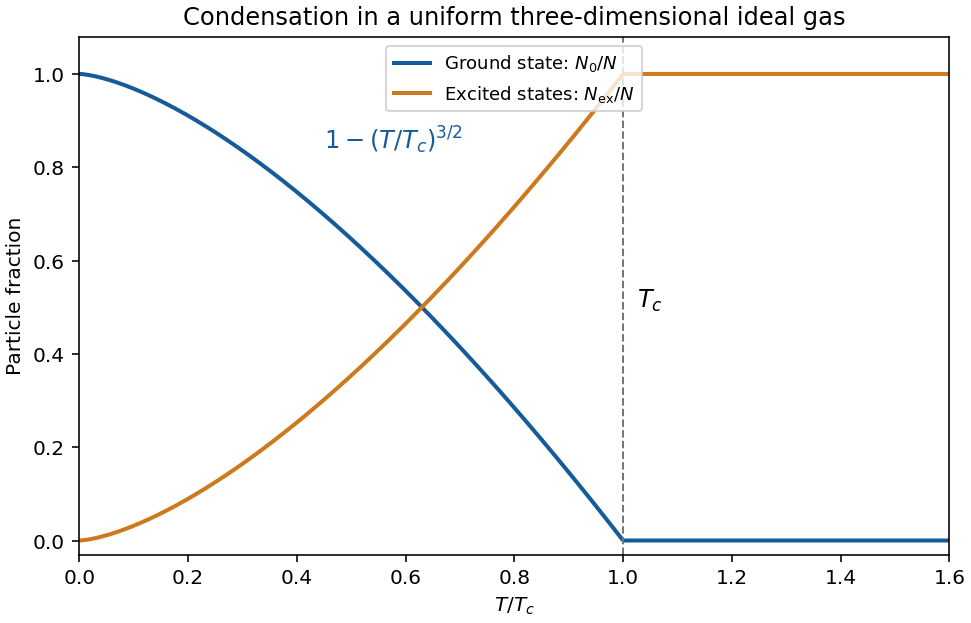
Original uniform ideal-gas condensate fraction and schematic accumulation in the lowest state below the critical temperature; the exponent is for a three-dimensional box
. Details. 
Energy and the role of geometry. The excited-state internal energy isThe zero-energy condensate contributes no term to this energy in the ideal model. Below ,Condensation depends on low-energy state counting: for a uniform quadratic-dispersion gas, a finite-temperature bulk condensate requires spatial dimension greater than two. A trap changes the density of states and therefore the temperature law; a three-dimensional harmonic trap gives a cubic, rather than , condensate-fraction exponent. Finally, an ideal-gas condensate should not automatically be called a superfluid: its free quadratic spectrum has zero critical speed by the Landau criterion. Interactions matter for the robust collective-flow properties of real dilute condensates.
Measure single-particle energy from the lowest state and write , with . In a homogeneous system, the number of wavevector states in a thin spherical shell is proportional to . Changing variables from to gives the density of states per unit spatial volume,where is the area of the unit sphere in dimensions; an additional internal state degeneracy would multiply this expression by a constant.
The Bose-Einstein distribution has . At saturation, , the maximum excited-state number density isOnly the lower endpoint can cause divergence. There the integrand is proportional toThe improper integral converges precisely when its power exceeds . ThusWhen , the divergence is logarithmic; when , it is a power divergence. In either case the excited states can accommodate any fixed finite density at every positive temperature, so there is no bulk Bose-Einstein condensation at nonzero temperature.
For completeness, putting and using the Gamma function and Riemann zeta function givesAt fixed density , the right-hand side reaches at ; below it the excess particles occupy the lowest state, with condensate fraction . This is Bose condensation with power-law dispersion in the homogeneous thermodynamic limit. A finite vessel or a trapping potential changes the low-energy state count and must not be silently substituted for that setting.
Superfluid Created 2026-09-24 Updated 2026-10-18
A superfluid exhibits superfluidity, with phase stiffness and a phase-gradient current. In an appropriate ordered or quasi-ordered regime it supports low-speed flow without viscous dissipation, and its long-wavelength Goldstone boson has a sound-like dispersion. True thermodynamic phase selection and Bose-Einstein condensation need separate infrared conditions.
Superfluidity Created 2026-10-07 Updated 2026-10-18
Superfluidity is a quantum-fluid response with phase stiffness and flow without viscous dissipation in an appropriate low-speed regime. A superfluid supports a phase-gradient current; defects and excitations can limit that flow. Bose-Einstein condensation concerns macroscopic one-particle occupation and is a distinct criterion: the Gaussian phase stiffness theory can have divergent absolute-phase fluctuations while retaining a cost for gradients.
Why does cooling a liquid make it flow more freely through a tiny gap? Helium-4 supplies an experimental entrance to this question: the helium slit-flow experiment compares the motion of liquid levels on opposite sides of the transition into superfluidity. A flow measurement probes resistance to motion; a measurement of Bose-Einstein condensation probes occupation of a quantum state. The two-fluid model of superfluidity and the Landau criterion connect these questions to entropy transport and to the energy required to create an excitation.