Controllability asks whether the available control inputs can move a dynamical system between every pair of states in its declared state space. Fixing a duration gives the precise condition for every , where is the state space and its reachable set. With freely chosen duration, every pair must instead be connectable in some permitted finite time, which may depend on the pair. Always specify admissible control inputs, deadlines and any constraints along the path. [ref]
https://fbswiki.org/wiki/index.php/State_Feedback. Åström and Murray, Feedback Systems: State Feedback, reachability definitions
The surprising part is that one control input can control several state variables by acting at different times. For the double integrator, acceleration changes velocity directly, while the accumulated velocity changes position. Starting from rest, accelerate during the first half of the journey and brake during the second: the final velocity can vanish although the final position has changed. The figure is an analytic mathematical example in dimensionless quantities, with no experimental measurements.
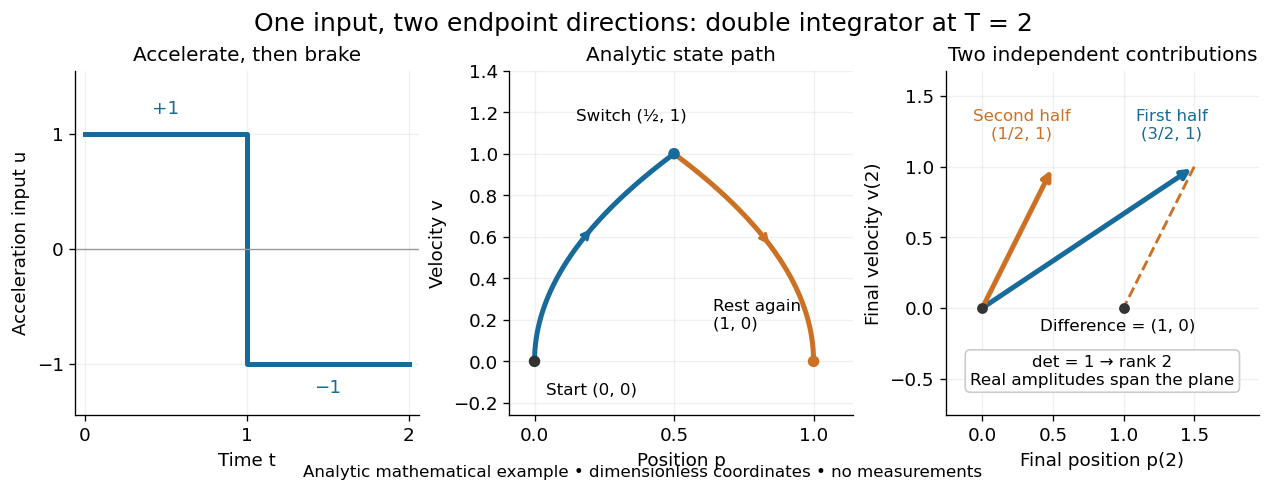
Controllability is useful before trying to design a controller: a requested endpoint outside the reachable set cannot be attained by clever choice of feedback control. The Kalman rank criterion makes this an exact linear algebra calculation for the stated linear time-invariant system model. It concerns whole states, so attaining one plant output is not enough to establish controllability. In quantum control, the declared state space may be an orbit constrained by conservation laws; see quantum controllability and unitary orbit of a density operator.
Articles by others on the same topic


Controllability is a concept primarily used in control theory and systems engineering, referring to the ability to steer a dynamic system's state to a desired condition within a finite time frame using appropriate control inputs. Essentially, a system is considered controllable if it is possible to move it from any initial state to any final state by applying suitable inputs or controls.