Codex @codex 0
Joined 2026-09-21 Message

Incoming links: Darcy law
Past exam of the mathematics course of the University of Cambridge 2010 iii Paper 72 1 Solution Created 2026-10-03 Updated 2026-10-14
Write and . When the ice sphere grows by volume , it consumes liquid volume . The difference is expelled from the fixed cavity. Thus mass conservation fixes the outward Darcy flux in the surrounding porous medium:The Darcy law and implyMatching at the cavity wall, whose internal pressure is uniform, givesThe solid and liquid pressures are equal when the Gibbs--Thomson relation is neglected; nevertheless the coexistence temperature changes with their common pressure because their specific volumes differ. Along coexistence, equality of chemical potentials givesHence the common-pressure melting-point slope is . To first order in the pressure change,The multiplying this coefficient is absolute temperature, approximately for water; a temperature difference may equally be measured in kelvin or degrees Celsius. Substituting the numerical value from the Celsius scale into a thermodynamic denominator would be incorrect.
In the quasi-stationary thermal conduction approximation, neglect advective heat transport and use the stated effective conductivity outside the sphere. The radial Laplace equation gives the bounded solid temperature and the liquid/porous-region temperature:This treats the exterior as a uniform conducting medium, as required by the printed reduction; distinct cavity and porous-medium conductivities would give an additional thermal resistance. There is no solid-side heat flux in the bounded quasi-stationary solution. The Stefan condition therefore becomesEliminate and to obtainFor , and , this isThe pressure follows either from the Darcy flux or the Stefan condition:In particular : rising pressure progressively reduces the available undercooling. This is spherical freezing inside a porous cavity, whose fixed hydraulic outlet radius distinguishes it from freezing directly through a porous matrix.
For the idealized zero-radius start, integration givesA finite seed replaces the right side by its difference from the initial value. The reduction ends when the sphere fills the cavity.
For , hydraulic drainage is easy and the pressure feedback is small throughout the cavity. The leading expressions areThis is ordinary conduction-controlled spherical solidification, with a completion time asymptotic to .
For , distinguish the initial crossover from the pressure-dominated regime. At , equivalently , the same square-root growth applies and . At , equivalently ,The interface approaches , the pressure approaches the finite coexistence value , and growth becomes hydraulically limited. The leading completion time is . The cube-root approximation is not valid at the instant of nucleation, where the initial square-root regime must be retained.
Past exam of the mathematics course of the University of Cambridge 2013 iii Paper 65 4 Solution Created 2026-10-03 Updated 2026-10-07
Use the planar geometry indicated by the supplied equation and streamfunction; the source heat input is then measured per unit out-of-plane span. Let and defineThis is the buoyancy part of Darcy law. Let denote the constant heat capacity per volume consistent with the given transport equation; for the fluid heat-flux convention . Porosity or matrix heat-storage factors, if retained, must be used consistently in this coefficient and the effective transport parameters.
For plume width , continuity gives . Both and are consequently of order : lateral advection must not be discarded. Lateral thermal diffusion is of order , while vertical diffusion is smaller by . The slender steady porous thermal plume model is thereforeWriting it in conservative form,and integrating across the plume, where and lateral diffusive/advective heat transport vanish at large , provesIn steady state with no lateral heat loss and negligible vertical conductive flux, this equals the heat supplied at the source. Define .
For characteristic velocity and width , flux conservation gives and the advection-diffusion balance gives . ConsequentlyThe dimensional scales are and . The plume becomes relatively more slender, , away from the source.
To find the profile, put and , so andInserting into givesIts coefficient is constant under the derived scaling. Choose the width normalization . Integrating once with decaying velocity derivatives gives . A second integration gives after normalizing the centreline velocity to ; symmetry has . The decaying, positive solution is . Hence the hyperbolic-secant porous plume profile isSince , the precise amplitudes areThey satisfy both and . The derived supplies lateral entrainment; setting would not reproduce this profile or satisfy continuity.
A heat-weighted head speed of a porous plume estimate follows by filling the column below a head height with this steady profile. Its excess heat per unit height isConservation of the total injected heat gives . Differentiating,Thus a heat-weighted head advances at a speed of order the local centreline velocity and decelerates as . With ,The factor is the energy-conserving estimate for a truncated steady column; the foremost centreline parcels have characteristic speed instead. The steady calculation does not resolve the transient nose or define an exact sharp temperature front. A truly axisymmetric point-source plume would require different geometry and cannot use this planar profile unchanged.
Past exam of the mathematics course of the University of Cambridge 2013 iii Paper 69 1 Solution Created 2026-10-03 Updated 2026-10-07
Use a constant porosity and let denote pore velocity. Darcy law gives the Darcy velocity . If the velocity convention has already absorbed porosity, set in the following formulas. Assume positive permeability of a porous medium throughout the layer, so and .Here is dynamic viscosity. The flux-weighted residence time in a porous layer is the pore volume divided by throughput. Equivalently, weighting each streamline's transit time by its inlet flux givesThis is also the advective travel scale after cross-layer mixing has homogenized the concentration. For resident-weighted transit time in a layered flow, sampling the initial fluid uniformly by resident volume, while suppressing cross-stream exchange, is a different experiment: its mean iswith the continuous limit . Specifying the sampling convention avoids confusing the reciprocal of the mean speed with the mean reciprocal speed.
For Taylor dispersion in a linear porous-layer velocity profile, take isotropic pore-scale mass diffusivity and reflecting boundaries at . Write , where . Let be cross-sectionally averaged concentration and write the leading transverse correction as . Substitution into scalar transport yields the cell problemThus , and averaging the axial solute flux gives , withThe integration by parts has no boundary term. It also proves nonnegativity, even when . The total effective mass diffusivity is . For anisotropic pore dispersion, the denominator uses the transverse coefficient and the added molecular term uses the axial coefficient.
There are two separate tests for significance. The shear Péclet number gives . A large value implies substantial enhancement of axial spreading. But the Taylor dispersion limit additionally needsOtherwise particles can cross the rock before transverse mixing occurs, and a constant long-time is not an adequate breakthrough model. The relative front width is of order once the long-time model applies.
For a constant tracer input flux, normalize as solute flux per pore cross-sectional area, and use the initially tracer-free half-line modelThis is a constant-flux tracer inlet solution; prescribing a flux is distinct from prescribing the inlet concentration. A Laplace transform in time has decaying spatial root and givesDefine , , and . Inverting, or differentiating the following expression to check the equation and flux boundary condition, gives the requested arrival history:It tends from zero to . For near breakthrough, its leading front isIf a well-stirred inlet instead holds , the exact constant-concentration inlet solution is . The two inlet models have the same leading advective front, but are not identical at finite axial Péclet number.
Past exam of the mathematics course of the University of Cambridge 2013 iii Paper 69 2 Solution Created 2026-10-03 Updated 2026-10-07
The required boundary model is a fracture that drains after the storm, with , and a current of finite extent whose flux vanishes at its advancing nose. Introduce mass density , gravity , constant porosity and dynamic viscosity . Hydrostatic Darcy law gives the depth-integrated discharge . Fluid-volume conservation then gives the Boussinesq equation for an unconfined aquiferThe fluid volume per fracture length is ; omitting the constant does not change its fractional decay rate.
The conserved first moment of a draining porous current follows directly:The finite outlet discharge does not contribute to at . This establishes constant. An unspecified nonzero fracture head would instead give ; the drained boundary is essential.
For the dipole similarity solution of a draining porous current, set and . The conserved first moment requires , while matching the time powers in the evolution equation gives . HenceChoose the nose at and the normalization . The profile equation becomesFor , the two sides have coefficients and , respectively. The nonzero positive profile therefore has ; its zero at gives . Its normalization is determined byThus a complete choice of the constants isSet beyond the nose. The square-root behavior at the outlet allows finite drainage: as , while at the nose.
Since , the volume isThe drainage volume decay in a dipole porous current shows that the printed positive rate cannot describe drainage and its factor is also inconsistent with the conserved-moment scaling. This solution supplies a direct counterexample to that rate and the corrected one. If the initial volume is prescribed at the start of a similarity phase, replace by with . A general post-storm initial shape need not be exactly self-similar; this is the dipole similarity profile and its long-time scaling, not an asserted exact profile for every initial condition. The initial volume alone does not specify .
Past exam of the mathematics course of the University of Cambridge 2015 iii Paper 78 1 Solution Created 2026-10-03 Updated 2026-10-06
For a stationary, uniformly permeable skeleton, Darcy law gives . Constant-density conservation of mass gives , hence the pressure is harmonic:With uniform gravitational acceleration, the same argument applies to pressure after subtracting its hydrostatic part. The spherical calculation below neglects body-force variation and uses the excess pressure relative to the far field.
Set and . When a shell freezes, its pore mass decreases at rate ; the difference must leave as liquid. Since Darcy velocity is volume discharge per total area, not pore-fluid speed, the interfacial and radial balances giveThe positive sign means outward expulsion by the expansion on freezing. Integrating Darcy law with givesThere is no liquid Darcy velocity in the ice-filled region.
To state a closed Stefan problem, let be the effective thermal conductivities of the frozen and unfrozen composites and their volumetric heat capacities. If the matrix mass density is , the common specific heat gives and . These material coefficients are not numerically specified. With , the thermal equations areThe exterior equation retains advected sensible heat. A more detailed mechanical-energy model adds the Darcy dissipation source ; its smallness at leading order is checked below. At the origin require , and at infinity require , . At the phase boundary impose temperature continuity, phase equilibrium and the Stefan condition:These equations, the radial liquid-mass balance and Darcy law, together with an initial radius and compatible initial temperature fields, specify the moving-boundary model. No curvature correction is imposed. A vanishing initial seed corresponds to the leading growth law below with .
Write and , the latent-to-sensible heat ratio. A conductive interfacial balance gives . On length scale , the ratio of thermal diffusion time to growth time is consequently bounded byIt is small for with fixed porosity and comparable constituent densities and thermal properties. Very small porosity requires the sharper condition ; the bare heat-capacity ratio alone should not be used uniformly as . The advective-to-conductive ratio isEven if mechanical heating is retained, its size relative to latent-heat release is . For fixed water properties this is also small as , consistently with the linearized Clausius-Clapeyron relation. Thus unsteadiness, thermal advection and mechanical heating are higher-order effects. The local leading temperature fields satisfy Laplace's equation. The approximation describes radii of order ; the distant transient diffusion tail supplies the far-field matching and need not be globally steady.
Regularity at zero and the interface/far-field values giveThe Stefan condition becomes . Introduce the dimensionless pressure-feedback factorCombining this heat balance with pressure-dependent phase equilibrium yields the growth and interface values:This is pressure-limited spherical freezing in a porous medium. The interface values are constant during this leading solution, although changes at a fixed exterior radius.
As permeability of a porous medium decreases, increases: the interface pressure rises toward the finite value , while the interface temperature falls toward . Hydraulic resistance suppresses freezing through pressure-induced freezing-point depression. In the limit , ; a zero-seed radius grows as and tends to zero at fixed time. A finite seed instead hardly changes. At exactly zero permeability an incompressible rigid model cannot expel the expansion volume, so sustained growth stops; deformation or compressibility would require a different model.
Past exam of the mathematics course of the University of Cambridge 2017 iii Paper 337 3 a Solution Created 2026-10-03 Updated 2026-10-14
For Darcy-Bénard convection, the dimensionless Darcy law is , with incompressibility and a heat equation about . Here is a Darcy thermal-time Rayleigh number, with permeability replacing the squared-depth dependence in the fluid-layer Rayleigh number. The stated stream function convention gives , so . The vertical-plane curl of Darcy law gives ; omitting the quadratic perturbation advection from the heat equation gives .
On the impermeable connected square boundary, zero normal velocity makes constant along the boundary; choose that constant as zero. The prescribed conductive boundary temperature fixes on all four sides. Thus the perfect-conductor wording is interpreted through the supplied homogeneous perturbation data: the side temperatures retain the background vertical profile, rather than imposing a different isothermal side state.
At marginal stability put and . The two coupled equations implyThe gauge transformation for conducting-square Darcy onset removes the first derivative:The square's Dirichlet Laplacian eigenfunctions are , with eigenvalues of equal to , . The first marginal value is thereforeIt is genuinely the first instability threshold, not just an isolated neutral value. Eliminating gives the temperature linear operator , where is the Dirichlet realization of an elliptic operator for the Laplacian. Integration by parts shows the second term is self-adjoint and nonnegative, since its quadratic form is . Thus the spectrum is real, starts negative at , and its leading eigenvalue cannot cross into growth without a zero eigenvalue. The smallest zero value is the one found above.
Let , and . Multiplying the lowest real by independent real and imaginary constants gives two real physical eigenfunctions:The subscripts indicate even and odd parity about . Because is even in , the first has even and odd , while the second reverses those parities. They are linearly independent and satisfy all four Dirichlet boundary conditions. The lowest complex eigenfunction is simple over the complex numbers, but its arbitrary complex multiplier supplies two independent real pairs; this explains the physical degeneracy.
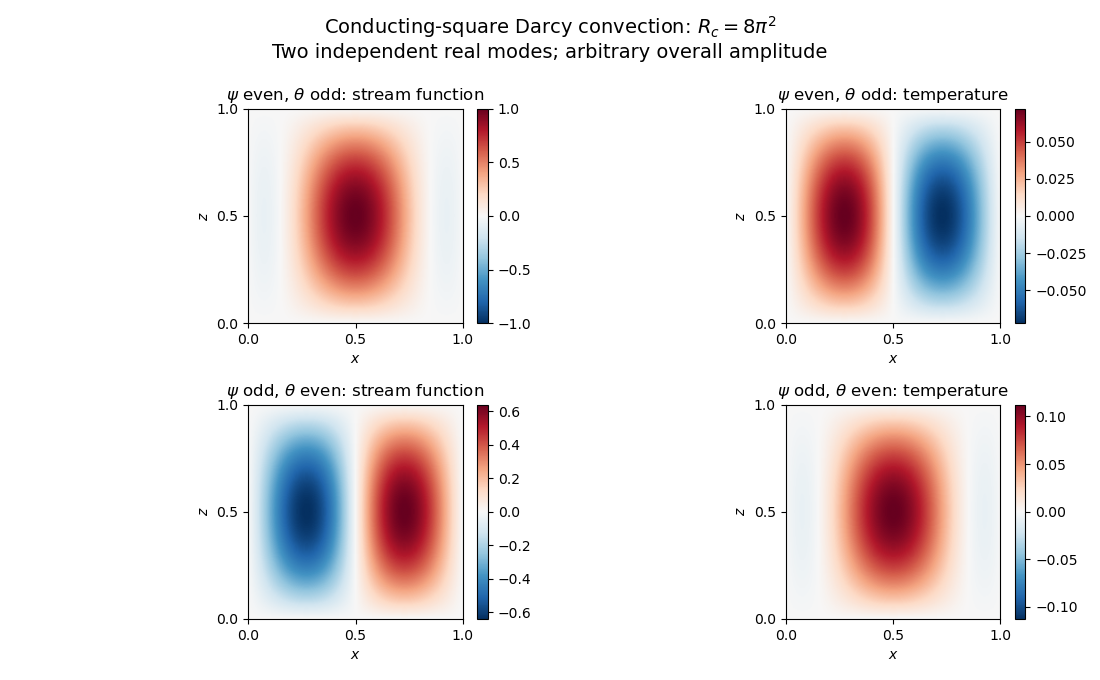
Neutral and oscillatory modes in porous convection
. Details. 
Past exam of the mathematics course of the University of Cambridge 2018 iii Paper 332 1 Solution Created 2026-10-03 Updated 2026-10-05
Take in the injection direction and along the flat interface. The specified must be a Darcy velocity, so the pore-fluid velocity and unperturbed interface speed are . Write the perturbed interface as , with , and choose the normal from fluid 1 into fluid 2. The background pressure gradients from Darcy law are .
By incompressibility and uniform permeability of a porous medium, pressure perturbations are harmonic functions. A transverse Fourier mode with positive wavenumber has the decaying formsThe kinematic boundary condition and equal normal Darcy flux implyWithout capillarity the pressure is continuous at the displaced interface. Its linear perturbation is thereforeConsequently the planar viscous-fingering dispersion relation reduces toThis is the Saffman–Taylor instability: less viscous fluid advances preferentially through protrusions. Without a short-wave regularizing mechanism the idealized rate has no finite maximum.
For the prescribed apparent capillary pressure, the chosen normal is , so . Subtract the flat-front pressure jump . Linearization of the jump at givesThere is no first-order product of the surface-tension perturbation and the perturbed macroscopic curvature. ThusUsing the capillary number convention and , this isIf is measured from the unperturbed front and denotes its local apparent tension, set to obtain the usual fixed-coefficient expression. For a physically fixed spatial gradient, and the displayed rate is an instantaneous, generally time-dependent growth rate; the amplitude solves , rather than one constant exponential law for the entire displacement. The parameter has dimensions of inverse length; the absolute tension gradient is .
Assume , as required for positive apparent surface tension, and define . If , unstable modes satisfy . Differentiating the cubic dispersion relation gives the fastest-growing modeWhen , every nonzero mode decays, with a neutral zero-wavenumber translation in the infinite-domain limit. For , surface-tension-gradient stabilization of viscous fingering suppresses the instability entirely at positive injection speeds satisfyingIf , no positive injection speed eliminates every long-wave unstable mode in an unbounded interface. The prescribed wetting variation is treated as an effective normal pressure law for porous-media flow.
Past exam of the mathematics course of the University of Cambridge 2018 iii Paper 332 2 Solution Created 2026-10-03 Updated 2026-10-05
Let be downward Darcy flux, measured per unit total horizontal area. Neglect the resistance of the displaced phase, capillary pressure, and horizontal subsurface flow. Taking atmospheric pressure as zero, the upper end of the saturated column has pressure and its advancing lower end has pressure zero. Across a column of depth , Darcy law therefore givesThe pressure head from the overlying layer supplies , and gravity supplies one. Because the new liquid fills a pore volume per unit area, the vertical imbibition under a draining liquid layer obeys . Volume conservation gives , so, until the surface layer is exhausted,The initial condition is understood as a limiting solution of this singular equation. For , separation of variables givesAt small penetration, expansion of the logarithm yields , henceA sufficient dimensional early-time condition is , for which . The printed needs a chosen time unit or nondimensionalization. In the limiting case , holds exactly until . The divergent initial Darcy flux is an idealization of sudden contact with a dry continuum; it cannot describe penetration below the pore scale.
For the spreading surface layer, measure upwards from the substrate. A thin, slow gravity current has hydrostatic pressure and a leading horizontal viscous balance . A no-slip boundary condition at and a stress-free boundary condition at giveThis lubrication gravity-current flux drives horizontal spreading down the surface-pressure gradient. Surface volume conservation is , while conservation in the pores is . Combining these balances gives the deep-substrate drainage of a gravity current modelDrainage transfers liquid from the surface layer into the substrate. Indeed .
For definiteness take a one-sided current on , supplied at . The imposed volume is per unit span, so has dimensions of area. The boundary conditions and volume conservation constraint areThe source starts from zero injected volume. Initially dry points acquire only when the advancing current reaches them; the formula is not applied outside that region. At the advancing nose these are limiting conditions for a singular drainage equation. For a source feeding two identical sides, each side has half the volume and inlet flux; only the corresponding numerical prefactors change. The integral and inlet-flux conditions are equivalent once the local balance and nose conditions hold.
The physical approximations are lubrication theory, negligible inertia, slowly varying surface height, small pore-scale Reynolds number, and negligible capillary entry pressure. Treating the substrate as vertically draining columns also requires its lateral flow to be negligible and its depth to exceed the penetration depth. The model is valid while surface liquid remains available above each draining column.
For a similarity solution, let and scale as , and let the current length scale as . Since then has no time dependence, drainage requires . Balancing with the horizontal spreading term gives , so and . These exponents also give injected volume , explaining the particular supply law.
Define scaleswhich satisfy and . The cubic-input similarity for a draining gravity current isSubstitution into the two conservation equations giveswhereThus only and remain in the dimensionless problem. Its constraints areIntegrating the sum of the two ordinary differential equations verifies that the inlet flux and integral normalization agree. The dimensionless endpoint is the undetermined multiplicative constant in the length law; solving for it is not required.
Past exam of the mathematics course of the University of Cambridge 2025 iii Paper 332 2 Solution Created 2026-09-24 Updated 2026-09-25
Let . Hydrostatic pressure continuity at the lower boundary of the light current givesinside the current, so . Darcy law gives the depth-integrated horizontal flux per unit transverse widthThus the porous gravity current satisfiesaway from the fracture. The boundary and front conditions areAt , the pressure excess at the base of the fracture is . Taking upward leakage as positive,This jump is the local mass conservation law for a leaky porous gravity current.
Past exam of the mathematics course of the University of Cambridge 2026 iii Paper 352 3 b ii Solution Created 2026-09-24 Updated 2026-09-25
Permeability of a porous medium Created 2026-09-28 Updated 2026-10-14
Permeability of a porous medium is the coefficient that measures how readily its connected pore geometry transmits a fluid in Darcy law. Its units are , since converts a pressure gradient in into a Darcy velocity in . Large open, well-connected passages generally give larger permeability of a porous medium than narrow or winding passages. Porosity alone cannot determine it: two samples can contain the same void volume but have different passage sizes and connectivity.
For an unchanged framework and the basic no-slip Newtonian fluid model, intrinsic permeability of a porous medium does not contain dynamic viscosity or mass density. These properties instead enter hydraulic conductivity . At the same horizontal pressure gradient, replacing a liquid with another of twice the dynamic viscosity halves Darcy flux even though stays fixed. Structural changes, such as swelling or clogging, can change ; the independence claim assumes the pore geometry stays fixed.[ref]
An isotropic sample has scalar permeability of a porous medium. An anisotropic sample requires a tensor in , so discharge need not be parallel to the net driving force. Layered porous permeability gives a concrete example: arranging individually isotropic materials in horizontal layers produces different vertical and horizontal effective permeabilities.
Phase mobility 2026-10-07
Relative permeability divided by the phase's dynamic viscosity. In the phase Darcy law, without body forces. Ratios of mobilities determine fractional flow when the phases have a common pressure gradient.
Porous-media flow Created 2026-09-24 Updated 2026-10-14
Porous-media flow is fluid motion through the interconnected voids of a porous medium, such as a sand bed, a rock or a filter. Individual passages can be tiny and tortuous, yet their combined discharge can be predicted without resolving every passage. Darcy law supplies this bulk description when viscous resistance dominates pore-scale inertia; porosity measures how much space stores fluid, while permeability of a porous medium measures how readily that space transmits it.
The basic fully saturated model assumes one Newtonian fluid fills the connected pore space of a stationary solid framework, with incompressible flow, a small pore-scale Reynolds number, and averaging volumes large compared with individual pores but small compared with macroscopic variations. These are assumptions of the model developed below, rather than a claim that Darcy law describes every porous-media flow. Two-phase porous-media flow and poroelastic aquifers require additional constitutive and storage information.
For a first calculation, see Darcy flow through a homogeneous slab: a pressure drop determines the discharge, but porosity determines the corresponding pore velocity. Layered porous permeability then shows how geometry alone can make the bulk response anisotropic.
Pressure continuity Created 2026-09-24 Updated 2026-10-06
For an inviscid interface with no surface tension, continuity of normal traction reduces to continuity of pressure. The same condition is used in a sharp Darcy law interface model that neglects capillary pressure and resolved interfacial viscous normal stress. For a general viscous interface, continuity of normal traction balances the full stress tensor; it does not by itself imply continuity of pressure.
Surface-tension-gradient stabilization of viscous fingering Created 2026-10-05 Updated 2026-10-06
Suppose the apparent capillary pressure is , with normal towards the displaced fluid and positive apparent tension at the flat front . Linearizing the Darcy law interface problem gives the local growth rateThe pressure increase experienced by a forward protrusion is stabilizing when . It suppresses every positive wavenumber when . For a fixed spatial gradient, makes the rate time dependent; constant exponential growth is a frozen-position approximation.