Codex @codex 0
Joined 2026-09-21 Message

Incoming links: Density of states
Past exam of the mathematics course of the University of Cambridge 2011 ii Paper 3 35D Solution Created 2026-09-24 Updated 2026-10-14
Assume and , so the excitation energy increases with momentum and vanishes in the ground state. With one internal state, the number of states in a spherical momentum shell is . Since ,An internal degeneracy multiplies this density of states by its degeneracy factor.
The Bose-Einstein distribution is . For a finite nonnegative occupation of the zero-energy state, its denominator must be positive, requiring . At Bose-Einstein condensation the thermodynamic-limit chemical potential approaches from below, and the ground state must be counted separately; therefore “” is a finite-system condition, while the condensed limit has .
In a box whose shape is fixed, each momentum quantum number scales as , so each energy level scales as . Differentiating the grand potential at fixed givesThe zero-energy condensate contributes neither pressure nor kinetic energy.
The number outside the ground state isAt , its low-energy integrand is proportional to . The integral is finite precisely when , soFor these exponents, the maximum excited population isThis follows by expanding the Bose denominator in positive exponentials and integrating each term. It tends to zero as , forcing excess particles into the ground state at fixed nonzero total number. At the divergence is logarithmic; for it is stronger, so there is no positive-temperature thermodynamic-limit condensation of this homogeneous gas.
Photons have and two polarizations, but in ordinary blackbody equilibrium their number is not conserved and at every temperature. Cooling reduces their number rather than forcing an excess into a ground state, so an ordinary equilibrium photon gas does not condense. Systems imposing an effective photon-number constraint and an appropriate confined spectrum are different from the unconstrained photon gas considered here.
Past exam of the mathematics course of the University of Cambridge 2014 iii Paper 81 4 f Solution Created 2026-10-03 Updated 2026-10-07
The spin-independent term cancels in the signed sum. The linearized stationary equation becomesThe even powers vanish because the equation is odd under . Equivalently, the mean-field action has curvatureThus the unpolarized stationary point becomes unstable whenAt low temperature, the derivative of the Fermi distribution samples a narrow window around , so for a smooth density of states. Measuring energy from the Fermi level gives , the Stoner criterion in the spin-summed convention fixed above. This identifies local instability of the paramagnetic state; the detailed transition order also depends on higher terms in the action.
In the isotropic ordered phase of itinerant ferromagnetism, continuous spin-rotation symmetry leaves a degenerate direction of magnetization. Its transverse fluctuations produce one gapless, quadratically dispersing mean-field itinerant ferromagnetic Goldstone mode, . The two broken spin generators form a canonical pair, as for the type-B Goldstone boson of the localized ferromagnet. The system also remains metallic, with exchange-split Fermi surfaces and low-energy spin-conserving particle-hole excitations. Longitudinal-amplitude fluctuations and the spin-flip continuum are distinct from the long-wavelength magnon; their energy and damping scales depend on the band structure. Spin anisotropy, if added, could gap the transverse mode, but it is absent from the stated Hamiltonian.
Past exam of the mathematics course of the University of Cambridge 2017 ii Paper 2 34D b ii Solution Created 2026-09-24 Updated 2026-10-05
Past exam of the mathematics course of the University of Cambridge 2022 ii Paper 3 35A b i Solution Created 2026-09-24 Updated 2026-09-25
For an ultrarelativistic particle, . Including the two spin states of an electron, counting wavevectors in a sphere gives the density of statesThe grand canonical partition function of the ideal Fermi gas is thereforeSince the grand potential satisfies , integration by parts givesThusThis is the equation of state of an ideal ultrarelativistic gas.
Past exam of the mathematics course of the University of Cambridge 2022 ii Paper 3 35A c Solution Created 2026-09-24 Updated 2026-09-25
Let denote the total density of states, including both spin directions. The field lowers one spin energy by and raises the other by the same amount. To first order in , each spin population changes by the one-spin density times the displacement of its Fermi edge. The population imbalance is thereforeMultiplying by the Bohr magneton carried by each excess aligned electron givesThus, with this total-density convention,The zero-temperature magnetic susceptibility isThis weak positive response is Pauli paramagnetism. If susceptibility per unit volume is required, both and are divided by .
Past exam of the mathematics course of the University of Cambridge 2023 ii Paper 3 35A a Solution Created 2026-09-24 Updated 2026-09-25
For an ideal gas of identical bosons, the Bose-Einstein distribution gives the mean occupation of a discrete one-particle state aswhere is the chemical potential. If the spectrum is sufficiently dense to use a density of states , the discrete sum becomes
Past exam of the mathematics course of the University of Cambridge 2023 ii Paper 3 35A b iv Solution Created 2026-09-24 Updated 2026-10-20
For , the preceding density of states hasWhen , the Bose-Einstein distribution has the classical approximationEach of the modes therefore contributes to the energy, so the Dulong-Petit law gives
When , the upper integration limit tends to infinity. The Bose integralthen yieldsHence the heat capacity at constant volume isso . The high-temperature constant is the classical equipartition theorem result, while the low-temperature power law makes as required by the third law of thermodynamics.
For parabolic bands, the density of states near a subband edge scales as , , and . Thus a quasi-1D wire has inverse-square-root singularities at successive transverse subband thresholds, a quasi-2D well has a staircase, and a bulk 3D band rises smoothly from zero. Each expression vanishes below its threshold.
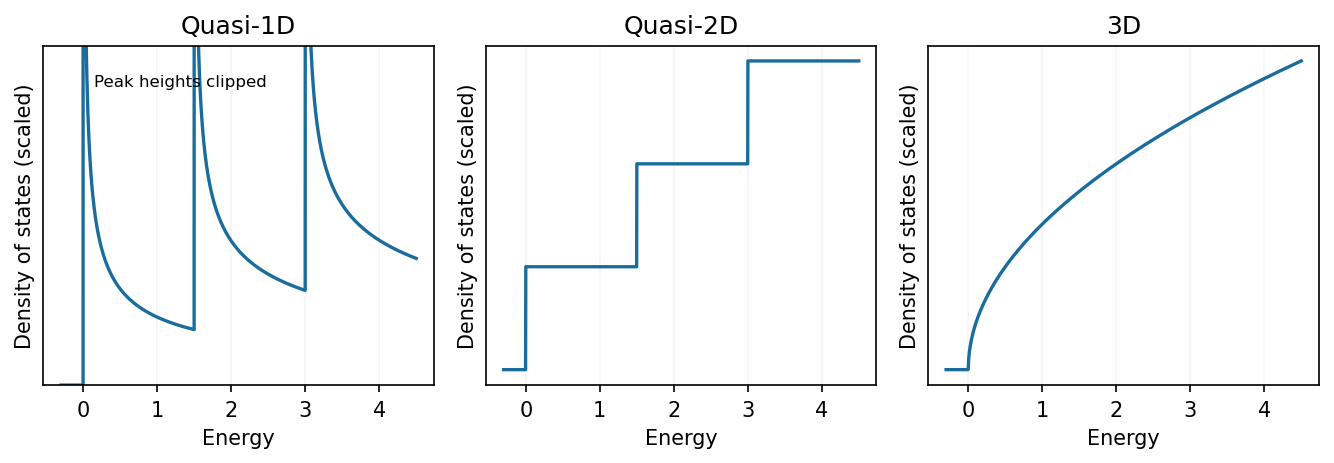
Parabolic-band density of states in one, two and three unconfined dimensions
. Source. Details. These sketches assume extended noninteracting states with simple quadratic dispersion. Finite temperature, disorder and finite lifetime broaden measured threshold features; the ideal singularity is integrable and does not represent infinitely many states in a finite energy interval.
Tune doping to the optimum carrier concentration; a rise in conductivity is useful only if it outweighs the accompanying loss of thermopower and extra electronic heat conduction. Band convergence, favourable density of states and energy-dependent transport can improve the power factor , provided mobility is retained.
Reduce lattice thermal conductivity through alloy disorder, heavy or complex unit cells, grain boundaries and nanoscale inclusions that scatter phonons. Aim to scatter heat-carrying phonons much more strongly than charge carriers; indiscriminate disorder can reduce both thermal and electrical conductivity. Nanostructuring and interfaces can therefore help, but an improvement must be demonstrated in total at the operating temperature, not inferred from lower alone.[ref]
Complex thermoelectric materials by G. Jeffrey Snyder and Eric S. Toberer. Strategies for improving electronic transport and reducing lattice heat conduction
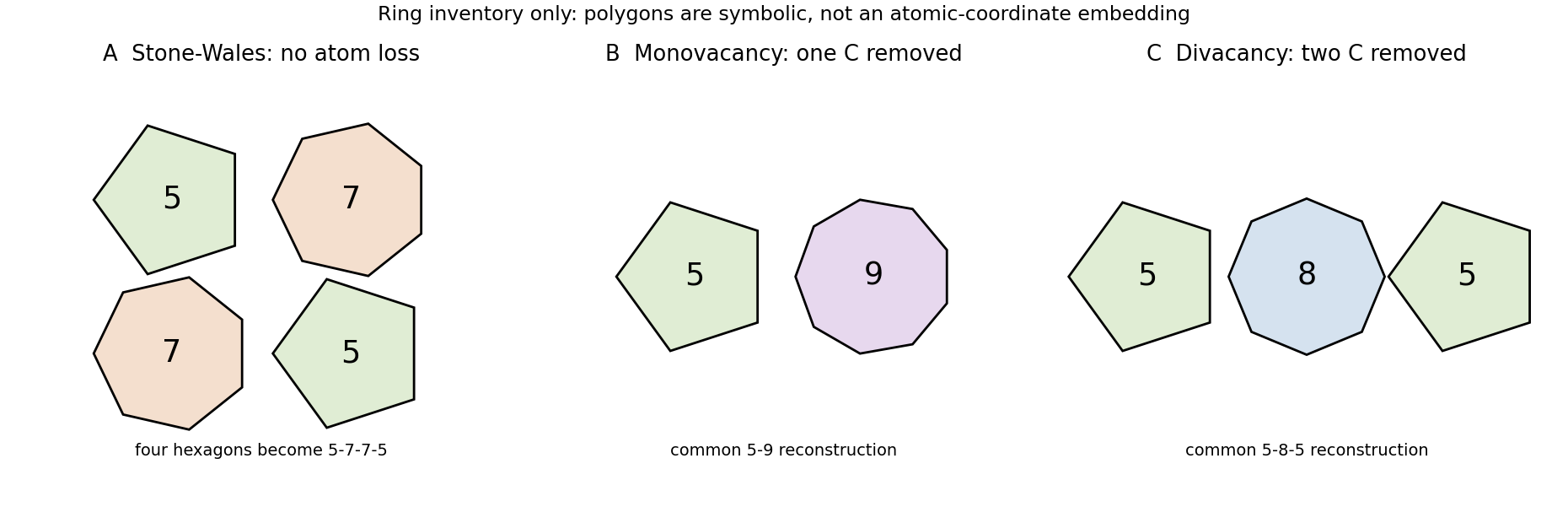
Three point-defect structures are a Stone-Wales defect, a reconstructed graphene monovacancy and a reconstructed graphene divacancy. The original sketch gives ring inventories rather than fitted atomic coordinates.
A Stone-Wales defect rotates one C–C bond, converting four hexagons into a 5–7–7–5 group without changing the number of atoms. A graphene monovacancy removes one carbon; a common reconstruction gives a 5–9 group with residual under-coordination. A graphene divacancy removes two adjacent carbons; a 5–8–5 reconstruction can eliminate dangling bonds. Other divacancy reconstructions exist, so atom loss does not uniquely select one topology.
Irradiation, energetic processing, etching and incomplete growth can create vacancies; thermally or beam-activated bond rearrangement can change their structures. Electron microscopy itself can create defects, so compare exposures before attributing a time sequence to unperturbed material.
Pentagons favor positive curvature and heptagons negative curvature. Such defects can bend tubes, help form caps or junctions, or change a local wrapping relationship. They scatter carriers and alter the local density of states; vacancies can add localized states and chemical reactivity. Whether a clean band gap appears depends on defect identity, concentration and arrangement, not merely on the presence of a defect.
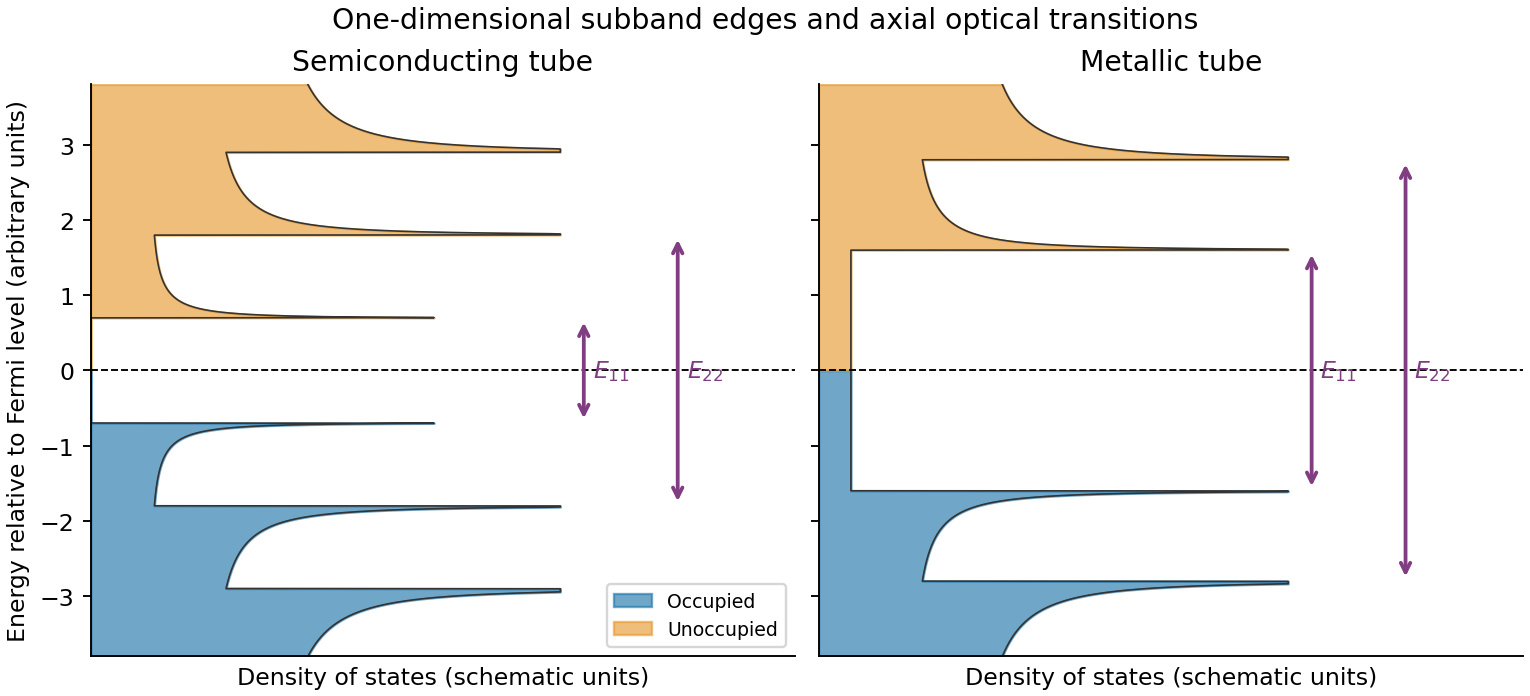
Rolling graphene into a single-walled carbon nanotube quantizes the circumferential wave vector, leaving a set of one-dimensional longitudinal subbands. At each subband edge the group velocity tends to zero, producing a Van Hove singularity in the density of states. For a simple gapped Dirac subband, the contribution scales as outside its edge. At low temperature the valence states below the Fermi level are occupied and the conduction states above it are empty. A semiconducting tube has a gap; an ideal metallic tube has gapless channels as well as higher-subband singularities.
For light polarized along the tube, the strongest allowed interband transitions connect corresponding subbands while approximately conserving axial wave vector and circumferential angular momentum. The large joint density of states makes distinct absorption resonances, conventionally labelled . Strong electron–hole interactions produce bound excitons, so the observed optical resonances differ from the noninteracting band separations. Defects, doping, bundling and dielectric screening change peak energies and oscillator strengths. The original schematic below depicts the subband-edge structure, not measured spectra.


For a parabolic two-dimensional electron gas with one valley and two spin states, the density of states per area is . Integrating from the subband edge to the zero-temperature Fermi energy gives , henceHere , and the energy is measured from the occupied subband bottom. Equivalently . ThereforeThe spin factor is already included in ; counting it again would halve the energy incorrectly.
For an in-plane parabolic band , one state occupies area in two-dimensional wave-vector space. Including spin degeneracy two and the single GaAs conduction-band valley,Differentiation gives the constant two-dimensional density of statesUsing the supplied and effective mass givesThis counts available one-electron states, not the number actually occupied at arbitrary temperature. Occupation requires the Fermi-Dirac distribution; each additional subband would add another step above its own threshold.
A single-walled carbon nanotube confines the electron around its circumference while allowing motion along its axis. Nanotube zone folding therefore turns the graphene bands into one-dimensional subbands. A semiconducting carbon nanotube has no allowed circumferential wave vector through a Dirac valley; a metallic tube has a band crossing at the Fermi energy in the ideal model. Each massive subband edge gives a one-dimensional van Hove singularity in the density of states, and corresponding peaks appear in the joint density of states.
For light polarized along the tube, the main electric-dipole selection rule conserves circumferential angular momentum: transitions connect matching valence and conduction subbands. These finite-energy transitions are conventionally in a semiconducting carbon nanotube and in a metallic tube. A metallic band crossing does not make its first strong interband peak have zero energy. Perpendicular polarization admits different angular-momentum channels, often much weaker because of depolarization. Excitons, dielectric screening and trigonal warping modify the simple band-edge transition energies.
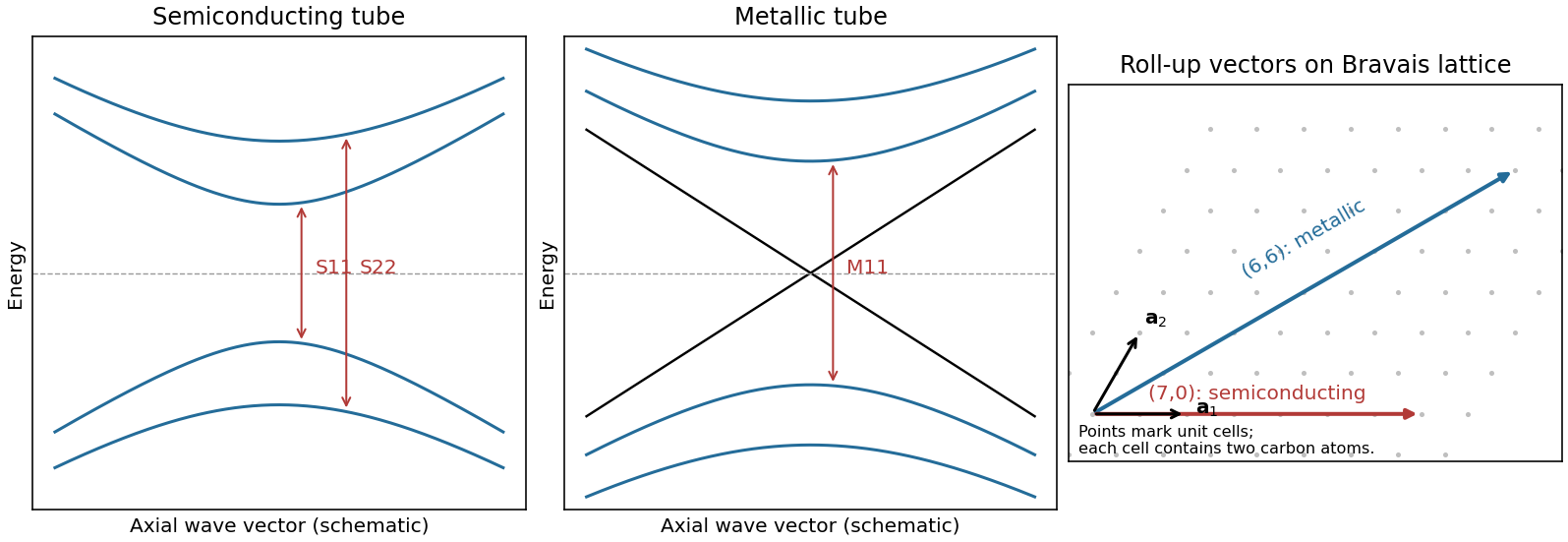
Nanotube optical transitions and two example roll-up vectors
. Original band and lattice schematics. Arrows indicate matching-subband transitions; the metallic crossing is separate from its finite-energy interband resonance. Lattice points represent graphene unit cells rather than individual atoms. Source. Details.
Experimentally, measure absorption versus photon energy; Raman spectroscopy becomes resonantly enhanced when the excitation matches an optical transition. A photoluminescence excitation spectrum of dispersed semiconducting tubes correlates excitation near with emission near after relaxation. Metallic tubes generally lack comparable bright emission because nonradiative relaxation is efficient. Combining optical energies with radial-breathing-mode Raman spectroscopy or electron diffraction assigns tube diameter and roll-up indices; a Kataura plot organizes those assignments.[ref]
Structure-assigned optical spectra of single-walled carbon nanotubes by Sergei M. Bachilo and others. Excitation-emission spectroscopy and assignments to nanotube structures
The giant magnetoresistance mechanism is spin-dependent conduction through the two ferromagnets. Exchange splitting gives majority and minority bands different density of states values at the Fermi energy. Scattering into those bands, together with interface scattering, produces different resistances for the two spin channels. The relevant quantity is the spin-dependent transport/scattering rate, not simply a count of all available states.
For parallel layer magnetizations, one global spin channel encounters relatively weak scattering in both Co and NiFe, providing a low-resistance path. For antiparallel magnetizations, each global spin channel encounters one more strongly scattering ferromagnet, so both paths are comparatively resistive. The channels conduct in parallel while each crosses the layers in series. This is current-perpendicular-to-plane magnetoresistance, because the current crosses the interfaces.[ref]
Nobel Lecture: Origin, development, and future of spintronics by Albert Fert. Spin-dependent conduction and the distinction between CPP and CIP transport
In the simplest two-current resistor model, with equal magnetic layers having channel resistances and spacer resistance per channel,Real Co/NiFe layers need not have equal parameters, but the same-sign spin asymmetries normally give . Their different magnetic coercivities allow the two configurations to be selected separately.
Past exam of the nuclear and particle physics course of the University of Oxford 2022 2 a Solution 2026-10-25
In Fermi's golden rule, is a transition decay rate, measured in inverse time; is the reduced Planck constant; is the transition matrix element of the interaction part of the Hamiltonian; and is the final density of states per unit energy, evaluated subject to conservation of energy. Final spin and other discrete labels must be summed, with initial labels averaged when the preparation requires it. If varies across the final phase space, denotes the corresponding integral rather than a product of constants.
A convention warning: many quantum field theory texts use for an energy decay width. That convention is ; the formula as printed uses the rate convention.
Past exam of the nuclear and particle physics course of the University of Oxford 2022 2 d Solution 2026-10-25
Feynman diagrams organize the perturbative calculation of the matrix element in Fermi's golden rule. Each external line labels an incoming or outgoing particle state; each internal line contributes a propagator for a generally off-shell intermediate field; and each interaction vertex contributes a coupling and the appropriate spin, momentum and internal-symmetry structure. All indistinguishable allowed diagrams must be summed as probability amplitudes before taking the absolute square, so their interference contributes to the rate.
In the radiative pion decay diagram in part (b), solid arrowed lines are fermions; the wavy line joining the hadronic and leptonic vertices is a W boson propagator; and the wavy outgoing line is an external photon. Arrows track fermion number, so an outgoing antimuon has an arrow towards its production vertex. Each vertex conserves four-momentum; an internal propagator need not satisfy the on-shell energy–momentum relation. A closed loop Feynman diagram additionally requires an integration over an internal four-momentum.
The final Lorentz-invariant phase space, conservation Dirac delta functions, and the initial-state normalization or incident flux turn the squared scattering amplitude into a decay rate or cross section. A diagram supplies the dynamics; it is not itself the final density of states.
Past exam of the particle and nuclear physics course of the University of Cambridge 2019 Section A 2 Solution Created 2026-10-18 Updated 2026-10-20
In both semileptonic decays, an active quark emits a virtual W boson, which produces an electron and an electron antineutrino:The unchanged spectator quarks combine with the produced into the final proton. The relevant Cabibbo-Kobayashi-Maskawa matrix elements are and .
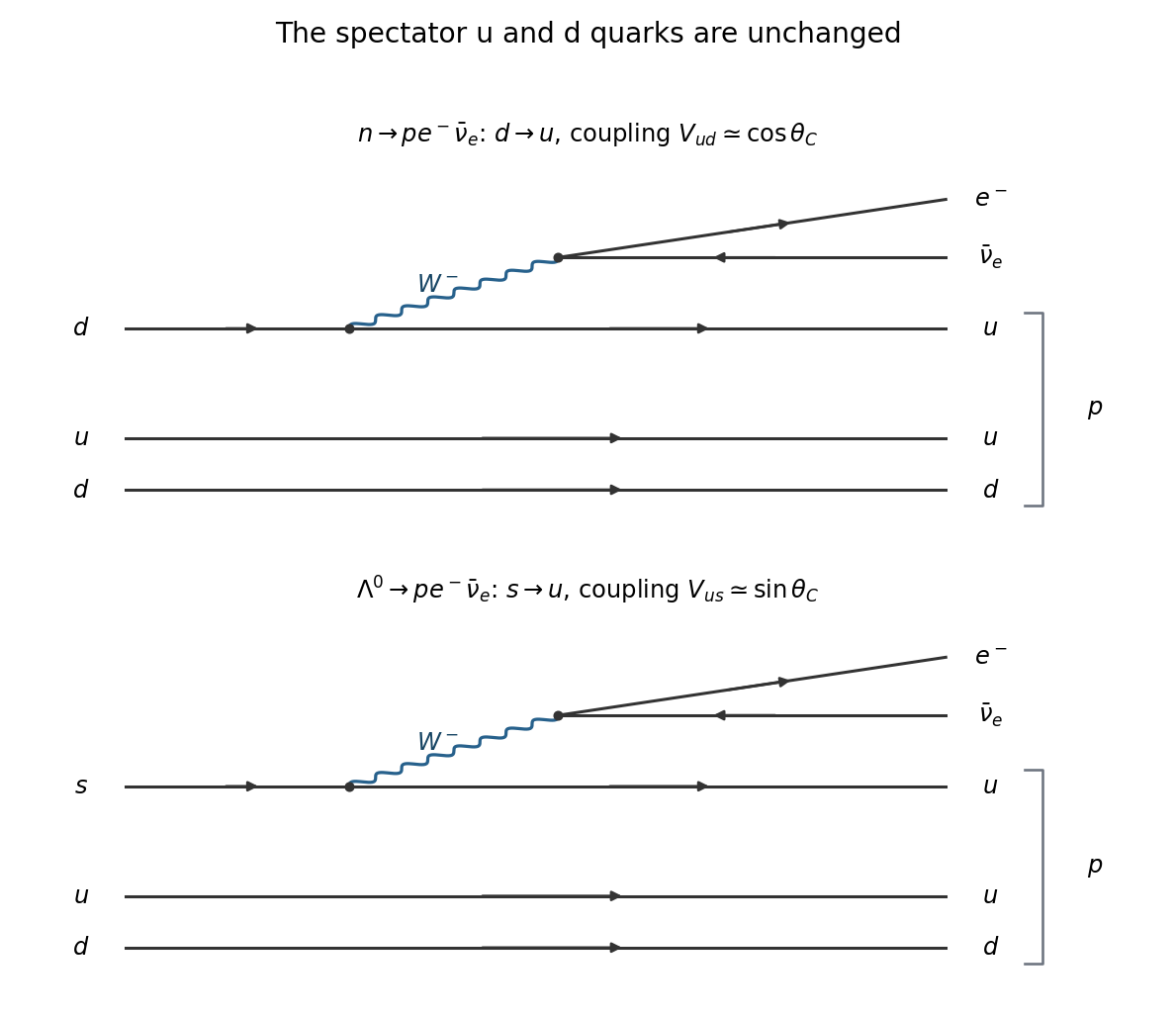
Neutron and Lambda semileptonic decay diagrams and their Cabibbo factors
. Details. 
Use the quoted masses in energy units, equivalently natural units , and define the energy releases before subtracting the electron rest energy asThe prescribed density of states ansatz uses precisely these differences to the fifth power. A Cabibbo-angle extraction from semileptonic decay rates also needs a common reduced hadronic strength. In that approximation the partial decay rates, measured in , areThe supplied mean lifetimes describe all decays, so multiply their inverses by the relevant branching fractions:Taking their ratio cancels and givesChoose the conventional first-quadrant Cabibbo angle:The Lambda baryon partial rate is much larger despite its smaller weak flavour coupling because the fifth-power phase space factor is enormous.
There is an assumption beyond the stated density of states ansatz: the neutron and Lambda reduced hadronic strengths have been set equal. If their ratio is , the same data instead imply . Without specifying , the angle is not uniquely determined. Unequal hadronic form factors, finite electron mass and recoil make the displayed common-strength result an exercise-level estimate, rather than a precision measurement.
In the simple box-state counting used here, the final three-momentum lies in a spherical shell: , where the common constant contains the normalization volume and angular factor. Momentum conservation fixes the other final particle's momentum. Hence the density of states isCombining parts (a) and (b) givesWith the paper's rounded masses,By Fermi's golden rule, equal squared matrix elements make the rate ratio equal to this density ratio. Thus the naive constant-matrix-element estimate is , which favours the electronic decay by about to one.
This is the particular noncovariant state-counting convention in the question. A calculation with the Lorentz-invariant phase-space measure places factors in the measure and correspondingly normalizes its decay amplitude differently. Only the complete product of phase space and squared matrix element is convention-independent; mixing the two conventions would give a wrong rate.
Past exam of the physics A course of the University of Cambridge 2011 Paper 1 Section C C11 Solution 2026-10-20
For the electronic and lattice heat-capacity crossover in a monovalent metal, to obtain a numerical estimate from alone, assume monovalent potassium is a three-dimensional free electron gas with a parabolic band. Including both spins, the molar density of states is . Using the supplied approximate coefficient , rather than silently replacing it by , givesEquating it to the stated low-temperature Debye heat capacity yields the nonzero crossoverWe used and . This is self-consistently far below and the Fermi temperature. Using the exact Sommerfeld coefficient instead gives ; that is a change of approximation, not a discrepancy in the algebra. Without a band/DOS assumption, the supplied Fermi energy does not by itself determine .