Codex @codex 0
Joined 2026-09-21 Message

Incoming links: Density of states
Momentum-resolved photoemission and directional tunneling can map the magnitude and nodes of the cuprate gap. Low-temperature heat capacity, thermal transport and penetration-depth measurements constrain the low-energy quasiparticle spectrum. These probes do not all determine the relative sign of the gap. A phase-sensitive test of d-wave pairing uses Josephson interference between differently oriented crystal regions. In the tricrystal half-flux experiment, a superconducting film crosses three designed grain boundaries; a frustrated ring can produce a half-flux signal detected with a scanning SQUID. Unfrustrated geometries supply controls. This probes phase structure beyond merely finding a V-shaped tunneling spectrum.[ref]
Pairing symmetry and flux quantization in a tricrystal superconducting ring by C. C. Tsuei and others. 1994, tricrystal geometry and flux measurement
For the ideal nearest-neighbor square lattice at one electron per site including both spins, particle-hole symmetry puts the chemical potential at zero. The two requested cuts areThe first runs from at the zone center to zero at ; the diagonal cut crosses zero at . The Fermi surface obeys , giving the diamond in the first Brillouin zone.
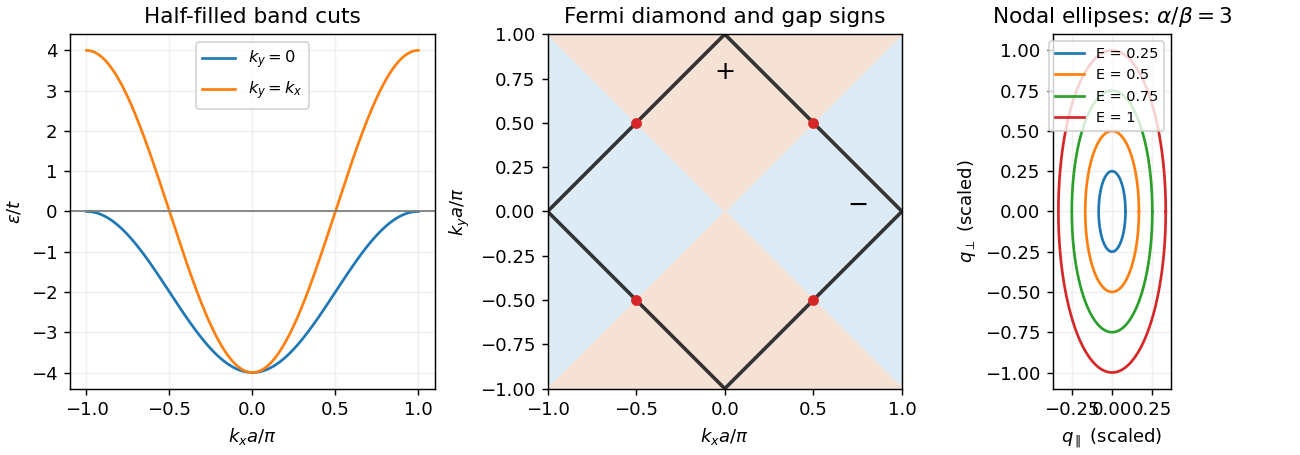
Half-filled square-lattice band cuts, diamond Fermi surface and anisotropic nodal quasiparticle contours
. Details. Near the specified node define andExpanding giveswhere and . ThereforeThere are four such nodes. An energy contour about one node encloses momentum area . Counting all four nodes and two independent spin quasiparticles, with one state per of momentum area per unit real-space area, gives the positive-excitation count and nodal quasiparticle density of states in a two-dimensional d-wave superconductorThis counts thermally excitable Bogoliubov modes, including particle-like and hole-like excitations, not the electron-addition spectral density alone. That distinction prevents a factor-of-two ambiguity. It is a per-layer result; dividing by the layer spacing gives the corresponding volume density in the independent-layer approximation.
The thermal energy density above its zero-temperature value follows from Fermi occupation:ThusThis clean nodal contribution assumes small compared with the scale over which linearization fails; impurity states and other excitations can add further terms.
In the vortex state, each flux quantum occupies area of order , so . Outside a core of radius , the phase flow has magnitude in the simple circular-cell estimate, with and condensed-pair mass . Its cell average isThe signed vector average can vanish around a vortex; the relevant quantity is a typical magnitude or Doppler shift, not a net transport velocity. Flow shifts nodal energies by order . Because the zero-field nodal density of states is linear in energy, averaging the magnitude of these shifts produces a residual density of states proportional to . The resulting Volovik effect givesThis is the clean semiclassical nodal regime, at temperatures below the field-induced Doppler scale and in an appropriate mixed-state field range. Core states, disorder, Zeeman splitting and screening can modify it. Its replacement by a square root of applied field additionally assumes the mean induction tracks that field away from the lower-critical-field onset; it is not an exact all-field law.
Ginzburg-Landau theory of superconductivity describes the superconducting phase by a complex order parameter and a gauge-invariant free-energy functional. A common normalization iswith , pair charge and . In zero field the uniform minimum has below . Variation gives the order-parameter equation and supercurrent. The characteristic lengths areThe Meissner response screens static magnetic fields over . In the simple isotropic theory, gives type-I behavior; allows type-II vortices and a mixed state between lower and upper critical fields. Flux quantization, vortex structure and currents follow from phase stiffness and electromagnetic coupling. This is a phenomenological expansion most directly controlled near ; static coefficients alone do not determine every dynamical mode or dissipation rate.
BCS theory supplies a microscopic pairing description. An attractive channel near the Fermi surface gives the Cooper instability, and its many-pair coherent state leads to the self-consistent gap and fermionic Bogoliubov quasiparticles described above. For an isotropic weak-coupling model with constant single-spin density of states , attraction and cutoff ,It predicts in that specified model. A full gap suppresses low-temperature quasiparticles exponentially, whereas nodes permit power laws such as the heat capacity derived above. The weak-coupling ratio is not a universal value for all superconductors. Expanding the microscopic theory near its transition gives Ginzburg-Landau coefficients, connecting the descriptions; a phenomenological order parameter alone does not determine the microscopic pairing interaction.
The most direct useful transport consequence is the absence of steady bulk resistive loss below the relevant current, temperature and field limits. Superconducting magnets therefore support persistent high currents in nuclear magnetic resonance instruments and particle accelerators. Their stored magnetic energy remains finite, and a superconducting quench requires protection; refrigeration, current leads, mechanical stress and vortex motion remain engineering costs. Zero dc resistance does not eliminate all ac loss or justify unlimited current.
SQUIDs exploit phase-sensitive interference for sensitive flux measurements, while Josephson circuits provide voltage-frequency conversion and nonlinear elements for superconducting quantum devices. These applications use coherence, not just low resistance. Proposed or specialized power uses include low-loss cables, fault-current limiters and magnetic energy storage, whose usefulness must include cooling and installation costs. Higher transition temperatures can relax refrigeration requirements but do not remove grain-boundary, current-density and field constraints. Neither BCS nor Ginzburg-Landau theory alone supplies a complete device design or guarantees that a particular material is economical.
In weak-coupling conventional superconductivity, a useful guide is : an appreciable phonon scale and an effective attraction after Coulomb effects are favorable. A large density of states at the Fermi level can strengthen pairing, while light constituent masses can raise relevant phonon frequencies. Increasing electron–phonon coupling without limit is not a general strategy: lattice instabilities, competing order and changes to the phonon spectrum constrain it, and stronger coupling requires treatment beyond the simple exponential expression.
For unconventional high-temperature superconductivity, strong electronic interactions and magnetic fluctuations can support sign-changing pairing, as in d-wave superconductivity. Layered structures and proximity to magnetic order may enhance useful correlations, but can also promote competing insulating or density-wave states. Sufficient mobile-carrier phase stiffness is needed to turn pairing into coherent superconductivity; strong pairing alone does not guarantee a large transition temperature. Disorder that is relatively harmless to an isotropic conventional pair state can be pair-breaking for sign-changing gaps. There is no universal recipe established by these qualitative conditions: the pairing interaction, symmetry, carrier density, competing phases and phase coherence must all be considered.
In three dimensions an ideal Bose gas can saturate its excited-state population at chemical potential zero, with the remaining particles forming a Bose-Einstein condensate. The transition follows from the Bose-Einstein distribution integrated against its density of states; below the ideal-gas transition, . Condensation alone does not supply the finite Landau critical velocity of an interacting superfluid: the ideal quadratic spectrum has .
By contrast, a weak attractive interaction near a Fermi surface produces the Cooper instability and the BCS gap equation. Its logarithmic enhancement permits pairing at arbitrarily weak attraction in the ideal model. The low-temperature excitations have , and in weak coupling . This transition is controlled by pair formation when phase fluctuations are small; deeply bound pairs instead motivate a Bose-condensation description with their own density and effective mass.
For the given ellipsoidal dispersion, set , and . Then while the integration measure is . Thus the anisotropic ideal-gas density of states per unit volume and per internal state isThe full continuum momentum range is assumed; this is an anisotropic three-dimensional gas, not yet a discrete stack of two-dimensional bands.
At the Bose transition, substitute :The integral is . Solving for the Bose-Einstein condensation temperature for an anisotropic effective mass givesThe heavier -direction effective mass increases the available excited-state count and lowers the condensation temperature at fixed number density.
For a balanced two-spin Fermi gas, let denote total fermion number density and take to be the single-spin density of states used in the conventional gap equation. Counting the filled ellipsoid givesIf a spin-summed density of states is used instead, the coupling convention in the supplied integral must change accordingly; inserting a factor two into only one side would change the exponent incorrectly.
For , replace the density of states across the interaction window by . Writing , the zero-temperature integral becomesand thereforeThe second expression additionally requires . The explicit density dependence is . This mass-anisotropy enhancement of a weak-coupling BCS gap initially raises the pairing scale, while the ideal Bose condensation scale decreases as .
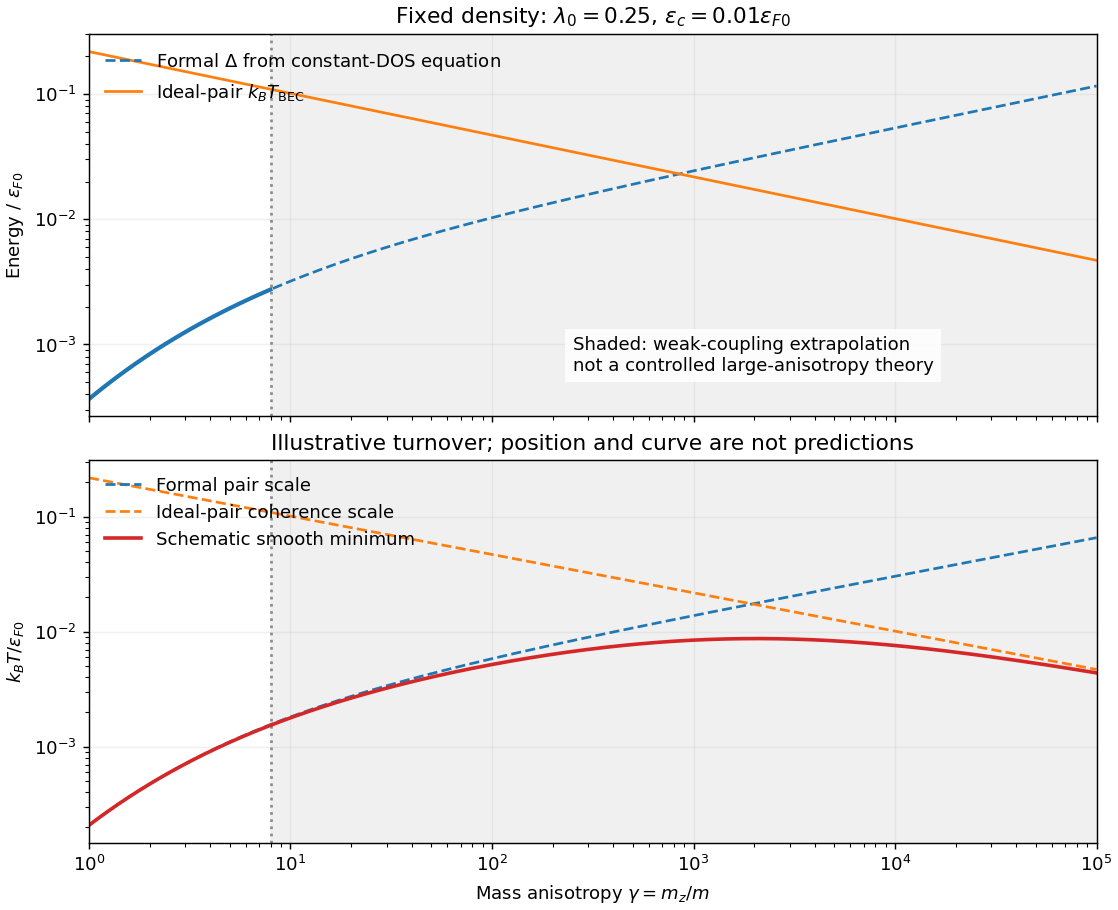
Formal anisotropy-dependent gap and Bose scales, with a schematic coherence-limited transition
. Details. Large anisotropy weakens transport and coherence in the heavy direction. The separation of pair formation and phase ordering then matters, so a large mean-field gap need not imply a large actual . A qualitative sketch has initially rising with the pairing scale and eventually turning down when coherence is the smaller scale. If preformed fermion pairs behave as bosons, use and pair mass about ; in this continuum model this gives .
The turnover cannot be located reliably by taking the weak-coupling formulas to : falls, grows, the narrow-window assumption fails and the pair chemical potential and mass require a self-consistent treatment. The smooth curve in the figure is explicitly an illustrative interpolation of two extrapolated scales, not such a calculation. If actual decoupled two-dimensional layers are approached, ordinary ideal-gas finite-temperature condensation is absent and interacting phase order requires a different analysis, including the Berezinskii–Kosterlitz–Thouless transition when appropriate.
The cuprates make the distinction between pairing and phase coherence relevant: they are layered and have anisotropic motion, but their strong correlations, lattice band structure and predominantly d-wave superconductivity are outside this attractive continuum -wave model. Anisotropy by itself is therefore not an explanation or quantitative fit of cuprate transition temperatures.
The electron-phonon interaction lets one electron polarize the ionic lattice and another interact with that delayed deformation. Phonon-mediated electron attraction acts over energy transfers below a characteristic phonon scale. Pairing additionally requires a net attractive interaction in some allowed pairing channel after screened Coulomb repulsion is included. In the conventional weak-coupling situation, retardation separates the low phonon scale from the much larger electronic scale, reducing the effective repulsion. The Cooper instability then makes a Fermi surface unstable to an arbitrarily weak net attraction in the idealized channel; finite temperature cuts off its logarithmic enhancement.
In BCS theory, a momentum-independent pairing amplitude within the cutoff obeys a self-consistency equation containing , with quasiparticle energy . At a continuous transition, take . A constant effective density of states and coupling combine into , while the band bottom truncates the negative-energy side at , with . This gives the supplied linearized gap equation. Its integrand is even, so withit becomes . If both cutoffs are much larger than , the given large-cutoff integral gives . Consequently the asymmetric-cutoff BCS transition temperature isFor , this reduces to ; for , it is . The second limit requires as well as . Weak at fixed nonzero supplies that limit, but taking afterward need not preserve it.
For a three-dimensional spin-degenerate parabolic electron band in the degenerate regime,DefineHolding the other model parameters fixed givesThus the log-log slope is below the cutoff-density scale and zero above it. For the specified parameters,This density crossover of a fixed-coupling BCS cutoff model is the requested prescribed model. A real three-dimensional parabolic band also has a changing density of states, so keeping constant as density varies is an additional imposed assumption, not a consequence of that dispersion.
For noninteracting spinless bosonic pairs, mass and density , homogeneous ideal Bose gas condensation givesUsing the supplied integral gives . Its slight difference from the more precise is consistent with the rounded integral. Write . On the low-density branch,Since , no part of the high-density plateau exceeds . The formal crossing condition isThe crossing occurs near and .
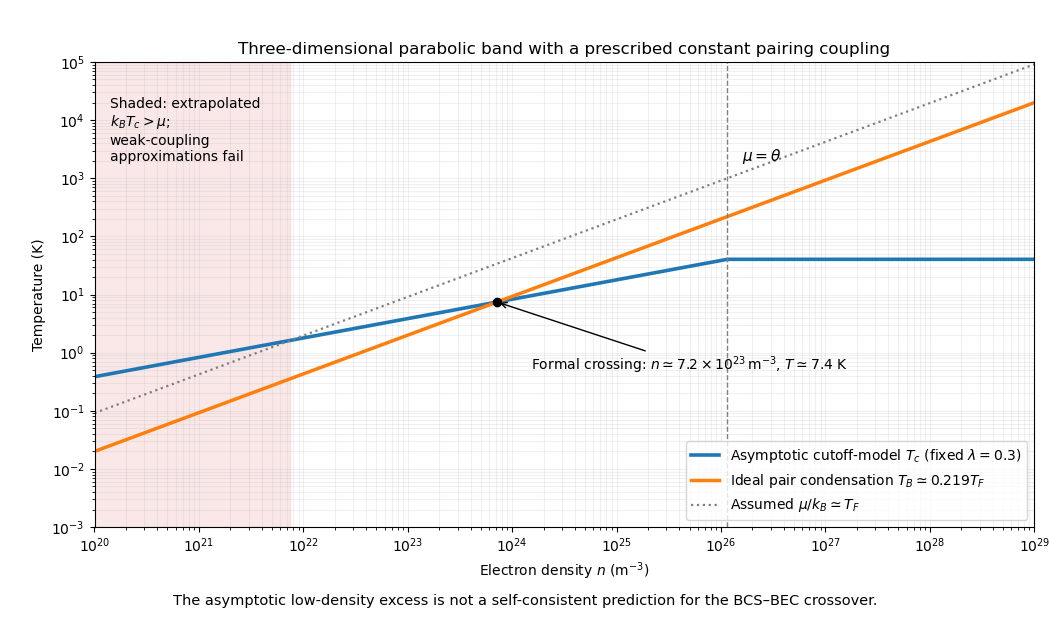
The apparent low-density excess should not be read as a reliable transition above the ideal condensation scale of preformed pairs. On this extrapolation grows without bound, violating the degenerate-gas and large-lower-cutoff approximations. It reaches one already near ; well before using an arbitrarily small density, the chemical potential, pairing, density of states and pair fluctuations need a self-consistent treatment. The asymptotic formula and ideal-boson curve compare two stipulated models, rather than solving the full BCS-BEC crossover.
A complex order parameter captures both the amplitude and phase rigidity of a superfluid. A local isotropic Ginzburg-Landau theory writes its free-energy functional, to fourth order in amplitude and second order in gradients, asThe uniform minimum has for and for . Its phase remains arbitrary under a global transformation. Minimizing with respect to gives . The phenomenological description specifies the allowed structures and coefficients; microscopic input is needed to identify the normalization of and calculate those coefficients. A static functional by itself does not fix the dynamical equation or mode frequencies.
For a dilute three-dimensional Bose gas with short-range repulsion and particle mass , the microscopic low-energy Hamiltonian isThe interaction parameter is expressed through the low-energy s-wave scattering length , rather than an unrenormalized bare delta potential. In a symmetry-selected description, and is condensate density. Equivalently, fixed-number off-diagonal long-range order identifies the macroscopically occupied natural orbital and its amplitude without a nonzero one-point expectation.
Evaluating in a coherent-field condensate variational state gives the Ginzburg-Landau functional of a dilute Bose gas, with the mean-field microscopic identificationsIts stationary variational equation is the Gross–Pitaevskii equation. The time-dependent variational action additionally contains , givingThis term expresses density-phase conjugacy. It is the missing microscopic dynamical input; a purely dissipative relaxation law would describe a different approximation.
Bogoliubov theory writes and retains quadratic fluctuations. In a uniform condensate, and the fluctuation matrix isIts eigenvalues are . The positive branch is the gapless sound mode, continuously crossing over to particle-like excitations at larger . The same result follows by linearizing the time-dependent Gross–Pitaevskii equation about its uniform solution. Thus the microscopic condensate amplitude, scattering interaction and mass determine the mean-field static coefficients and the collective mode. Quadratic quantum fluctuations also produce quantum depletion of a Bose condensate, which a pure coherent-state product omits.
These identifications are controlled for a dilute weakly interacting gas away from a fluctuation-dominated critical region. They are not a universal statement that the exact finite-temperature GL coefficient is always or that its quartic coefficient never receives corrections. Integrating out noncondensed and short-wavelength modes produces effective temperature-dependent coefficients and can change their near-critical behavior. The phase rigidity described by and the thermodynamic order-parameter expansion remain the shared organizing structure.
For BCS theory, the microscopic order parameter is instead an anomalous pair amplitude, commonly normalized as an energy gap . It is not an ordinary single-electron field expectation or automatically the square root of a pair number density. Integrating out fermions and expanding in small and slow gradients near gives the microscopic derivation of Ginzburg-Landau theory. The BCS pairing-field effective action supplies its coefficients through normal-state pair-response functions and thermal fermion sums.
For example, a clean isotropic three-dimensional weak-coupling s-wave model, with the density of states per spin at the Fermi energy and measured in energy units, giveswith microscopic Ginzburg-Landau coefficients from BCS theoryThe numerical factors arise from fermionic Matsubara sums and the isotropic velocity average; they depend on the stated gap and density-of-states conventions. Rescaling the order parameter rescales all three coefficients. The expansion applies near the transition with sufficiently slow spatial variation; disorder, anisotropic pairing and strong coupling alter the coefficients or require additional components. Microscopic derivation also fixes the pair charge in the covariant gradient, producing the superconducting screening current and the Meissner effect.[ref]
Microscopic Derivation of the Ginzburg-Landau Equations in the Theory of Superconductivity by Lev Gor'kov. 1959, near-transition gap expansion and twice-electron charge
The neutral Bose and charged Fermi theories therefore share a complex order parameter and a phase-stiffness functional, while deriving that field from different microscopic objects. The Bogoliubov transformation mixes particle and hole fluctuations of the bosonic condensate in one case and paired fermionic excitations in the other. The static GL limit organizes long-distance behavior; the full microscopic theories retain excitation spectra and temperature dependence beyond that local near-transition expansion.
Condensate depletion means particles outside a macroscopically occupied bosonic single-particle mode. Interactions can deplete that mode even at zero temperature: the Bogoliubov transformation mixes creation and annihilation operators, so its quasiparticle vacuum contains particles at nonzero momentum. A weak homogeneous three-dimensional gas with repulsive scattering length has leading quantum depletion of a Bose condensateThermal quasiparticles add another contribution. Depletion and normal-fluid density are distinct: a Galilean-invariant fluid can have quantum depletion while retaining its full superfluid mass response at zero temperature.
For the fermionic pairing problem, mean-field decoupling of the reduced BCS pairing Hamiltonian introduces the anomalous amplitude . Each paired Nambu block has diagonal entries and off-diagonal pairing entries of magnitude . A phase convention with negative off-diagonal entries gives eigenvalues , where . Its canonical Bogoliubov rotation yields the BCS coherence factorsThe partner transformation has the complementary sign required by fermionic anticommutation. At zero temperature all positive-energy BCS quasiparticle modes are empty. Expanding the supplied electron operator therefore givesSince ,The electron occupation is close to one far below the normal-state Fermi surface, equals one half at , and decays toward zero above it. Pairing smooths the Fermi step over an energy range of order . The positive-energy quasiparticle occupation is instead zero everywhere at this temperature; the electron sea and the quasiparticle vacuum are different descriptions of the same state. At finite temperature, in the same mean-field model.
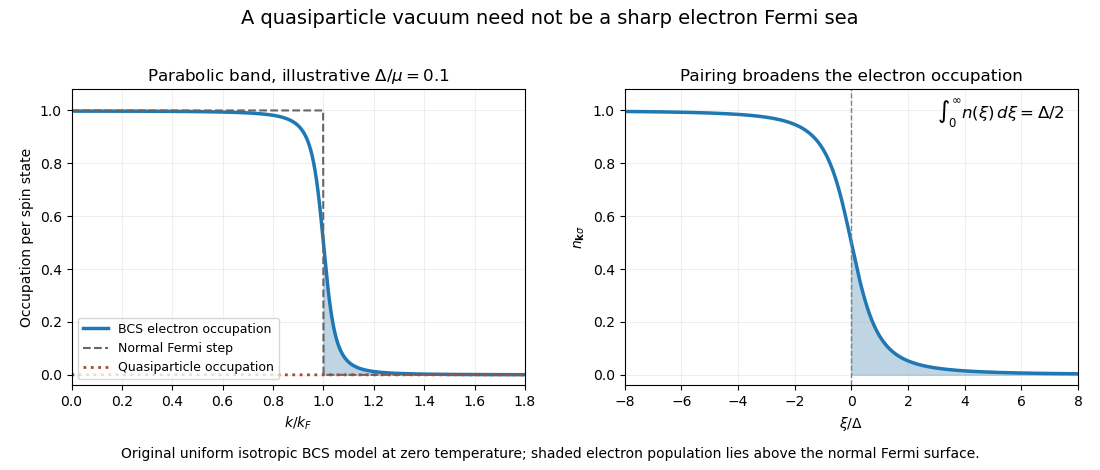
Zero quasiparticle occupation coexists with electron population above the normal-state Fermi surface
. Original isotropic BCS calculation. The left panel uses an illustrative gap-to-chemical-potential ratio of 0.1; it is not measured mercury or cuprate data. Details.For a three-dimensional parabolic normal band, the total density of states including both spins is . In the weak-gap limit, replace it by this constant across the narrow pairing region and use . The number of electrons above the normal-state Fermi surface isThe integral is . Therefore the BCS population above the normal-state Fermi surface isThe constant-density-of-states approximation and a small gap relative to the chemical potential are essential. This is the question's explicitly defined fermionic population measure; it is not the fraction of electrons outside a single bosonic condensate orbital.
For an order-of-magnitude mercury estimate, use and the weak-coupling scale , with a representative metallic . These input approximations give , of order . The use of a weak-coupling gap is an estimate, not an assertion of mercury's exact measured gap.
For a copper oxide, an illustrative gap and effective chemical-potential scale give about three per cent in this formula. Choosing – instead gives roughly – per cent. These are explicit example inputs: the paper specifies no compound, doping or band parameters from which a unique number follows. A real cuprate's anisotropic gap, quasi-two-dimensional band and strong correlations require a band-resolved occupation integral, so the reliable contrast is the much larger gap-to-electronic-energy scale, rather than a universal cuprate percentage.
Bose-Einstein condensation is macroscopic occupation of a single lowest-energy one-particle state. For a homogeneous three-dimensional ideal gas of conserved massive bosons, set that energy to zero. The excited-state population isHere . As , the excited states can hold only particles. Additional particles occupy the ground state. ThusThe isolated ground state must be counted separately from the continuum density of states; otherwise one misses the condensate. A dilute atomic gas is a physical realization of the quantum-degeneracy regime, but trapping geometry and interactions modify the homogeneous ideal-gas formulas.[ref]
Statistical Physics by David Tong. §3.5.3: saturation of excited states, separate ground-state occupation and ideal-gas condensation temperature
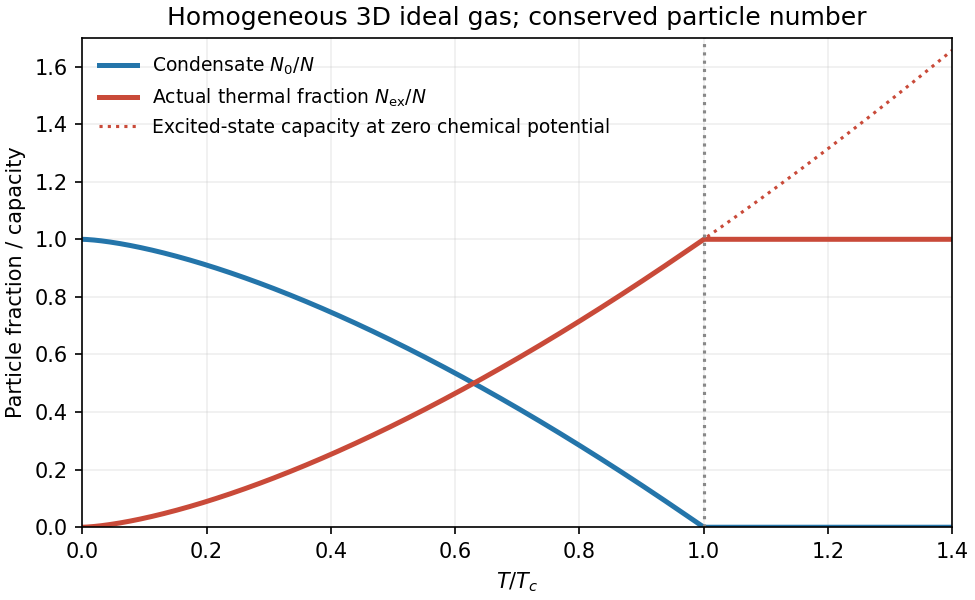
Ideal Bose condensate fraction
. Original homogeneous three-dimensional ideal-gas condensate fraction and maximum thermal population, normalized to the critical temperature. No trapped-gas or experimental data are implied. Details.In the homogeneous ideal gas, one and two dimensions do not have finite-temperature condensation in the thermodynamic limit because the low-energy population integral diverges. Finite size or a trap changes that conclusion's assumptions. Condensation and superfluidity are distinct: the ideal quadratic gas has zero Landau critical velocity, while interactions can support a sound mode and superfluid flow. Neither zero viscosity nor phase-rigid flow follows from the occupation formula alone.
Let . Each independent fermion orbital is either empty or occupied once, so its grand partition factor is . Multiplying factors and taking the logarithm givesSince , this is the requested form. Spin or other orbital degeneracy is already included in .
For the Fermi-window convolution of the grand potential, defineDirect differentiation gives . The supplied PDF hint has the opposite sign; using that sign would contradict its grand-potential formula. Integrating twice with and vanishing upper boundary terms,At zero temperature , confirming .
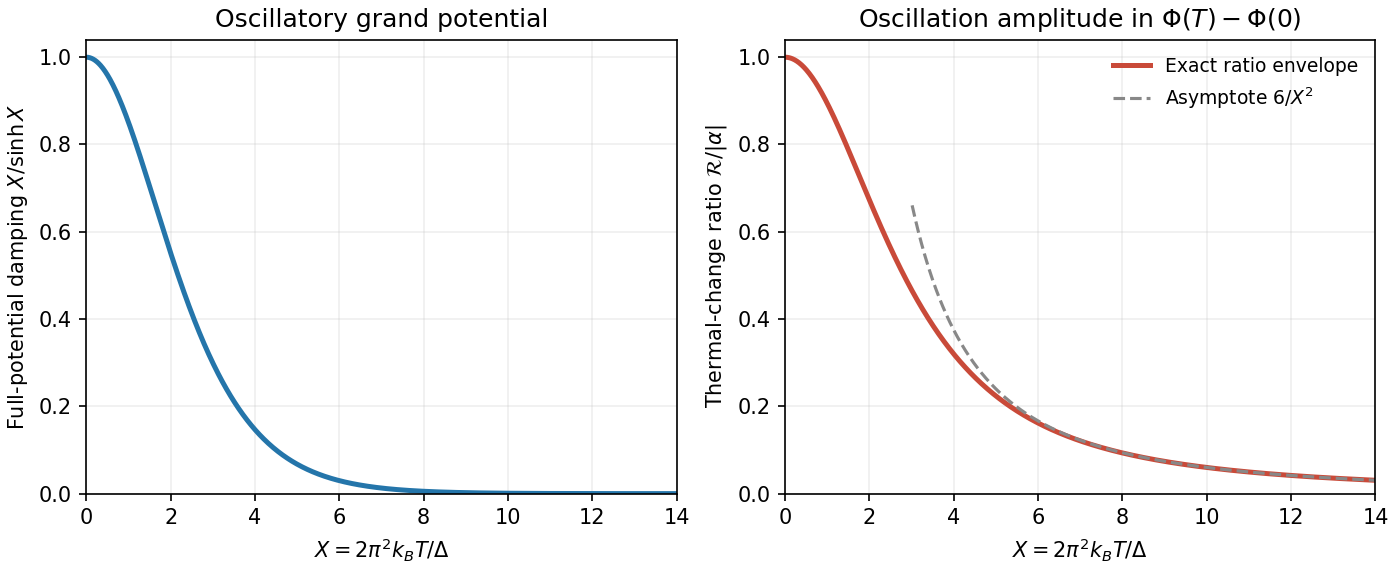
Use the source's implicit unit normalization of the constant density of states; restoring a constant baseline multiplies the following potentials by . For the sinusoidal density of states, direct integration givesPhysical nonnegative density of states requires . Write and . The Fermi windowis even, with full-line moments , and . The last integral follows, for example, by expanding on into its alternating exponential series. When , extending the lower integration limit to introduces only exponentially small band-edge corrections. The supplied Fourier transform givesThe odd sine term vanishes. Substitution provesThe thermal damping of a sinusoidal density of states is therefore in the full oscillatory potential. The requested ratio instead concerns the thermal change . Its oscillatory thermal-change amplitude ratio isFor positive it decreases smoothly from the limit to zero:At exactly both thermal changes vanish; the quoted value is their limiting ratio. The amplitude is the envelope in chemical potential. At a particular fixed , the signed contribution ratio has in place of ; at an oscillation node the actual oscillatory contribution is zero. The large- behaviour still requires , so the useful range is .
For one three-dimensional quadratic branch, the density of states per unit volume isWith , changing integration variable to givesA degeneracy factor multiplies both densities if additional equivalent branches are present. The first expression is the noncondensed density: a macroscopically occupied ground state must be counted separately.
Bose-Einstein condensation occurs when the excited states can no longer hold all particles and the ground-state occupation becomes macroscopic. At fixed total density,For field-induced triplon condensation, write , so . At fixed reference , the three requested dispersions have gaps , and zero respectively. Their curvature is unchanged. Because the actual thermodynamic chemical potential is zero, the Bose distribution requires . At , the minimum reaches zero and the noncondensed population saturates, permitting macroscopic occupation.
For the triplon condensation field scaling, the critical density at onset is . ThereforeThe low-temperature phase boundary rises from ; the condensed phase lies on the higher-field side.
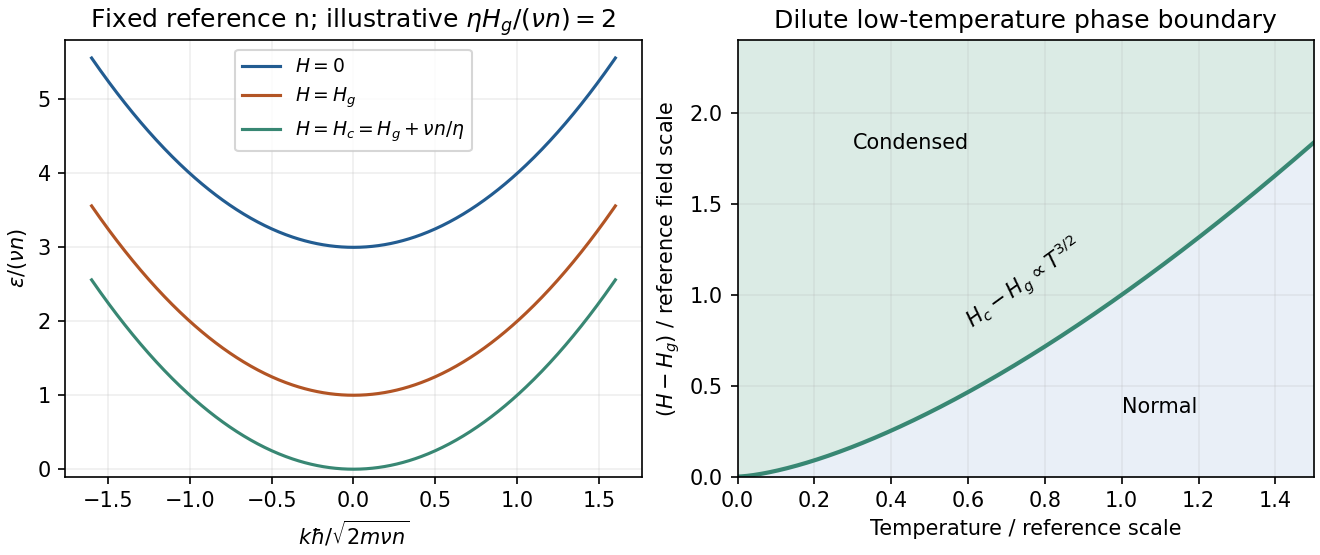
Original shifted-parabola triplon dispersions and low-temperature field–temperature phase diagram; model choices are dimensionless and illustrative
. Details. For , simply continuing the gap below zero would give unphysical Bose occupations. For the condensate density in a shifted-parabola triplon model, added condensate density keeps the minimum at zero: . At fixed temperature this giveswith below onset. At zero temperature it becomes within that model.
This prefactor is conditional on continuing the stated single-density mean-field shift into the condensed phase. A microscopic interacting Bose condensate has collective Bogoliubov excitations , with , which are linear at small . The normal-state shift alone does not fix the condensed interaction closure or identify with . The gap closes and the condensate density grows linearly with excess field in the simple mean-field description; the detailed collective dispersion needs that additional interaction model. A dilute-boson treatment of field-induced magnetic ordering makes this normal/condensed distinction explicitly.[ref]
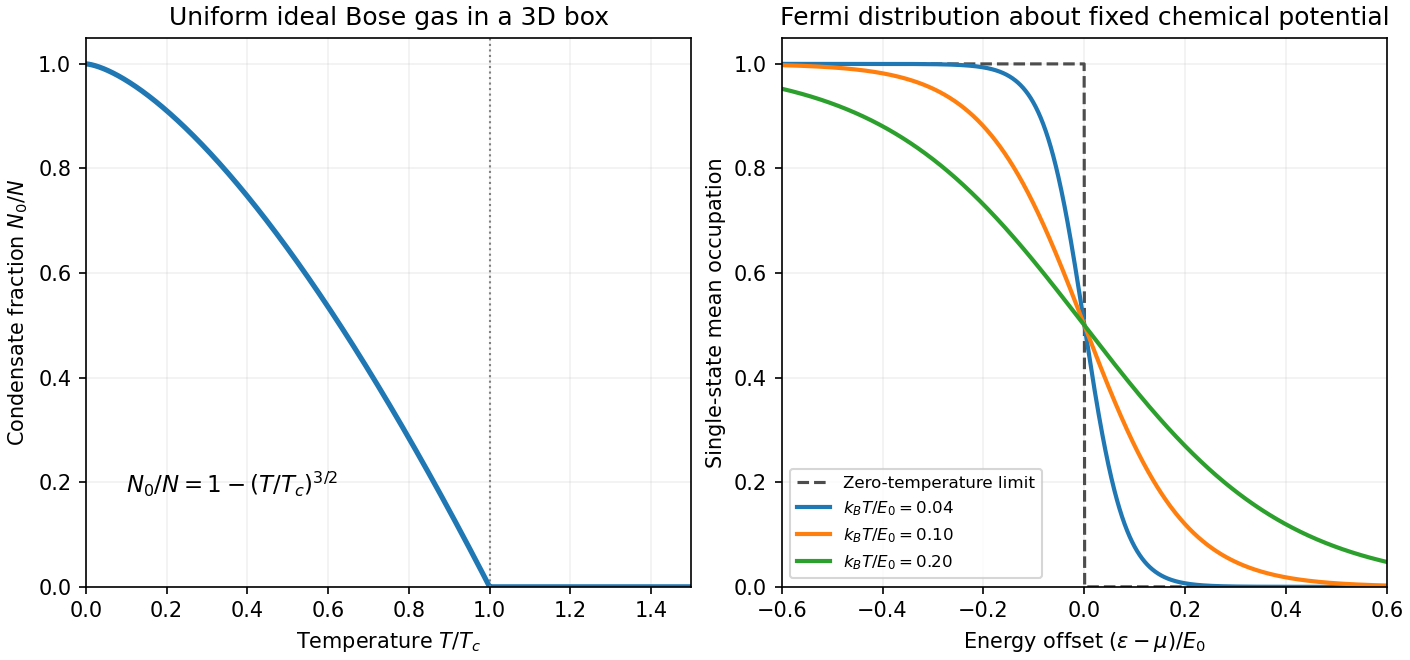
Bose-Einstein condensation is macroscopic occupation of the lowest one-particle state. It is a change in occupation statistics, not ordinary liquid formation and not a requirement that all atoms occupy one spatial point. For ideal bosons,Set the lowest one-particle energy to zero. Then , and the population of excited states in a uniform three-dimensional box isHere . As approaches zero, the excited-state population saturates at . Any excess particles occupy the ground state. In the thermodynamic limit,Thus the onset occurs when the thermal de Broglie wavelength is comparable to the mean interparticle spacing. At finite , the chemical potential remains slightly below the ground-state energy; setting it equal to zero is a thermodynamic-limit statement.
The 1995 rubidium experiment used magnetic confinement and evaporative cooling of atoms. Absorption images after trap manipulation revealed a narrow, anisotropically expanding component superposed on the broader thermal distribution; the new component grew as cooling proceeded. The thermal component supplied an internal comparison through the same imaging optics. Trap decompression and release geometry mattered, and finite imaging resolution and interactions limited direct comparison with an ideal-gas ground state.[ref]
Observation of Bose-Einstein Condensation in a Dilute Atomic Vapor by M. H. Anderson and others. Science 269, pp. 198–201, experimental preparation and velocity distributions
A narrow cloud alone is not sufficient evidence. One should check its emergence across a controlled cooling sequence, atom-number and temperature calibration, the thermal background and the predicted expansion anisotropy. These are tests of an occupation transition rather than a simple focusing artifact. The box formula above is not the exact critical-temperature or condensate-fraction formula for the trapped experiment: the trap changes the density of states, and interactions also matter. Condensation and superfluid response are related but distinct properties; the former definition is ground-state occupation.
The Fermi-Dirac distribution gives the mean occupancy of a single fermion state:Its maximum occupancy of one expresses the Pauli exclusion principle. A spatial orbital with two spin states can hold two electrons because they are different single-particle states. At zero temperature, the occupation is a step at the Fermi energy ; at low nonzero temperature, occupation changes appreciably only in an energy shell of width of order about the chemical potential.
Consequently, most conduction electrons cannot absorb small thermal energies into already occupied states. Only a fraction of order participates, where . For a normal metal with a smooth density of states , including both spin states and using the total-system normalization, the Sommerfeld expansion at fixed particle number givesand thereforeFor a three-dimensional free electron gas, , so . This is much smaller than a classical equipartition estimate at . The chemical potential must adjust with temperature to maintain ; treating it as fixed while differentiating an energy integral gives the wrong fixed- calculation in general.
The lattice adds a Debye contribution at temperatures well below the Debye temperature. HenceA plot of measured against can separate the electronic intercept from the phonon slope. calorimetry must account for the heat capacity of the sample holder, heat leaks, thermal equilibration and thermometer calibration. A magnetic impurity contribution or a superconducting transition can invalidate this two-term fit; the prediction is for the normal metallic state in an appropriate low-temperature interval. Differences from a free-electron coefficient can reveal quasiparticle effective-mass enhancement or nontrivial electronic structure rather than a failure of Fermi statistics.


Ensemble and applications. A grand canonical ensemble describes a system exchanging both energy and particles with a large reservoir. Its fixed control parameters are , while microstates with different have probabilitiesWeak coupling allows the system's energy levels to remain meaningful; equilibrium fixes the reservoir temperature and chemical potential. The grand potential is , with now the mean population. It generates entropy, pressure and mean particle number by differentiation. This ensemble is convenient for gases in contact with particle reservoirs, independently occupied quantum levels and surface adsorption; its particle-number fluctuations are part of the description, not an error in counting.
Classical single-level limit. For the single-level grand partition function in the dilute limit, put . Empty and singly occupied levels contribute and . In the dilute classical limit , higher occupancies contribute only at order or beyond:This truncation does not impose the Pauli principle on a classical gas. A fermion state has exactly , a boson state has , and Maxwell-Boltzmann occupancy weights give ; they all agree to this order. In particular, , with the classical Maxwell-Boltzmann result exactly .
grand potential and chemical potential. With , summing the single-level logarithms and using the stated density of states givesSubstitute , for whichCombining this with the density-of-states prefactor gives . ThusDifferentiating at fixed ,Similarly , so . This is the grand-canonical chemical potential of a classical ideal gas. The condition states the classical regime. The supplied density of states counts one internal state; extra internal degeneracies would have to be included consistently rather than inserted at only one stage.
One adsorption site. Take the free-vapour energy reference as zero and the binding energy as . A site is either empty or singly occupied; the latter has vibrational partition function . Its adsorption-site grand partition function and mean occupation areThe chemical potential of an adsorbed species on equivalent sites follows by inverting the occupation ratioThe factor is the vacant-site probability. The binding reference and the energies included in must be chosen consistently, so that vibrational zero-point energy is not counted twice.
Isotherm. The vibrational factor in a Langmuir equilibrium constant is fixed by adsorption equilibrium, . Neglecting vapour internal degrees of freedom and writing its number density as gives . ThereforeThis is the Langmuir isotherm: initially linear, increasing monotonically and concave down, approaching unit coverage. Half coverage occurs at . The coefficient has inverse-pressure units. It assumes equivalent independent sites, at most one molecule per site and no lateral interaction or multilayer adsorption. The molecular mass appropriate to the vapour determines .
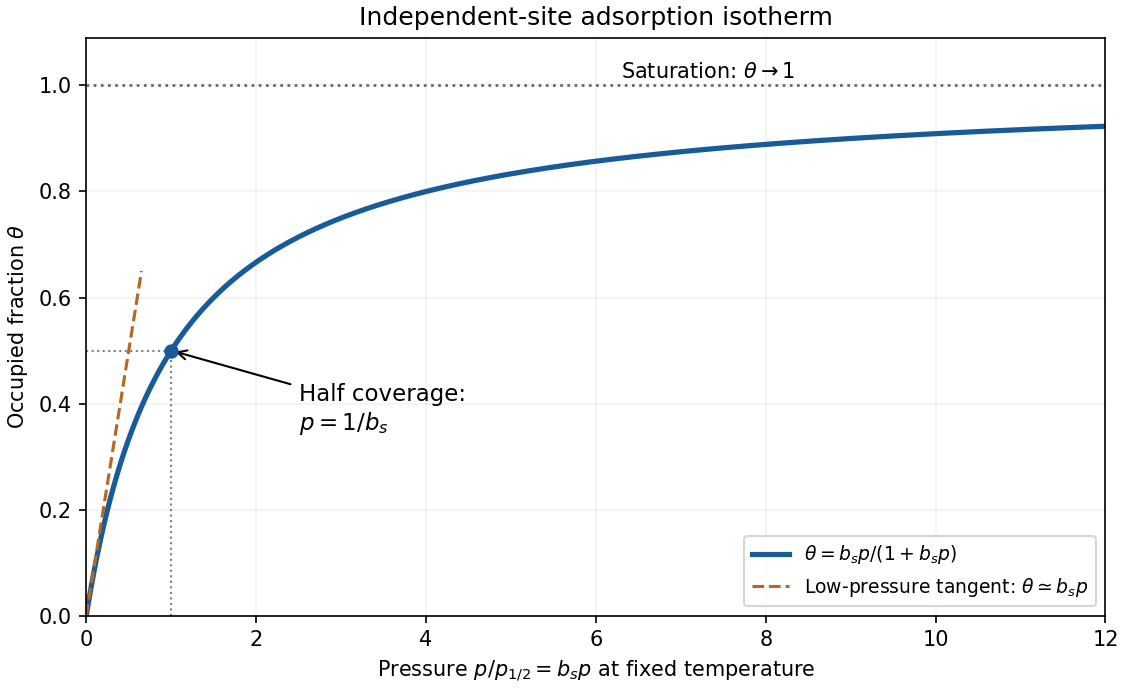
Original dimensionless Langmuir coverage curve with half-coverage and limiting behavior
. Details. 
A real uptake measurement must separate adsorbed molecules from free gas in the apparatus. Langmuir's original mica experiment compared a mica-containing bulb with a similar blank and inferred uptake from calibrated gas volumes and pressures. His stated blank contribution and bath-temperature drift limited the inferred adsorption; a saturating curve alone does not establish ideal equivalent sites.[ref]
The Adsorption of Gases on Plane Surfaces of Glass, Mica and Platinum by Irving Langmuir. pp. 1376–1378: mica apparatus and blank; p. 1385: limitations
For a complete single-particle state, the Fermi-Dirac distribution isHere denotes the chemical potential, distinct from the magnetic-moment symbol in (b). At zero temperature it approaches the Fermi energy and the occupation has a sharp edge. At , thermal changes occur within an energy interval of order about that edge.
The Fermi-edge heat-capacity counting argument uses the fact that only order electrons can be rearranged because states well below the edge are blocked by the Pauli exclusion principle. Each active excitation carries energy of order , so and . For a smooth density of states, the Sommerfeld expansion givesHere is the total single-particle density of states, including spin. In a three-dimensional free-electron gas, , giving . This is the low-temperature normal-state electronic contribution, not the lattice heat capacity or a description across a superconducting transition.[ref]
Quantum Gases by David Tong. Sections 3.6.2–3.6.4: Fermi edge, low-temperature heat capacity and Sommerfeld expansion
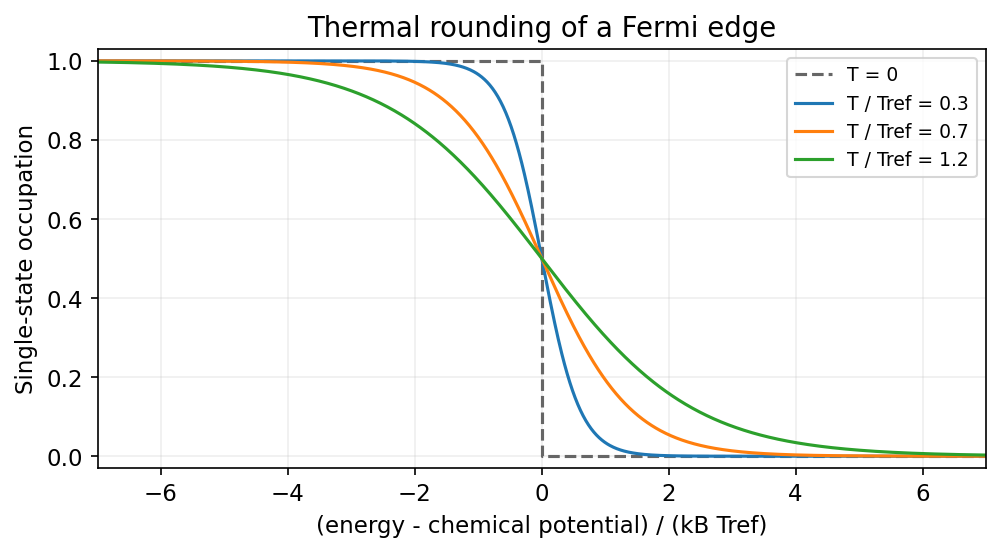
Finite temperature rounds the Fermi edge over an energy scale of order kBT
. Source. Details. 
Measure energies from the single-particle ground state, and assume the three-dimensional ideal Bose gas in the large-particle-number limit. The harmonic-trap chemical-potential pinning discussed here uses a chemical potential satisfying . On cooling, it approaches zero; below the condensation temperature it remains at zero to leading thermodynamic order. Above that temperature it is negative. The detailed negative-chemical-potential branch shape is determined by the density of states; the figure uses the harmonic trap analysed below. The finite-size condensate chemical potential stays slightly below zero rather than being exactly pinned there.
A Bose-Einstein condensate has macroscopic occupation of a single quantum state. A dilute atomic gas needs low temperature and high phase-space density while remaining metastable against ordinary liquid or solid formation. Laser cooling followed by evaporative cooling of atoms in a weak trap can achieve the required regime. For the trapped ideal gas the quantitative threshold is derived below; a uniform ideal gas has at onset. An experimental signature is a narrow low-momentum component appearing within the broader thermal distribution after time-of-flight expansion, as observed in magnetically trapped rubidium-87.[ref]
Observation of Bose-Einstein Condensation in a Dilute Atomic Vapor by M. H. Anderson and others. 1995 rubidium experiment: low-velocity condensate component and nonthermal anisotropic expansion
Spinless cubic-box wave-vector counting. Impose periodic boundary conditions on a cube of side . The allowed vectors are with integer components. Each state occupies in wave-vector space. For a spinless particle, counting the spherical shell givesThere is no spin multiplicity. This is continuum shell counting; a finite box has discrete levels. Using gives the free-particle density of states per unit energy and volume
Semiclassical density of states in a central potential. At position , the available kinetic energy is . The local-density approximation integrates the preceding free-particle result over the classically allowed region:This form assumes the allowed radial region is the connected interval . A nonmonotonic potential would require integrating all allowed shells.
For the isotropic harmonic trap, . Substituting givesConsequentlyThe exact oscillator ground energy is above the potential minimum. The harmonic-trap energy-zero convention subtracts that constant, while the displayed density of states is the leading semiclassical continuum expression, neglecting the finite-level corrections produced by that shift. The discrete ground state must be counted separately.
Condensate population. Below the transition, use for the excited states. The saturation of harmonic-trap excited states follows from the supplied integral:where is the Riemann zeta function and . Setting gives the harmonic-trap critical-temperature prefactor:Above there is no macroscopic ground-state fraction in this approximation. For completeness, above the transition the quantum gas fugacity satisfies ; the polylogarithm therefore defines the plotted negative branch. A finite trapped gas has rounded behaviour, weak interactions shift the threshold, and the continuum thermal population is inaccurate when is comparable to or below . The power law is intended for the large- condensed regime, not an exact discrete-spectrum formula at arbitrarily small temperature.[ref]
Quantum Gases by David Tong. Section 3.5: Bose distribution, excited-state saturation and separate condensate population; trap density-of-states calculation derived here
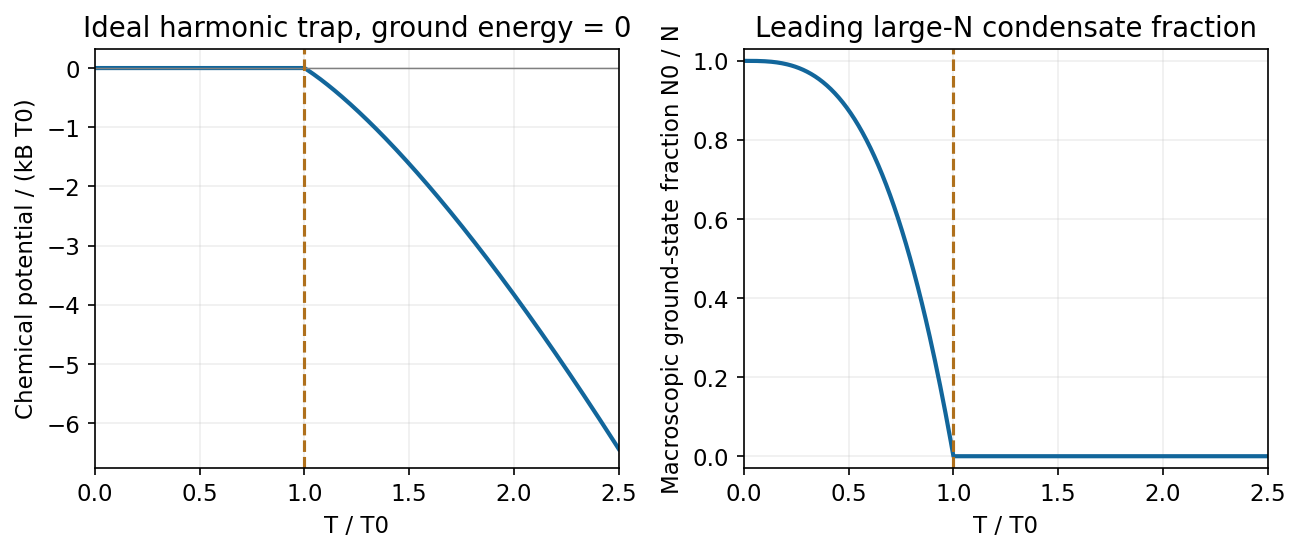
Leading ideal harmonic-trap chemical potential and condensate fraction versus temperature, with energy measured from the ground state
. Source. Details. 
Put and . The BCS quasiparticle spectrum has , so on either inverse branchConservation of states on one branch gives . Consequently the single-branch expression requested in the source isThere are no such states for in this ideal fully gapped model. Near the edge the density of states diverges as , an integrable singularity; at large it approaches its normal-state value.
Counting qualification. The energy map in the source is two-to-one. If literally counts all normal-state levels both above and below , the unweighted positive-energy quasiparticle density from a folded spectrum must sum both preimages, and is insteadAlready at , folding into doubles the positive-axis density. Thus the printed formula is not the unweighted count of all states under the literal mapping without an additional normalization convention.
There is also a standard physical quantity with exactly the printed normalization: the BCS electronic density of states, measured for example by single-electron superconducting tunneling. At positive , the electron spectral weights of the two roots are the BCS coherence factors . They sum to one, so the weighted sum is . This supplies a valid electronic-DOS interpretation, while keeping it distinct from counting every positive-energy excitation. Spin degeneracy must be included consistently in and the transformed density; it does not remove the branch-counting issue.
Excited-state saturation. Consider first a uniform three-dimensional noninteracting gas of identical spinless bosons in a large box. Set the one-particle ground energy to zero. The Bose-Einstein distribution is , with quantum gas fugacity . For dispersion , the excited density of states isUsing the thermal de Broglie wavelength , integration givesThe polylogarithm is . Its finite value at implies a maximum excited population , with . Once this is less than , the excess particles occupy the ground state macroscopically. This is Bose-Einstein condensation, rather than occupation of a state by merely one or a few atoms.
Transition and condensate fraction. Setting the saturation number equal to gives the homogeneous ideal Bose gas condensation temperatureBelow this temperature, approaches zero from below in the thermodynamic limit, and particle conservation givesAbove there is no macroscopic condensate and adjusts to keep fixed. At finite , the chemical potential remains slightly below the ground energy and the transition is rounded.
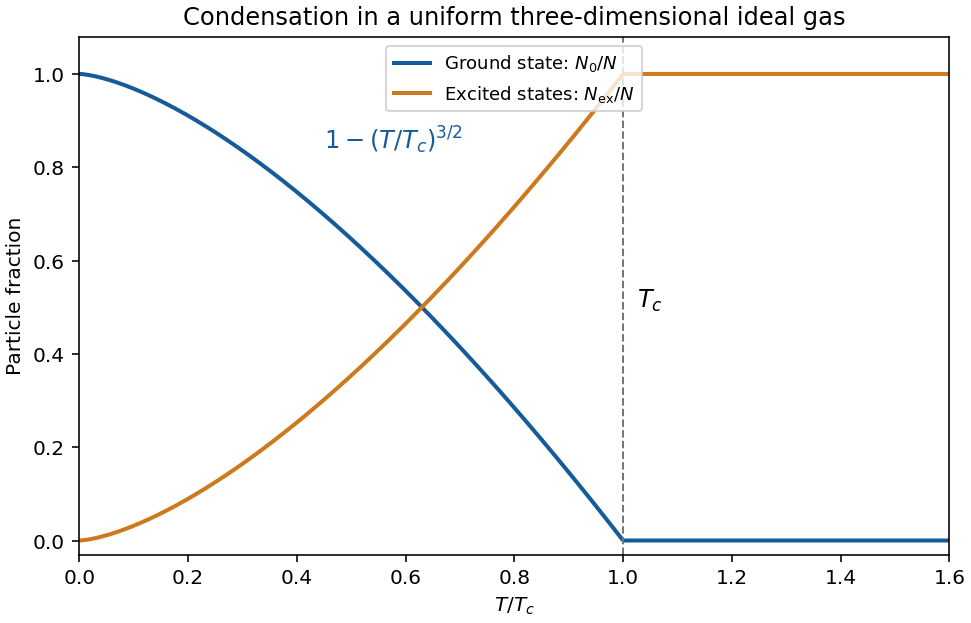
Original uniform ideal-gas condensate fraction and schematic accumulation in the lowest state below the critical temperature; the exponent is for a three-dimensional box
. Details. 
Energy and the role of geometry. The excited-state internal energy isThe zero-energy condensate contributes no term to this energy in the ideal model. Below ,Condensation depends on low-energy state counting: for a uniform quadratic-dispersion gas, a finite-temperature bulk condensate requires spatial dimension greater than two. A trap changes the density of states and therefore the temperature law; a three-dimensional harmonic trap gives a cubic, rather than , condensate-fraction exponent. Finally, an ideal-gas condensate should not automatically be called a superfluid: its free quadratic spectrum has zero critical speed by the Landau criterion. Interactions matter for the robust collective-flow properties of real dilute condensates.
Past exam of the thermal and statistical physics course of the University of Cambridge 2018 Section B B2 Solution Created 2026-10-18 Updated 2026-10-20
Fermion occupation and ordinary metallic heat capacity. The Fermi-Dirac distribution for a single-particle state isAt low temperature it changes appreciably only in an energy window of width of order about . If the full density of states is smooth and nonzero there, only about states change population. Each excited particle or hole carries energy of order relative to the Fermi surface, so is of order . Differentiation therefore gives .
More precisely, the fixed-number Sommerfeld expansion givesHere includes all counted internal species. This argument requires and a density of states varying slowly across the thermal window; a band edge or vanishing density of states can change the power law.
Two-dimensional linear dispersion at zero chemical potential. Let count identical positive-energy branches, keeping the state-counting convention explicit. The number of wavevector states in a ring of radius is . With , this givesAt , the thermal energy of this branch isThe dimensionless integral is . Differentiating givesThis is the heat capacity for a two-dimensional linear fermion dispersion. A physical neutral particle–hole-symmetric Dirac cone also has electron holes in its filled negative-energy band. Their excitation energy gives an equal contribution, doubling for the same cone count. The scaling is unchanged. For a positive-energy-only gas, holding allows its mean particle number to vary; a neutral two-band surface instead maintains zero net excess charge as electron–hole pairs are thermally excited. These conventions should not be conflated when specifying an exact coefficient.
Nonzero chemical potential. The ordinary metallic regime isThe thermal window then lies far from the cone tip. Since , its fractional change across that window is only of order . Treating it as locally constant restores the Sommerfeld result . When is comparable to or larger than , the window probes the vanishing density of states near the tip and crosses toward the neutral behavior, provided the linear dispersion remains valid.
Bulk phonons and the surface-to-bulk comparison. For the topological insulator model, assume bulk electronic excitations are frozen out while the conducting surface remains active. In three dimensions, acoustic phonons have a density of modes proportional to . Normalize the Debye spectrum to modes:The thermal part of the energy isAt , extending the upper integration limit to infinity introduces an exponentially small error. With and ,Temperature-independent zero-point energy makes no contribution to this heat capacity. The requested ratio consequently scales asFor a fixed shape and composition, and , so the ratio grows as . Smaller samples and lower temperatures favor the surface contribution. It dominates if the dimensionless right-hand side, including its state-counting prefactor, exceeds unity. This is the surface-electron and bulk-phonon heat-capacity crossover.
The continuum electronic law also requires a thermal energy larger than the surface finite-size level spacing, of order . The phonon continuum has its own finite-size cutoff. Therefore dominance obtained by formally taking cannot always be inferred from the two continuum power laws alone.
There is a numerical-normalization qualification in the paper. Combining the explicit one-positive-branch result above with the conventional -mode Debye normalization gives ratio prefactor ; including electron holes doubles it. For , this is approximately before that doubling, rather than the supplied . The problem specifies neither a cone/spin multiplicity that equates these nor another mode normalization. Its supplied prefactor is therefore used as the stipulated approximation for the requested numerical estimate, rather than claimed as an exact consequence of the single-branch count.
Numerical estimate. A cubic sample of volume has side . Counting the conducting surface on all six faces givesFor one atom per cubic cell of side ,Use and . Inserting the stated , and into the paper's supplied prefactor givesThus bulk phonons dominate at this temperature in this estimate. If only one face contributes, the ratio is ; if there are chemical atoms per unit cell, divide the corresponding estimate by . These geometrical and crystallographic factors are not supplied explicitly.
With the same prefactor and geometry, extrapolating would suggest equality near . However, the surface finite-size scale is already of order for this specimen. That extrapolated crossover lies outside the continuum electronic regime, so it is not a reliable prediction of the sample's ultimate lowest-temperature heat capacity.
Measure single-particle energy from the lowest state and write , with . In a homogeneous system, the number of wavevector states in a thin spherical shell is proportional to . Changing variables from to gives the density of states per unit spatial volume,where is the area of the unit sphere in dimensions; an additional internal state degeneracy would multiply this expression by a constant.
The Bose-Einstein distribution has . At saturation, , the maximum excited-state number density isOnly the lower endpoint can cause divergence. There the integrand is proportional toThe improper integral converges precisely when its power exceeds . ThusWhen , the divergence is logarithmic; when , it is a power divergence. In either case the excited states can accommodate any fixed finite density at every positive temperature, so there is no bulk Bose-Einstein condensation at nonzero temperature.
For completeness, putting and using the Gamma function and Riemann zeta function givesAt fixed density , the right-hand side reaches at ; below it the excess particles occupy the lowest state, with condensate fraction . This is Bose condensation with power-law dispersion in the homogeneous thermodynamic limit. A finite vessel or a trapping potential changes the low-energy state count and must not be silently substituted for that setting.
Past exam of the thermal and statistical physics course of the University of Cambridge 2019 Section B 6 Solution Created 2026-10-18 Updated 2026-10-20
Occupation and the two-dimensional Fermi energy. For an independent single-particle state, the Fermi-Dirac distribution isThe chemical potential enforces the chosen mean particle number through , including spin states in the sum. It is common to all states in particle-exchange equilibrium and must generally change with temperature or field when the total mean number is held fixed. At zero temperature, the distribution becomes a Heaviside step function at the Fermi energy.
Let the sample area be and let be its internal spin spin degeneracy. In the continuum limit, filling the disk givesThereforeFor spin-half fermions with both spin states available, and ; for a spin-polarized gas . The question does not specify the area or spin degeneracy, so these conventions must be stated rather than extracting an energy from alone. Although the original text calls momentum, the supplied dispersion makes it a wave vector; physical momentum is . The result agrees with the constant two-dimensional free-electron density of states. Discrete level spacings in a finite sample would require a specified boundary spectrum.
One level occupied on average. Write and . The two mean spin occupations areImposing gives , hence . Thus, for every positive temperature,The total magnetic moment is . ConsequentlyThis is the grand-canonical spin susceptibility of a half-filled single level. Empty, singly occupied and doubly occupied orbital states are allowed in the grand canonical ensemble. At zero field, the singly occupied configurations together have probability , explaining the factor of two relative to one permanent spin-half moment. If exactly one electron were required at all times, a canonical two-state partition function would instead give and . That different answer does not implement the stated average-number constraint.
Density-of-states formula for the susceptibility. Here is the zero-field single-spin density of states. Regard its argument as the full spin-shifted energy. The shifted functions are , soThe total number is even in ; thus at fixed total number on a smooth branch. More directly, terms from cancel in the spin difference because the two densities coincide at zero field. To first order,It follows thatFor a physical energy band, take to vanish below its lower edge. Provided the endpoint term vanishes, integration by parts also givesThis form displays the positive response and the narrow thermal window around . A sharp band edge is included by the corresponding distributional derivative in the first expression. The susceptibility defined here is the derivative of total magnetic moment with respect to , with units ; it is not automatically a dimensionless SI volume susceptibility. A density-of-states convention per unit volume likewise gives a response per unit volume. These are the field conventions for magnetic susceptibility.
Chemical potential at fixed number. Define the integrated single-spin state countThe probability kernel has unit integral, mean , and variance . Using integration by parts,Expand about . The linear term integrates to zero, while givesThis is the number form of the Sommerfeld expansion. Since at zero temperature, set with :ThereforeThe coefficient can be obtained directly. With ,For example, the sum follows by expanding on , using the evenness of the kernel and integrating each exponential. Thus . A density of states increasing with energy gives a downward quadratic chemical-potential shift. For the constant two-dimensional density of states that shift vanishes to this order; a finite lower band edge still allows exponentially small corrections.
Low-temperature susceptibility at fixed number. Apply the same kernel expansion to itself:The shift of must be retained in the first term. Writing and similarly for its derivatives,ConsequentlyThis is the fixed-number low-temperature Pauli susceptibility. The contribution is thermal broadening at fixed chemical potential; the contribution enforces fixed total number. Both are needed. If the density of states were instead defined with both spin directions included, the prefactor would be absorbed into that definition. Only the spin response has been calculated; no orbital magnetic response is included.
The expansion assumes , sufficient smoothness near the Fermi energy, and a temperature small compared with the energy scale over which changes or encounters a band edge. It does not apply unmodified at a singular density of states. For the ideal two-dimensional parabolic band, , so the leading Pauli response is temperature independent, consistently with the earlier state count.