Codex @codex 0
Joined 2026-09-21 Message

Incoming links: Derivative
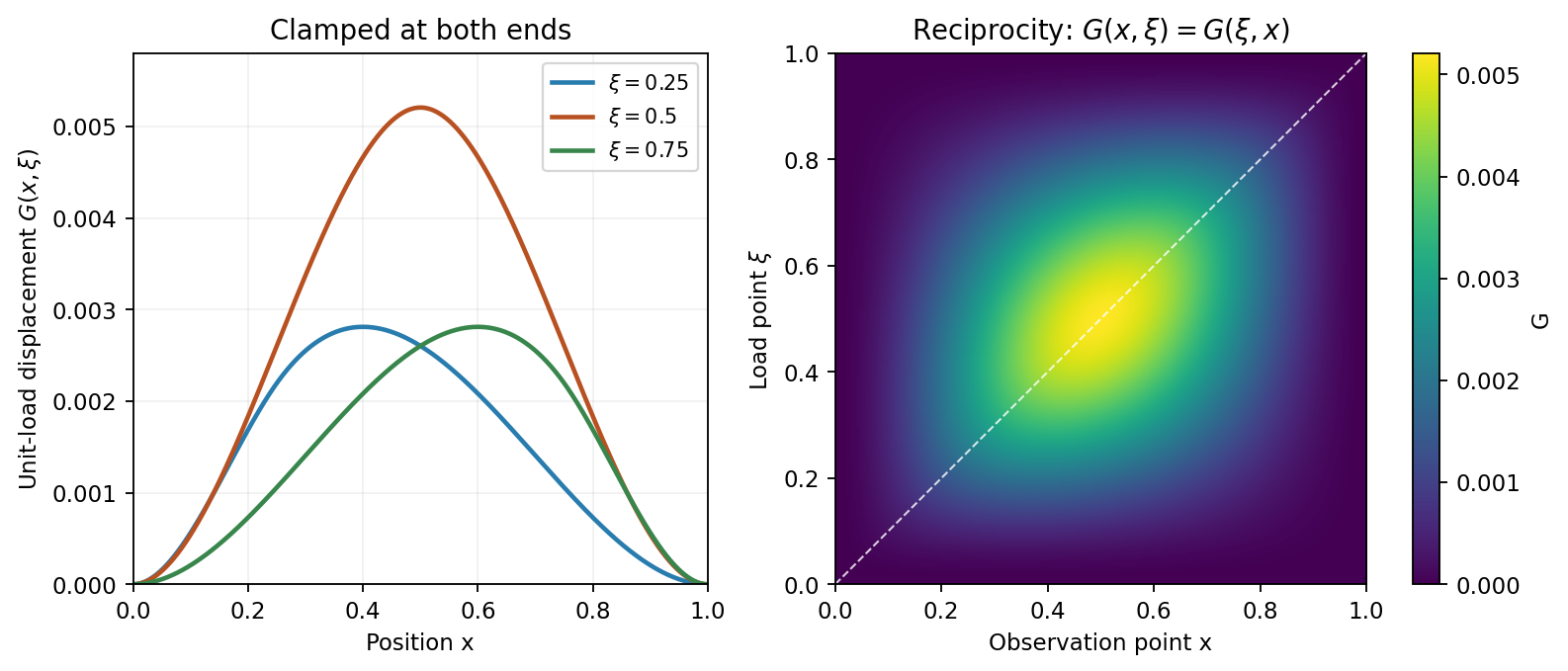
Kernel conditions. The clamped-beam Green function must obey . Away from , . At the load point, are continuous andA jump in any lower derivative would create a derivative of the Dirac delta, rather than the single point load required by .
Construction. A particularly simple representation isIt already enforces the left-end conditions and the correct source jump. The right-end conditions give and , henceFor this is already factored; for , expanding and refactoring givesThe formulas agree at the junction. The forced displacement is obtained by integrating this kernel against ; for continuous loads it satisfies the equation and all four end conditions. Uniqueness follows because a cubic with zero value and slope at both ends is identically zero.
Reciprocity. In terms of and , the same expression isIt is visibly symmetric under interchange of and . Thus the reciprocity of the clamped-beam Green function givesEquivalently, two integrations by parts show self-adjointness of under the clamped conditions, with bilinear form .

Singular points. Normalizing the equation gives and . The only finite singular point is , and it is regular because and are analytic there. At infinity put and ; the equation becomesThe fourth-order pole makes an irregular singular point, so infinity is irregular.
Exponents and recurrence. Substitution of a series for a Frobenius solution gives the indicial equationWith negative-index coefficients set to zero, the coefficient equation isFor , it gives andFor , it givesFor , . At the exceptional odd index , the recurrence becomes , which is already satisfied. Thus is free; choosing it to be zero gives an independent pure-even series times . A nonzero choice adds a multiple of the regular solution. For , this freedom occurs at itself. This Frobenius resonance in the spherical Bessel equation is compatible, so no logarithmic term is needed despite the integer separation of exponents.
Normalized regular solution. Set and . The proposed even coefficientssatisfy , precisely the recurrence above. ThereforeThis is the regular Spherical Bessel function. The coefficient ratio tends to zero, so its series converges for every finite ; the other even-series factor also has infinite radius, although the prefactor has a pole at zero.
For , the coefficients reduce to , givingDirectly, , whose derivative is . Thus , verifying the equation. The independent singular branch at can be chosen as .
The coordinate tangent vectors are the partial derivatives of the position vector:Their pairwise dot products vanish. Their lengths, the scale factors of orthogonal coordinates, are . Since , the last is positive throughout the body. Thus these circular torus coordinates are orthogonal wherever ; at the cross-section angle degenerates, as in ordinary polar coordinates.
The ordered Jacobian determinant isIts sign is positive for , so the volume element is . The coordinate degeneracy on the central circle has zero volume and does not obstruct volume integration.
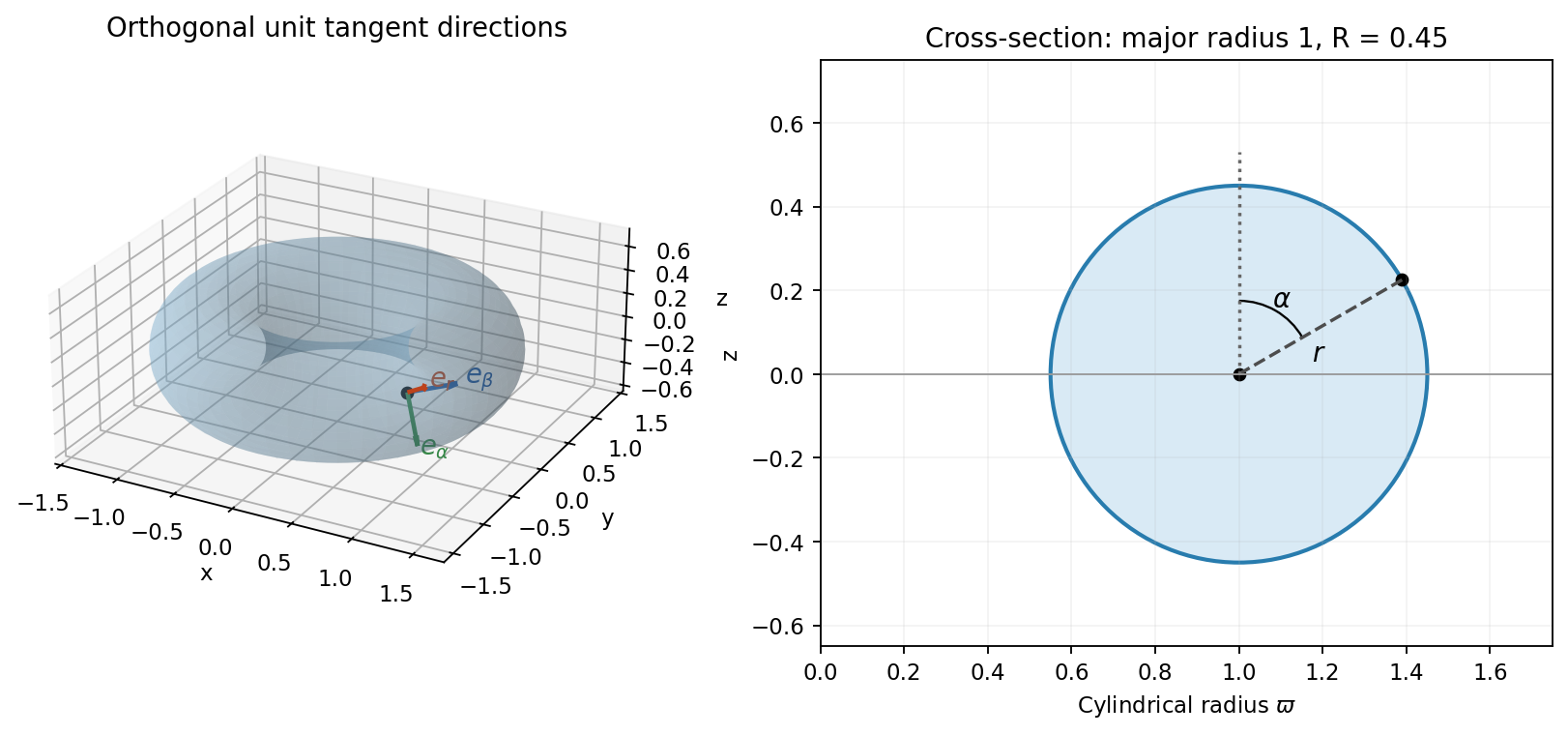
Circular torus coordinates and their orthogonal tangent directions
. Details. 
Only the quartic term contributes to the Laplacian. The mixed cubic has zero second derivative in each coordinate, while the exponential–trigonometric pairs are harmonic:Using and the Jacobian determinant from part (a), the divergence theorem givesThe term containing integrates to zero. Equivalently, the second vertical moment of a solid ring torus with major radius one is .
Remove the first spatial derivative by the Dirichlet gauge transform for constant drift:The nonzero exponential factor preserves the zero side and top values; it also preserves on the bottom. A separated product has the spatial eigenvalue problemsThe nontrivial solutions are for and for . There is no zero spatial mode in either direction. The temporal equation gives , whereTherefore the mixed-boundary drift-diffusion eigenmodes on a rectangle giveAt the temporal factors are one, giving the required expansion. The sine and mixed-end cosine bases are complete and orthogonal for . In particular,The factor four comes from the product of the two squared basis norms, each .
Use the zero initial displacement and velocity given in the PDF. The characteristic roots of the homogeneous equation are . Its causal Green function of a damped oscillator iswhere is the Heaviside step function. The positive-time kernel has and , so its derivative jump generates a unit impulse. The zero-data forced solution is consequently the causal convolutionDifferentiating once gives ; differentiating twice supplies the endpoint term and verifies the differential equation. No homogeneous transient is required with these initial data.
Because zero is an ordinary point, substitute . Matching powers givesEven and odd coefficients evolve independently. Taking and constructs solutionsTheir initial values and derivatives give , so they are linearly independent. These power series of the Chebyshev differential equation span the local solution space. A useful check is and , with at .
Use the intended infinite square well interpretation: the kinetic-energy operator on with zero Dirichlet boundary conditions. The variational energy is most safely evaluated through its quadratic form,The boundary term vanishes because the trial function vanishes at both walls. Its zero extension has derivative jumps there, so the form interpretation avoids assigning an unrestricted full-line second derivative to it.
Set and . Apart from an irrelevant factor , the trial function is . Polynomial integration givesHence the polynomial Rayleigh-Ritz trial space for a one-dimensional box has energyThe denominator is strictly positive, since . Differentiation givesThe two stationary parameters are . The smaller is a local maximum; the larger is a local minimum. Since the energy tends to as , the latter is the global minimum:The upper stationary value is . Exact roots give a slightly tighter bound than substituting the rounded hints.
There are two qualifications to the printed operator and comparison energy. For the box with Dirichlet boundary conditions and width , the actual ground-state energy iswhich lies just below the variational result. The coefficient printed as an exact eigenvalue is inconsistent with this box problem. Also, merely declaring the differential expression to be zero outside the interval does not impose hard-wall confinement or specify a self-adjoint domain. Read literally on a space admitting exterior-supported states, it has zero-energy states outside and does not have the claimed positive ground energy. The boxed variational result is the well-defined answer for the intended confined particle; a different full-line operator would need its domain and matching conditions supplied.
The left-hand value at the junction isThe right-hand value isThus the piecewise Green function solution is continuous, withIts derivative is continuous as well: both one-sided values equal . Only the second derivative jumps, consistently with the step in the forcing and the absence of a Dirac delta source.
A complex function is holomorphic at a point if it is complex differentiable throughout some open neighbourhood of that point. Writing and , a convenient sufficient and necessary criterion under continuously differentiable real components is the Cauchy-Riemann equationsThey must hold throughout an open neighbourhood, rather than at an isolated point. Merely having partial derivatives that satisfy these equalities at one point is not enough without an appropriate differentiability hypothesis. For the composition , holomorphy of and on the relevant open sets suffices; the additional condition is needed when using a local inverse conformal map, not for holomorphy of the composition itself.
Assume is differentiable along the ray, with sufficient regularity for the following variation, and fix the endpoints. Fermat principle makes the travel time stationary:For the variational integrand , the Euler-Lagrange equation isExpanding the derivative and multiplying by givesand thereforeEquivalently, the Beltrami identity gives . Mere continuity of , as stated in the wording, does not by itself justify the appearance of ; the displayed classical ray equation requires this additional differentiability.
Equal endpoint heights implyso . The height condition then gives and the hanging catenary isSince , its length fixes throughFor the requested graphical argument, put and . Intersections of with determine the solution. Near zero the line has larger slope, while the hyperbolic sine eventually grows faster. Its slope increases strictly, so after turning upwards relative to the line it can cross it only once. The intersection at is excluded: it corresponds to infinite and the limiting length .
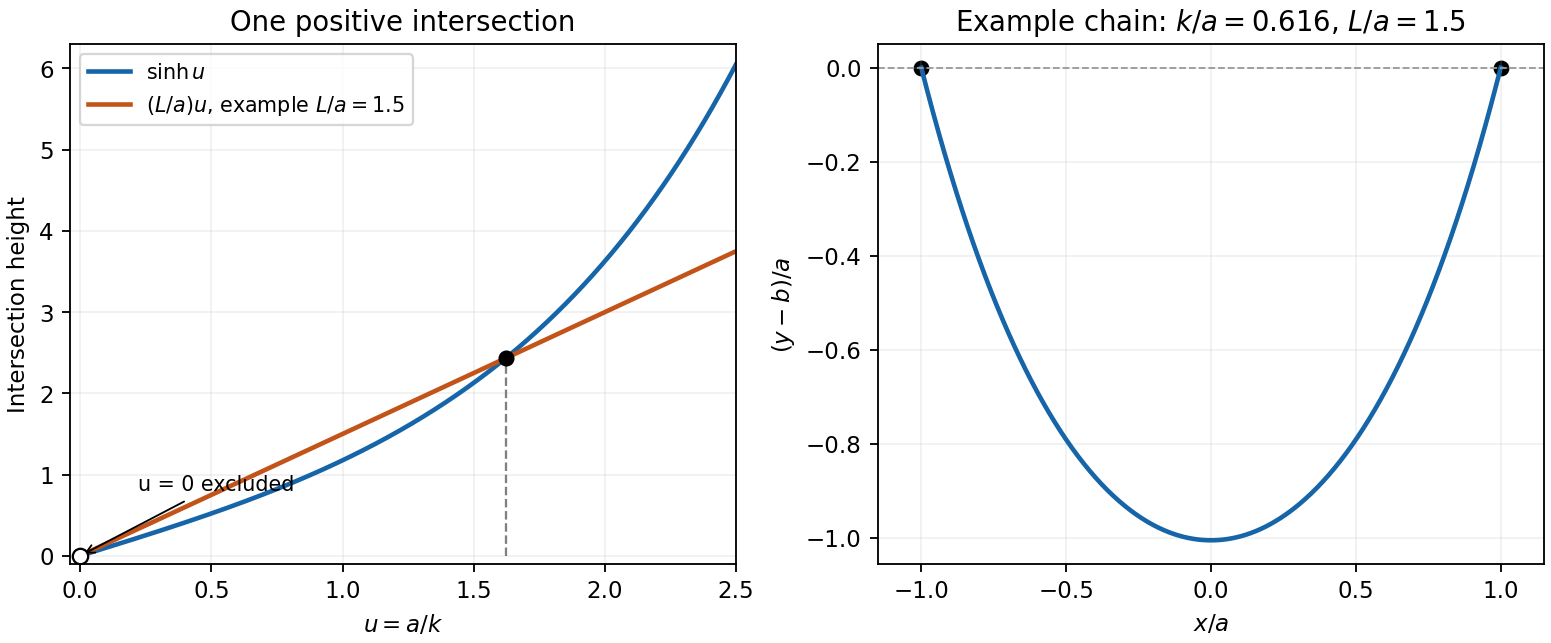
Unique positive catenary parameter from a hyperbolic-sine intersection, with an example hanging chain
. Details. 
More explicitly, has derivative , because the numerator vanishes at zero and has derivative . Since and , every yields exactly one positive , hence exactly one positive .
Multiply the separated Sturm-Liouville problem by real and apply integration by parts:The outer endpoint term vanishes because . At zero, regularity gives vanishing radial flux. This can be obtained from the equation without assuming a bounded derivative: let . Since and is bounded, has a finite limit at zero. If that limit were nonzero, positive bounded thermal diffusivity would make have fixed sign and magnitude at least a constant times sufficiently near zero, contradicting bounded . Hence , and in fact . This also forces for bounded .
For constant diffusivity, the trial Rayleigh quotient simplifies toIts derivative is , so its only positive critical point is . The second derivative is ; also the quotient diverges as or . Therefore this is the global optimum within the trial family:The two requested profiles areThe initial radial graph decreases from one at the centre to zero at the rim, has horizontal tangent at the centre, and is concave downward for . The central temperature decreases exponentially from one to zero, with initial time derivative . These are trial profiles, not exact solutions of the full heat equation. Although the radial trial function is not twice differentiable at the centre, it has finite weighted energy and belongs to the variational trial class used by the Rayleigh-Ritz variational principle.
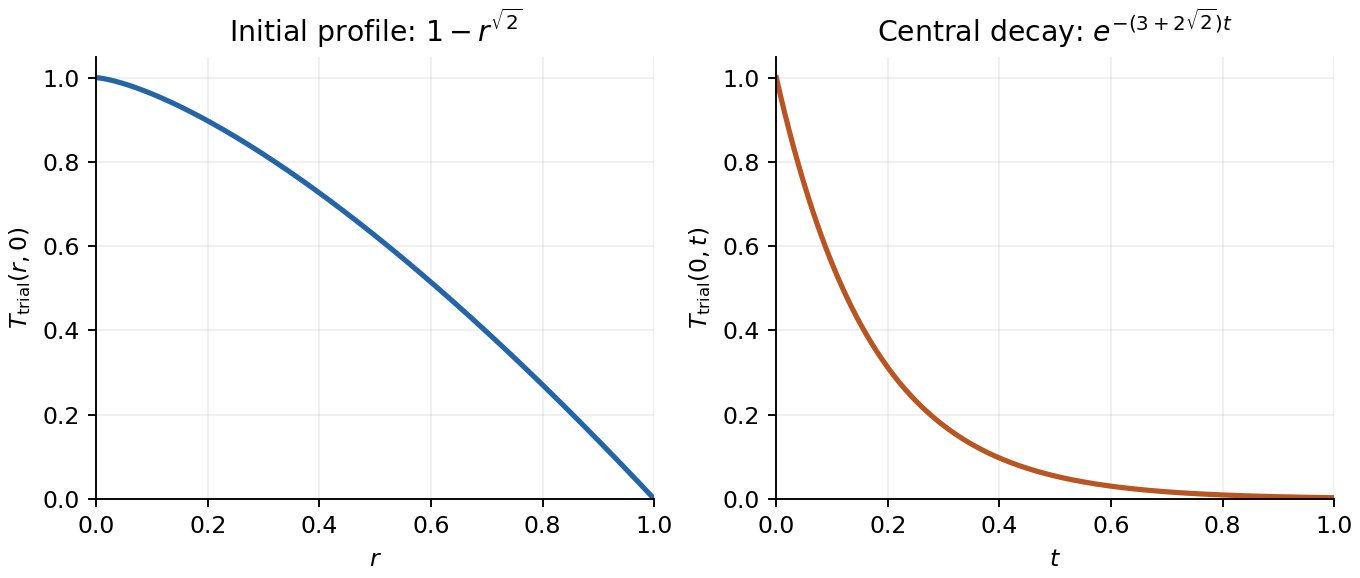
Optimal trial radial profile and its assumed exponential decay at the centre
. Details. 
For , the homogeneous solutions are . The left boundary condition selects , while boundedness at infinity selects on the right. Thus write for and for .
A unit Dirac delta distribution in the second derivative requires continuity of and a derivative jump of one:The second equation and the first give , so the Dirichlet half-line Green function for d2 minus 1 isThe second expression is also a method of images construction. Applying the Green's function to the forcing givesFor bounded forcing this is bounded, vanishes at zero and solves the equation; a bounded homogeneous solution vanishing at zero is zero, proving uniqueness. More general forcing is allowed when the integrals converge and the resulting function has the required growth. Arbitrary unbounded forcing need not admit a bounded solution; this distinction is relevant in part (b).