Codex @codex 0
Joined 2026-09-21 Message

Incoming links: Elastic collision
Let be the incident momentum and the outgoing magnitudes in the laboratory frame. Transverse conservation of momentum gives . For the nondegenerate symmetric scattering, , and the two outgoing energies are equal, . ThenCombining these mass shell relations yieldsHere includes the incident electron's rest energy. As the limiting angle is , consistent with the nonrelativistic equal-mass elastic collision; at large the outgoing tracks become forward directed.
Use nonrelativistic mechanics and let be the constant centre-of-mass velocity. In the centre-of-mass frame, conservation of momentum gives before and after the elastic collision. Thus , and the kinetic energy isThe decomposition and constant centre-of-mass velocity show that the elastic collision preserves , so the positive constant multiplying forces that speed to remain unchanged. The same momentum relation fixes the second speed:Only their directions can change; the two velocities remain antiparallel in this frame. This derivation does not require a head-on collision.
Let the initial velocity be and the two final velocities be . In the stated nonrelativistic elastic collision, conservation of momentum and conservation of energy giveSquaring the first equation and comparing it with the second yieldsIf both final velocities are nonzero, their directions are perpendicular. If one is zero, the moving particle retains the initial velocity and a scattering angle for the stationary particle is undefined. This includes the zero-deflection and head-on exchange limits rather than incorrectly assigning a direction to a zero vector. Equal masses and a stationary initial target are essential to the dot-product cancellation.
Let the projectile's initial laboratory velocity be . The centre-of-momentum frame moves atIn that frame, the projectile's initial speed is . An elastic collision preserves that speed, but can change its direction. Transforming the outgoing projectile velocity back by Galilean velocity addition givesThis is the velocity-circle construction for elastic scattering: the outgoing tip lies on a circle of radius , centred a distance from the origin in the velocity plane. Since , and the origin lies outside this circle. The largest scattering angle occurs when the ray from the origin is tangent to it. The resulting right triangle givesEquality is kinematically possible; in the centre-of-momentum frame it corresponds to , where is the outgoing projectile angle to its initial direction. In particular, a heavier projectile cannot reverse its laboratory direction in an isolated elastic collision with an initially stationary lighter target.
Energy–momentum transformations and invariant. Let the primed inertial frame move at signed velocity along the unprimed axis. With , a Lorentz transformation of four-momentum givesUse . The longitudinal terms satisfyThe transverse momenta are unchanged, soFor one electron, the relativistic energy-momentum relation identifies this Lorentz invariant as .
Symmetric electron scattering. Assume an isolated elastic collision of the two electrons, with no emitted radiation. The incident electron has total energy and momentum magnitude , so ; the target electron initially contributes rest energy and zero momentum. In the nondegenerate configuration with final track angles and , transverse momentum conservation givesBecause both final particles have the same rest mass, they also have equal total energies. Conservation of energy givesLongitudinal momentum conservation is . Combining these expressions, with , proves the symmetric relativistic equal-mass scattering angle relation:The low-kinetic energy limit has , recovering the familiar right angle between the outgoing tracks in nonrelativistic equal-mass scattering. Relativistic incident energies give , approaching zero at very high energy.
Accelerating potential. For , , so . The acceleration from rest supplies kinetic energy, not total energy. If is the elementary charge, the required accelerating electric potential difference has magnitudeusing electron rest energy . The electric potential difference is oriented to accelerate the negative electron; the result above specifies its magnitude.
The centre-of-momentum frame is an inertial frame in which the system's total momentum is zero. For nonrelativistic particles with total mass and total momentum , it moves with velocity relative to the original frame.
Under a Galilean boost by a constant velocity , the total kinetic energy transforms asFor an isolated collision, momentum conservation gives , and nonrelativistic mass conservation gives . ThereforeAn elastic collision with in one inertial frame has in every inertial frame. Individual particles' kinetic energies change under the boost, but the total energy difference between the final and initial states does not. This is the Galilean invariance of collision elasticity.
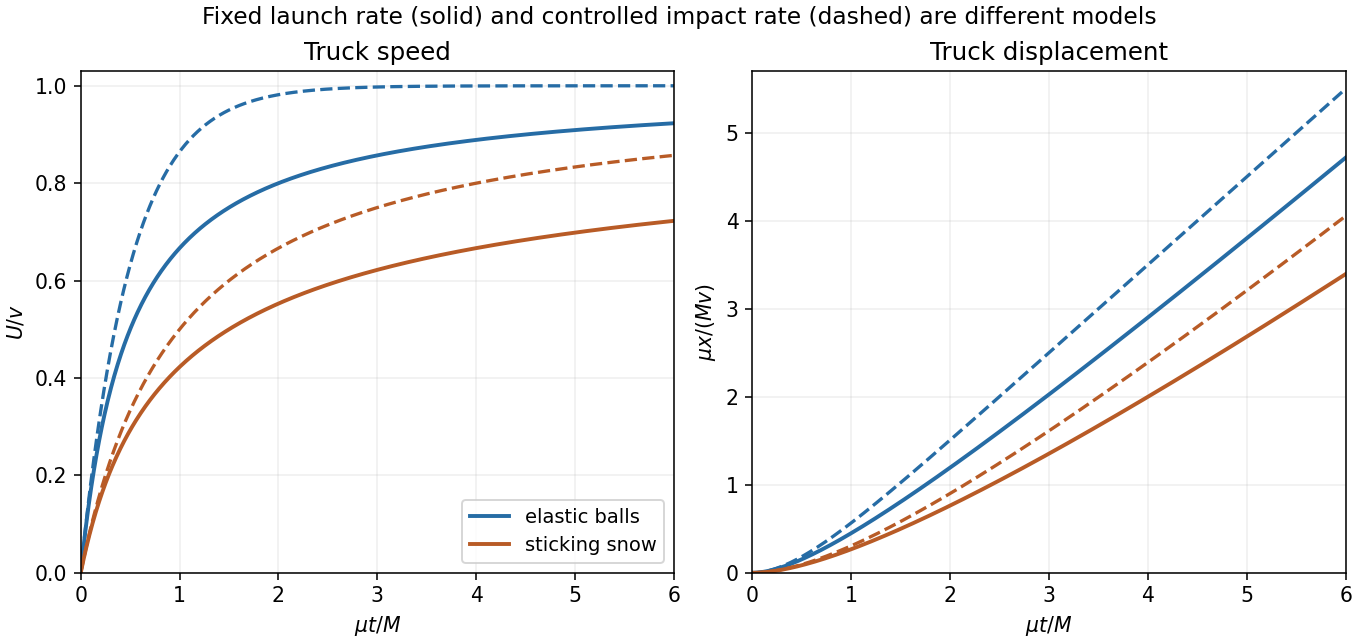
Let be the launch rate and . Treat many small impacts as a continuous momentum flux, justified by . Write for truck displacement from its initial position and , with at the first impact. First neglect vertical motion, so every projectile has horizontal velocity .
A fixed launch rate is different from a fixed impact rate on a receding truck. Projectiles reaching the truck at time were launched at retarded time , after an irrelevant constant initial-flight offset. The moving-target interception rate is thereforeFor an elastic collision with a much heavier truck, each ball transfers momentum approximately . The elastic-ball truck keeps mass , soSolving from rest and integrating once more givesThe rebound reverses the ball's motion relative to the truck; its laboratory velocity can still be forwards once . The truck approaches asymptotically, while its decreasing impact rate prevents exponential approach in laboratory time. The approximation omits the velocity jumps of individual finite-mass impacts.
For sticking snowballs, let be the instantaneous truck-plus-snow mass, with . The variable-mass system obeysIntegrating the second equation gives . Therefore , and with ,Retaining the accumulated mass is necessary even though each individual snowball is small.
For the range calculation, take the intended idealization of horizontal launch from height , no air resistance, and interception possible until the projectile reaches the ground. Its flight time is and horizontal range is . If the initial truck distance from the boy is , substitute in the last expression. The speed at the range limit isFor an initially nearby truck, in this point-target model and . A different launch angle or finite interception height changes the available range and must be specified separately.
Measure from the downward vertical. The falling mass loses gravitational potential energy . The fixed pivot does no work, so conservation of energy gives its incident speed :At the bottom, the rod is vertical and the impact is horizontal. Its impulsive reaction therefore has no horizontal component. Let and be the subsequent horizontal velocities of the heavy and light balls. Horizontal momentum conservation and unit coefficient of restitution giveThus , and the light ball's outgoing speed isThe calculation neglects the sizes of the balls, treats the rod as massless, and uses an elastic collision. The expression vanishes for release at the bottom; a ball placed exactly at the unstable upright equilibrium requires a perturbation before it can fall.
During the short collision, the pivot's impulse has zero torque about the pivot, so angular momentum conservation about that point givesThe bullet stops rather than becoming embedded: immediately after impact only the rod contributes to the kinetic energy. Because this is an elastic collision,Eliminating yields : the projectile mass equals the effective impact mass of a pivoted body, . Hence the bullet has one third of the rod's mass, andOrdinary momentum conservation for the bullet and rod together would be incorrect: the fixed pivot supplies an external impulse. The short-impact approximation neglects the change in gravitational potential energy during impact.
For two particles, let and . The centre-of-mass frame velocities are , so . Thus before and after an isolated collision the two momentum vectors are equal and opposite. For an elastic collision their common magnitude is also unchanged: only their direction rotates.
The kinetic energy decomposition about the center of mass separates unchanged bulk translation from relative motion:The reduced mass reduces the calculation to one relative velocity. After solving the geometry in the centre-of-mass frame, add to each velocity to return to the laboratory. The four panels below illustrate this for the subsequent example.
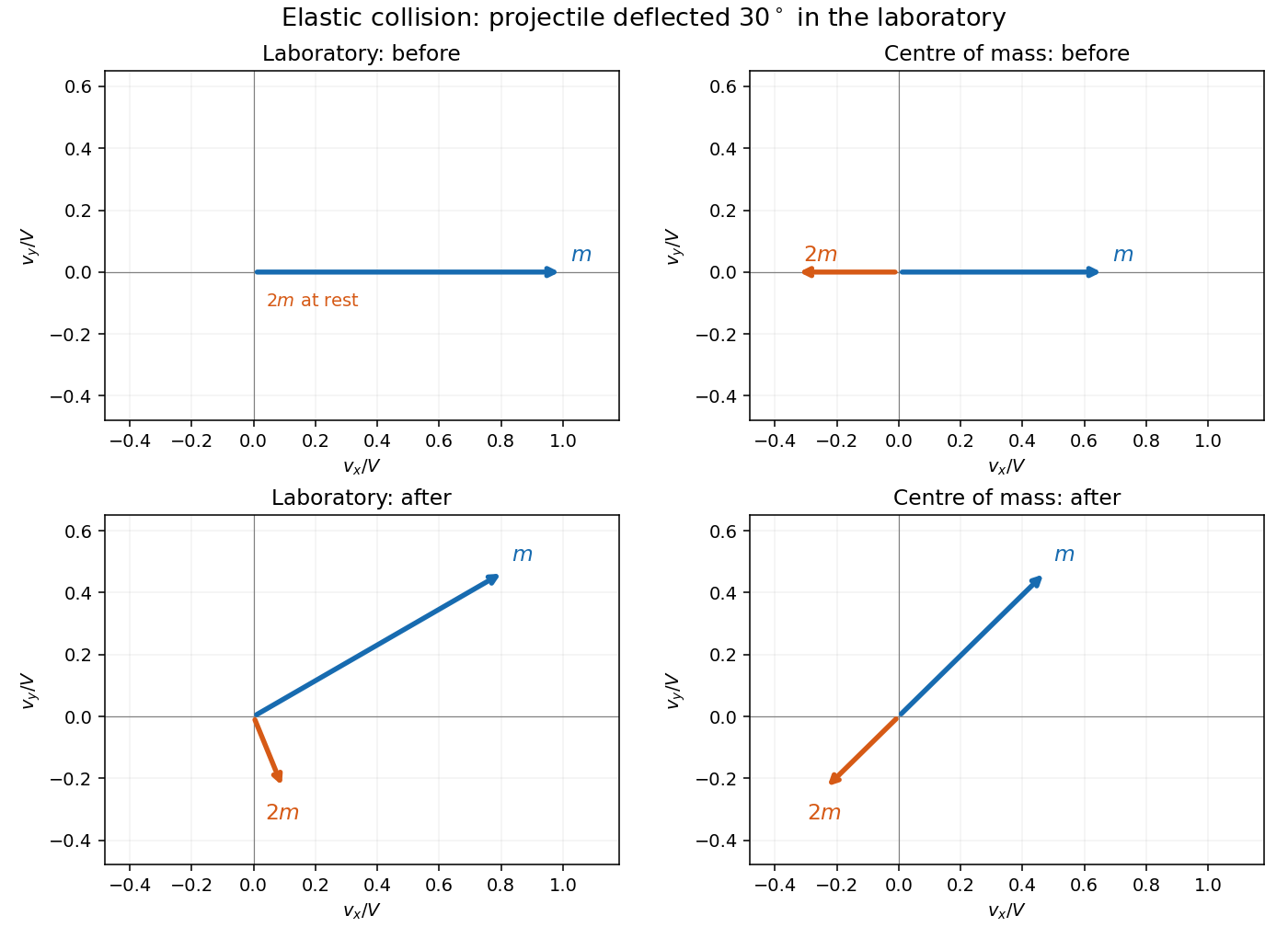


For masses and , the constant centre-of-mass velocity is . Initially the laboratory velocities are and zero, while the centre-of-mass frame velocities are and . After the elastic collision they areAdding produces the lower-left panel's laboratory velocity vectors. The given laboratory angle impliesThe centre-of-mass frame scattering angle is therefore different from the laboratory angle. Reflection across the -axis gives the equally possible negative-angle configuration.
Choose the initial incident velocity as . The centre-of-mass velocity in the laboratory frame isIn the centre-of-mass frame, the initial velocities are and . Conservation of momentum and kinetic energy in an elastic collision preserves these two speed magnitudes. Let be the outgoing angle of particle 1 in that frame, measured from the initial positive direction. ThenAdding to transform back to the laboratory frame givesThe nonnegative laboratory recoil angle is measured below the incident axis in this choice of scattering plane. Hence the recoil angle in a two-body elastic collision obeysThe source identity therefore uses for the projectile's outgoing direction in the centre-of-mass frame. If instead it denotes particle 2's outgoing direction, the corresponding expression has in the denominator. A signed laboratory angle for the drawn target trajectory would carry a minus sign. At zero deflection the target remains at rest, so its direction is undefined; is a limit.
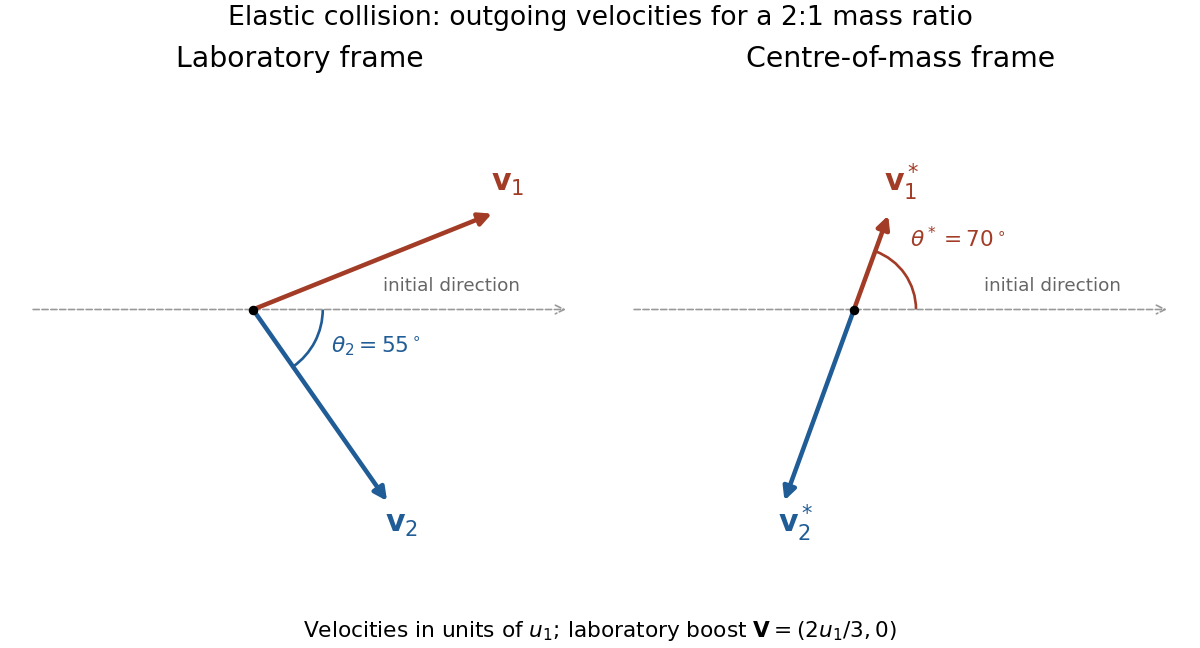

For , the ratio in 9 tends to , givingThis recovers the nonrelativistic equal-mass elastic collision result: momentum conservation gives , while conservation of kinetic energy gives . Subtracting the squared momentum relation leaves . Exactly at there are no outgoing nonzero velocities defining such angles; the result is the limit through positive kinetic energies.
A Lorentz invariant has the same value when the same physical system is described in any inertial frame. The components of its energy-momentum four-vector change, but their Minkowski norm does not. In particular the relativistic energy-momentum relation iswhere is the rest mass. Individual total energy and momentum are frame-dependent; the combination on the left is invariant.
For the fixed-target annihilation, the initial total laboratory energy is and its total momentum is the incident particle's , with . The centre-of-mass energy available for new-particle creation is thereforeIn the centre-of-mass frame the total momentum vanishes, so can supply the new particles' total rest energy at threshold. One does not subtract the annihilated particles' original rest energy. The excess laboratory energy beyond is associated with motion of the whole final system in the laboratory frame.
For the subsequent elastic collision, the equal and opposite transverse components of final momentum imply equal final momentum magnitudes, and hence equal final energies, for the two identical particles. By conservation of relativistic energy, each hasTheir final momentum magnitude and the incident momentum magnitude obeyLongitudinal momentum conservation gives . It follows that the equal-angle relativistic elastic scattering relation isThis derivation assumes nonzero incident kinetic energy and the stated symmetric outgoing paths. The angle between those paths is , which is evaluated in the two following parts.
For an elastic collision with , the positive root in the laboratory scattering circle formula is the only nonnegative one. With ,ConsequentlyThe heavy target can absorb a finite momentum with negligible velocity and negligible kinetic energy. Thus the projectile may change direction substantially while retaining its speed; a backward reflection also has .
For equal masses and an elastic collision, andThus the nonzero outgoing branch isand the other nonnegative algebraic root is . The latter is the head-on transfer of the incoming momentum and kinetic energy to particle 2: . A stationary particle has no defined outgoing direction, so this root is not a separate physical outcome for every chosen .
On the nonzero branch, momentum conservation givesThe two nonzero outgoing velocities are perpendicular: squaring momentum conservation and comparing with kinetic energy conservation gives . For , the nonzero root is negative and must be rejected; backward scattering of a moving incident particle is impossible in this equal-mass, initially stationary-target case.
Inertia is resistance to a change of motion. Translational inertia is measured by mass in Newton's second law; rotational inertia about a specified fixed axis is measured by the moment of inertiawhere is perpendicular distance from that axis. For a thin uniform rod, take axes perpendicular to the rod. With linear mass density ,The second result uses the parallel axis theorem; direct integration over gives the same value. The axis specification is essential: an ideal thin rod has zero moment of inertia about its own longitudinal axis.
During the short elastic collision, neglect the impulse from gravity. The pivot can exert an external impulse, so total linear momentum of rod plus particle need not be conserved. Its torque about the pivot is zero, so conservation of angular momentum about that point applies. Let be the particle's signed outgoing horizontal velocity, and the rod's outgoing angular velocity, positive towards the incident motion. ThenSubstituting into the kinetic energy equation givesDiscarding the zero-impulse branch , the actual collision givesThe rod's lower end initially moves forward at , so the bodies separate. Afterwards the free particle undergoes projectile motion. With the pivot as origin and downward, its trajectory is , , where at the collision. The rod instead swings about the fixed pivot in a vertical plane as a physical pendulum.
The rod's initial rotational kinetic energy is . Reaching the horizontal raises its centre of mass by , increasing gravitational potential energy by . Consequently,For the threshold case, measure the rod's angle from the downward vertical and reset at its first horizontal turning point, so and . The restoring torque about the pivot gives the exact equation of motionAt the horizontal, , so the rod immediately swings back. Conservation of mechanical energy yieldsOn the initial descent its explicit time dependence is specified by the definite integralIt continues through the vertical to , reverses, and repeats without damping. An alternative expression valid throughout the oscillation uses the Jacobi elliptic sine. Put , , and let denote the complete elliptic integral of the first kind. ThenThis is not simple harmonic motion at an amplitude of . Its oscillation period exceeds its own small-amplitude value by the factor .
A simple pendulum of length obeys . At the same amplitude , its oscillation period is , soThe rod swings more slowly. Its equivalent simple pendulum length is , not the distance to its centre of mass. The same oscillation period ratio holds in the common small-amplitude limit, but replacing the actual 90-degree motion by that limit would underestimate both oscillation periods.
Take upwards in the source diagram. Write for 's incoming speed, so the initial velocities areA contact-direction assumption is needed for a unique answer. The diagram specifies the incoming velocities but does not specify the contact normal or an outgoing angle. First adopt the usual intended model: the impulse is horizontal, so neither particle changes its component of velocity. This is the smooth oblique collision model with a horizontal line of centres at impact. Bringing to rest in the direction then brings it entirely to rest.
Let be 's outgoing component of velocity. Conservation of momentum and conservation of kinetic energy givePut . The second equation becomes , so . ThereforeThe outgoing kinetic energies areThe outgoing speed of is , directed above the negative axis at angle . The initial kinetic energy is also , as required for an elastic collision.
For the perfectly inelastic collision with these same incoming velocities, both particles share a common outgoing velocity. Conservation of momentum givesIts direction is again above the negative axis. The separate translational kinetic energies of the constituents and their total areThe loss of translational kinetic energy isThis becomes internal energy, for example deformation and heating; total energy is conserved. In the elastic collision no kinetic energy is lost and the particles separate with different velocities. In the perfectly inelastic collision relative motion disappears and the common velocity is the original centre of mass velocity.
The limitation of the printed data can be made explicit. Without the horizontal-impulse assumption, write the final velocity of as . Then conservation of momentum determinesand conservation of kinetic energy gives onlyThere is a family of possibilities. For a concrete second solution, givesThese velocities conserve both components of momentum and conserve kinetic energy, and they satisfy the specified vanishing component for , while requiring a different incoming speed. They can arise from a smooth contact normal proportional to . Thus the horizontal-impulse result is conditional, rather than uniquely implied by the printed statement. For any member of this family the corresponding sticking result remains well determined once is chosen:The last expression is the lost relative kinetic energy in a perfectly inelastic collision of these two point masses.
Interpret as the vertical drop of the cylinder's centre of mass, and initially take the suspended rod to be vertical. The moment of inertia of a uniform solid cylinder is . Before impact, rolling without slipping gives , so conservation of mechanical energy givesUse the usual instantaneous smooth elastic collision model: the horizontal impact impulse passes through the cylinder's centre of mass, and the floor supplies negligible tangential impulse during impact. The cylinder's angular velocity is then unchanged during impact; its rotational kinetic energy does not transfer to the bob. The rod supplies no horizontal impulse when vertical. If and are the signed cylinder and bob velocities immediately afterwards, conservation of momentum and the unit coefficient of restitution giveDuring the subsequent simple pendulum swing, conservation of mechanical energy givesThe cylinder generally slips immediately after this impact, which is consistent with imposing rolling without slipping only on the descent.
Impact convention matters. The floor-impulse dependence of a rolling-cylinder collision gives a different answer if a different constraint is imposed. If instead the floor enforces rolling without slipping throughout the impulsive collision, it supplies a nonzero horizontal impulse. The cylinder's effective translational mass is then . Writing for the impulse delivered to the bob gives , and . Hence and , giving . The original wording specifies the descent constraint but does not specify an impulsive floor-friction law; the first boxed value uses the smooth-impact convention.
Choose the heavier particle's outgoing velocity above the initial direction. Let its speed be , and let the lighter particle have components . Thus and are nonnegative deflections on opposite sides. Conservation of momentum givesThe elastic collision conserves kinetic energy:Taking the squared magnitude of the vector momentum equation yieldsEliminate with the kinetic energy equation. For a nontrivial collision, , soSubstituting back into the two momentum components givesThereforeThe ratio alone does not determine the quadrant: for , the lighter particle can move backwards. The two component equations select the correct . At , the outgoing direction is perpendicular to the initial direction; the displayed tangent has a pole there.