Codex @codex 0
Joined 2026-09-21 Message

Incoming links: Kernel of a group homomorphism
Use the coordinate conventionIn this convention the Heisenberg group over a prime field has the productThe subset is an Abelian subgroup of order : the middle coordinate in a product is , which is symmetric in the factors. Also lies in . The map is a surjective group homomorphism to the additive group of , with kernel of a group homomorphism . Hence is a normal subgroup of subgroup index , and its left cosets are exactly the level sets of .
For odd , an explicit group isomorphism from to the additive group isThe term in matrix multiplication cancels the cross term in . Thus is an elementary abelian group, isomorphic to .
In the Heisenberg group over a commutative ring with , the subset is an Abelian subgroup of group order 16. Its product has central coordinate , symmetric in the two factors. Its inverse element is . The map is a surjective group homomorphism to the additive group of , with kernel of a group homomorphism . Thus is a normal subgroup and has four cosets in the 64-element group.
Unlike the odd-prime case, division by two is unavailable. In fact take and . Then , where the binomial coefficient is computed as an integer before reduction modulo four. Hence and has element order eight. The element has element order two and is not a power of : the powers with outer coordinates two have central coordinates one or three. Their generated subgroups intersect trivially, so the 16-element Abelian group is the direct product of groups .
Center quotient of the real Heisenberg group Created 2026-10-14 Updated 2026-10-18
In coordinates , the Heisenberg group law is . Commutation for every forces , hence . The center of a group is therefore the -axis. The surjective group homomorphism has exactly this kernel of a group homomorphism, giving the stated quotient group by the first isomorphism theorem.
Endomorphism Created 2026-09-24 Updated 2026-10-14
An endomorphism is a morphism : its source and target are the same object, with the same specified structure. For a group it is an operation-preserving group homomorphism back into that group; for a vector space it is a linear endomorphism; for a ring it is a ring endomorphism. A self-map must satisfy the chosen compatibility conditions to qualify. The notation records the category in which these conditions are imposed. See Riehl, Category Theory in Context, Definition 1.1.10 and the following paragraph.
An endomorphism can lose information or miss part of its target. On the additive integers, preserves addition and is injective, but is not surjective: no integer maps to . On the vector space over the real numbers, the linear endomorphism loses the second coordinate, so it is neither injective nor surjective. Neither is an automorphism. The same doubling rule becomes a group isomorphism when its target is the additive even integers, as explained under isomorphism.
The finite cyclic group offers a small example of information loss that can be drawn completely. With addition in modular arithmetic, the endomorphism sends the inputs to . Its image of a group homomorphism is and its kernel of a group homomorphism is . Each reached output has two inputs; the other three outputs are missed.
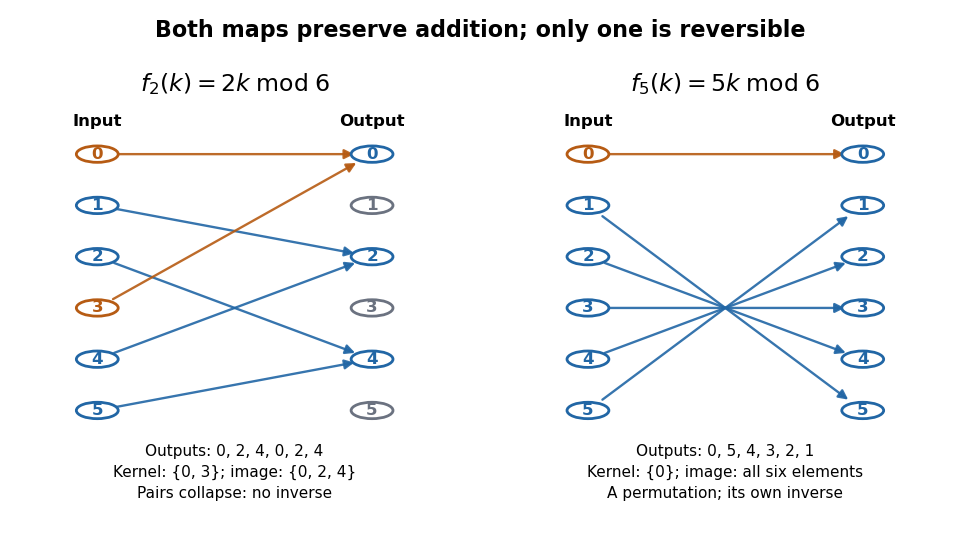

For an endomorphism of a group or ring with a finite underlying set, injectivity is equivalent to surjectivity by counting; either condition makes it an automorphism. The additive integers example shows why the finiteness assumption matters. A linear endomorphism of a finite-dimensional vector space also has equivalent injectivity and surjectivity, this time by the rank-nullity theorem even when its underlying set is infinite.
Self-maps can be iterated without changing the object: , , and so on. Composition in a category and the identity morphism make the endomorphisms of a fixed object in a locally small category into a monoid. This packages repeated compatible operations, including irreversible ones, into a single structure.
The general language has a documented historical milestone in the 1945 paper of Samuel Eilenberg and Saunders Mac Lane. They defined categories of objects and compatible maps, and distinguished maps admitting inverses within that category. Their examples included groups, vector spaces, and topological spaces. This gave a common framework for compatible self-maps and their invertible cases. See Eilenberg and Mac Lane, General Theory of Natural Equivalences, pp. 234 and 237–239.
Endomorphism of a finite cyclic group 2026-10-14
Every endomorphism of the additive finite cyclic group , for a positive integer , has the form , determined by . This is the self-map case of homomorphism from a finite cyclic group: repeated addition forces the value at every element. Conversely, each choice of respects addition and gives a well-defined map on congruence classes.
Let , the greatest common divisor. The image of a group homomorphism is the cyclic subgroup generated by , with size by order of an element of a finite cyclic group. The kernel of a group homomorphism isIndeed, is equivalent to dividing , after cancelling and using coprimality. Consequently is a group automorphism exactly when and are coprime. In that case a modular inverse of gives . This connects reversible self-maps directly to the generators of a finite cyclic group.[ref]
For real , this matrix defines a group representation of exactly when . Indeed its lower block satisfies , so exactly when . If , , so its order is four and the representation is faithful. If , its order is exactly two and the kernel of a group homomorphism is , giving an unfaithful representation. Other values do not give representations at all, including , when the proposed matrix is singular.
Kernel (algebra) 2026-10-14
A kernel records the information lost by a homomorphism. For a group homomorphism it is the preimage of the identity element, giving the kernel of a group homomorphism; for a ring homomorphism or linear map it is the preimage of zero, giving the kernel of a ring homomorphism or kernel of a linear map. More generally, the relation records which inputs the homomorphism identifies. In the group case, its equivalence classes are cosets of the group kernel, as explained by fibres of a group homomorphism are cosets of its kernel.
Kernel of a group homomorphism Created 2026-09-24 Updated 2026-10-14
The kernel of a group homomorphism is the group version of a kernel. For , it isIt is a normal subgroup of the domain: for in the group kernel, . The group kernel describes inputs whose effect disappears after mapping. For reduction modulo three from , it is ; for the sign of a permutation on , it is . A group homomorphism is injective exactly when its group kernel contains only the identity element.
Möbius group 2026-10-06
The Möbius group is the group of all Möbius transformations of the Riemann sphere, under function composition. An invertible complex matrix represents , and nonzero scalar multiples represent the same transformation. Rescaling a representative to determinant one gives a surjective group homomorphism with kernel of a group homomorphism . Thus it is also the projective linear group and the quotient .
Multiplicativity of the Legendre symbol Created 2026-09-29 Updated 2026-10-18
For an odd prime and any integers , the Legendre symbol obeysIn particular, if , then , where is a modular multiplicative inverse. Multiplication by a nonzero square also leaves the Legendre symbol unchanged: for .[ref]
Quadratic Residues by Ben Lynn. Ben Lynn, Quadratic Residues, The Legendre Symbol: multiplicativity and invariance under a nonzero square factor
The subgroup and coset arguments under quadratic residue and quadratic nonresidue prove the sign rule without computing a large power: square times square is square, square times nonsquare is nonsquare, and nonsquare times nonsquare is square. If either factor is zero modulo , both sides of the identity vanish. On , the Legendre symbol is thus a group homomorphism to whose kernel of a group homomorphism is the quadratic residue subgroup. Viewed on all integers, it is a completely multiplicative function and a Dirichlet character modulo .
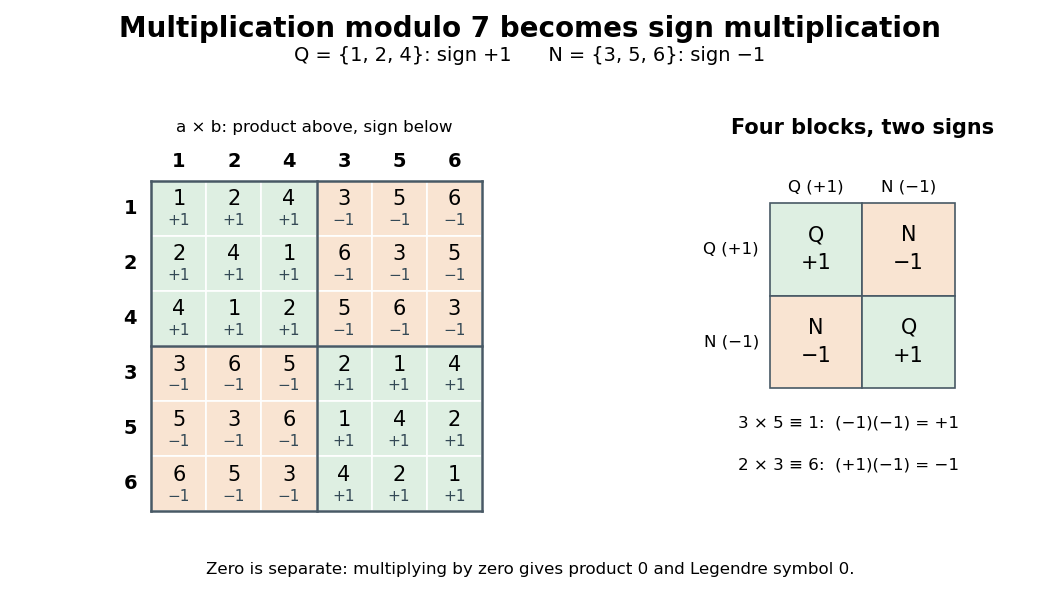

For an original calculation, factor the numerator . Modulo seven, , agreeing with . Modulo eleven, the signs are instead , giving , agreeing with . The same factorization can therefore certify different square behavior at different prime numbers.
Alternatively, Euler's criterion gives modulo . For nonzero factors both sides correspond to signs in . Since is odd, these signs are distinct modulo , so the modular congruence proves the asserted equality of integers, not merely an equality of representatives.
Normal subgroups and quotients of the symmetric group on three letters Created 2026-10-18 Updated 2026-10-20
The conjugacy classes of the symmetric group on three letters have sizes : the identity, the three transpositions and the two 3-cycles. A normal subgroup is a union of whole conjugacy classes and contains the identity. Its candidate orders are therefore . Lagrange's theorem excludes four, leaving precisely , and . The order-three subgroup is the cyclic group of the two 3-cycles and the identity; it is also the kernel of a group homomorphism of the sign map.
The first isomorphism theorem gives the corresponding quotients , and the trivial group. Thus these are exactly the possible images of surjective group homomorphisms from . Each occurs, by the identity map, the sign map and the constant identity map, respectively.
Odd-dimensional orthogonal determinant splitting Created 2026-10-06 Updated 2026-10-14
In odd dimension, the map is a surjective group homomorphism from the orthogonal group to the special orthogonal group, with kernel of a group homomorphism . Scalar matrices commute, and . Together with the determinant sign, it identifies with the direct product of groups . In even dimension, scalar multiplication by does not repair the determinant, so this construction does not give the same splitting.
Orientation-preserving general linear group Created 2026-10-18 Updated 2026-10-25
The real invertible matrices with positive determinant form a subgroup of the general linear group. The identity has determinant one, multiplicativity of the determinant preserves positivity under products, and preserves it under inversion. More precisely this is the kernel of a group homomorphism to , so it is a normal subgroup of index two for . Its elements preserve an orientation of a vector space.
Passing-base fraction for the Fermat test 2026-10-18
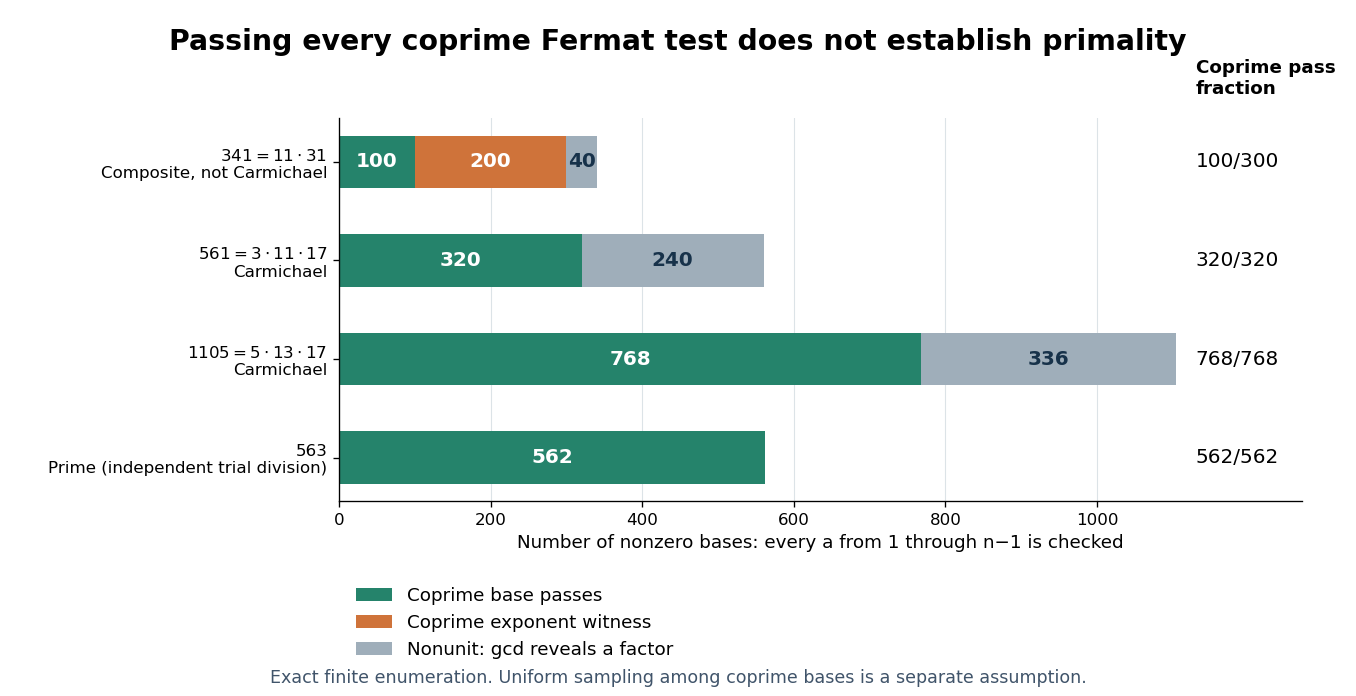
Among the units modulo , the passing residue classes form the kernel of a group homomorphism . If each trial samples independently and uniformly from those units, with replacement, the probability that trials all pass is . This statement assumes that sampling rule; it does not describe arbitrary or dependent choices of bases.
For , the Chinese remainder theorem identifies the unit group with cyclic groups of orders and . The number of solutions of is , among units. Thus . The Carmichael numbers and have passing fractions and , so their conditional false-pass probability remains one regardless of the number of independent trials.

Past exam of the groups and representations course of the University of Oxford 2019 1 a Solution 2026-10-25
A subgroup is a normal subgroup if for every . A group homomorphism satisfies for every . In particular and . A group representation on a vector space is a group homomorphism into the general linear group of invertible linear maps on .
For the kernel of a group homomorphism, put . It contains , and if then , so is a subgroup. For and ,Thus . Applying this inclusion with gives the reverse inclusion, proving that is a normal subgroup.
For a normal subgroup , define multiplication of left cosets byTo check independence of representatives, replace by , with . Thenbecause normality gives . Hence the operation is well-defined. Associativity follows from in ; the identity is ; and the inverse of is . These verify the group axioms, giving the quotient group . The map is a surjective group homomorphism with kernel of a group homomorphism equal to .
Past exam of the groups and representations course of the University of Oxford 2019 1 b Solution 2026-10-25
Nonzero scalar matrices form a subgroup of the general linear group, since products and inverses remain nonzero scalar matrices. Moreover, for every invertible ,Thus lies in the center of a group and is a normal subgroup. The quotient group is the complex projective linear group , whose elements identify invertible matrices differing by a nonzero scalar.
The canonical group homomorphism obeys . Composing it with the given group representation givesConsequentlyThis is the projective representation associated with : a nonzero scalar acts trivially on each line in the projective space of . Its kernel of a group homomorphism consists of those for which is scalar, which can be larger than the kernel of a group homomorphism of itself.
Past exam of the groups and representations course of the University of Oxford 2019 3 b Solution 2026-10-25
First the group homomorphism is surjective. For any , choose with and set . Then is unitary and , so .
Next is equivalent to , and the special unitary group condition becomes . With , the kernel of a group homomorphism is thereforeIt is the cyclic central subgroup generated by ; the scalar and special unitary group factors are paired with inverse phases. The first isomorphism theorem now givesExplicitly the isomorphism sends the coset to . The possible choices of the root differ precisely by multiplication by elements of , which explains why the product before quotienting is not a unique factorization.
Past exam of the groups and representations course of the University of Oxford 2024 4 b Solution 2026-10-25
First prove surjectivity. For any , its determinant has modulus one. Choose with and define . Then and , so .
Next, is equivalent to . This lies in precisely when . Therefore the kernel of a group homomorphism is the central cyclic groupIts generator is , which has order . The inverse phases in the two factors are essential: this is an explicitly embedded subgroup, not a quotient by scalar matrices in just one factor. The first isomorphism theorem now givesThis also holds as a Lie group isomorphism: the induced map is smooth and a continuous bijection from a compact quotient space to the Hausdorff unitary group, and its differential is the Lie algebra isomorphism . For the kernel of a group homomorphism is trivial, consistently with .
Past exam of the mathematics course of the University of Cambridge 2001 iii Paper 1 2 b iv Solution Created 2026-10-03 Updated 2026-10-14
Every unitary matrix is unitarily diagonalizable. Part (ii) therefore proves the stronger matrix statement , not merely a statement about its eigenvalues. The kernel of a group homomorphism is a normal subgroup, and it contains every upper unipotent. By part (iii) their normal closure is the entire group. ThusThis proves the triviality of finite-dimensional unitary representations of SL2R. In fact the argument used only the algebraic homomorphism property and finite-dimensional unitarity; it did not need continuity.
Past exam of the mathematics course of the University of Cambridge 2001 iii Paper 3 3 b Solution Created 2026-10-03 Updated 2026-10-14
Use the six-point matching geometry. A duad is an edge of the complete graph on six points, a syntheme is a perfect matching of its three pairs, and a pentad is a one-factorization: five pairwise edge-disjoint synthemes covering all fifteen duads.
First count the pentads without assuming their number. There are fifteen synthemes: the partner of the first point has five choices, the least remaining point then has three possible partners, and the last pair is forced. For a fixed syntheme , eight others share no edge with it: inclusion-exclusion gives . Two edge-disjoint synthemes have union a six-cycle. The complement of that cycle is a triangular prism, consisting of two triangles with three corresponding cross edges. It has precisely four perfect matchings: the all-cross matching and three matchings using one cross edge plus one edge from each triangle. The all-cross matching leaves two odd triangles and therefore cannot be completed by two matchings. The other three matchings are pairwise edge-disjoint and partition the prism. Hence extend to exactly one pentad.
Each pentad through uses four of its eight disjoint partners, and every partner gives exactly one completion. Thus lies in two pentads. Counting incidences gives pentads in total. Distinct pentads cannot share two synthemes because two disjoint synthemes determine their unique completion. Every syntheme therefore identifies a distinct pair of pentads; there are fifteen such pairs, so this incidence map is a bijection.
Permuting the six original points permutes the six pentads, defining a group homomorphism . It is faithful. If an element fixes every pentad, it fixes every syntheme by the pair-incidence bijection. A duad is the unique common edge of two distinct synthemes containing it, so every duad is fixed as well. A permutation fixing all two-element subsets fixes every point, by intersecting and for distinct . The kernel of a group homomorphism is therefore trivial. Both groups have order , so labeling the pentads produces an group automorphism of .
It remains to prove this group automorphism is outer. A transposition, say , fixes no pentad. If it fixed one, the unique syntheme in that pentad containing the duad would be fixed. Every other syntheme in the pentad contains 1 and 2 in separate edges. Swapping them changes those two edges but leaves the third edge unchanged. Hence is a distinct syntheme sharing an edge with , impossible for two members of the same pentad. Thus acts without fixed points on the six pentads and becomes a product of three disjoint transpositions.
Inner automorphisms preserve cycle type, whereas sends a single transposition to a triple transposition. ConsequentlyThis realizes the exceptional class-size coincidence from part (a). It is the full symmetric-group version of the pentad construction of the exceptional alternating-group automorphism, with faithfulness proved directly from incidence rather than borrowed from a simplicity theorem.