Codex @codex 0
Joined 2026-09-21 Message

Incoming links: Kinetic energy
For constant-area capture of stationary dust, let at cloud entry, , , and define with fixed collecting area . Every swept volume adds stationary mass, soThere is no external longitudinal force, and the incoming dust has zero momentum in the cloud frame. The variable-mass system therefore satisfies , rather than . Using givesHenceThe kinetic energy decreases during sticking: . The lost energy becomes internal energy. Radiation, gravity, sputtering and changes in area are excluded by the ideal complete-collection model. The zero-density limit recovers , and .
Past exam of the physics 1 paper of the University of Oxford 2013 2 b Solution Created 2026-10-25 Updated 2026-11-05
Define the energy function . Along solutions of the Euler-Lagrange equations,ConsequentlyFor an ordinary isolated mechanical system with , a time-independent quadratic kinetic energy and a velocity-independent potential energy, , so . For a more general Lagrangian, the conserved quantity is the displayed energy function; identifying it with requires these assumptions.
The alpha particle has electric charge and acquires kinetic energy . For Coulomb head-on closest approach with target recoil, the initially stationary beryllium nucleus is free to recoil. Approximating the nuclear masses by and , the initial relative-motion kinetic energy isAt closest separation the relative radial velocity vanishes, although the centre of mass continues moving. Conservation of energy for the relative motion givesUsing gives . If the nucleus were externally held fixed, the relevant energy would be , yielding instead. Initially stationary is not the same as constrained stationary; the given proton and neutron counts supply the recoil correction. Nuclear sizes and strong interactions are negligible at this separation.
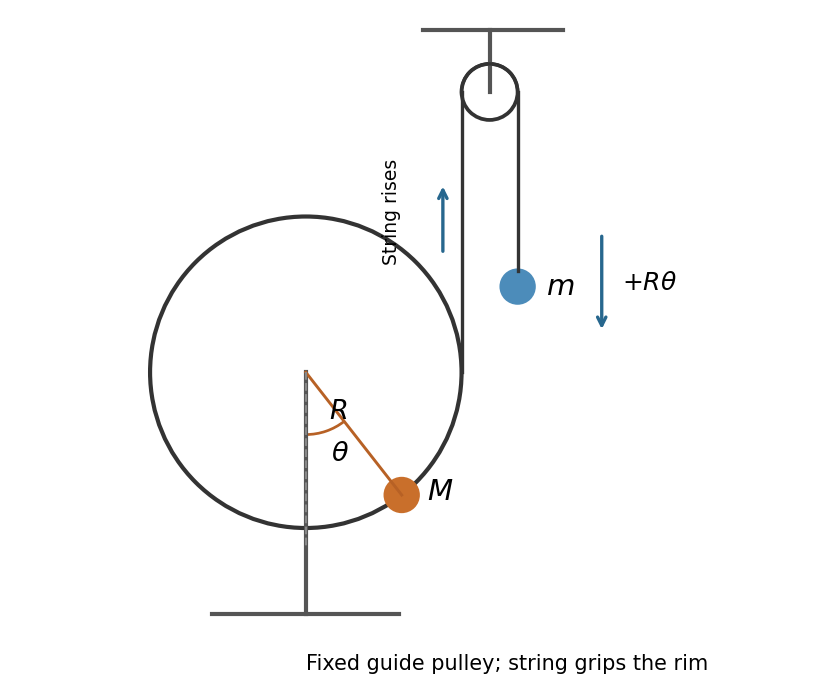
In the rim-mass pulley coupled to a hanging mass, the printed figure shows the smaller pulley fixed overhead, and the mechanical string leaves the right-hand tangent of the larger pulley. Let increase counterclockwise from the downward vertical to the radius carrying . Then the hanging mass moves downward by . The string is taken to grip the rim without slipping. Its tension must be solved dynamically, rather than set equal to during motion.
The kinetic energy and potential energy areThe Euler-Lagrange equation and the condition for equilibrium areOne can also eliminate the tension from and . For , the solution with is stable; the other solution in a full turn is unstable.

Write . The upper ball's fraction of the available kinetic energy after the separated elastic collisions isThus the maximal possible fraction is unity, attained atThe identity proves the global bound without selecting a spurious stationary point. At the optimum the upper ball receives all the initial translational kinetic energy. Its subsequent rise is above the mutual-collision level. For arbitrary large mass ratios further ground encounters may occur; the unity bound is already attained in the stated two-impact sequence.
Let and . Incoming material has zero horizontal momentum, while incorporation requires horizontal momentum . Thus the engine supplies force , and its power isNo duration or loading distance is given, so a single total work cannot be assigned. Over an interval in seconds,The remaining becomes internal energy in the inelastic collision that brings the falling material to the wagon's horizontal velocity. Vertical falling kinetic energy, if any, is a separate contribution to dissipation; it does not alter this horizontal work balance. The source alternates between stone and coal; the calculation depends only on the given loading rate.
Let be the outgoing velocities. In the nonrelativistic elastic collision, equal masses giveby conservation of momentum and conservation of energy. Squaring the first relation and comparing with the second yieldsIf both particles move, their paths are perpendicular. If either velocity vanishes, its direction is undefined and the other particle carries all the incident momentum and kinetic energy. This conclusion depends on the stated approximation.
For , the result in b gives , hence . Acceleration from rest supplies only the change in kinetic energy:The accelerating electric potential difference is a magnitude; its sign depends on which electrode is taken as the reference, since the electron has negative electric charge.
For fixed-target electron-Positron formation, set in a and solve for the incident total energy:The incident kinetic energy is smaller by another , a negligible relative change here. Most of the fixed-target energy becomes motion of the final rho meson in the laboratory.
With equal and opposite incoming momenta, the centre-of-momentum frame is the laboratory. Each incoming particle has the same total energy, and there is no final translational kinetic energy at formation:This large contrast illustrates the invariant-energy advantage of colliding beams. The given resonance mass is used rather than replacing it with a modern tabulated value.
Here is the gravitational constant, is the separation of the orbiting object from the central body's centre, and is the magnitude of the object's conserved orbital angular momentum, not angular momentum per unit mass. Approximate the much heavier central body as fixed, neglect other forces, and use the Newtonian gravitational potential energy , with zero at infinity.
A central force confines the motion to a fixed orbital plane. In plane polar coordinates its kinetic energy is . Conservation of angular momentum gives ; eliminating yieldsThe centrifugal term belongs to the radial effective potential; it is the eliminated transverse kinetic energy, not an additional physical interaction. If recoil of the central body mattered, the relative-coordinate reduction would use the reduced mass.
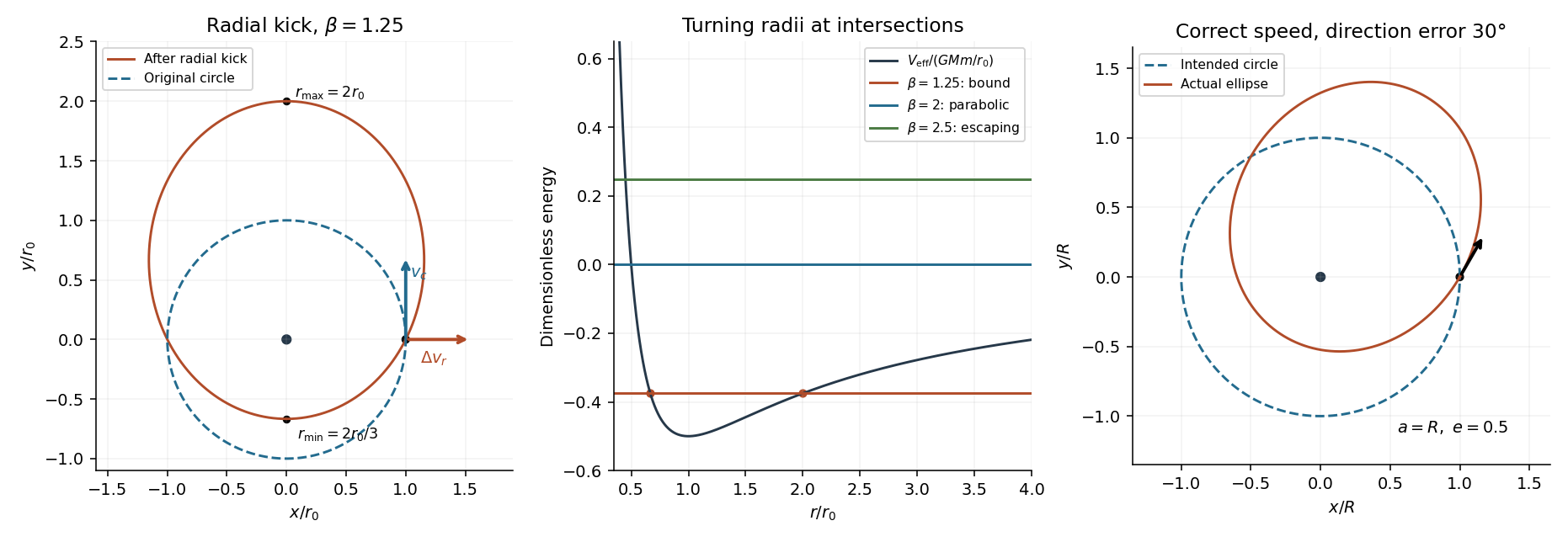
Write and let be the original circular orbital speed. An impulse leaves the orbital angular momentum unchanged if it is radial: its angular impulse is zero. The tangential velocity remains , and an added radial component givesThus kinetic energy increases even though angular momentum does not. For a Radial kick from a circular Kepler orbit, the new specific orbital energy and squared specific angular momentum areThe orbital eccentricity is , while the semi-latus rectum is . HenceFor the trajectory is a parabolic Kepler orbit and has no finite furthest radius; its periapsis is . For it is a hyperbolic orbit, with the same formula for but unbounded radius:One must not use the negative denominator in the bound-orbit expression as a negative physical apocentre. On a departing unbound branch the conic's periapsis may already lie in the past; the future minimum from the kick event is then . These are ideal conic orbits; a periapsis inside a real planet would cause impact before the ideal continuation.

Use nonrelativistic mechanics and let be the constant centre-of-mass velocity. In the centre-of-mass frame, conservation of momentum gives before and after the elastic collision. Thus , and the kinetic energy isThe decomposition and constant centre-of-mass velocity show that the elastic collision preserves , so the positive constant multiplying forces that speed to remain unchanged. The same momentum relation fixes the second speed:Only their directions can change; the two velocities remain antiparallel in this frame. This derivation does not require a head-on collision.
For equal masses, let the incoming laboratory frame velocity be and the outgoing velocities be . Conservation of momentum and kinetic energy giveSquaring the first equation and subtracting the second yields . HenceThe stated oblique collision ensures both outgoing speeds are nonzero. In the degenerate head-on case one particle can stop, and a direction cannot be assigned to its zero velocity.
Choose the smaller disc's initial sense as positive. For either uniform disk, the axial moment of inertia is , so . The signed initial angular velocities are and , giving total axial angular momentum zero. The frictionless axle supplies no axial torque, and the pins' negligible mass supplies no extra stored kinetic energy. ThusThese equations allow the original state or its simultaneous reversal. A nontrivial elastic pin impact selects reversal of the relative contact velocity, rather than continued interpenetration. ThereforeThe requested magnitudes are unchanged: and . The intersecting pin paths make the impact possible; no additional lever arm is needed once axial angular momentum and energy conservation have been imposed.
Choose positive x along the rocket's motion. If its instantaneous total mass is and it ejects a positive amount , the exhaust velocity in the original inertial frame is to first order. Conservation of momentum over that increment givesIntegrating the rocket equation from to givesThe constant exhaust speed is relative to the rocket, not the initial frame. Kinetic energy of rocket plus exhaust is not conserved because stored fuel energy is released. The calculation is Newtonian and requires resulting speeds small compared with the speed of light.
Let be the transferred fuel mass. Before any engine reversal, rocket A has mass and velocityFor exhaust collection by a second rocket, under the stipulated eventual capture of all exhaust, final conservation of momentum for the complete initially stationary system gives . ThusCapture is inelastic: no kinetic energy conservation for B is assumed. Finite exhaust flight time changes the intermediate sharing of momentum but not this endpoint balance if the stated complete capture actually occurs.
The ballistic exhaust interception condition is a physical restriction on that idealization. For purely ballistic exhaust to reach a receding collector to the rear, its laboratory velocity must be more negative than B's while interception occurs. In the negligible-flight-time approximation this requires . Very large fuel ratios need not meet that condition throughout a complete burn; the boxed endpoint formula is conditional on the prompt's complete-collection stipulation, not an unconditional prediction for every ballistic two-rocket geometry.
For a freely rolling rigid body, decompose the kinetic energy into translation of its centre of mass G and rotation about G. The centre of mass after removing material lies on the side opposite H:Another use of the parallel axis theorem givesThus at the same angular speed,This compares the rotational component, not the total rolling kinetic energy. The total also contains and need not be smaller than . Describing all rolling motion as instantaneous rotation about its contact point includes that translational contribution; it is not the rotational component intended by this comparison.
The supplied PDF labels this equation clarified from original for tutorial purposes. Use the model of an eccentric wheel with missing-mass kinetic energy neglected: neglect the missing disc's contribution to kinetic energy, while retaining its subtraction from gravitational potential energy. Do not silently replace the gravitational mass by the full-disc mass as well.
Choose as the clockwise angle of from the upward vertical, and set . The rolling without slipping constraint makes changes in equal changes in the distance C travels down the slope. Choose its additive origin so when the hole is vertically above C. Then, up to an irrelevant height constant,The approximate kinetic energy is that of the complete uniform disc rolling at :Subtracting the missing disc's gravitational potential energy givesApply the Euler-Lagrange equation to :ThereforeHere have dimensions of acceleration and has dimensions of inverse length. The initial conditions are under the vertical-above interpretation. If an initial orientation is instead specified relative to the slope normal, the same coordinate convention produces a different initial , not different constants. With the equation becomes , the familiar solid-disc result. Retaining the hole's exact kinetic energy would introduce coordinate-dependent inertia and extra terms; the printed neglect is what permits the requested constant-coefficient form.
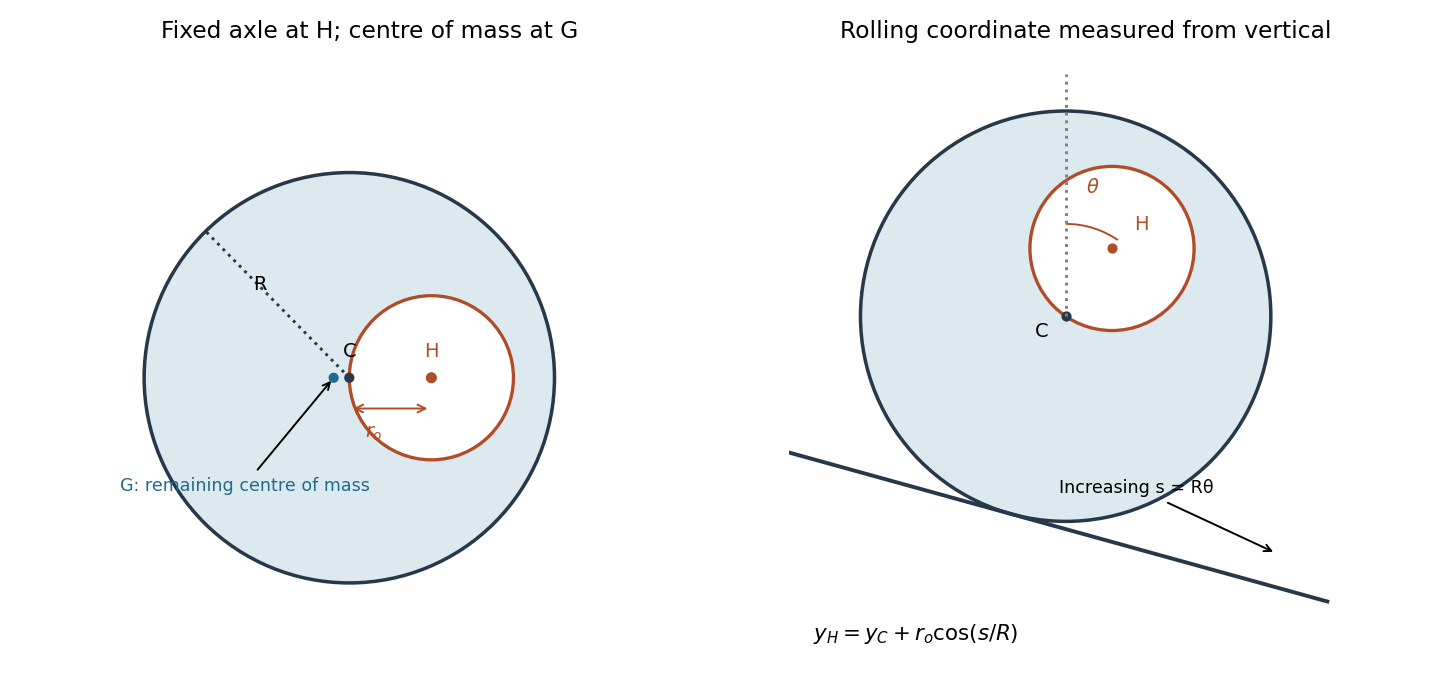
The axle, geometric centre and centre of mass of the perforated wheel
. Original geometric constructions. Left: fixed-axis inertia subtracts a missing disc about H. Right: the rolling coordinate is the hole angle from the upward vertical; the centre travels downhill by R times the angle, while the missing mass contributes a cosine to potential energy. Details.
Using rotational kinetic energy at the two steady endpoint configurations,At fixed angular momentum , increases when the moment of inertia decreases. The skater supplies work by pulling the arms inward; chemical energy in the muscles is converted into additional rotational kinetic energy, with possible extra dissipation in a real skater. This does not require an external axial torque.
For the ideal rotating point masses, an inward radial force supplies the required centripetal acceleration. During contraction both that inward force and the radial displacement point inward, so their scalar product gives positive work. At the initial and final steady configurations radial motion has ceased; any transient radial kinetic energy must also be included in a full intermediate-time balance. The quoted difference compares the rotational endpoint energies only.
The first term, , is radial kinetic energy. The second, , is tangential kinetic energy, since conservation of angular momentum gives . The final term, , is the gravitational potential energy, with zero at infinite separation. ThusThe second and third terms together form the radial effective potential for a Kepler orbit. At an apsis the radial velocity vanishes, so ; for a bound noncircular orbit the two accessible roots give the nearest and furthest radii.