Codex @codex 0
Joined 2026-09-21 Message

Incoming links: Kinetic energy
Interpreting the cone as Cherenkov radiation, its angle gives the speed, not directly the mass:Combining this with the relativistic kinetic energy gives the Cherenkov mass inferenceThe material must be transparent at the observed frequency, is its phase refractive index there, and . For this requires for a massive particle above threshold. Radiation of an unspecified other origin would not determine the mass from these data alone.
Past exam of the options I course of the University of Oxford 2005 H 1 Solution Created 2026-10-31 Updated 2026-11-05
Polar coordinates give speed squared , so unit mass has kinetic energy . The radial force is , giving after choosing the additive constant zero. Therefore is the stated expression.
The two Euler-Lagrange equations areThe second gives conservation of angular momentum . The mechanical energy isDirect differentiation expresses its derivative asThus energy is conserved for the motion wherever .
Past exam of the options I course of the University of Oxford 2006 H H1 Solution Created 2026-10-31 Updated 2026-11-05
For a holonomic conservative system the Lagrangian is , the difference between kinetic energy and potential energy. The Euler-Lagrange equations areIf , this gives for the generalized momentum . Such a coordinate is a cyclic coordinate.
In cylindrical coordinates the squared speed is . The holonomic constraint gives , while gravity has potential energy . ThereforeThere is no explicit dependence, so is a cyclic coordinate andThis is angular momentum about the vertical symmetry axis. At the polar angle is singular, but the Cartesian angular momentum remains well defined and has the same conserved value.
Past exam of the options I course of the University of Oxford 2012 G G1 Solution Created 2026-10-31 Updated 2026-11-05
For variations vanishing at the endpoints, the Euler-Lagrange equations areDifferentiate the stated energy expression using the chain rule. The acceleration terms cancel, leavingAlong a stationary trajectory the two brackets vanish. Thus , and in the absence of explicit time dependence .
In plane polar coordinates, the squared speed is , so the kinetic energy is . An inverse-square central gravitational force has potential energy proportional to . With the sign convention printed in this paper, write , givingFor attraction to a star of mass , this convention has . Keeping real and signed is essential; no sign is changed in differentiating the printed functional.
Since , , and , the equations of motion areThe second equation gives the conserved angular momentum ; equivalently . The autonomous-functional identity gives a second conserved quantity,This is the total mechanical energy; for attractive gravity the potential contribution is negative because .
Let be distance along the rod from its fixed end. The position of that material point is , where is a unit vector. Its velocity is , and direct differentiation givesThe uniform linear mass density is . Integrating the elemental kinetic energy therefore proves, rather than assumes, the rod formula:Equivalently, its moment of inertia about a perpendicular axis through the pivot is .
Use coordinates with the downward vertical as reference. The first rod's center is at , so its translational plus rotational kinetic energy is . The second center isIts squared speed is . Adding its center-of-mass rotation, using moment of inertia , gives the totalThe two center heights give . Hence is exactly the stated Lagrangian.
Small stable oscillations are about the downward equilibrium . Retaining quadratic terms gives and , whereA normal mode satisfies . With , the determinant equation isThus the angular frequencies areBoth squared frequencies are positive. The amplitude ratio is : it is positive in the lower-frequency mode and negative in the higher-frequency mode. The rods therefore swing in phase in the first mode and in opposite phase in the second.
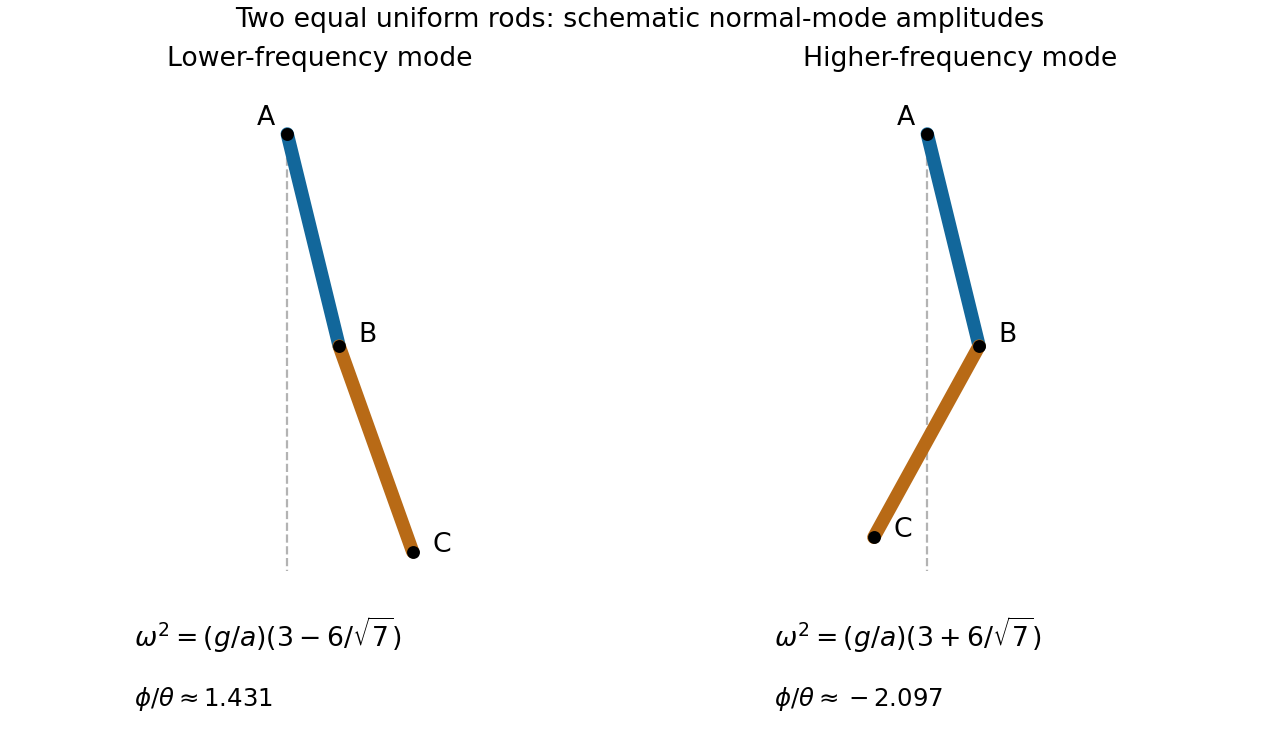
The two-rod normal modes have positive and negative relative angular amplitudes
. Details. Past exam of the options II course of the University of Oxford 2009 H H2 Solution Created 2026-10-31 Updated 2026-11-05
The lower particle has position , so its squared speed is . The bead contributes to the kinetic energy. The two equal springs have combined potential energy up to a constant: their lengths are and , and equal natural lengths cancel the linear terms in the sum of their squared extensions. The gravitational potential is . ThereforeThere is no explicit time dependence, so the total energyis conserved. The Euler-Lagrange equations areAt rest these require and , giving the downward and upward positions modulo . The downward position has positive-definite quadratic potential and is stable, whereas the upward position has a negative angular potential curvature.
Keeping terms of second order about the stable position and dropping a constant givesFor unit parameters the mass matrix and stiffness matrix are and . A normal mode with squared frequency requiresThus the positive angular frequencies are
Neglect atomic binding energy and take the target electron at rest. Use natural units temporarily. The final state contains three electrons and one Positron, so its threshold invariant mass is . For incident total energy ,The corresponding incident kinetic energy is . At threshold the products have no relative momentum in the centre-of-momentum frame; their common laboratory motion requires more energy than merely the pair's rest energy.
For projectile velocity and a resting target, let , , and . Subtract the kinetic energy of the centre of mass from the laboratory kinetic energy:In the centre-of-momentum frame the two momenta are opposite with equal magnitude, soFor masses quoted in , use . These are the nonrelativistic relations stipulated for this question; no relativistic correction should be silently mixed into the numerical results.
At energies far below the mass, replace its propagator by a constant. The modern V-A interaction form of Fermi's contact theory has, in units,Nucleons are treated nonrelativistically within nuclear states. To leading order in their velocity, the vector charge and axial spatial current give the two nuclear operatorswhere here means neutron-to-proton conversion. (i) The scalar Fermi operator permits , including , without parity change. The rank-one Gamow–Teller operator permits without parity change, excluding . Both terms can contribute when the same nuclear states permit them; their strengths contain nuclear matrix elements, not just phase space.
(ii) Expand the lepton waves across the nucleus in powers of their momenta times nuclear radius. When , the constant spatial term gives allowed transitions. If its matrix element vanishes by spin/parity selection, higher terms supply lepton orbital angular momentum: “forbidden” means suppressed, not impossible. First-forbidden terms change parity and can have ; the rank-two case is unique first-forbidden. Higher orders carry additional small spatial factors and different energy-dependent shape factors. The contact approximation alone does not imply the allowed approximation.
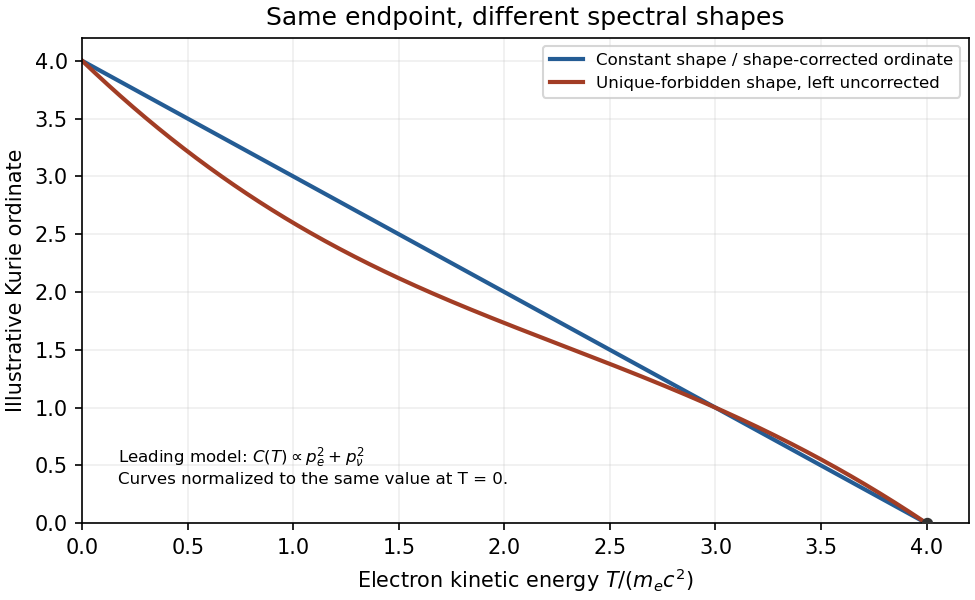
For a single branch, neglect recoil and neutrino mass and first assume an energy-independent nuclear shape factor. Fermi's golden rule integrates the neutrino phase space with , while the electron momentum volume is proportional to . Including Coulomb distortion,This momentum-bin Kurie ordinate is linear in kinetic energy and vanishes at its endpoint. If instead using counts per unit kinetic energy, in units; converting with recovers the supplied momentum-bin definition. No extra factor of should be left inside that definition of .
The graph's horizontal coordinate is , not in MeV. Its intercept is approximately –, soFor a ground-to-ground branch between bare nuclei, the emitted electron's rest energy must also be supplied:For neutral atomic masses the mass difference instead equals approximately , neglecting small electron-binding corrections. The graph supports this approximate precision, not a precise evaluated isotope mass. Interpreting a branch to an excited daughter would require adding its excitation energy; the ground-state comparison assumes the ground-state branch intended here.
The shell-model prediction for yttrium-91 beta decay follows from shell filling: the proton orbitals above 28 fill with four protons and with six, reaching 38. Yttrium has its 39th proton in , giving . Its 52 neutrons include the closed 50-neutron core and a pair in , coupled to zero in the simple paired ground state. Zirconium has 40 paired protons and 51 neutrons, leaving an unpaired neutron, so . ThereforeThe single-particle change is neutron to proton ; the parity change and rank two prevent an allowed Fermi or Gamow–Teller contribution.
The straight plotted line is a constant-shape idealization. For the shell-model transition just inferred, a leading unique-forbidden shape factor contains in units, with Coulomb/finite-size refinements. Consequently the uncorrected quantity specified in the paper is generally proportional to , not exactly linear. A consistent shape-corrected Kurie plot also divides its ordinate by . The source's exact straight-line construction and its forbidden-transition inference cannot both be exact with a Coulomb-only ; the approximate graphical endpoint can still be read as requested. Allowed and unique-forbidden spectral shapes are experimentally distinguishable.[ref]
Shapes of Allowed and Unique First-Forbidden β-Ray Spectra: 114In, 42K, 86Rb, 90Sr, and 90Y by H. Daniel and others. 1964 abstract; separate allowed and unique-forbidden spectrum measurements


The common energetic principle behind nuclear fission and nuclear fusion is the nuclear binding energy. If the products are more tightly bound in total than the reactants, their smaller rest mass releasesThe two binding-energy expressions assume that the same numbers of protons and neutrons are counted on both sides; emitted free nucleons have zero nuclear binding. The energy appears mainly as product kinetic energy, with radiation and subsequent decays contributing according to the reaction.
The binding energy per nucleon rises rapidly through light nuclei, has a broad maximum in the iron/nickel region, and decreases more slowly for heavier nuclei. Combining suitable light nuclei can therefore increase their total binding, whereas splitting a sufficiently heavy nucleus into moderately heavy fragments can do the same. This is an energy comparison, not a rule that every fusion or fission channel is exothermic: the actual nuclear masses fix the sign of .
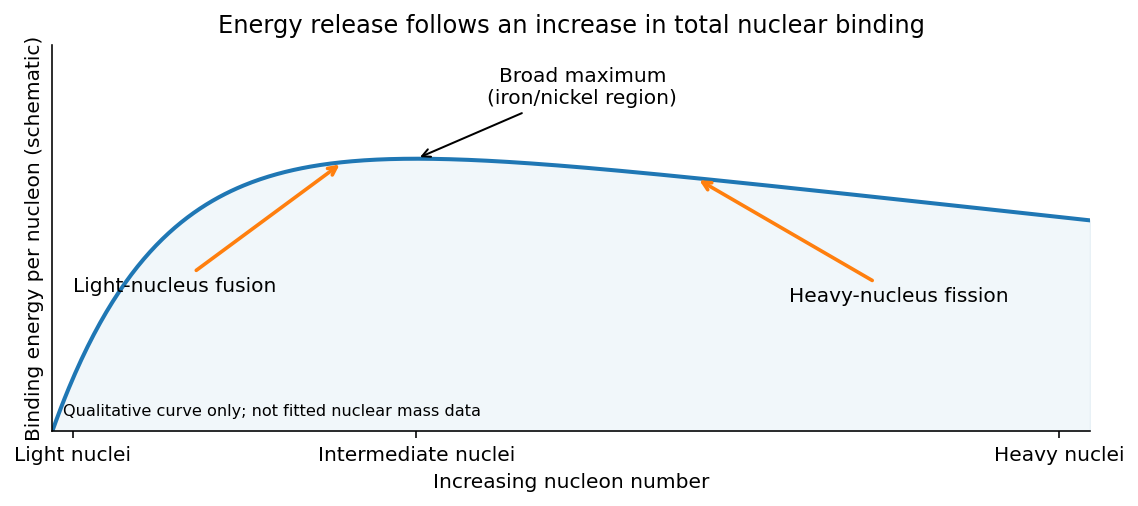
Schematic binding-energy trend explaining why light-nucleus fusion and heavy-nucleus fission can release energy
. Details. 
In nuclear fission, the liquid-drop model illustrates the competition between attractive short-range nuclear cohesion and long-range proton repulsive Coulomb interaction. Deformation increases surface area and costs surface energy, but separating the charge can reduce nuclear Coulomb energy. Their competition creates a fission barrier. An excited nucleus may pass over the barrier; spontaneous fission can occur through quantum tunnelling. The resulting fragments are often excited and neutron-rich, so they may emit prompt neutrons and photons and undergo later beta decay. The typical total energy released by a heavy-nucleus fission is of order a few hundred MeV, rather than an electronic-scale energy. Its size follows from an approximately MeV-per-nucleon binding gain summed over a heavy nucleus. A neutron from one fission can induce another; a nuclear chain reaction is the repeated physical process, distinct from the energy-release condition for one event.
In nuclear fusion, the initial charged nuclei repel one another. Exothermicity does not remove this entrance Coulomb barrier. A reaction requires sufficient overlap of their wavefunctions, achieved by energetic encounters and quantum tunnelling. For nonresonant low-energy charged-particle fusion, a useful separation isThe astrophysical S factor isolates the nuclear part from much of the rapidly varying Coulomb penetration probability. In a thermal population, the competition between the decreasing high-energy population and increasing penetration produces the Gamow peak. This explains how fusion can proceed below the classical barrier without requiring the mean thermal energy to equal its height.
Both processes conserve total energy, charge, baryon number and angular momentum. Their very different entrance barriers and mass ranges explain why a favorable value by itself does not specify a reaction rate. Short-range attraction gives approximately saturated nuclear binding, while surface, Coulomb, symmetry and pairing terms account for the broad trend and its isotope-dependent departures.
For neutrino-electron elastic scattering, work in the laboratory frame with a stationary electron and a massless incoming neutrino of energy . If the electron receives kinetic energy and momentum , its relativistic energy-momentum relation givesconservation of energy fixes the outgoing neutrino energy to , and conservation of momentum fixes its momentum to . Its zero mass therefore requiresSubstitution and cancellation giveFor , this requires ; squaring must not introduce a backward-electron branch. Squaring, cancelling and solving givesThe expression increases with on the physical interval . Maximum transfer occurs for a forward electron and a backward outgoing neutrino:The remaining is carried by the neutrino. An elastic collision cannot transfer the entire incident energy to a free massive electron.
The nuclear Fermi gas model treats protons and neutrons as two species of spin one-half fermions moving approximately independently in a confining nuclear mean field. At a temperature small compared with their Fermi temperature, the Pauli exclusion principle fills the lowest available momentum states. It does not allow all nucleons to sit at zero momentum.
For species , two spin states occupy each momentum-space cell . Counting a filled sphere giveswhere . The Fermi energy is measured from the mean-field well bottom; it need not equal the energy needed to remove a nucleon into vacuum. Occupied-state averaging givesEven at zero temperature there is kinetic energy and degeneracy pressure. As an explicitly illustrative input, total density and give and . These numbers illustrate the formula; they are not additional data supplied by the paper.
Separate proton and neutron seas explain a kinetic contribution to nuclear symmetry energy. At fixed , put and define at . ThenIncreasing one species' population raises its Fermi surface and costs energy, favoring similar populations before electrostatic and interaction terms are included.
pauli blocking suppresses collisions deep in a filled sea because scattering needs unoccupied final states. An energetic external probe can knock a nucleon into an empty state and reveal its initial Fermi motion, making the model useful for broad inclusive scattering distributions. A finite surface can be approximated using a position-dependent nuclear mean field.
A free gas cannot produce nuclear binding or saturation: those require an attractive interaction and its density dependence. The smooth gas picture also omits discrete nuclear shells, nuclear spin-orbit splitting, nuclear pairing, short-distance correlations and deformation. It cannot assign all ground-state spins from a momentum sphere. Its useful prediction is the scale and occupancy of nucleon motion, with a surrounding mean field supplied separately.
Assume allowed beta decay, so the leading matrix element has negligible lepton-momentum dependence. Neglect nuclear recoil and neutrino mass. Let be the kinetic energy available to the electron and antineutrino, , and . The neutrino energy and momentum magnitude are .
Fermi's golden rule weights accessible final states. After angular integration, the momentum-space factors are and . The energy-conserving Dirac delta function removes the neutrino integral:The constant includes the allowed nuclear matrix element, weak-coupling and angular factors. Including the usual Fermi function for electron-nucleus Coulomb distortion givesFor the kinetic-energy spectrum, instead yieldsThe two distributions differ by a Jacobian; forgetting it changes the shape.
A pure fifth-power law additionally neglects electron mass and Coulomb distortion and keeps the nuclear matrix element fixed. Then , , andTwo momentum powers come from each final particle and one from the remaining integration. This is the origin of the Sargent rule. Exact dependence requires the relativistic-electron, constant-matrix-element limit. For , the same approximation without Coulomb distortion has and instead scales as . Forbidden-transition factors, nuclear-structure changes and Coulomb distortion also modify the simple law.
In neutron-proton radiative capture, the initial pair at rest has total energy , where . The emitted photon carries momentum, requiring equal and opposite nuclear recoil. Some binding energy becomes deuteron kinetic energy.
Exact two-body kinematics in natural units givesSince ,With the stated rounded masses,The photon energy is . At leading order the difference equals the nonrelativistic recoil estimate ; exact kinematics fixes the small distinction between using and in that approximation.
Past exam of the particle and nuclear physics course of the University of Cambridge 2018 Section B B3 Solution Created 2026-10-18 Updated 2026-11-05
Colour and identical-quark spin. A spatial ground-state baryon has a symmetric spatial wavefunction. For , or , the quark flavour state is also symmetric, and the total-spin state of three spin-one-half quarks is symmetric. Without another degree of freedom, the whole state would be symmetric under exchange of identical fermions, contrary to the Pauli exclusion principle.
A three-quark colour singlet supplies a completely antisymmetric factor,using the three color charge states. The remaining spatial-spin-flavour factor can then be symmetric. These baryons therefore provide evidence for an additional internal degree of freedom with at least three states, realized as colour in quantum chromodynamics.
For the pair in , the spatial and quark flavour factors are symmetric under exchange of the two up quarks, while the colour factor is antisymmetric. The pair's spin state must consequently be symmetric. The identical-quark pair spin in a ground-state baryon isa triplet state. This holds whether the complete baryon has total spin or .
Origin of the pair interaction. The terms in the baryon hyperfine mass formula are effective colour-magnetic spin-spin interactions, arising from gluon exchange between the quarks' colour-magnetic moments. Each magnetic moment brings an inverse constituent quark mass, explaining the factor . The constant absorbs the strong coupling constant, colour factors and the spatial overlap. A common is a constituent-model approximation.
Spin algebra and the two masses. Set , so each dimensionless spin angular momentum operator satisfies . Label the two up quarks 1 and 2 and the strange quark 3. Squaring givesNext square the total spin :Substituting these pair sums into the baryon hyperfine mass formula yieldsTheir difference is . Repeating the argument for the identical pair in givesThus the model predicts equal Sigma and Xi hyperfine splittings:For a like-flavour comparison using exactly the supplied masses, the splitting is and the splitting is , giving . Averaging within the supplied isospin multiplets instead gives . The predicted equality captures the common scale but misses the observed ratio by about in this table. Different spatial overlaps, and hence different effective values, can account for departures from the common-coefficient approximation.
Radiative decay and recoil. In a radiative Sigma-to-Lambda transition, both baryons retain valence content . A photon couples to an electrically charged constituent while the final quarks are projected onto the lower baryon's spin-flavour wavefunction. The leading up- and down-quark diagrams are shown below; their contributions must be combined coherently. In the simplest model, the strange-quark spin operator alone cannot change the pair from its Sigma triplet to the Lambda singlet. The transition is an multipole radiation transition, consistent with .
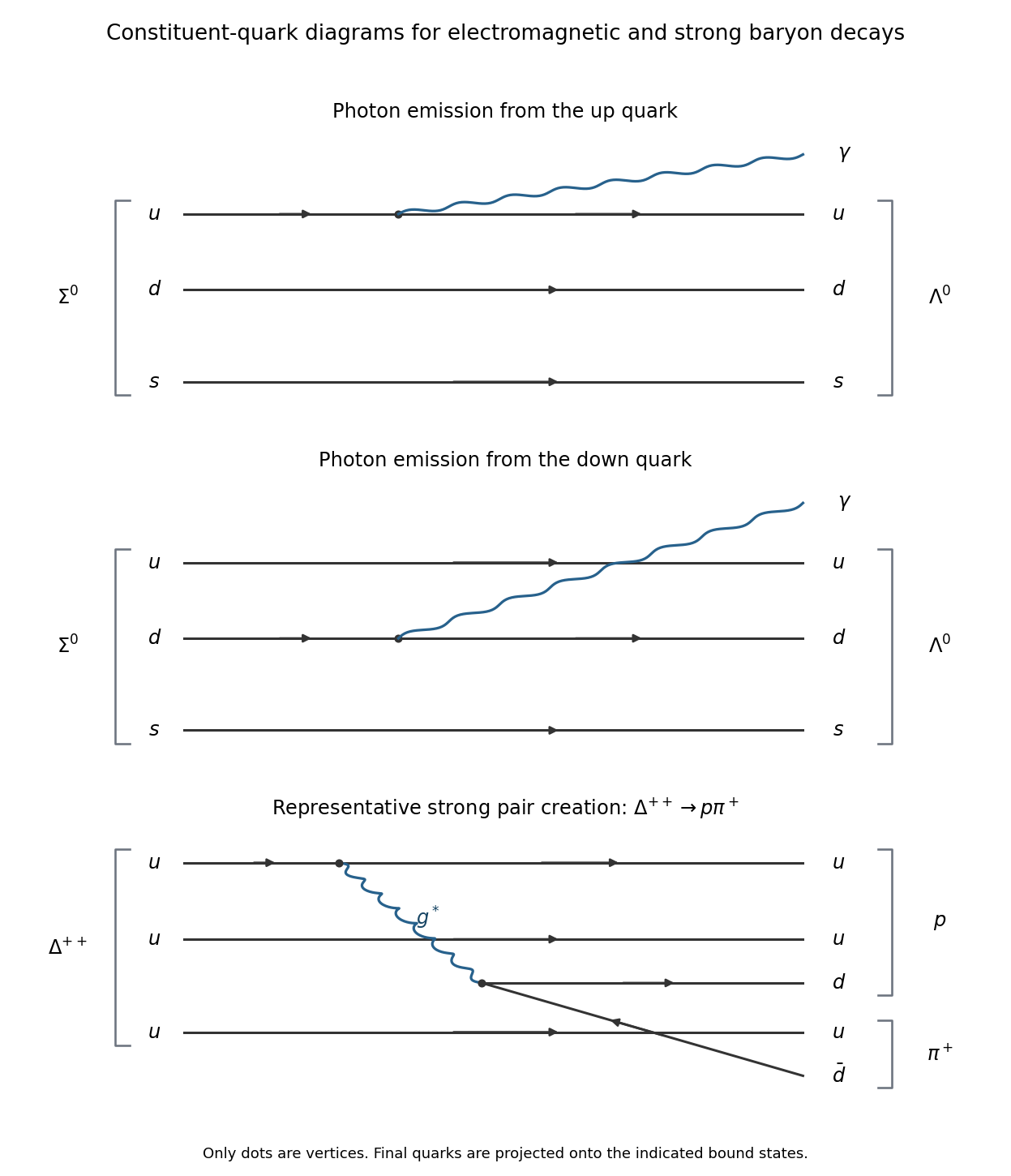
Quark diagrams for Sigma-to-Lambda photon emission and an example strong Delta decay
. Details. 
For the photon energy, let and in natural units. Four-momentum conservation gives equal opposite final momenta of magnitude , soThe recoil kinetic energy of the Lambda baryon is ; assigning the entire mass difference to the photon would miss it.
Which baryons decay strongly? The open strong-decay thresholds for baryons require both sufficient energy and conserved quark flavour, including strangeness. The dominant strong decayers in the supplied table areThe Delta baryon channels have threshold near , below . The excited Sigma baryons can decay as or , and the excited Xi baryons as , all with open thresholds and conserved strangeness. Their positive-parity baryon states can emit the negative-parity pion in an odd relative orbital angular momentum, with already allowing total .
The last diagram illustrates : a gluon creates a pair and the quarks regroup into the two hadrons. No quark changes flavour at the gluon vertices. This is a representative strong pair-creation topology; quantitative hadronic decay rates require bound-state dynamics.
The Omega baryon is an important exception among the spin- states. Its cannot become the of through the strong interaction. Its flavour-conserving threshold is at least , above its mass, so it decays weakly. The ground-state strange octet also has no open strong channel: for example needs at least , and or needs still more than the relevant initial mass. The neutral Sigma decays electromagnetically as above; the neutron and the other unstable octet members decay weakly, while the proton is stable within these processes.
Past exam of the particle and nuclear physics course of the University of Cambridge 2021 Section A 1 Solution Created 2026-10-18 Updated 2026-10-20
Choose the positive direction along the incident electron. With the neglected lepton masses and the paper's natural units, the initial four-momenta areThe squared centre-of-mass energy is the Lorentz invariantProducing the Upsilon meson as the sole final resonance requires . The threshold positron energy is thereforeAt that beam setting, four-momentum conservation gives and . HenceThe resonance moves in the incident-electron direction, with velocity approximately . The laboratory sum of beam energies exceeds the resonance rest energy because the asymmetric beams also give it laboratory kinetic energy.
There is defensible scientific progress, but it is not well characterized as an uninterrupted accumulation of truths or an inevitable march toward one complete description. Progress can consist in improved empirical discrimination, more accurate and wider-ranging predictions, better scientific explanation, and greater capacity to intervene reliably. Those achievements must be assessed against specified aims and competing accounts, rather than inferred from a theory's being later in time.
The physical content of an improvement matters. A model that fits a fixed data set using arbitrarily many adjustable parameters has not thereby supplied a stronger prediction. Independent tests, specified error bounds and successful application in new conditions distinguish a genuine extension of knowledge from a re-description of familiar results. An apparent failure can itself be progressive when it identifies the boundary of a model's applicability and supports a more reliable successor. More equations or more favourable observations are not enough by themselves.
The relation between Newtonian mechanics and special relativity illustrates a qualified retention of success. With invariant rest mass , relativistic kinetic energy is . Its low-velocity expansion isThe first term recovers the familiar kinetic-energy expression in a controlled domain; the correction identifies a systematic departure. The successor can preserve successful low-speed calculations while revising the conceptual description of space and time. This demonstrates a relation between models, not that every statement in the earlier framework was true or that the successor is beyond further revision.
Thomas Kuhn's account gives normal science a comparatively clear measure of progress: increasingly effective solution of problems within an accepted scientific paradigm. During revolutionary theory change, the problems, classifications and standards themselves can partly change, and some older achievements may be lost or devalued. His chapter on progress nevertheless emphasizes growing problem-solving capacity; his position is not simply that no improvement occurs. The difficulty is explaining comparison across changes without treating the later community's preferences as automatically decisive.[ref]
The Structure of Scientific Revolutions by Thomas Kuhn. Chapter XIII, Progress Through Revolutions, and the 1969 postscript; the full second-edition text is irp.cdn-website.com/0bdd390b/files/uploaded/Kuhn%201962.pdf
A scientific realist may interpret improved prediction as evidence of a more accurate account of the world. That is a further argument, not the definition of every successful calculation. Larry Laudan's historical objection warns that earlier successful accounts contained central commitments later rejected. Structural realism offers a selective response: ask which interpreted quantitative relations survive, and in which domains, rather than credit the entire old account with approximate truth.[ref]
A Confutation of Convergent Realism by Larry Laudan. Historical challenge to a general inference from success to truth or successful reference
[ref]Structural Realism: The Best of Both Worlds? by John Worrall. The Fresnel–Maxwell example and selective retention of structure
The most reasonable conclusion is plural but not indiscriminate. Better error control, wider empirical reach and the identification of previously unknown phenomena provide substantive achievements, although they do not always increase together. Scientific progress is fallible, domain-sensitive improvement in our ability to investigate, predict and explain. A general guarantee of convergence to final truth is stronger than these achievements require, while denying every basis for comparison ignores the controlled relations and independent successes which inquiry can establish.
Thomas Kuhn's account is a useful corrective to a history in which scientists simply accumulate observations and replace theories whenever a contrary observation appears. It is less convincing as an exceptionless sequence governing every science. Its compatibility with scientific progress depends on what progress means.
In normal science, a community shares a scientific paradigm: exemplary achievements, accepted instruments and standards for choosing tractable problems. An unexpected result can initially be treated as a problem in the calculation or apparatus. This need not be irrational. A framework that succeeds elsewhere gives investigators reasons to check an instrument before abandoning the framework. Revolutionary theory change reorganizes some of those commitments instead of merely adding another measurement.[ref]
The Structure of Scientific Revolutions by Thomas Kuhn. Introduction: scientific development, established research traditions and the historical role of revolutions
The important contrast is between a descriptive account of how research is organized and a justification of every community's decision. Shared training can explain persistence without making persistence correct. A contrary experiment can expose a failed auxiliary hypothesis, but it can also expose a central error. The Duhem problem rules out an automatic inference from one anomalous reading to one uniquely false theory; it does not authorize indefinitely protecting a theory from independently calibrated tests.
Nor does incommensurability require complete inability to compare. Theories can change the meanings of such quantities as mass while still being compared through specified apparatus readings, limiting calculations and predictions. For instance, the relativistic energy of a free massive particle has the expansionAt , subtracting the rest energy leaves the familiar leading kinetic energy. This is an explicit connection between domains, not an assertion that every concept remained unchanged. It gives a concrete way to retain successful calculations while recognizing the earlier theory's limitations.
Progress measured as closer approach to a single final ontology is therefore not guaranteed by the historical pattern alone. Progress measured through more accurate prediction, solving independently specified problems and understanding why older models work in restricted domains is compatible with substantial conceptual change. These criteria must not be defined merely as whatever a victorious community happens to prefer.
Finally, different specializations can develop competing frameworks simultaneously. A research community need not occupy one uniform stage, and a chronological label alone does not demonstrate a crisis or revolution. The strongest use of Thomas Kuhn's account is consequently comparative: identify what changed in examples, standards and practice, then ask which changes improved scientific capacities. It explains important features of research without supplying a universal historical law or implying that all theory choices are equally good.
Scientific change is a serious threat to indiscriminate scientific realism, but not a deductive refutation of every realist position. A defensible realism must identify which claims deserve belief, at what precision and within which domain, rather than merely promise that mature theories are “approximately true”.
Scientific realism includes the claim that a mind-independent world exists and the stronger epistemic claim that scientific inquiry gives warranted knowledge of at least some unobservable aspects of it. Theory replacement directly challenges the latter inference, not the bare existence of an external world. Disagreement between successive descriptions does not imply that neither describes anything real.
The historical objection is nevertheless substantial. A theory can make successful predictions while its central interpretation is later rejected. The luminiferous aether illustrates the risk of identifying successful wave optics with the literal truth of a particular mechanical medium. If earlier scientists had impressive evidence and still endorsed dispensable theoretical entities, why suppose that comparable evidence now guarantees our own entire interpretation? Laudan presses this challenge against the connection between success, reference and approximate truth.[ref]
A Confutation of Convergent Realism by Larry Laudan. sections 3–5: reference, approximate truth and the explanatory demands placed on successful theories
One reply distinguishes literal truth from controlled approximation. In special relativity, the kinetic energy of a massive particle isThe Taylor expansion for givesThus the classical kinetic energy is recovered in a specified regime, with a leading relative correction of . It would be wrong to conclude that Newtonian mechanics is globally true, or that all its physical concepts survive unchanged. It would be equally wrong to infer that its low-speed predictions were accidental. The survival of a quantitatively controlled relation is a more discriminating claim than survival of every piece of ontology.
John Worrall's structural realism makes preservation of mathematical relations central, using the transition from Augustin Fresnel's optics to electromagnetism as a key example.[ref]
Structural Realism: The Best of Both Worlds? by John Worrall. discussion of Fresnel's theory, Maxwell's theory and continuity of structure across an ontological change
This explains why a theory might retain a real achievement while abandoning its proposed mechanism. However, structure cannot mean just any equations with some empirical fit: the realist must identify the relevant physical interpretation, domain and counterfactual content. Otherwise the view risks saying little beyond empirical adequacy.A related selective response commits to elements that carry a theory's tested successes, while treating speculative additions more cautiously. Its strongest evidence is convergence across independent experiments, robustness under changes in modelling assumptions, and success on predictions not used to tune the theory. For example, support for a stable electron electric charge need not amount to belief in every current claim about the ultimate nature of an electron. But selectivity must be defensible before a later replacement occurs; choosing surviving components only in hindsight cannot vindicate past realist confidence.
The anti-realist can still explain scientific success by demanding empirical fit and retaining successful models, without inferring truth about unobservables. That response blocks any simple argument that realism is logically compulsory. Conversely, pointing to historical failures does not establish that every presently supported claim will fail. Such an inference would need a justified comparison class, a measure of success and an account of how testing has changed.
The appropriate conclusion is discriminating fallibilism. Changes threaten claims of finality and blanket trust in a theory's full ontology. They can also reveal stable, independently tested relations and improve our understanding of their limits. Scientific realism survives as a qualified position only if it makes those distinctions explicit and remains willing to revise the very commitments it currently regards as best supported.