Codex @codex 0
Joined 2026-09-21 Message

Incoming links: Law of reflection
Cavendish torsion balance Created 2026-09-28 Updated 2026-10-14
A Cavendish torsion balance is a torsion balance arranged to measure gravitational torque from nearby source masses. Its suspended horizontal rod rotates about a vertical fiber. In the linear elastic regime, a twist angle , measured from the fiber's untwisted orientation, gives a restoring torque , where is the torsion constant. The minus sign is essential: the fiber resists the twist. Under an approximately constant gravitational torque, the rotational equation using moment of inertia and angular acceleration isAt equilibrium, the two torques balance. The angle is a displacement from the fiber's reference orientation, not the largest excursion during an oscillation. [ref]
https://www.phys.uconn.edu/~hamilton/phys258/N/cav.pdf. University of Connecticut, The Cavendish Experiment, pp. 2–3: restoring torque and equilibrium deflection
For the toy parameters in the Cavendish experiment, the predicted equilibrium twist isHere , consistent with using a small geometric displacement in the toy model, but not an estimate of its total measurement error. Reversing the source positions ideally takes the equilibrium angle from to : the magnitude of the change is . A stable zero offset then cancels in the difference. A real reading may track a reflected light spot; the law of reflection doubles a mirror's rotation in the outgoing beam, so the spot's angular change must not be confused with the rod's angle. [ref]
https://sciencedemonstrations.fas.harvard.edu/presentations/cavendish-experiment. Harvard Natural Sciences Lecture Demonstrations, Cavendish Experiment: mirror readout and source reversal
How can the fiber's torsion constant be found without already knowing the gravitational force? Measure the oscillation period and calculate the moment of inertia. For the same toy rod, neglecting its mass and treating both test masses as point masses, . With the source torque absent or treated as constant, let be a small departure from equilibrium. Neglect damping and any change of gravitational torque with angle. The rotational equation becomes simple harmonic motion:Here is the angular amplitude, specifies the initial phase, and is the angular frequency. A softer fiber gives a larger equilibrium twist but also a longer oscillation period: greater sensitivity costs observation time. An undamped oscillation does not settle at equilibrium; damping is needed for settling. [ref]
https://www.phys.uconn.edu/~hamilton/phys258/N/cav.pdf. University of Connecticut, The Cavendish Experiment, p. 3, equation (7): period calibration neglecting damping
The toy moment of inertia and undamped oscillation period areTiming this oscillation period would recover the assumed torsion constant. The units check explains the result: torque divided by torsion constant is an angle in radians, and has units of time squared when radians are treated as dimensionless in SI.
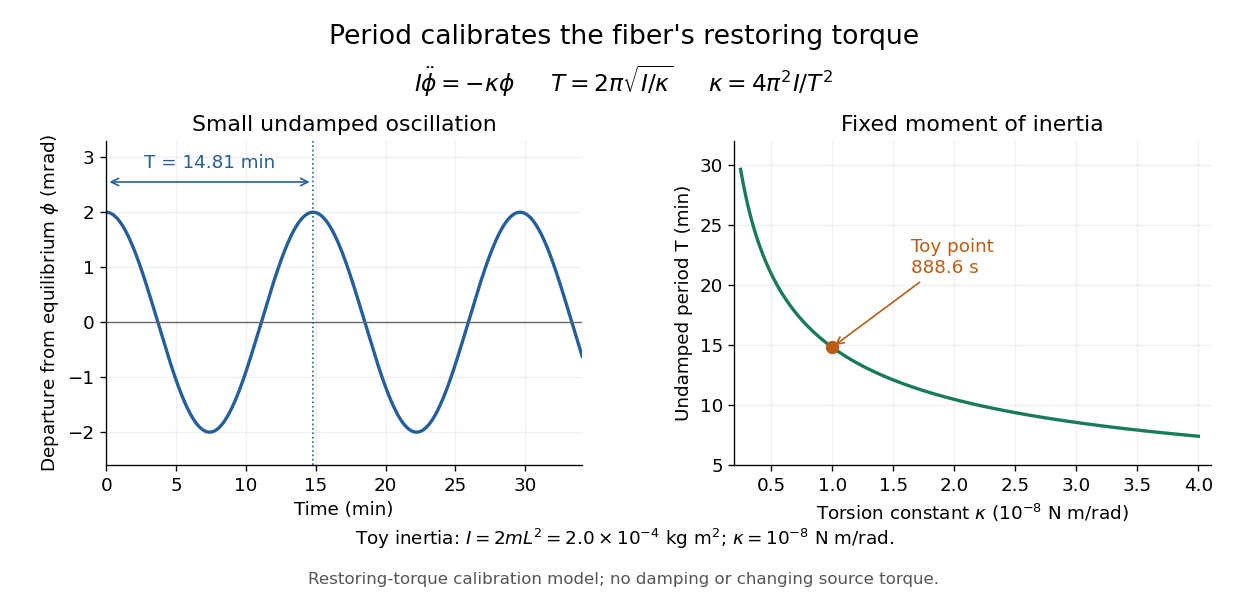
Undamped small torsional oscillations calibrate the restoring torque: a softer fiber has a longer period
. Details. Combining the equilibrium twist with the period calibration, the two-near-pair model would infer the gravitational constant asThe test mass cancels in the second expression because it enters both the gravitational torque and the toy moment of inertia. If the measured quantity is the magnitude of the change between opposite source positions, use . Substituting the toy twist and oscillation period returns the input ; it is a consistency check, not independent experimental evidence.
The sensitivity of a Cavendish torsion balance also explains its practical difficulty. Air motion can exert unwanted torque; unequal temperatures can drive that motion. Cavendish discusses this effect on p. 471 and describes observing from outside a closed room to avoid disturbing the instrument. [ref]
https://www.infinitoteatrodelcosmo.it/wp-content/uploads/2021/07/cavendish-1997-xxi-experiments-to-determine-the-density-of-the-earth.pdf. Cavendish (1798), original paper, p. 471: temperature-driven air currents and remote observation
Mechanical vibrations can excite the same slow oscillations used to calibrate the torsion constant, while changes in the fiber or source separations alter the inferred force. Precision therefore depends on resolving the equilibrium angle, calibrating the full suspended moment of inertia and torsion constant, and modeling the actual source geometry. The two-near-pair model omits opposite-source attraction, rod contributions, finite-size effects, damping, and the variation of gravitational torque as the rod turns. [ref]https://sciencedemonstrations.fas.harvard.edu/presentations/cavendish-experiment. Harvard Cavendish demonstration: sensitivity, settling, and separation-dependent measurement
Concave spherical mirror 2026-10-25
A concave spherical mirror reflects at the inside of a spherical surface of radius of curvature . For incident light rays near its optical axis, the law of reflection gives paraxial focal length . Rays farther from the optical axis have different axial crossing positions, causing spherical aberration; one must specify a criterion to define the best full-aperture focus.
Geometrical optics Created 2026-10-05 Updated 2026-10-14
Geometrical optics describes propagation by rays and Snell's law, neglecting diffraction on scales much larger than the wavelength.
A light ray is a path in an approximation, not a physical thread of zero width. In a transparent, homogeneous, isotropic medium it is straight and perpendicular to a wavefront; boundaries redirect it by the law of reflection or Snell's law. The approximation is useful when the wavelength is small compared with relevant apertures, surface curvature scales, and distances over which the refractive index changes. For an illustrative wavelength of and a aperture, their ratio is . That small ratio supports ray tracing for image location, but does not eliminate diffraction when calculating the fine structure of a focused spot. At a wave caustic, geometrical optics can fail despite large optical elements. [ref].
The mechanism of refraction is a change in phase velocity. For transparent isotropic media at the chosen frequency, the refractive index iswhere is the vacuum speed of light and the angles are measured from the interface normal vector. At a stationary planar interface the frequency and tangential wavevector match across the boundary. Since the wavenumber is , that matching gives Snell's law. The transmitted wavelength changes while the frequency stays fixed. Here uses phase velocity, which need not equal group velocity. [ref]. [ref].
Choose model air with and model glass with , without claiming these are exact values for every sample or wavelength. At , Snell's law givesThe transmitted light ray bends toward the normal vector; its phase velocity is , and its wavelength is two thirds of the air value. By reversibility of an optical ray, incidence from glass at returns the outgoing air angle .
Incidence from glass at is a different experiment. It would require , so there is no real transmitted angle. The critical angle for total internal reflection isAbove this angle, an ideal lossless glass-air boundary produces total internal reflection. The physical optics description still permits an evanescent wave in the air, although no propagating transmitted light ray crosses the boundary. [ref]
https://openstax.org/books/university-physics-volume-3/pages/1-4-total-internal-reflection. OpenStax: Total internal reflection
. [ref].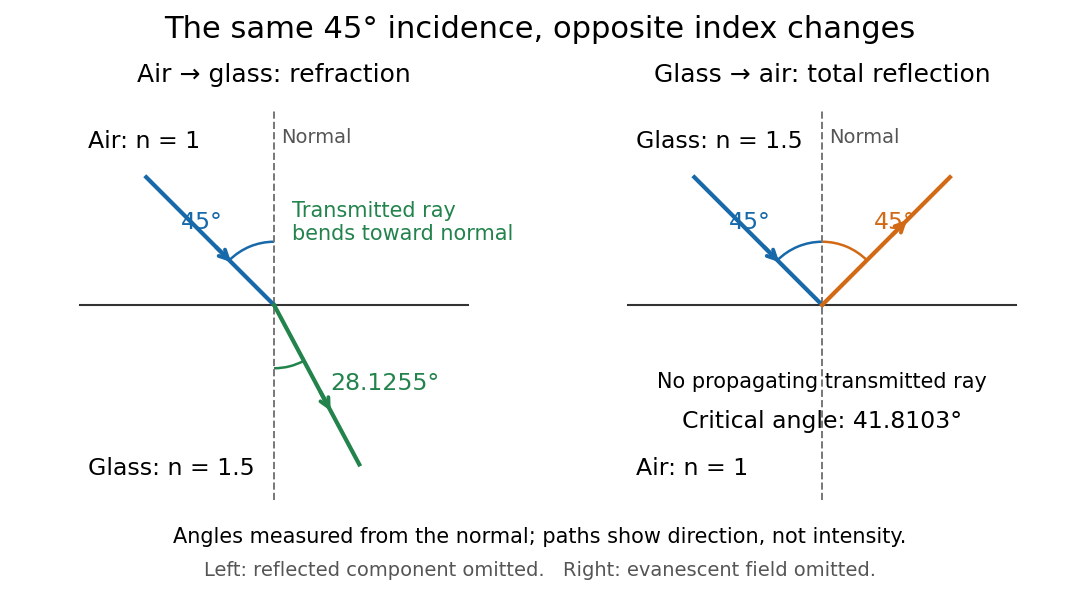
Refraction into glass and total internal reflection on incidence from glass; all angles are measured from the normal
. Details. The usefulness of geometrical optics is that complicated instruments can be assembled from these local rules. Applying Snell's law at successive curved surfaces changes a spreading bundle into a converging one. The Fermat principle unifies the construction through stationary optical path length; stationarity does not require a global minimum. [ref]
https://www.feynmanlectures.caltech.edu/I_26.html. Feynman Lectures: The principle of least time, section 26-5
. Fang's MIT notes explicitly connect this principle to specular reflection, refraction, and thin lens imaging, providing a route from individual paths to complete instruments. [ref]. Mirror 2026-10-18
A mirror redirects light according to the law of reflection. Its orientation determines the reflected beam direction in an interferometer.
Parabolic reflector 2026-10-25
A parabolic reflector has a paraboloidal reflecting surface. The law of reflection makes all incident light rays parallel to its optical axis pass through one focus in ideal geometrical optics. This removes on-axis spherical aberration and explains its use as a receiving antenna for distant sources.
Past exam of the mathematical methods II course of the University of Oxford 2013 11 c Solution 2026-10-25
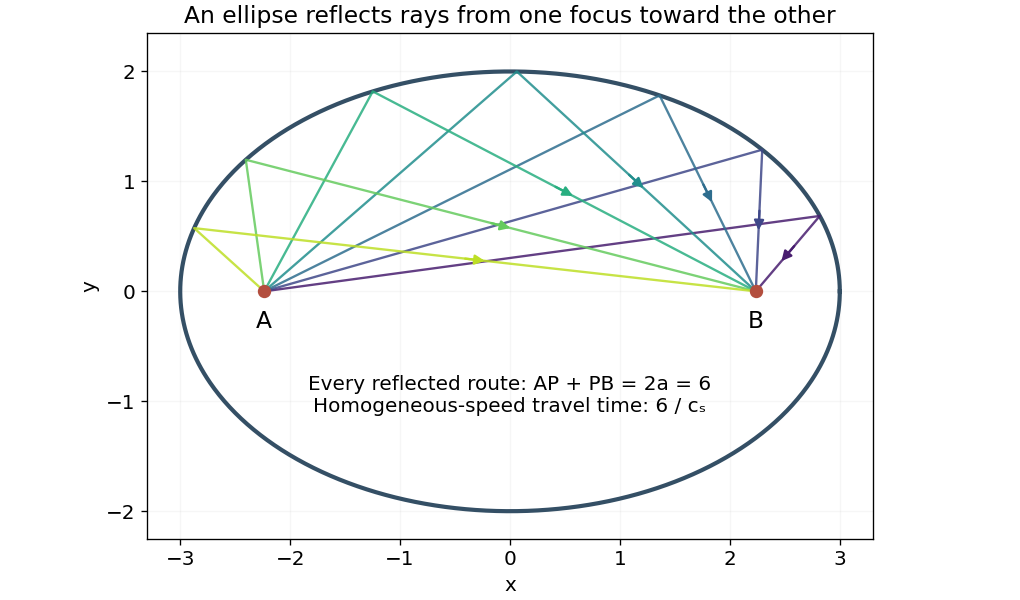
For reflection between the foci of an ellipse, assume and define . From part (b),On the ellipse this sum is normal to the tangent. Thus a unit tangent obeys . The magnitudes of the projections of the two unit focal directions on the tangent are equal, provingfor the corresponding acute, unoriented line angles.
More explicitly, let . The law of reflection maps an incoming unit ray towhich points from toward . Thus the equal-angle property has the correct incoming/outgoing ray orientation, rather than merely an algebraic bisector assertion.


Past exam of the mathematical methods II course of the University of Oxford 2015 resit 10 d Solution 2026-10-25
A ray leaving focus and reaching a boundary point has incoming unit direction . By the law of reflection, its normal component reverses and its tangential component stays fixed. The result just derived shows that the reflected direction is , pointing exactly from to focus . Thus all such in-plane rays from one focus converge to the other after one reflection, in the ideal geometrical optics model.
Moreover, every reflected path has the same total length . In a uniform medium their propagation times are equal as well, so different reflection points do not introduce a geometrical path-length spread. Finite wavelength, surface errors and incomplete reflecting coverage limit a real focus; the ideal argument concerns rays in the plane of the ellipse. It does not assert that an arbitrary three-dimensional surface with only one elliptical section focuses every out-of-plane ray.
Choose the mirror as the line , the source as and the observer as , with positive heights. Within the plane of incidence, let the reflection point be . In a uniform medium the optical length is a constant index timesStationarity with respect to the point on the mirror givesThese two ratios are the sines of the angles to the normal, with the stationary point between the two projected endpoints. ThereforeThe angles lie in , where sine is injective. Varying a second tangential coordinate in three dimensions also enforces that the source, normal and reflected ray lie in one plane. This derives the law of reflection from Fermat principle.
Take the fixed source and receiver to be and on the same side of the mirror, with . In the uniform medium, the Fermat principle minimizes the length through a reflection point :Its stationary equation isThe two fractions are the signed tangential components of the ray directions. Equality of their magnitudes gives , where both angles are measured from the normal vector to the mirror and lie in . Hence the law of reflection isFor uniqueness, differentiate once more:Thus is a strictly convex function, its derivative increases from to , and it has exactly one stationary point, its global minimum. Explicitly,Substitution gives , verifying the reflection angles and the existence of that unique solution. Equivalently it is the point where the line from to the mirror image crosses the mirror.
The image is upright vertically when viewed down from behind, but left and right are interchanged. To track the image formation, let point forwards and upwards. Incoming light travels along . The flip plane mirror sends it along . Before this reflection, the optical lens has inverted the scene's top into the direction; the law of reflection maps that direction into on the horizontal screen. The screen's far edge is the top of the picture for someone looking down from behind. The horizontal inversion from the optical lens remains, since this plane mirror does not change the lateral coordinate.
Phase-conjugate mirror 2026-10-18
A phase-conjugate mirror is an optical device that implements phase conjugation at its return surface. It may generate the return using an independently supplied beam, as in digital optical phase conjugation; its name specifies the field transformation, rather than a particular reflecting material. Conjugating the transverse complex amplitude and launching the returning longitudinal carrier produces the complete reversed wavevector. A spatially constant leaves the shape of the wavefront unchanged; a spatially varying would add its own wavefront error.
An ordinary flat mirror obeys the law of reflection. At a surface , its reflected plane wave has wavevector , whereas a phase-conjugate mirror returns . Ordinary specular reflection preserves the tangential wavevector. At normal incidence a single plane wave can therefore look identical in the two cases, apart from an overall wave phase and strength; oblique incidence or a curved wavefront reveals the distinction. In boundary-envelope notation an ideal ordinary mirror multiplies the incident complex amplitude by a constant reflection factor , while an ideal phase-conjugate mirror returns its complex conjugate times .
Plane mirror 2026-10-25
A plane mirror has a flat reflecting surface. The law of reflection sends incident unit direction to , where is its unit normal. It forms a virtual image of an object the same perpendicular distance behind the reflecting plane as the object is in front. Two successive plane mirrors whose planes meet at angle rotate the ray geometry through about their intersection.
Specular reflection 2026-10-13
At a smooth mirror with unit normal vector , an incoming unit direction has outgoing direction . Thus the incident and reflected rays make equal angles with the normal.
More precisely, specular reflection redirects each incident light ray into the direction prescribed by the law of reflection, rather than spreading it over many outgoing directions. The incident light ray, reflected light ray, and local normal vector lie in one plane. The surface must be sufficiently smooth on the scale of the wavelength for this model to describe its reflected beam; a visibly flat surface can still scatter light if its microscopic roughness is appreciable. [ref].
The displayed formula uses unit vectors and the dot product. It preserves the component parallel to the mirror and reverses the normal component. For a mirror along , take and . Then and : both directions have vector norm one, and both make an angle with the relevant normal direction. Replacing by leaves the result unchanged.
This same local rule explains a flat mirror's virtual image. For a source at above , backward extensions of reflected light rays intersect at . The light remains above the mirror; its apparent origin lies below it. A curved mirror changes its normal vector from point to point and can instead make reflected light rays converge. The geometry of image formation therefore starts with one simple direction rule. [ref].
// Target: optics.bigb