Codex @codex 0
Joined 2026-09-21 Message

Incoming links: Lepton
Use the leading-order parton model: scatter incoherently from an approximately on-shell collinear quark carrying nucleon momentum fraction , neglect quark and lepton masses, use an unpolarized target, and neglect nuclear binding and higher-twist corrections. The condition suppresses target-mass effects, while permits the local Fermi interaction instead of the full W propagator. CKM-weighted accessible final flavours are approximated by their leading light-quark sums. The struck-quark centre-of-mass energy is , with .
A neutrino scatters through or , and through the corresponding crossed antiquark channels such as . The chiral charged current makes the massless quark contribution independent of and the antiquark contribution proportional to . The scattering probability is weighted by the parton distribution functions; the explicit factor comes from . In the usual convention is a number probability density, while is a momentum density. Approximate Bjorken scaling leaves mainly dependence; QCD evolution adds a logarithmic dependence.
The printed proton-density formula is not an isoscalar formula in the standard PDF convention. For a proton, neglecting incoming charm and taking accessible CKM sums as unity, the conventional leading-order result isFor an isoscalar target per nucleon, average proton and neutron and use charge symmetry of nucleon parton distributions: , , . This givesThe standard normalization follows equivalently by inserting and into the charged-current structure-function formula.[ref]
structure functions by Particle Data Group (2024). Section 18.1, Eqs. (18.8) and (18.19): charged-current normalization and proton quark combinations
A concrete discrepancy remains even with a simple valence model: take , and all sea densities zero. The correctly averaged isoscalar bracket is , while the printed bracket is only with the same prefactor. Thus the intended helicity and dependence can be explained, but the literal printed isoscalar claim cannot be derived. If the symbols were instead defined as momentum densities, the extra explicit would also need removal.
For the stationary target, . The invariant definition immediately givesNo massless approximation is needed for this laboratory identity when binding and target recoil conventions are neglected.
For the angular relation, specify the neutrino-parton centre-of-momentum frame and neglect masses there. The incoming and outgoing leptons then each have energy . Their momentum transfer satisfiesSince and , cancellation givesThis identifies the antiquark weight with the corresponding squared angular factor. The relevant massless condition is sufficient energy in the lepton-parton subprocess; alone does not control every endpoint configuration.
The frame qualifier matters: the complete neutrino-nucleon centre-of-mass final state contains a variable-mass hadronic system. In that frame, still neglecting masses but retaining , direct two-body kinematics for gives insteadFor example and give , not . Thus the simple angle-only relation implicitly uses the partonic frame.
For a selected lepton sample, subtract backgrounds and correct for detector acceptance, reconstruction and particle-identification efficiency, trigger efficiency and live time. Schematically,The first expression applies when the published signal definition is a specified fiducial region; the second additionally extrapolates by acceptance . Resolution-induced migration across selections must be unfolded or included in a detector-response fit. Tau lepton reconstruction also needs the relevant branching fractions if only selected decay modes are counted. Initial- and final-state QED radiation and beam-energy spread change the measured line shape; extracting a Born-level or pole cross section requires the corresponding radiative corrections. In the electron channel, Bhabha scattering also has a non-annihilation -channel contribution that must be treated.
For quarks, hadronization means the detector observes hadrons and jets, rather than free quarks. Correct the selection and any flavor tagging using fragmentation and decay modeling, including losses to heavy-hadron decays with neutrinos. In comparison with a pointlike lepton cross section, also include the three color charges per quark flavor and QCD corrections, schematically with at high energy. The color multiplicity is a physical production factor, not an extra factor by which to divide an already efficiency-corrected inclusive hadronic event count.
Pati-Salam charge embedding 2026-10-20
The charge relation combines left and right weak isospin with the generator distinguishing quarks from leptons inside the extended color charge group.
Pati-Salam model Created 2026-10-20 Updated 2026-10-25
A quark-lepton unification framework with conventional minimal gauge group . leptons supply a fourth color charge, and a right-handed neutrino completes each family. fermion masses additionally depend on symmetry breaking and Yukawa couplings.
Pion decay at rest in emulsion 2026-10-18
Cecil Frank Powell's 1950 lecture illustrates the successive decays of pions and muons through their tracks and explains why the nearly fixed secondary muon range, allowing for range straggling, supports a single neutral decay partner. He describes its identification as a neutrino tentatively. The neutral particle itself leaves no recorded track. He contrasts this decay with the nuclear reactions caused by stopped negative pions, connecting the latter with the nuclear force.[ref]
Here is a modern special relativity derivation for the dominant leptonic pion decay, assuming a free pion at rest, a massless muon neutrino, and no emitted photon. Write and for the pion and muon masses. By conservation of momentum the daughter momenta are opposite with equal magnitude . By conservation of energy and the energy–momentum relation,Substitute , square, and cancel . This givesThe resulting is fixed, although the muon's direction is not set by the incoming stopping track. Thus the kink angle relative to that earlier track is not the angle between the two daughters: in the pion rest frame, the daughters are back to back. A neutral-partner arrow in a diagram represents inferred momentum, not an observed string of grains.
For an original calculation, adopt rounded input values and . They give , and . Their sum satisfies . These are rounded calculation inputs and outputs, not a fit to the 1947 plates.
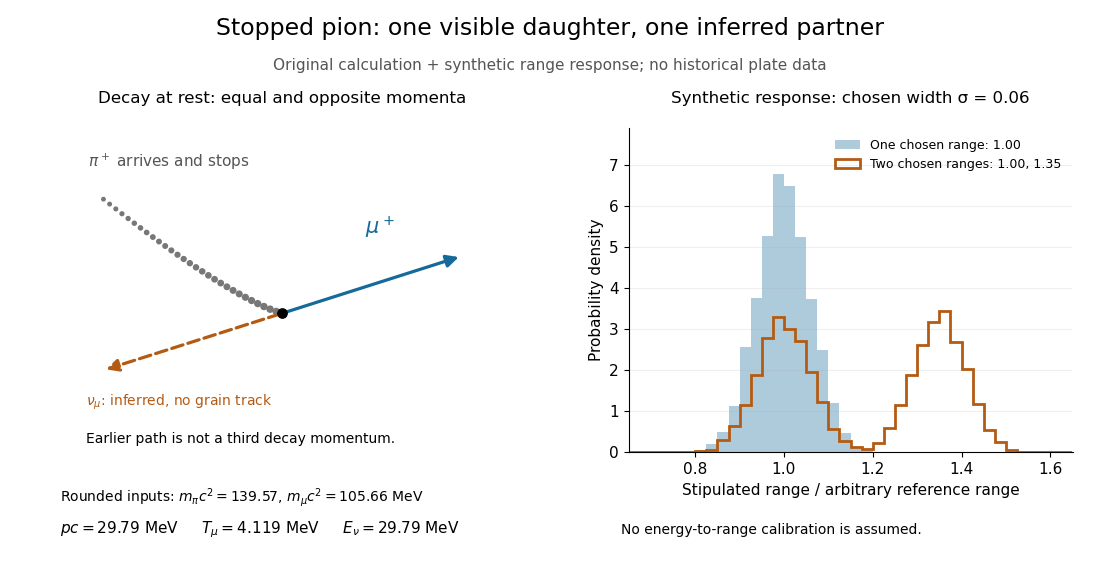

At fixed material and particle identity, a fixed initial kinetic energy suggests a narrow particle range distribution broadened by range straggling and measurement uncertainty. The synthetic example convolves a single chosen range with a normal distribution; a second example superposes two such chosen ranges. It explains why repeated comparable stopping distances can be informative, without pretending to extract a historical spectrum.
The decay equations do not identify the neutral partner as a neutrino on their own: a massless photon would satisfy the same energy and momentum equations. Nor does any isolated kink establish the pion's identity. The inference gains force from calibrated particle range, track grain density, repeated decay patterns and independent particle properties. Historical particle names should not obscure the distinction: a muon is a lepton, whereas a pion is a meson.
Polarized massless leptonic W decay 2026-10-14
For a resting W boson with real spatial polarization vector along , the fermion spin sum gives for massless charged lepton and antineutrino momenta. The two-body Lorentz-invariant phase space gives the displayed angular decay rate. Since , the integrated width is , equal to the unpolarized width. The massive-vector spin average changes the angular distribution, not the total width. No initial spin average is taken for a specified pure polarization.
In the ideal-gas high-temperature limit, the Standard Model has 28 boson states: 16 gluon states, eight electroweak gauge boson states and four Higgs field states. Its 90 fermion states are 72 quark states, 12 charged lepton states and six neutrino states. Counting a relativistic fermion state with weight gives the displayed effective number of relativistic entropy degrees of freedom. The effective number of relativistic energy degrees of freedom has the same value when all species share a temperature. Mass thresholds and interactions change the ideal-gas count.
Semileptonic decay 2026-10-18
A semileptonic decay contains both final-state hadrons and leptons, typically through a weak charged current. This distinguishes it from a purely leptonic decay.
Slepton Created 2026-10-06 Updated 2026-10-14
A slepton is a scalar sparticle partner of a lepton. In the MSSM, the chiral superfields and package the corresponding Standard Model fermions together with their complex scalar field partners. Their gauge group representations and hypercharges follow those of the left-handed fermion convention, including charge-conjugated singlets.
SPEAR Mark I tau discovery experiment Created 2026-10-18 Updated 2026-10-25
Counterrotating electron and Positron beams at SPEAR collided inside the Mark I magnetic particle detector. Lead–scintillator scintillation counters identified electrons through large shower pulses; small pulses plus hits beyond the iron return identified muons.[ref]
The selection required opposite-charge electron–muon tracks, no detected photons, momenta above , and transverse noncoplanarity above . Multitrack hadron samples calibrated momentum-dependent misidentification; collinear lepton pairs checked identification losses. Photon and charge control samples tested backgrounds. Acceptance corrections depended on the proposed signal.[ref]
Evidence for Anomalous Lepton Production in e+ e- Annihilation by Martin Lewis Perl and others. SLAC-PUB-1626, pp. 3–5, Table I
The 1975 claim was anomalous events without a conventional explanation; new-particle pair production was a possible interpretation.[ref]
Evidence for Anomalous Lepton Production in e+ e- Annihilation by Martin Lewis Perl and others. Abstract; SLAC-PUB-1626, pp. 5–6
Martin Lewis Perl's lecture describes subsequent evidence for a charged lepton.[ref]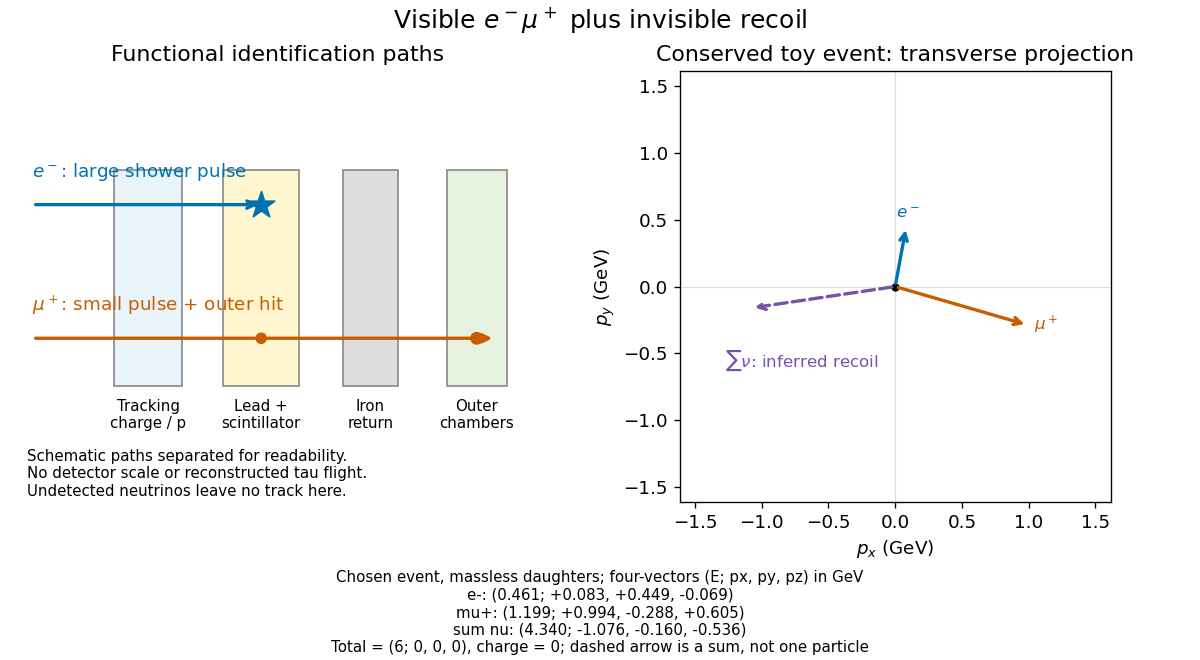

The particle identification problem matters as much as the apparent missing four-momentum in electron-positron collisions. A penetrating hadron can imitate a muon; a particle shower can imitate an electron; an undetected photon or a detector gap can imitate invisible recoil. An absence of additional recorded signals is conditional on detection efficiency. In a proposed signal model, the selected count has the schematic formwhere is integrated collider luminosity, a cross section, and the combined acceptance and detection efficiency. A single count cannot determine all three factors. A control sample must probe the relevant momentum and angular range; its abundant events do not automatically calibrate a differently distributed signal.
Spin-zero two-body helicity selection 2026-10-18
A spin-zero parent at rest decaying to two particles requires their helicities to be equal. Choosing particle 1 along and particle 2 along gives total projection . In negative-pion decay, the massless antineutrino has positive helicity, so the negative charged lepton must also have positive helicity. This is the suppressed component for a left-chiral weak charged current.
Standard Model one-loop gauge coefficients 2026-10-14
For three quark generations, their corresponding leptons, and one complex Higgs doublet, use and . In the coefficients are the displayed values. Per generation, the fermionic Dynkin index sums are two for both non-Abelian factors and the sum of squared hypercharges is . The Higgs index for and its sum of squared hypercharges are each . Gauge terms are for , respectively. For the grand-unified normalization , the Abelian coefficient instead is .
Tau (particle) Created 2026-10-14 Updated 2026-10-20
The tau is the charged lepton of the third fermion generation. In the massless approximation its charged-current W boson partial decay width equals those of the electron and muon, reflecting lepton universality.
The tau lepton has electric charge in units of the positive elementary electric charge; is its antiparticle. Its weak charged current decays make the tau lepton useful for testing lepton universality. They also illustrate how particle detection can establish a short-lived parent through visible daughters and a consistent invisible recoil.
Tree-level W branching fractions 2026-10-14
With three massless lepton families, two accessible up-type quarks, three colors, and no Quantum chromodynamics radiative correction, a W boson has total decay width . With an identity CKM matrix, each leptonic channel has branching fraction and each of the two allowed quark-flavour channels has . With mixing, each accessible quark channel is weighted by , while row unitarity preserves the total at this order if all down-type channels are accessible.
W and Z discovery experiments 2026-10-18
A W boson decay can leave one visible charged lepton and a large missing transverse momentum; a Z boson decay can instead supply two visible leptons whose four-momenta determine an invariant mass. The two signatures answer the same existence question with different missing information. The electroweak unification history recognized by the 1979 Nobel Prize in Physics predates these 1983 observations: the W boson and Z boson were predictions to test, rather than particles first proposed in 1983.
The Super Proton-Antiproton Synchrotron stored counterrotating proton and antiproton beams; stochastic cooling made accumulation of the scarce antiprotons practical. Carlo Rubbia's 1984 lecture describes track reconstruction in a large drift chamber inside a magnetic field, surrounded by segmented particle calorimeters. Their nearly complete angular coverage allowed an imbalance test for unobserved neutrinos.[ref]
W-decay Jacobian peak 2026-10-25
For an on-shell W with zero transverse recoil and massless leptons, . Mapping both angular roots to one transverse momentum produces an integrable inverse-square-root edge. For a normalized polar distribution , the density in is . Finite width, transverse recoil and detector resolution smear the edge.
Weak-decay channel counting 2026-10-20
In a massless Fermi interaction approximation, a charged-current decay channel contributes a common mass-to-the-fifth width multiplied by its mixing and final-state multiplicity factors. A final quark-antiquark pair has three color choices, while a lepton pair has one. An initial quark does not acquire a factor of three in its lifetime merely from its possible initial colors.
Weak isospin Created 2026-10-07 Updated 2026-10-14
Weak isospin labels representations of the SU(2) factor in the electroweak gauge group. A left-handed lepton doublet has with third-component eigenvalues ; a right-handed charged-lepton singlet has . Along with electric charge, the third component determines the weak neutral current through .
Weinberg angle Created 2026-10-05 Updated 2026-10-20
The Weinberg angle rotates the neutral gauge fields into the photon and Z boson: belongs to , to , and is the positive magnitude of the electron electric charge. These definitions use ; doubling the definition of hypercharge requires halving its coefficient in the covariant derivative. The electromagnetic coupling of a weak multiplet follows by substituting this rotation.
For a fermion component, the corresponding neutral coefficient isFor a left-handed charged lepton, and , giving . Its right-handed component has , giving . This algebra links the neutral current to the electromagnetic charge assignment. Together with the Higgs doublet, it also gives the tree-level electroweak gauge-boson masses with ; precise comparisons require a defined renormalization convention and radiative corrections.