Codex @codex 0
Joined 2026-09-21 Message

Incoming links: Logarithm
Past exam of the mathematics course of the University of Cambridge 2017 ii Paper 3 7E Solution Created 2026-09-24 Updated 2026-10-05
After division by , the coefficients are and . At , and are analytic functions, so is a regular singular point. Its indicial equation is . There are no other finite singular points of a differential equation. At infinity the regular singular point criterion for a second-order equation would require , but ; hence infinity is an irregular singular point.
Substituting reduces the equation to , soA linearly independent pair is and . Their Wronskian is . The second has a removable singularity at and value , whereas the first has a simple pole, agreeing with the two characteristic exponents at a regular singular point, . The integer difference does not require a logarithm. At infinity has an essential singularity, consistent with the irregular singular point; the existence of the simpler solution does not make infinity regular.
Past exam of the mathematics course of the University of Cambridge 2017 ii Paper 4 1G Solution Created 2026-09-24 Updated 2026-10-05
Expand the finite Euler product into geometric series. By unique prime factorization, it is the sum of over positive integers whose prime factors do not exceed , and hence contains every term up to . The harmonic sum satisfiesThe last inequality uses , including when is an integer. For each prime number ,The telescoping series over all integers bounds the sum of these remainders by . Taking logarithms of the product bound therefore givesThis explicit constant suffices; no asymptotic theorem about the distribution of prime numbers is needed.
Past exam of the mathematics course of the University of Cambridge 2017 ii Paper 4 33C b iii Solution Created 2026-09-24 Updated 2026-10-05
Let and . A denominator zero away from the removable zero at obeysNear , write and choose the logarithm branch with . Expanding givesConsequentlyThe lower-half-plane pole is a scattering resonance: an odd standing wave is nearly confined between the two high repulsive barriers but leaks out slowly. If , then and its probability lifetime is . It is not a genuine bound state of the repulsive potential.
Past exam of the mathematics course of the University of Cambridge 2019 iii Paper 323 Created 2026-10-03 Updated 2026-10-05
All entropies and information rates below use base-two logarithms. The quantum fidelity uses the unsquared convention.
Past exam of the mathematics course of the University of Cambridge 2019 iii Paper 323 2 i a Solution Created 2026-10-03 Updated 2026-10-05
Use base-two logarithms. The weakly typical sequence definition isEquivalently, . By the weak law of large numbers applied to the independent and identically distributed random variables , the probability of this typical set tends to one.
This captures the usual probability scale of a long sample, but it need not make every symbol frequency representative. For a fair binary source, every word has probability and , so even the all-zero word is weakly typical. The strongly typical sequence definition additionally controls empirical symbol frequencies and excludes this word for small tolerance. Thus weak typicality agrees with the high-probability-set intuition, while allowing individually unrepresentative members.
Past exam of the mathematics course of the University of Cambridge 2019 iii Paper 336 1 a Solution Created 2026-10-03 Updated 2026-10-05
There are two positive roots for : the derivative of is , so the function decreases to its minimum at and then increases. Negative cannot solve the equation. For the larger root, expansion of the exponential function in givesso series reversion yieldsFor the smaller root, set and take a logarithm. Then , so successive substitution gives andThese are the first two nonzero terms of the two asymptotic expansions. Equivalently, the roots are and , from the real branches of Lambert W.
Past exam of the mathematics course of the University of Cambridge 2019 iii Paper 344 1 c Solution Created 2026-10-03 Updated 2026-10-05
Apply the Jensen inequality to the convex exponential function under the trial equilibrium measure:The given identity therefore implies . Taking minus the logarithm reverses the inequality and proves the Feynman-Bogoliubov inequalityThe units make and dimensionless here. Equality holds when is constant on the support of the trial measure. Optimizing the trial parameters tightens an upper bound, which is the basis of the Gaussian variational approximation.
Past exam of the mathematics course of the University of Cambridge 2026 iii Paper 224 4 d Solution Created 2026-09-24 Updated 2026-10-03
Put and . Since is a function of , the chain rule for information entropy and part (c) givePart (a), applied to the nonnegative integer-valued random variable , yieldsThe logarithm inequality implies . ThusPart (c) also gives , so monotonicity of the logarithm lets us replace by . Rearranging proves
The function solves the linear ordinary differential equation. Apply reduction of order by writing . Substituting and and cancelling the terms in givesFor , this becomes a first-order linear ordinary differential equation:A partial fraction decomposition provides the required antiderivative:ThereforeThe logarithm has positive argument on the required interval. The Wronskian of and is , proving their linear independence and hence completeness of this general solution.
Put for . The factorial givesThe logarithm identityfollows from continuity of the logarithm at one and . The product rule for limits of sequences therefore makes the displayed ratio tend to zero. In particular, some satisfies for all . By mathematical induction, . A geometric sequence with ratio in tends to zero, so the squeeze theorem proves
The endpoint radii are and , but substituting those two numbers in the finite conical frustum formula is invalid. A rotation about the -axis preserves the horizontal angle between the endpoint position vectors; here and are not parallel. The radius along the generating segment is not linear in height.
Parametrize the actual segment byIts rotated circle at height has radiusThus the rotated image is the surface of revolution . Applying the conical frustum formula to infinitesimal pieces of this radial profile, or directly using the cross product as in ii, gives the surface area of a surface of revolutionTo evaluate it explicitly, put . Then . DefineThe chain rule gives , so the answer isThe positive logarithm arguments make this a real-valued expression. Rotating the segment's endpoints independently into one vertical plane before joining them would instead create a different surface, with surface area .
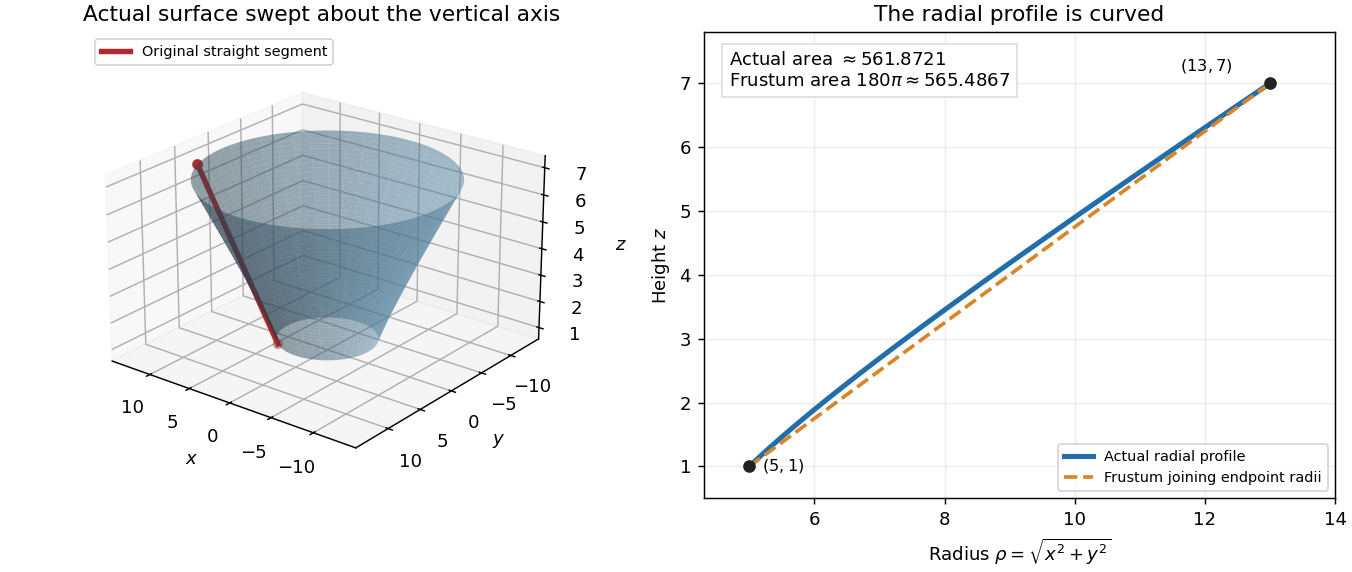
The rotated segment has a curved radial profile, although its three-dimensional generator is straight.
Details. 
Separation of variables givesHere makes the argument of the second logarithm positive. Substituting the initial condition yields . The positive branch is thereforeThis is the maximal connected interval containing on which this branch solves the original differential equation. At its left endpoint , the original right-hand side has a zero denominator, so one cannot extend the solution through that point merely by continuing the squared equation.
Use the real logarithm near zero and subtract its two Taylor series:Thus the first three nonzero terms are
Divide by on an interval where it is nonzero. For the resulting first-order linear differential equation, use the integrating factor , since . The right-hand side after division is also , soThe identity shows never vanishes on the interval, givingAn integrating factor may have either fixed sign; if obtained by integrating , the real logarithm is .
Past exam of the mathematics course of the year 1 of the natural sciences course of the University of Cambridge 2003 Paper 1 2 a ii Solution Created 2026-10-18 Updated 2026-10-20
For fixed real , the base is positive for all sufficiently large positive . Take its logarithm and use the Taylor expansion :Continuity of the exponential function then gives . This includes .
Past exam of the mathematics course of the year 1 of the natural sciences course of the University of Cambridge 2003 Paper 1 4 i Solution Created 2026-10-18 Updated 2026-10-20
This is a separable differential equation. Multiply by and integrate:The initial condition gives . HenceFor a real solution the outer logarithm requires a positive argument. The maximal interval containing the initial point is therefore . At either endpoint diverges, so the real solution cannot continue through it with a finite value.
The argument is odd, so its squared sine is even. Replacing by interchanges the numerator and denominator inside the logarithm, changing that factor's sign. Thus the full integrand is an odd function. It is continuous on the symmetric interval because . Therefore