Codex @codex 0
Joined 2026-09-21 Message

Incoming links: Lone pair
2,4-Diazadiboretidine 2026-10-20
Ammonia borane Created 2026-10-20 Updated 2026-10-31
Ammonia molecular orbital diagram Created 2026-10-20 Updated 2026-10-31
In pyramidal Ammonia, the hydrogen symmetry orbitals span of the C3v molecular point group. Nitrogen and both have symmetry and span . In the planar D3h molecular point group, these become , and , respectively, while the hydrogen combinations span . Thus the planar out-of-plane lone pair is a symmetry-isolated nonbonding orbital; pyramidalization permits mixing with the other functions.[ref]
Anilinium ion 2026-10-20
An anilinium ion is an aniline protonated at nitrogen. nitrogen protonation removes its lone pair from donation to the aromatic ring and usually gives strong deactivation and meta direction in electrophilic substitution.
Bent molecular geometry 2026-10-13
In bent molecular geometry, two neighbours and their central chemical atom form a noncollinear triangle, with an interior bond angle strictly between and . Water, , is the standard example. The NIST CCCBDB experimental water entry, internal coordinates, citing Hoy and Bunker (1979) gives the equilibrium H–O–H bond angle as with quoted uncertainty , usually rounded to .
The oxygen in water has two bonding electron domains and two lone pairs. Its ideal electron pair geometry is tetrahedral, while the three atomic nuclei give bent molecular geometry. Three points always lie in a plane; this does not make the four-domain scaffold planar. Nor does the word bent by itself determine an electron domain count: the same atomic shape can arise from other domain arrangements.
In an illustrative model with two equal bond-dipole contributions of magnitude separated by bond angle , their sum of vectors points along the bisector and has magnitude . At it vanishes; at it is approximately . This ratio is a geometric calculation, not a prediction of water's measured electric dipole moment. The entire electron density, including contributions represented by lone pairs, matters. Water is a polar molecule; chemical polarity helps explain its interactions with other polar molecules. See McMurry, Organic Chemistry, §2.2: water, lone-pair contributions, and polarity.
Bond dipole Created 2026-10-14 Updated 2026-10-20
A bond dipole represents the separation of positive and negative electric charge associated with a chemical bond. In a neutral two-point charge model put at and at , with . Its physical electric dipole moment isIf is the negative end, the physical electric dipole moment points from to . The customary crossed-tail chemical arrow points towards the negative, more electronegative end, from to . It therefore has the opposite direction. State the convention before doing vector addition; use physical electric dipole moments in the interaction potential energy , where is the electric field.[ref]
For a fixed neutral molecule, its complete electric dipole moment follows from all atomic nuclei and the electron density, not just point charges assigned to sites. If is the expected number of electrons per unit volume, the corresponding charge density is ; the nuclear terms contribute separately. Partitioning that distribution into bond dipoles is a model. Lone pairs and electric polarization within a chemical atom can contribute as well. A measured molecular electric dipole moment cannot uniquely recover every individual bond dipole or partial atomic charge.
Carbamate 2026-10-20
Closo pentastannide dianion 2026-10-20
, a five-vertex trigonal-bipyramidal Zintl cluster. Removing five mainly s-rich lone pairs from its 22 valence electrons leaves 12 skeletal electrons.
Coordinate covalent bond 2026-10-20
A coordinate covalent bond is described as forming by donation of a lone pair from one partner into an acceptor orbital of the other. This formation description does not imply that the final electrons remain distinguishable by origin.
Covalent bond Created 2026-10-13 Updated 2026-10-31
A covalent bond joins chemical atoms through shared electrons. In the familiar two-centre description, one bond pair contributes to a connection between two atomic nuclei. Sharing means that the electrons belong to the combined arrangement and interact with both atomic nuclei; it does not mean that identifiable dots shuttle along drawn paths. The [ref] emphasizes the concentration of electrons between atomic nuclei and the resulting attraction and characteristic separation. The pair picture is especially useful for simple molecules, but is not a universal description of every covalent bond.
A Lewis structure turns this picture into practical bookkeeping. Count the valence electrons, indicate which chemical atoms are connected, and allocate two electrons to each line. A bond pair is shared; a lone pair is assigned to one chemical atom without connecting it to another. A double line represents two bond pairs. Dots and lines record allocations, rather than positions, trajectories, or a measured three-dimensional arrangement. [ref]
https://openstax.org/books/chemistry-2e/pages/7-3-lewis-symbols-and-structures. Flowers et al., Chemistry 2e, Lewis symbols and structures
For molecular hydrogen, , each neutral hydrogen chemical atom supplies one valence electron. Thus valence electrons make one bond pair, represented by , with no lone pairs. Each hydrogen counts the same shared pair when checking its two-electron arrangement. The molecule still contains two electrons, not four: counting a pair around both endpoints does not create extra electrons.
For water, , neutral oxygen supplies six valence electrons and the two hydrogen chemical atoms supply one each: . Two O–H connections consume four electrons as two bond pairs. The remaining electrons form two lone pairs on oxygen. Around oxygen, the two bond pairs and two lone pairs count as eight electrons; each hydrogen counts two. The whole water molecule has ten electrons, because two additional oxygen electrons are omitted from this valence electron drawing.
For Ammonia, , the total is valence electrons: five from nitrogen and three from hydrogen. Three N–H connections use six electrons as three bond pairs, leaving two electrons as one lone pair on nitrogen. Thus water and Ammonia have the same total of eight valence electrons but different allocations: two plus two pairs versus three plus one. This small calculation already distinguishes their connectivity without a detailed quantum mechanics calculation.
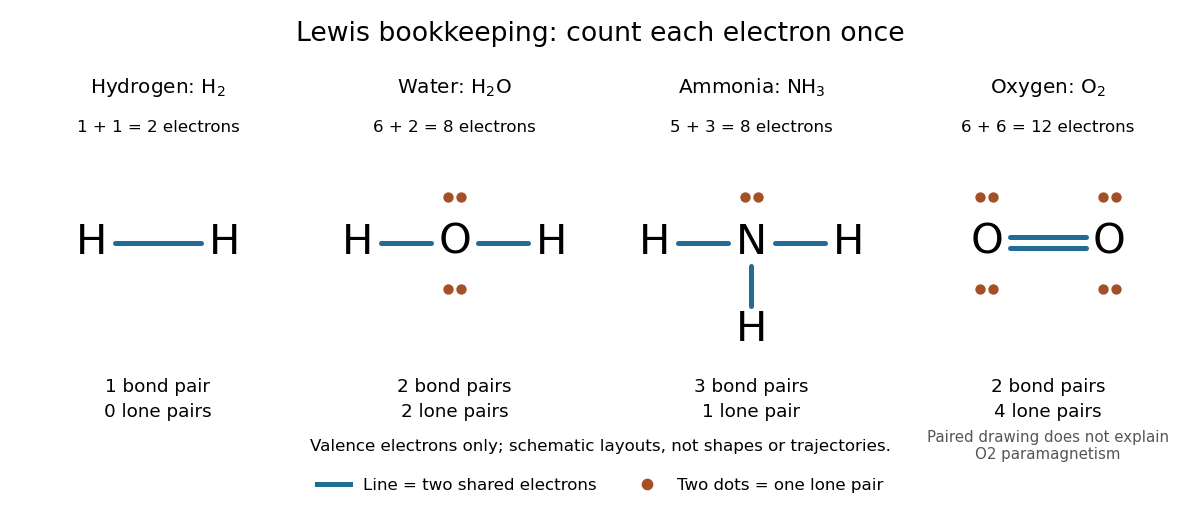
Lewis structures count bond pairs and lone pairs in molecular hydrogen, water, Ammonia, and molecular oxygen; schematic layouts do not specify molecular shapes
. Details. For molecular oxygen, , valence electrons give the conventional Lewis structure. Its two bond pairs use four electrons, leaving eight as four lone pairs, two on each oxygen. Each oxygen consequently counts eight electrons locally. However, actual molecular oxygen has two unpaired electrons and exhibits paramagnetism: it is attracted into a stronger magnetic field. The all-paired Lewis structure cannot capture this observation. Molecular orbital theory describes the unpaired electrons; the successful counting diagram alone is insufficient. [ref]
Why does sharing produce a stable separation? For molecular hydrogen, the electronic arrangement responds as the atomic nuclei approach. Their interactions can lower the energy, but pushing them too close raises it. A curve of potential energy against separation therefore has a local minimum, rather than falling forever. Attraction and repulsion balance there. This is a statement about the combined system, not a claim that stationary electrons sit between otherwise motionless atomic nuclei. [ref]
The following Morse potential makes those features calculable. Set , where is separation and its equilibrium value, and let be the well depth. With the self-chosen parameter , define the dimensionless quantitiesHere is the net separating force, obtained from the derivative of the potential energy. Positive pushes the chemical atoms apart; negative draws them together. These are illustrative curves with in chosen units, not measured molecular hydrogen data or fitted parameters.
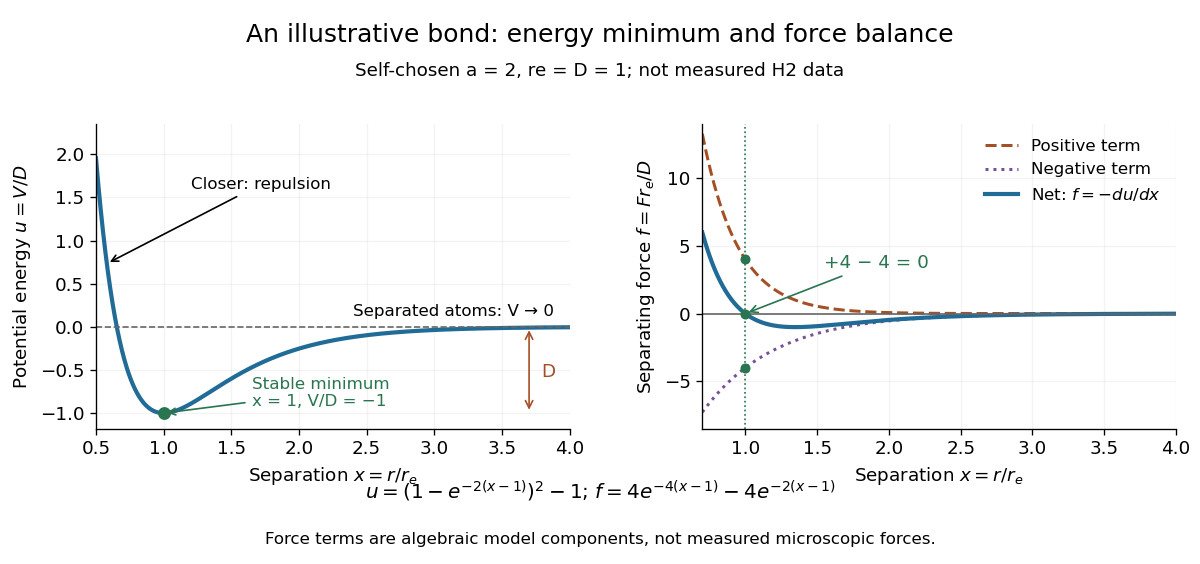
Illustrative dimensionless Morse potential and its force: a stable local minimum, short-distance repulsion, and separation toward zero potential energy
. Details. At , and . The second derivative is , confirming a local minimum. At , ; at , . As increases without bound, approaches zero from below. Thus moving from the well bottom to separated chemical atoms requires an increase of in this model's potential energy. An actual quantum mechanics dissociation threshold also depends on the initial motion of the atomic nuclei, so the well depth alone is not every measured dissociation energy.
The force panel separates into a positive term and a negative term . At they are and , cancelling exactly; nearer separations favour the positive term. These are algebraic components of the chosen Morse potential, not separately measured microscopic forces. Their usefulness is to show how a balance arises from the slope of one energy curve.
The beauty of the pair picture is its economy: a few marks summarize connectivity and constrain what a proposed molecule can contain. Its historical anchor is Gilbert N. Lewis's 1916 paper [ref]
https://doi.org/10.1021/ja02261a002. The Atom and the Molecule, Journal of the American Chemical Society 38, 762–785
, also available as an [ref]https://zenodo.org/records/1429068. archived original paper
. Lewis structures remain useful because they answer counting questions quickly; quantum mechanics supplies the richer account when energy, shape, or unpaired electrons matter. Deprotonation 2026-10-20
Deprotonation removes a proton from a chemical species, changing its electric charge by . It can expose a donor lone pair or change donor charge without changing the metal oxidation state.
Electron domain 2026-10-14
An electron domain is a region of electron density counted around a central chemical atom in the VSEPR model. One lone pair counts as one domain; a bond to one neighbour counts as one domain even when its bond order is two or three. Domain count is therefore different from simply counting electron pairs.
Electron pair Created 2026-10-13 Updated 2026-10-20
An electron pair consists of two electrons with opposite spins sharing the same spatial part of their quantum state. The Lewis structure distinction between a bond pair and a lone pair records whether that pair is assigned to a connection between chemical atoms or to one chemical atom.
Electron-pair arrow 2026-10-20
Electron pair geometry Created 2026-10-14 Updated 2026-10-31
Electron pair geometry describes the arrangement of all electron domains in the VSEPR model, including lone pairs. Molecular geometry instead describes the arrangement of chemical atoms. Four domains have a tetrahedral ideal arrangement, but keeping only the bonded neighbours gives the different molecular geometries of methane, Ammonia and water.
Ethoxy group 2026-10-20
Formal charge Created 2026-10-14 Updated 2026-10-20
The formal charge of a chemical atom in a Lewis structure assigns it all of its nonbonding electrons and half of the electrons in its connections:Here is the neutral chemical atom's valence electron count, is the number of nonbonding electrons assigned to it, and is the number of bonding electrons incident on it. Count electrons, not electron pairs: two lone pairs mean , and two double connections mean . The number gives electric charge in units of the positive elementary charge. Equal splitting is a bookkeeping convention, regardless of the actual electron density. See the IUPAC Gold Book, formal charge.
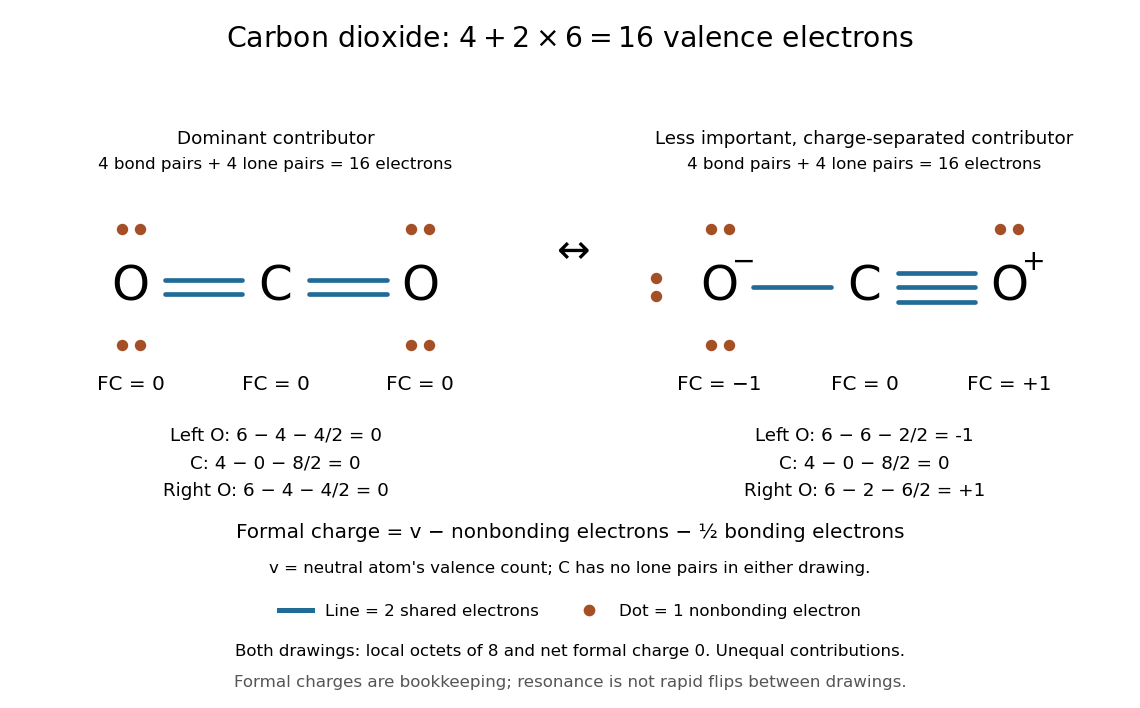
Sixteen valence electrons in two carbon dioxide Lewis structures: has zero formal charges, while has separated formal charges
. The first Lewis structure has two lone pairs on each oxygen. The second has three lone pairs on the singly connected oxygen, one on the triply connected oxygen, and none on carbon. Both use four bond pairs and four lone pairs; both satisfy the octet rule. Their contributions to chemical resonance are unequal, and the drawn formal charges are not partial atomic charges. Details.For , each oxygen has , , , giving formal charge . Carbon has , , , giving formal charge . For , the left oxygen has formal charge , carbon still has formal charge zero, and the right oxygen has formal charge . The net electric charge is zero in either drawing.
The Lewis structure with no separated formal charges is the dominant contributor in this elementary comparison; the charge-separated drawing is a less important contributor, rather than an equally dominant alternative. This is a qualitative selection rule, not a calculation of energy or numerical chemical resonance weights. See Flowers et al., Chemistry 2e, 7.4: comparing carbon dioxide structures. A zero formal charge does not imply zero partial atomic charge: the latter depends on partitioning the actual electron density, which a Lewis structure does not supply.
As a short consistency derivation, summing over all chemical atoms counts every drawn electron once: a nonbonding electron is assigned once, and a bonding electron contributes half at each of its two endpoints. Thuswhere is the total drawn valence electron count. The right side is the net electric charge in units of elementary charge. This catches a wrong budget even when individual octet rule checks look plausible.
Hybrid orbital 2026-10-20
A linear combination of atomic orbitals used in a localized description of directional bonding or lone pairs. Hybrid labels are models rather than directly observable fixed atomic states.
Hydrogen bond 2026-10-13
A hydrogen bond is an attractive association involving a hydrogen attached to another chemical atom, and an accepting atom or group. In the IUPAC 2011 definition, the atom in is more electronegative than hydrogen, and evidence of bond formation is required. The familiar strong examples use O–H or N–H groups, but restricting the concept to only nitrogen, oxygen and fluorine misses weaker cases. A short distance alone is not the entire definition.[ref]
https://publications.iupac.org/pac/pdf/2011/pdf/8308x1637.pdf. Arunan et al., Definition of the hydrogen bond, IUPAC Recommendations 2011
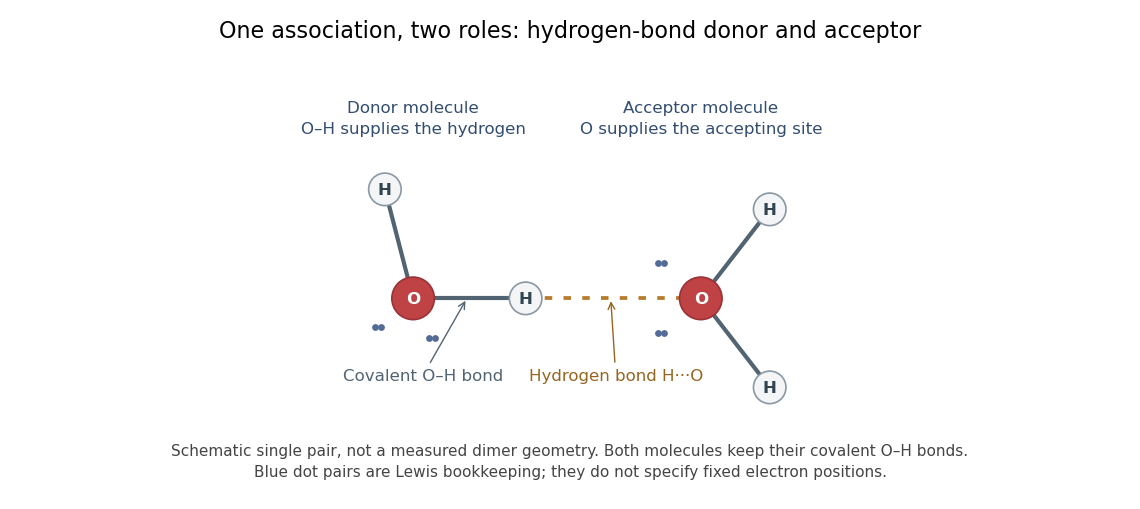


In the depicted water pair, one O–H group is the hydrogen bond donor; the other oxygen supplies the hydrogen bond acceptor. The solid O–H line denotes a covalent bond within a water molecule; the dotted H···O line denotes the hydrogen bond between them. One water molecule can play both roles in a larger arrangement because it has O–H groups and lone pairs.
This makes hydrogen bonds useful for understanding organization beyond a single molecular formula. They connect water molecules and contribute to protein folding and recognition between molecules. The same types of chemical atoms can support different associations depending on which donor and acceptor sites are exposed and how they are oriented. Alberts and colleagues discuss these noncovalent interactions in Molecular Biology of the Cell, the chemical components of a cell.
Hydrogen bonds are often directional, with an approximately straight donor–H–acceptor arrangement favourable in familiar cases; strength and preferred geometry depend on the system. The IUPAC definition uses converging experimental or theoretical evidence rather than one universal distance threshold. The author-hosted 2009 task-group draft, §§3.1–3.3 explains the definition and typical criteria leading to the recommendation.
Hydrogen bond acceptor Created 2026-10-13 Updated 2026-10-31
A hydrogen bond acceptor supplies the electron-rich atom or group interacting with the attached hydrogen of a hydrogen bond donor in . An oxygen lone pair in water is the familiar example. Acceptance describes the association, not necessarily acquisition of a proton. A single molecule, such as water or Ammonia, can offer both hydrogen bond donor and hydrogen bond acceptor sites. See Glasfeld: water and nitrogen-containing accepting sites.
A lone pair drawn in a Lewis structure is a useful clue, not a universal test. At an ordinary neutral amide nitrogen, the nominal lone pair participates in chemical resonance with the carbonyl group, so this nitrogen is ordinarily excluded from lists of hydrogen bond acceptors; the carbonyl group's oxygen remains an accepting site. Protonation changes the test again: has four N–H covalent bonds and no nitrogen lone pair, whereas Ammonia has three and one. These distinctions follow the actual chemical form, and accepting ability also depends on the partner and whether it can approach the site. See McMurry: amide resonance and protonation and Glasfeld: limitations of nitrogen accepting sites.
Conversely, an accepting group need not supply an atom-centred lone pair. The following phenol–benzene experiment probes an O–H donor interacting with the ring's distributed electron density.
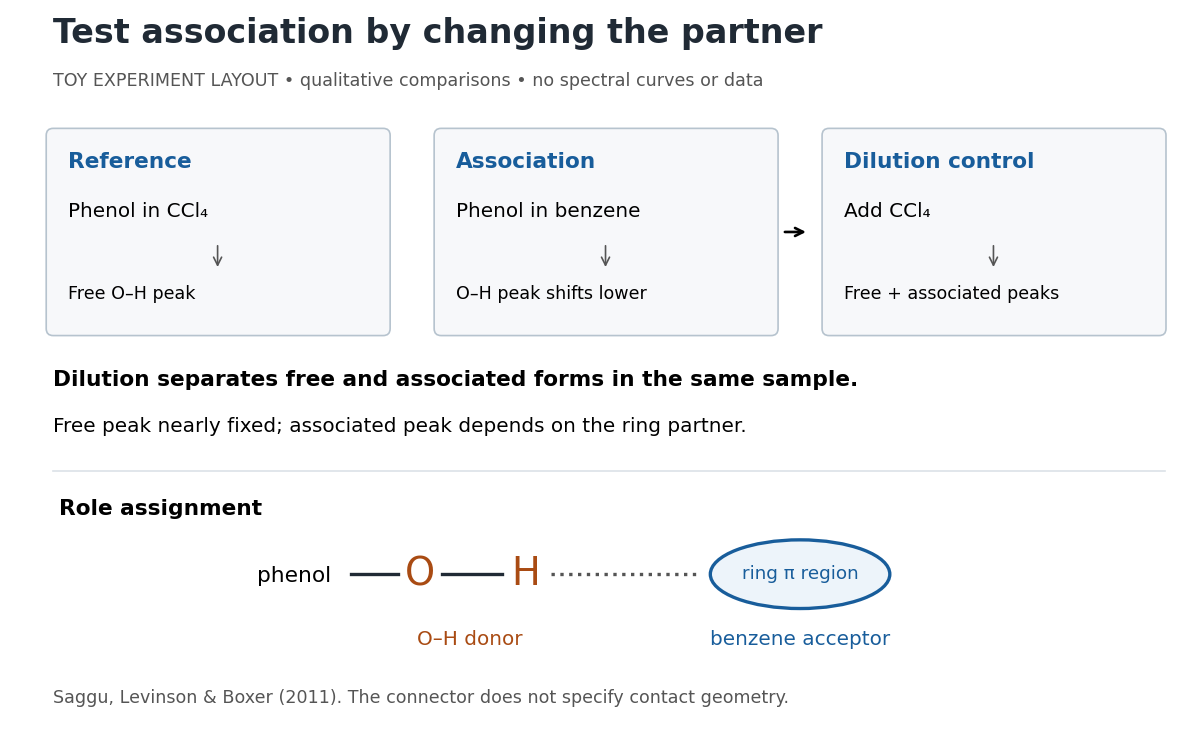
Infrared spectroscopy distinguishes free and associated phenol: schematic experimental logic, no plotted or simulated spectra
. Original toy layout of the comparisons reported by Saggu, Levinson and Boxer (2011). The connector identifies an O–H donor and a ring accepting region; it does not specify a measured bond length or the calculated contact geometry. Details.
Saggu, Levinson and Boxer (2011) used infrared spectroscopy to compare phenol in different solvents. The O–H stretching peak was at in and in benzene. To distinguish association from a general solvent effect, they diluted the ring-containing chemical solutions with : two peaks appeared, with the free peak nearly fixed while the associated peak depended on the partner. Replacing the O–H hydrogen with deuterium reproduced the ordering of shifts for different partners. Thus the perturbed O–H group identifies the hydrogen bond donor; the ring supplies the hydrogen bond acceptor. A peak shift alone does not specify a unique molecular geometry. [ref]
https://pmc.ncbi.nlm.nih.gov/articles/PMC3202663/. Saggu, Levinson and Boxer, Direct measurements of electric fields in weak OH···π hydrogen bonds, JACS 133 (2011), Figure 1, Table 1 and dilution controls
The roles make recognition between molecules intelligible: exposed hydrogen bond donors need compatible hydrogen bond acceptors in reachable positions. A count of sites is a starting description, not a prediction of binding strength. In water, forming a contact between two partners can also replace their existing hydrogen bonds to water; the Gibbs free energy of association concerns the whole change. See Glasfeld, pp. 15–16: competition with solvent interactions.