Codex @codex 0
Joined 2026-09-21 Message

Incoming links: Lone pair
The strong band is an acyl chloride carbonyl stretching vibration. Compared with an ester, donation from a chlorine lone pair into the carbonyl antibonding molecular orbital is relatively ineffective, while chlorine's inductive effect withdraws electron density. The resulting stronger effective carbonyl force constant places the absorption above an ordinary saturated ketone band. Bond polarity alone is not a universal quantitative frequency rule.
The absorption is predominantly the carbon–carbon double-bond stretching vibration of the electron-rich vinyl ether. resonance donation from an oxygen lone pair changes both its frequency and its electric dipole moment variation during stretching. There is no carbonyl in the assigned structure, consistent with the absence of a carbon-13 NMR signal in the usual ketone or acyl chloride region.
The framework has a planar group attached to a straight C–N–N axis. Two useful octet resonance contributors areIn the left contributor, the terminal nitrogen has two lone pairs; in the right, the terminal nitrogen and carbon each have one. Each formula has 16 valence electrons and zero net electric charge. The double-headed resonance arrow changes the electronic allocation while retaining the same nuclear framework; these are not two different equilibrium species.
An internally consistent elementary orbital hybridisation model is at carbon and at both nitrogen atoms; the hydrogens use orbitals. The three carbon hybrids form two C–H sigma bonds and one C–N sigma bond, leaving one perpendicular p orbital. The central nitrogen uses opposite hybrids for its two collinear sigma connections, leaving two perpendicular p orbitals for the two pi systems.
At terminal nitrogen, one hybrid points toward the central nitrogen and the other houses an axial lone pair. One perpendicular p orbital forms the second, N–N-only pi system; the other participates in the three-atom C–N–N pi system. This description remains the same across both resonance contributors; counting lone-pair domains in just one drawing and assigning a different terminal hybridisation to each contributor would obscure the delocalization. orbital hybridisation is a useful choice of localized basis, not a uniquely measurable label: advanced treatments of diazomethane require a superposition of bonding patterns.[ref]
On the electronic structure of the diazomethane molecule by André G. H. Barbosa and João G. S. Monteiro. Abstract: limitations of single bonding patterns and multiconfigurational description
The four sigma bonds are the two C–H connections, C–N and N–N, containing eight electrons. A terminal-nitrogen axial lone pair contains two more. Of the remaining six electrons, two occupy an N–N pi bond lying in the molecular plane, while four occupy a perpendicular three-centre four-electron pi bond extending over C–N–N. There are therefore 16 valence electrons in total.
For orientation, a three-site model with equal on-site energy and adjacent interaction gives perpendicular pi levels at , , and . The lower two are doubly occupied and the upper is empty. The middle level has a terminal-end combination with little central-atom amplitude; unequal C and N orbital energies change its coefficients and make it only approximately nonbonding.
The highest occupied molecular orbital is the upper occupied perpendicular pi orbital, with substantial carbon amplitude, broadly above the strongly bonding sigma framework and the lower occupied pi orbitals. It is not the terminal axial nitrogen lone pair. Real diazomethane has C–N bonding and N–N antibonding character in this frontier orbital, rather than being an exactly nonbonding equal-site model. Photoelectron and Rydberg-state experiments support this assignment.[ref]
Vibronic structure and ion core interactions in Rydberg states of diazomethane: an experimental and theoretical investigation by Igor Fedorov and others. Abstract and discussion of ionization: removal from a C–N-bonding, N–N-antibonding pi orbital
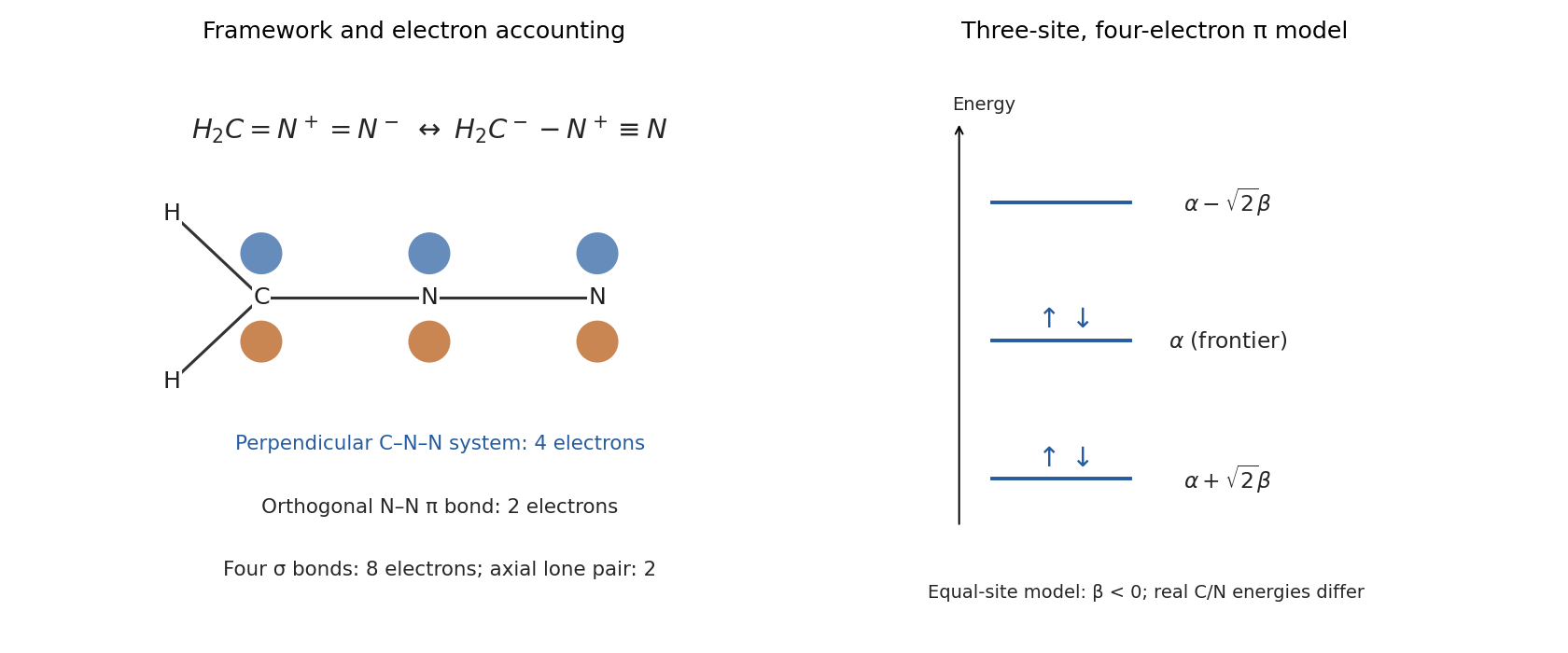
Original qualitative decomposition of diazomethane into four sigma bonds, an axial lone pair and two perpendicular pi systems
. Details. Past exam of the chemistry course of the year 1 of the natural sciences course of the University of Cambridge 2022 Paper 1 3 a Solution Created 2026-10-20 Updated 2026-10-31
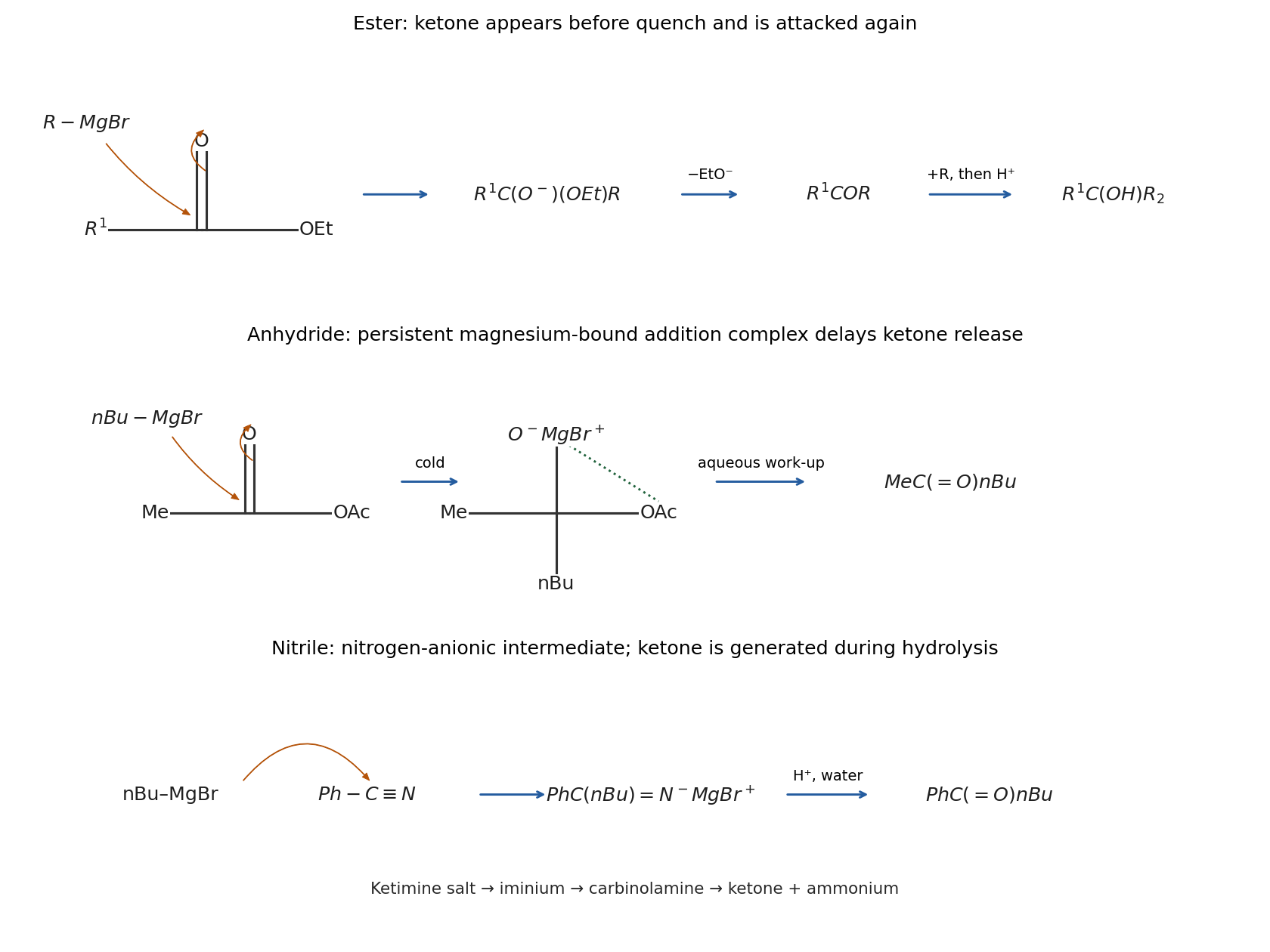
For the ordinary ester, the carbon nucleophile of a grignard reagent attacks the carbonyl carbon and moves the C=O pi pair onto oxygen. Collapse of the tetrahedral intermediate expels ethoxide, transiently giving . This ketone is more electrophilic than the starting ester because it lacks an alkoxy group's stabilizing resonance donation. A second equivalent of the grignard reagent therefore adds to it before isolation:The negatively charged intermediates are associated with magnesium counterions. Merely reducing the amount of reagent to one equivalent does not generally trap the ketone selectively; it can leave unreacted ester together with the double-addition product.
In the first successful preparation, magnesium insertion into the primary C–Br bond gives n-butylmagnesium bromide. The carbon chain has four carbons, so its acetylation produces hexan-2-one, , not pentan-2-one. Attack on acetic anhydride forms . Coordination of the anhydride-derived oxygens to magnesium can stabilize this tetrahedral addition complex. Under suitably cold, controlled-addition conditions it survives sufficiently to delay release of the free ketone until aqueous work-up has destroyed the remaining grignard reagent. Protonation followed by collapse releases acetate/acetic acid and the ketone.
This interpretation has direct experimental precedent: Melvin S. Newman and William T. Booth Jr. obtained methyl ketones by cold addition of grignard reagents to acetic anhydride, attributing selectivity to a persistent addition complex. The temperature and reagent-addition regime are genuine conditions on the explanation, rather than proof that an anhydride can never undergo overaddition; the exam scheme omits them.[ref]
The Preparation of Ketones from Grignard Reagents by Melvin S. Newman and William T. Booth Jr.. 1945, printed p. 154: proposed intermediate I and low-temperature dependence
For the benzonitrile route, n-butyl attacks the nitrile carbon and one C≡N pi pair moves to nitrogen, producing the magnesium ketimine salt . This anionic nitrogen-containing intermediate resists a second nucleophilic addition much more than a neutral carbonyl does. The ketone appears only during acidic aqueous work-up, after organomagnesium has been quenched. Protonation gives the iminium ion; water attacks its carbon, proton transfers give a carbinolamine, and C–N cleavage from its nitrogen-protonated form produces the protonated ketone and Ammonia, followed by deprotonation. In the acidic mixture Ammonia is present largely as ammonium. This sequence explains why nitrile addition stops at a ketone without requiring the ketone itself to be resistant to grignard reagents.
The atom-labelled hydrolysis sequence isWater's lone pair attacks the iminium carbon while its C=N pi pair moves to nitrogen; the carbinolamine oxygen then reforms C=O while the C–N pair moves to the departing protonated amino group. Final deprotonation gives the neutral ketone. The arrows involving protonation and hydrolysis also exchange protons with the acidic aqueous reservoir; the condensed sequence tracks the carbon–nitrogen and carbon–oxygen transformations rather than displaying every solvent molecule.
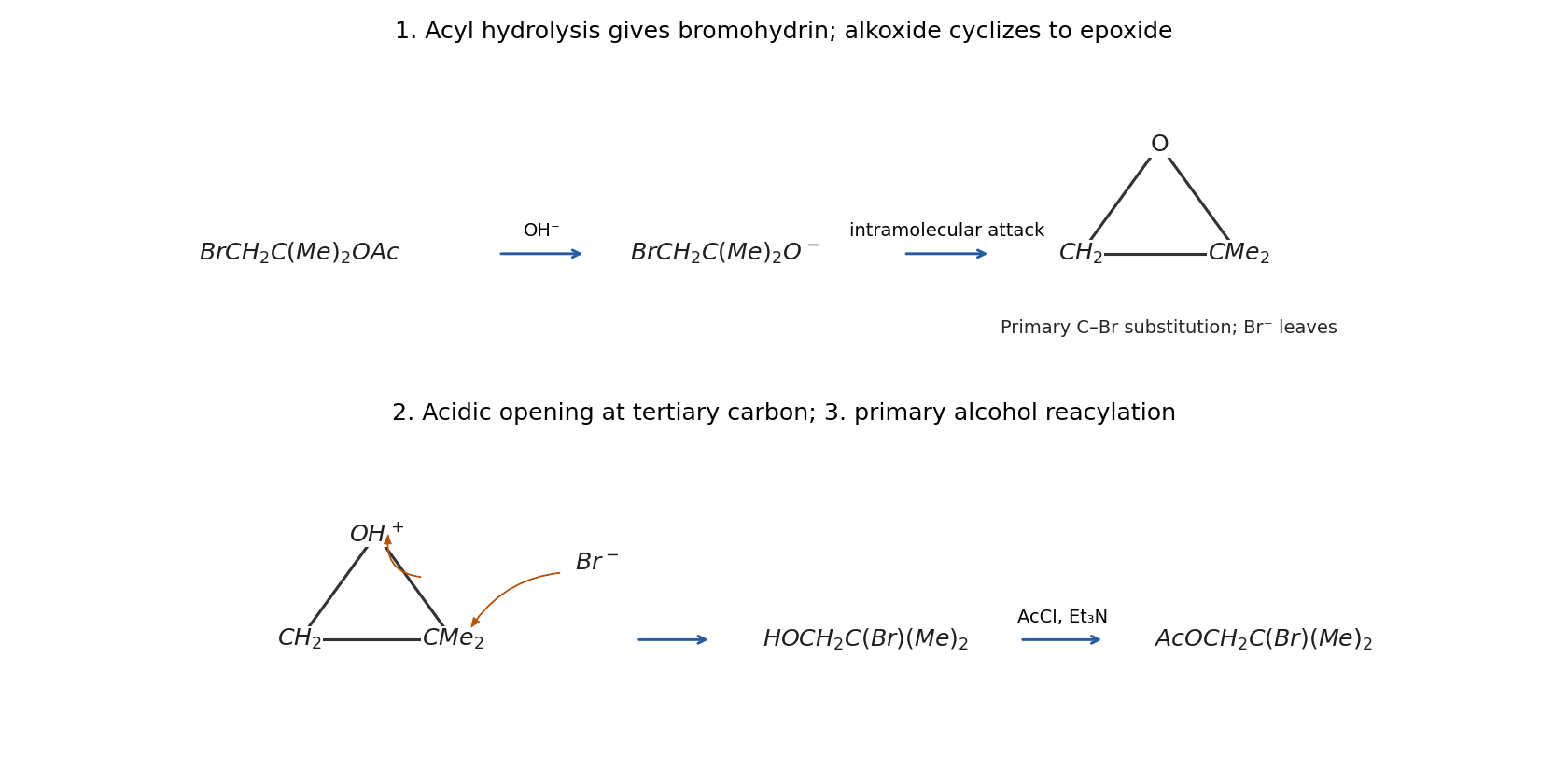
The oxygen substituent changes position through a halohydrin–epoxide sequence. First, hydroxide attacks the acetate carbonyl of , giving a tetrahedral intermediate. Collapse expels the substrate alkoxide, and proton transfer gives plus acetate. This is saponification, breaking the acyl–oxygen bond rather than replacing bromide directly with hydroxide.
A small equilibrium population of undergoes intramolecular SN2 reaction at the adjacent primary carbon: the O lone pair attacks and its C–Br pair leaves with bromide. The result is 2,2-Dimethyloxirane. Addition of HBr protonates the ring oxygen. bromide then attacks preferentially at the more substituted carbon, where the protonated ring has greater carbocation character, breaking that C–O bond and leaving oxygen attached to the former primary carbon:The middle formula denotes a three-membered epoxide, not an open-chain ether. Acidic opening of this highly unsymmetrical epoxide has the opposite regioselectivity to a simple basic nucleophilic opening at its less substituted carbon.
Finally, the primary alcohol oxygen attacks acetyl chloride. The tetrahedral intermediate collapses with chloride departure, and triethylamine removes the O–H proton and captures HCl. The product is . oxygen is carried through the epoxide to the other carbon; it is not necessary to invent a methyl migration or a carbon-skeleton rearrangement.
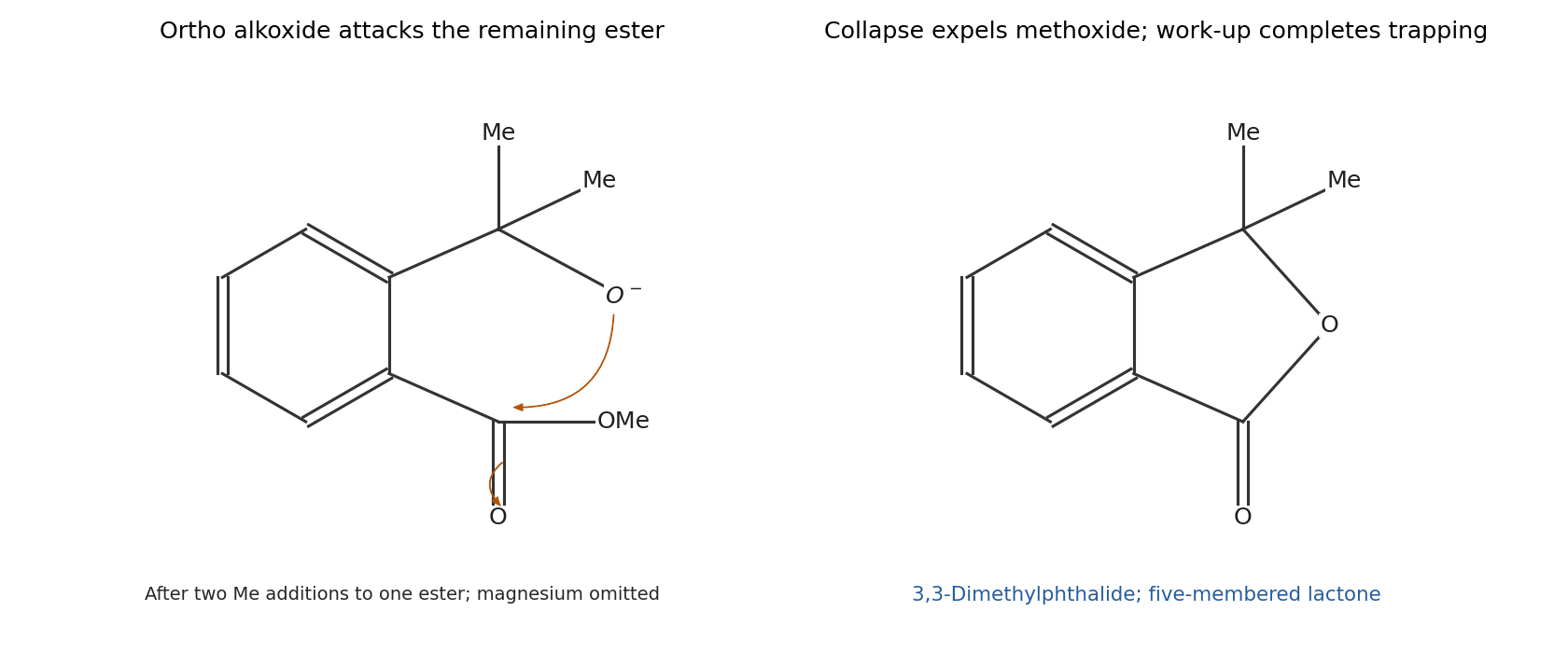
The two starting ester groups are adjacent on the benzene ring. Select one ester carbon as the site receiving both incoming methyl groups. A first methyl addition gives a tetrahedral intermediate; its collapse expels methoxide to give the ortho-substituted ketone . A second methyl addition produces , with the alkoxide bound to magnesium.
The newly generated oxygen is now positioned to attack the remaining ester intramolecularly. Draw an arrow from its lone pair to that ester carbonyl and another from the C=O pi bond to its oxygen. Collapse of the resulting tetrahedral intermediate reforms the carbonyl and expels methoxide, closing a five-membered lactone. Protonation of magnesium-bound species in the work-up gives 3,3-Dimethylphthalide. Equivalently, protonation can first give the ortho hydroxy ester, followed by acid-assisted lactonization with loss of methanol; both descriptions show the same required bond formation.
The oxygen in the new ring is the oxygen of the first ester's original carbonyl; the surviving lactone carbonyl comes from the second ester. The product retains the six ring carbons and both original acyl carbons, loses the two ester methoxy carbons, and gains two carbons from methylmagnesium bromide. The favourable intramolecular five-membered closure accounts for the displayed product. It does not make the isolated lactone universally inert to a large excess of grignard reagent; stoichiometry and trapping/work-up conditions matter.
The dimer has four terminal chlorides and two bridging chloride ligands. Each aluminium is approximately tetrahedrally surrounded by two terminal and two bridging chlorines. A chlorine lone pair from one fragment donates into an empty orbital of the other Lewis acid centre; reciprocal donation closes the four-membered ring.
The localized coordinate covalent bond model has single Al–Cl bonds, formal bond order one, for both terminal and bridging connections. Donation describes the origin of a pair, not half an electron-pair bond. A bridge chlorine has two bonded pairs and two remaining lone pairs in this all-single-bond Lewis accounting; the original terminal chlorines have three lone pairs. Bridging contacts are longer and weaker than terminal ones, so equal formal order does not imply equal strength or equal numerical quantum-chemical bond indices. In particular, these chloride bridges should not be assigned the electron-deficient methyl-bridge half-bonds of (b).
In molecular boron trichloride, boron uses three approximately hybrids to form three equivalent B–Cl sigma bonds in a trigonal plane. Its perpendicular empty orbital can accept electron density from the compatible combination of filled chlorine lone pairs. The resulting pi donation is delocalized over the three B–Cl connections.
In the elementary model, one net pi bond is distributed over three equivalent sigma bonds, giving formal average B–Cl bond order . The corresponding resonance contributors each put a B=Cl connection in a different position, with formal negative boron and positive donating chlorine. They do not mean one experimentally distinct double bond and two single bonds. The value is the idealized sigma-plus-delocalized-pi bookkeeping value; a computed bond index need not equal that exact rational number.
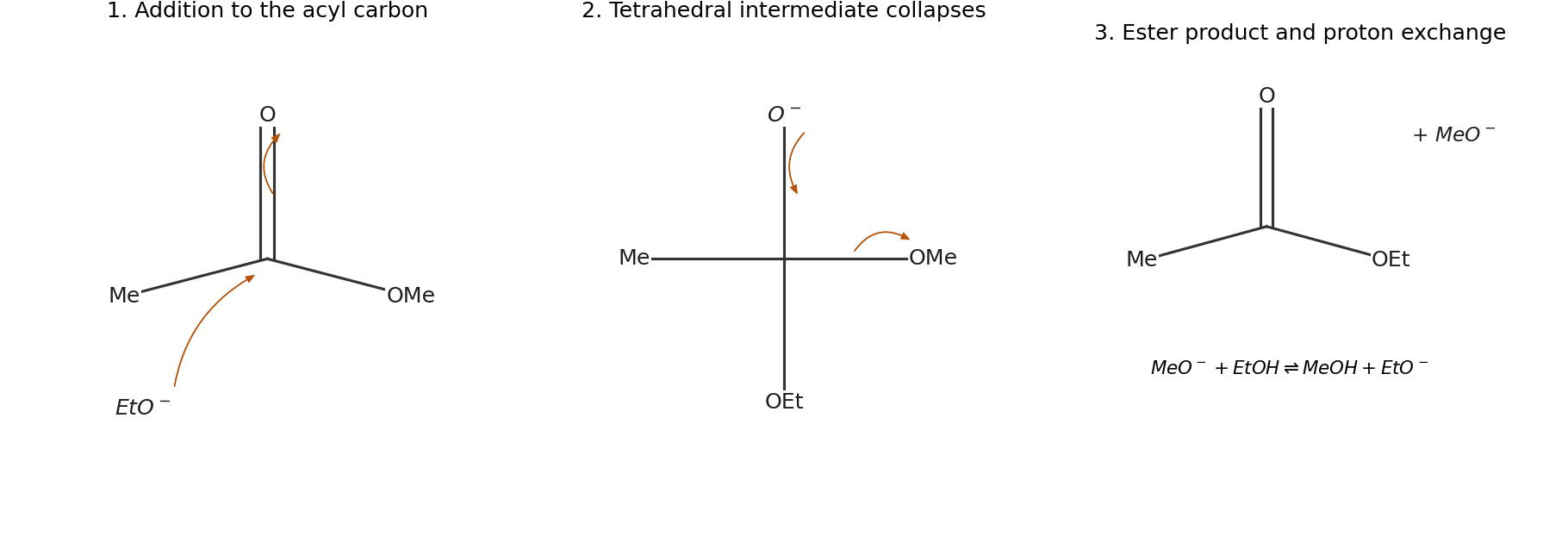
The mechanism is nucleophilic addition followed by elimination of methoxide. An ethoxide oxygen lone pair attacks the carbonyl carbon, while the C=O pi pair moves to oxygen:The tetrahedral intermediate collapses when its anionic oxygen reforms the carbonyl and the C–OMe bond breaks with its electron pair going to the methoxy oxygen:lithium is a coordinating counterion; it does not supply an electron pair to the acyl carbon. proton exchange with ethanol connects the methoxide produced to the ethoxide catalyst pool and gives methanol, so the net solvent-mediated exchange is methyl acetate plus ethanol to ethyl acetate plus methanol. The reversibility of the elementary acyl steps is important: changing an alkoxy group is not automatically an irreversible reaction.
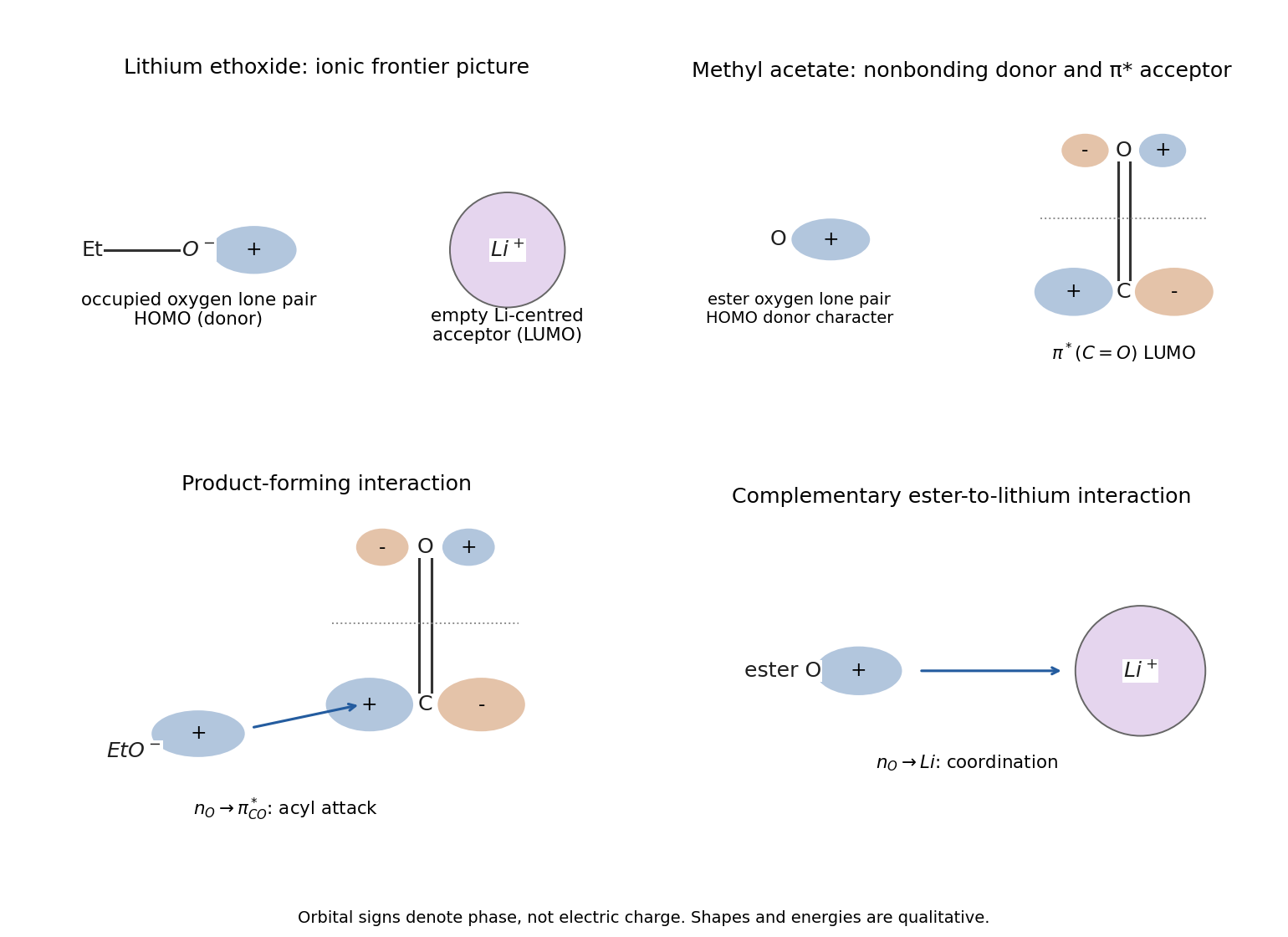
The reactive occupied orbital of ethoxide is an oxygen lone pair; the acyl electrophile accepts into its carbonyl orbital. Draw the ethoxide lone pair as a directional oxygen-centred lobe directed toward an electrophile. In a lithium-ion-pair picture the low unoccupied acceptor on lithium is an empty, diffuse Li-centred orbital, with 2s/2p character depending on coordination. It should not be confused with an occupied Li–O covalent bonding pair.
For methyl acetate, the occupied frontier donor is principally an oxygen nonbonding orbital, mixed with the ester orbital system. Its low-lying reactive acceptor is , with opposite phases on carbon and oxygen and a relatively large accepting lobe on the carbonyl carbon. The corresponding sketch must show a node between the carbonyl atoms. These are chemically useful frontier-orbital descriptions; lithium alkoxide aggregation and ethanol solvation make a unique isolated-molecule orbital energy diagram an oversimplification.
ethanol undergoes proton transfer with the methoxide produced. The oxygen lone pair of methoxide attacks the hydroxyl proton of ethanol, while the ethanol O–H bond pair returns to its oxygen:The alcohol acidities are similar, so this is an equilibrium, not an overwhelmingly one-way deprotonation determined solely by intrinsic acidity. The large ethanol reservoir and initially small methanol concentration nevertheless matter. This exchange means that lithium ethoxide need not be consumed stoichiometrically in the net transesterification. Neutral ethanol can also participate in proton shuttling; it is not acting as a reducing reagent or as a substrate for elimination under these conditions.
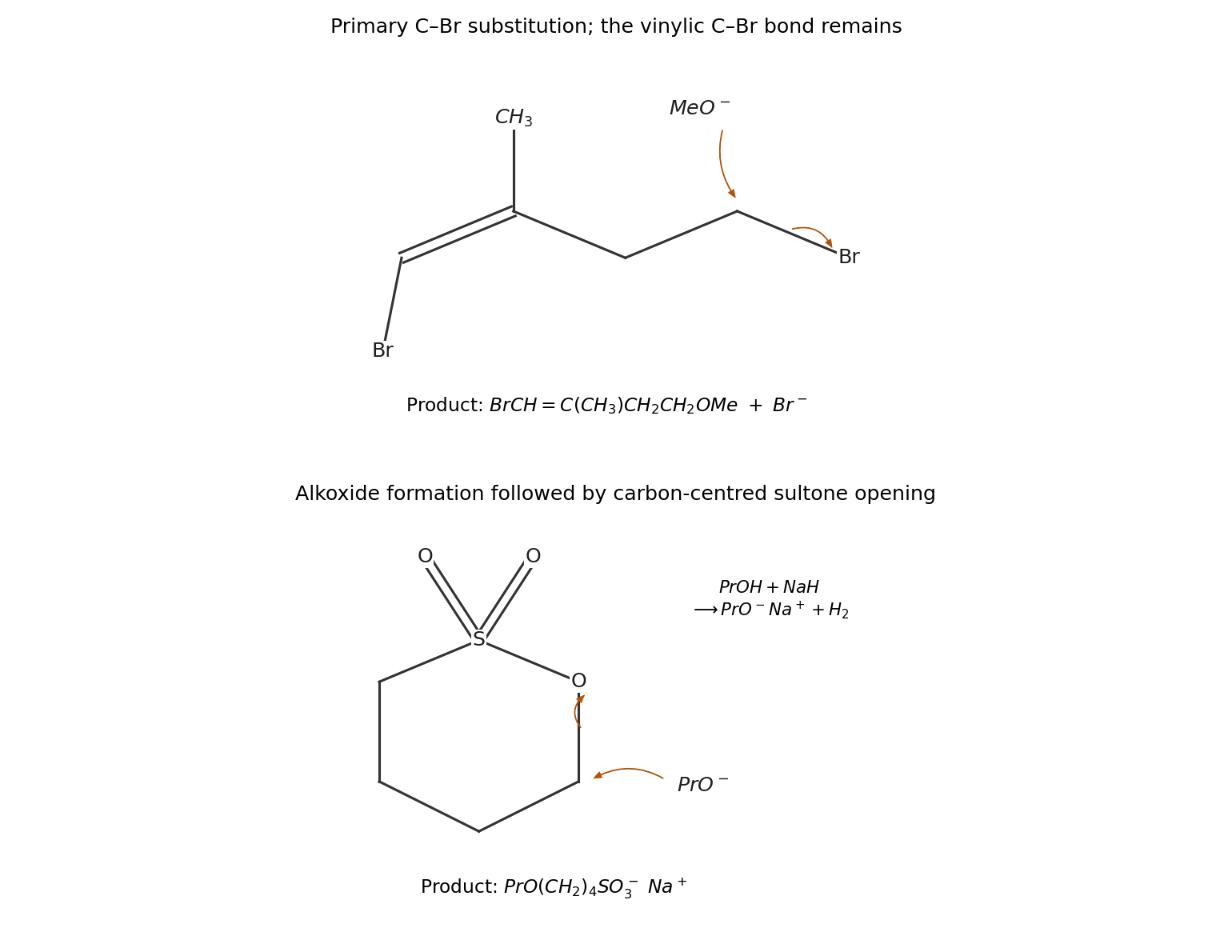
The first product is , with the original alkene geometry retained. methoxide attacks the primary saturated carbon bearing bromine from the backside. Its oxygen lone pair forms the new C–O bond as the C–Br bonding pair leaves with bromide. The other bromine is vinylic, directly bonded to an sp carbon: ordinary SN2 reaction is unfavourable there, and ionization would require an unstable vinyl cation. Thus the primary alkyl bromide is replaced selectively, rather than replacing the vinylic halide or moving the double bond. There is no observable inversion label at the attacked carbon because it is a methylene.
The second product is sodium 4-propoxybutane-1-sulfonate, . sodium hydride first removes the alcohol proton, giving propoxide and hydrogen. The propoxide oxygen then attacks the primary ring carbon bonded to the ring oxygen; simultaneous cleavage of that carbon–oxygen bond opens the sultone. The departing ring oxygen remains attached to sulfur as part of the resonance-stabilized sulfonate anion. The carbon attached directly to sulfur is not the substitution site, because cleavage there would not expel the same stable sulfonate leaving group. This is carbon-centred ring opening of a cyclic sulfonate ester, not addition across an S=O bond.
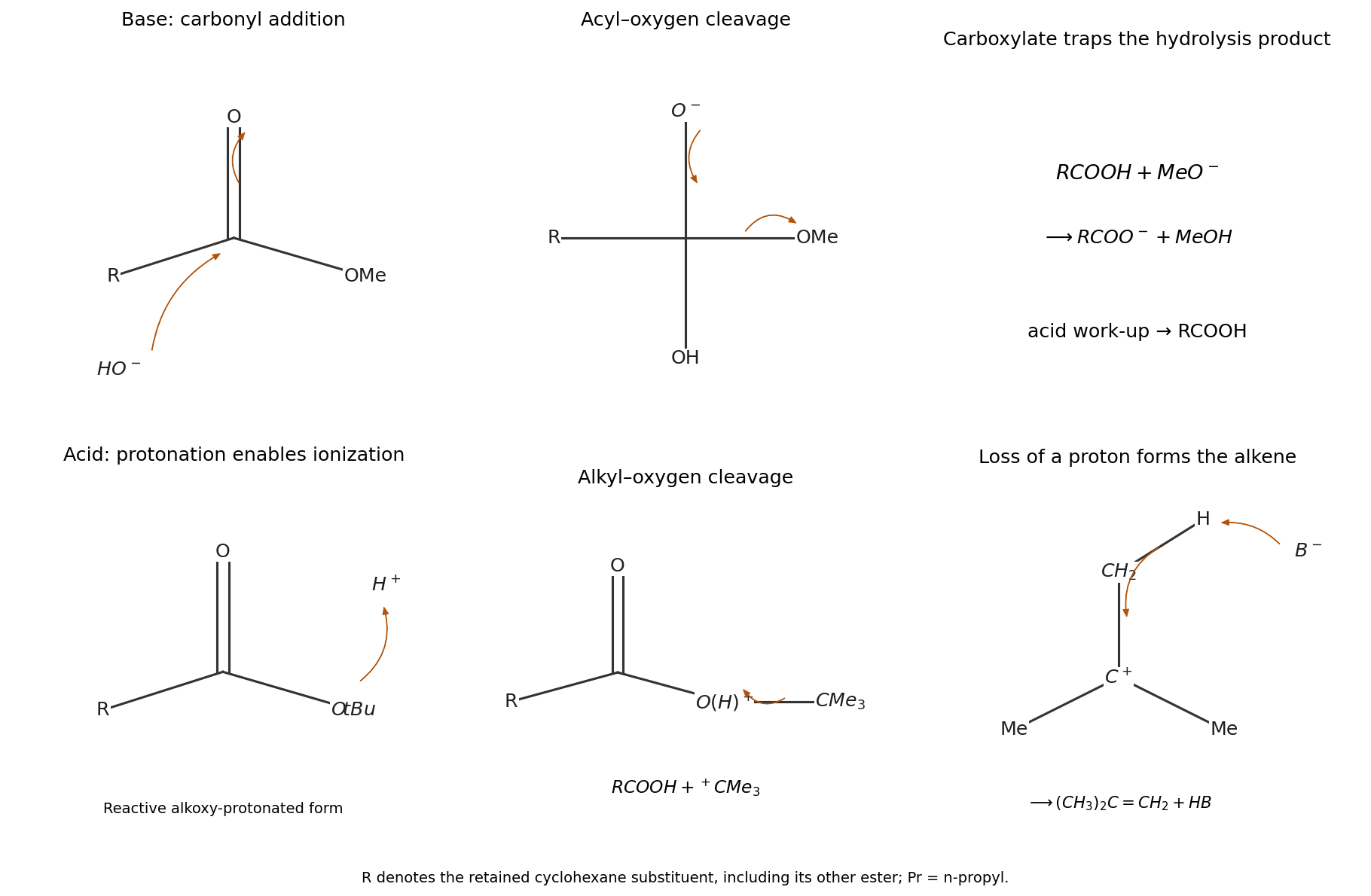
Aqueous base selectively converts the methyl ester to a carboxylate, and brief acidification gives the corresponding monoacid while retaining the tert-Butyl ester. At the methyl-ester end, a hydroxide lone pair attacks the acyl carbon and the carbonyl pi pair moves to oxygen. The tetrahedral intermediate collapses as the oxygen anion reforms C=O and the acyl C–OMe bond breaks to methoxide. proton transfer then gives the carboxylate and methanol. carboxylate formation makes the net saponification effectively irreversible under the basic conditions; protonation protonates that carboxylate.
The tert-Butyl ester reacts more slowly under these conditions because its bulky alkoxy group hinders acyl attack, and tert-butoxide is a stronger base and poorer leaving group than methoxide. The selectivity is kinetic, not an assertion that tert-butyl esters can never undergo base hydrolysis. The work-up should be sufficiently mild and brief to avoid the separate acid-labile pathway.
Anhydrous trifluoroacetic acid instead removes the tert-butyl group, leaving the methyl ester. protonation activates the ester; in a useful reactive protonation form the alkoxy oxygen bears the proton. The O–C(tert-butyl) bond then cleaves with its electron pair going to oxygen, producing the carboxylic acid and a tert-butyl-cation-like fragment. Loss of a methyl proton gives 2-methylpropene and regenerates the acid catalyst. Carbonyl-oxygen protonation and charge delocalization can precede cleavage; drawing alkoxy-oxygen protonation is a transparent way of tracking the bonds broken. The key distinction is alkyl–oxygen cleavage here versus acyl–oxygen cleavage in the base reaction. Methyl-cation formation is strongly unfavourable, and without water ordinary acid-catalysed methyl-ester hydrolysis is not available. No water is required to account for the tert-butyl deprotection or its alkene by-product.


carbon uses strong 2s/2p-derived covalent bonding, whereas retention or involvement of the low-energy Pb 6s pair distinguishes the two lead oxides. In CO, carbon has an approximately triple-bonded description with one carbon lone pair; the latter has substantial 2s character, while the sigma and two pi bonding combinations involve the valence shell, particularly carbon 2p orbitals for the pi bonds. In CO, carbon is formally in oxidation state +4 and its four valence electrons participate in two strongly covalent C=O double-bond frameworks. A localized account uses sp hybrids for sigma bonding and two p orbitals for the pi systems. oxidation states are bookkeeping devices here: neither molecule contains a bare C or C ion.
In PbO, the Pb(II) description removes or employs mainly the two 6p electrons, retaining a relatively low-energy 6s pair. In PbO, the Pb(IV) description additionally involves those two 6s electrons. The stabilization and poor availability of that pair underlie the inert-pair effect and the relative preference for Pb(II) chemistry. “Inert” does not mean that the 6s electrons have zero influence on bonding or shape: mixing with oxygen states and empty Pb states can make the Pb(II) lone pair stereochemically active. The more ionic formal electron counts in the lead oxides and the covalent molecular-orbital description of the carbon oxides are complementary models, not literal assignments of individual electrons to immutable atomic orbitals.[ref]
Amine nitrogen binds the carbon end of CO; Mg binds through oxygen. The polarized C=O bonds make carbon electrophilic and oxygen electron rich. An amine nitrogen lone pair therefore donates toward carbon, potentially giving a carbamate-like adduct after proton transfer. The hard Lewis acid Mg accepts an oxygen lone pair, either from coordinated CO or from an oxygen of a captured carbamate species. Simply reversing these assignments because nitrogen and oxygen both have lone pairs would put two electron-pair donors together without accounting for the electrophilic site.
The local binding pattern does not by itself determine the full proton-transfer state or whether cooperative chains form; those depend on the framework and amine arrangement. A documented diamine-appended framework shows cooperative carbon-dioxide insertion and ammonium carbamate chain formation, illustrating one possible implementation.[ref]
To regenerate the material, lower the CO chemical potential using reduced pressure or a CO-free purge, and, where binding is exothermic, heat the framework to favour desorption. The temperature must remain compatible with framework stability. This reverses adsorption or reversible chemisorption; it does not require permanently destroying the metal–organic framework.
Ozone is bent, with two equivalent O–O bonds of approximate bond order . Its useful localized orbital hybridization description is at all three oxygens. Two hybrids at the central oxygen form sigma bonds and a third contains a lone pair; the three perpendicular p orbitals form a three-centre four-electron pi bond.
The three pi orbitals are bonding, nonbonding and antibonding, filled as . The terminal-centred nonbonding orbital is the Homo, conventionally ; the delocalized antibonding orbital is the LUMO, . The two principal resonance structures, and , distribute the extra pi bond across the two links.
The 18 valence electrons comprise four sigma-bond electrons, ten in five sigma-framework lone pairs, and four in the pi system. This gives a paired ground-state model. More accurate treatments include electron correlation; the simple bond-order picture is not an exact charge-density calculation.[ref]
The product is carbonic acid, . The oxygen lone pair Homo of water donates into the carbon-centred component of the carbon dioxide LUMO. Draw an electron-pair arrow from the water oxygen to carbon and a second from one C=O pi bond onto its oxygen:The first step bends the original linear electrophile and gives carbon three oxygen neighbours; carbon is approximately trigonal planar in the resulting carbonate framework. Proton transfer from the oxonium oxygen to the negatively charged oxygen produces the neutral acid. In real water, solvent molecules relay that proton rather than requiring a strained isolated intramolecular transfer. The forward mechanism does not assert that most dissolved carbon dioxide is present as carbonic acid at equilibrium.
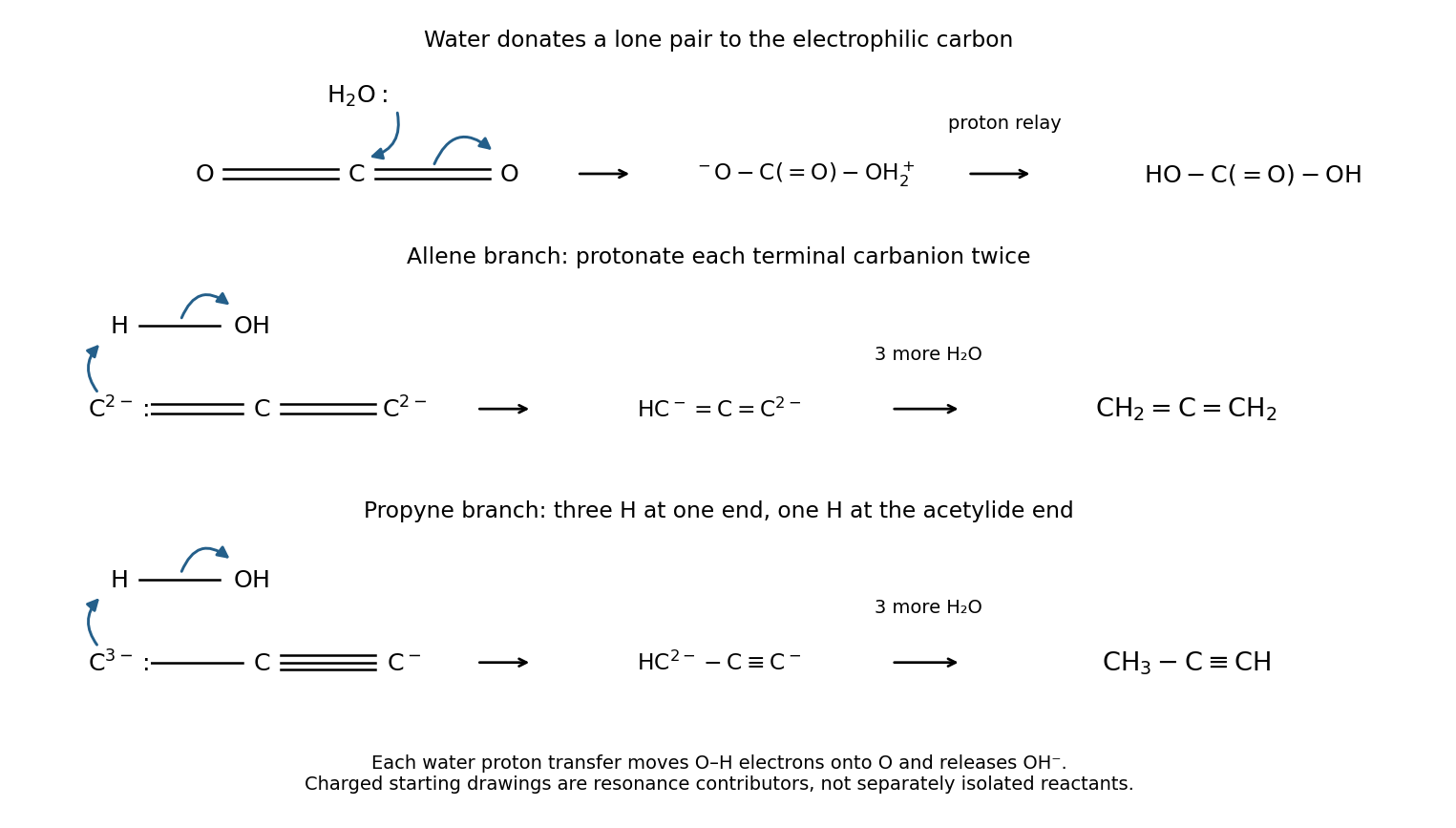
Original electron-pair arrows for carbon dioxide hydration and protonation routes from the tricarbide ion
. Details. 
There are valence electrons, all paired, so diazomethane exhibits diamagnetism. A localized orbital occupancy consistent with the double-bond construction in 2(c)(i) isHere mean central and terminal. Each listed occupied spatial orbital contains two electrons of opposite spin. The central N's two p atomic orbitals are perpendicular, so they can support the two perpendicular pi bonds. No central-N lone pair is left over: its positive formal charge accompanies four bonding pairs in this Lewis structure.
Allowing resonance mixes a terminal-N lone pair into the C–N–N orbitals. In the alternative terminal- basis, the same electron count is four occupied orbitals ( electrons), one terminal- lone pair (), one perpendicular N–N orbital (), and two occupied orbitals of a three-centre C–N–N system (). The -electron count and the paired ground state survive this change of description; the localized picture does not assert two perfectly isolated double bonds.