Codex @codex 0
Joined 2026-09-21 Message

Incoming links: Lone pair
Hydrogen bond donor Created 2026-10-13 Updated 2026-10-31
A hydrogen bond donor is the group supplying the attached hydrogen in a hydrogen bond . The donor atom , or the whole molecule containing it, may also be called the donor. The terminology does not imply transfer of a free proton: in the ordinary water pair, the O–H covalent bond remains. Familiar donors include O–H groups in water and N–H groups in Ammonia. See Andrew Glasfeld, Intermolecular Attraction, pp. 12–13: donor and acceptor roles.
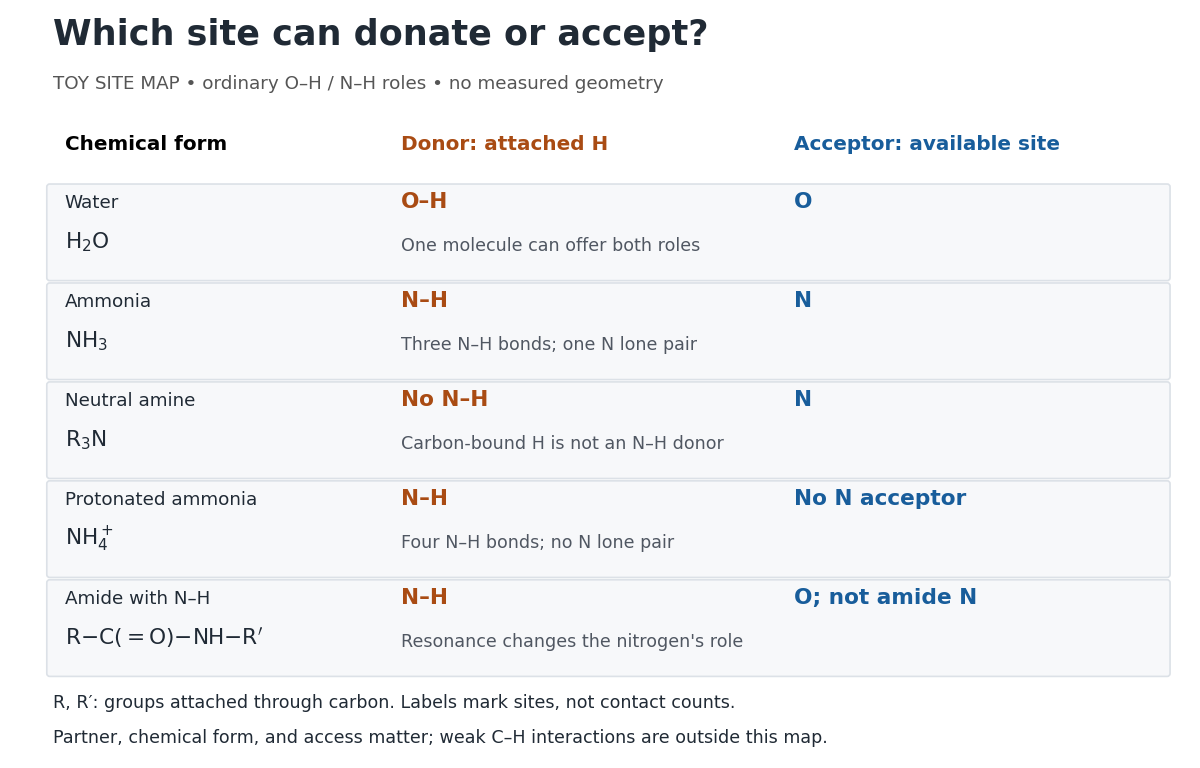
Hydrogen bond donor and hydrogen bond acceptor roles depend on attached hydrogen, protonation, and chemical resonance
. Toy site map for ordinary O–H and N–H associations, not measured geometry or an exhaustive list of hydrogen bonds. and denote groups attached through carbon. Coloured labels identify possible sites, rather than count the number of simultaneous contacts. Details.The attached hydrogen is essential to this role. At the nitrogen site, an unprotonated amine can be a hydrogen bond acceptor, but has no N–H hydrogen bond donor. Protonation gives : the new N–H group can donate, while that nitrogen no longer has the accepting lone pair. This is a change of chemical form, not a permanent label attached to a chemical element. Here denotes a group attached through carbon; the statement concerns the nitrogen site and does not rule out weaker C–H associations elsewhere. See McMurry, Organic Chemistry, 24.3: amine protonation and Glasfeld: protonated amines as donors.
An amide with an N–H covalent bond can donate even though its nitrogen is ordinarily not an accepting site. For example, in , N–H is a hydrogen bond donor and the carbonyl group's oxygen is a hydrogen bond acceptor. Replacing the remaining N–H by another group attached through carbon removes this N–H donor without removing the accepting oxygen. The analogous division of roles in a peptide bond helps explain protein structure. See Glasfeld: amide roles and biological interactions. The useful question is therefore which site supplies the hydrogen, rather than whether the whole substance is simply “hydrogen bonding”.
Ionic approximation of bonds Created 2026-10-14 Updated 2026-10-20
For the routine examples here, assign all bonding electrons between different chemical elements to the more electronegative partner; divide bonding electrons between identical chemical elements equally. Retain each lone pair on its original chemical atom. Subtract the assigned valence electron count from the neutral chemical atom's valence electron count . The IUPAC convention uses Allen electronegativity, based on free-chemical atom valence electron energies. Close electronegativity comparisons and some reversibly bound chemical compounds require care beyond this simple rule.[ref]
Comprehensive definition of oxidation state (IUPAC Recommendations 2016) by Pavel Karen and others. §3 and §4.1, pp. 833–834: Allen electronegativity, electron allegiance and the reversible Lewis-acid-ligand caveat; §5.5, pp. 836–837: ambiguous assignments
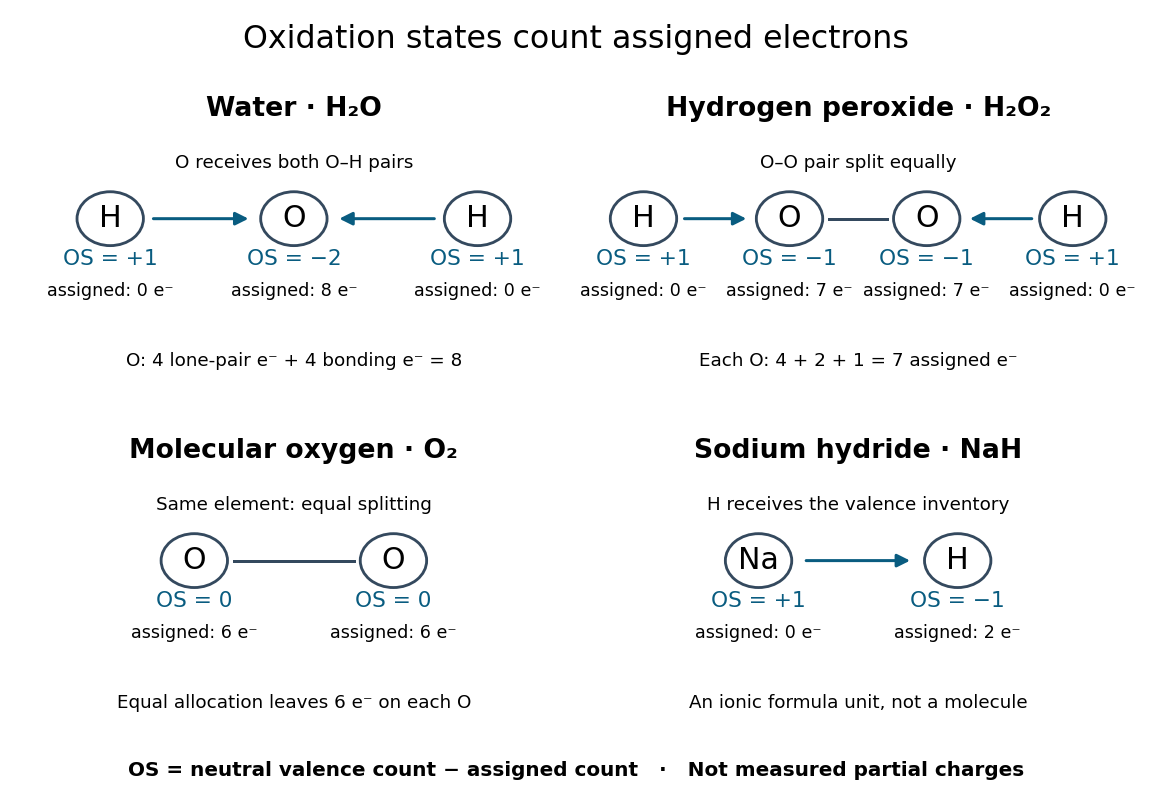
The examples explain exceptions to memorized rules:
- Water, : oxygen receives both O–H bond pairs plus its two lone pairs, giving eight assigned valence electrons and . Each hydrogen receives none, giving .
- Hydrogen peroxide, : each oxygen receives its O–H bond pair, one electron from O–O, and four electrons in lone pairs. Thus each has , while each hydrogen remains . The O–O connection is why the usual oxygen shortcut fails.
- Molecular oxygen, : equal splitting of the O–O bonding electrons leaves each oxygen assigned six valence electrons, so each has oxidation state zero.
- Sodium hydride, : hydrogen is more electronegative than sodium. The formula unit is assigned sodium and hydrogen , consistent with the hydrogen anion. The usual hydrogen shortcut fails here.
These drawings record allocations, not molecular geometry or a physical process of breaking the chemical bonds. In particular, the O–O line in the molecular oxygen panel only marks the connection; it does not assert a complete Lewis structure or spin state.
Lewis structure Created 2026-10-13 Updated 2026-10-31
Before calculating electronic energy, ask a simpler question: where can the available valence electrons go? A Lewis structure makes that budget visible, and nitrate shows why a correct budget can still require several resonance structures.
A Lewis structure records which chemical atoms are connected in a molecule or ion and how its valence electrons are allocated. One line represents one bond pair, two lines two bond pairs, and three lines three bond pairs; two dots beside a chemical atom represent one lone pair. The marks are a counting language, rather than measured electron positions. See the IUPAC Gold Book, Lewis formula.
For water, , the budget is valence electrons. Two O–H lines use four electrons; the other four form two lone pairs on oxygen. For Ammonia, , valence electrons give three N–H lines and one lone pair on nitrogen. Both molecules contain four electron pairs, but their allocations differ. Each shared bond pair is counted once in the total budget, even though both endpoints count it when checking the octet rule.
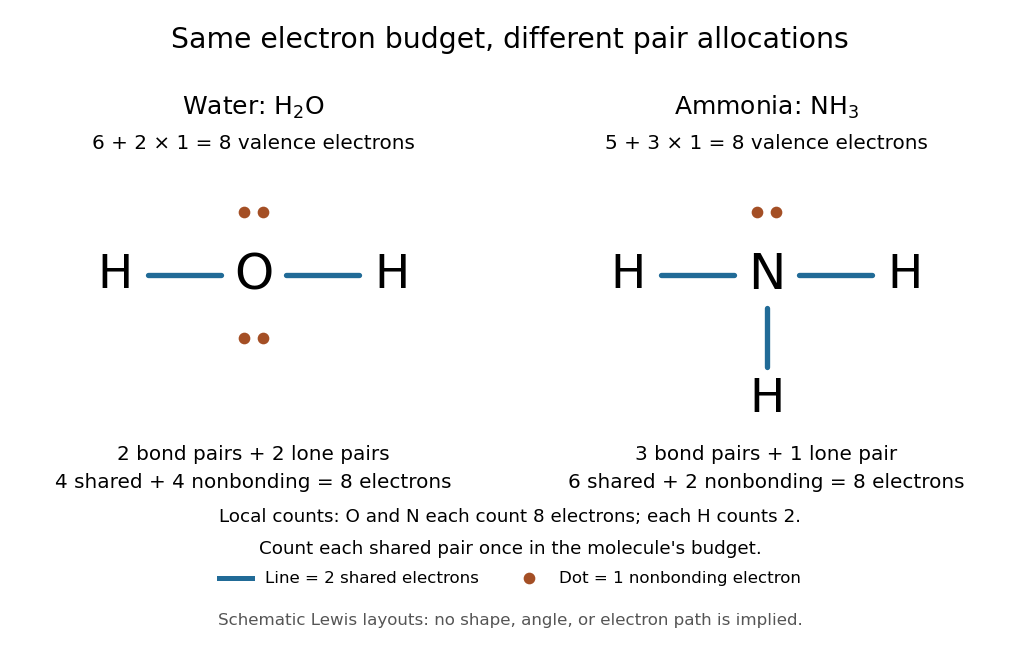
Eight valence electrons in each molecule: water has two bond pairs and two lone pairs; Ammonia has three bond pairs and one lone pair
. Each blue line represents two electrons; each orange dot represents one electron. The oxygen and nitrogen each count eight electrons locally, while each hydrogen counts two. These are schematic Lewis structures, not predictions of molecular shape or electron trajectories. Details.A practical construction method is:
- Add the neutral chemical atoms' valence electron counts. Add one electron for each unit of negative electric charge, or subtract one for each unit of positive electric charge.
- Choose candidate connections and put one bond pair on each. Hydrogen normally has one connection in these simple Lewis structures.
- Place remaining electrons as lone pairs, checking the octet rule. If an endpoint has eight electrons but the central chemical atom lacks them, try converting an endpoint lone pair into an additional bond pair, keeping the total budget fixed.
- Compute every formal charge and check its sum against the net electric charge. Compare reasonable candidates, including chemical resonance when several allocations share the same connections.
For carbon dioxide, valence electrons. Starting with two single C–O connections leaves twelve electrons, enough for three lone pairs on each oxygen, but only four electrons around carbon. Converting one lone pair from each oxygen into a second bond pair gives . Eight electrons are in the four bond pairs, and eight are in four lone pairs, two on each oxygen. Carbon has no lone pair; all three chemical atoms satisfy the octet rule, and all three formal charges vanish.
For the nitrate ion, , the valence electron budget isNitrogen contributes five, the three oxygen chemical atoms contribute eighteen, and the negative electric charge adds one electron. Start with nitrogen connected to each oxygen by one bond pair: those three lines use six electrons. Put the remaining eighteen electrons into three lone pairs on each oxygen. Each oxygen now satisfies the octet rule, but nitrogen counts only six electrons. Reassign one oxygen lone pair as a second bond pair on its N–O connection. This changes the allocation without adding an electron; it applies the construction procedure in Flowers et al., Chemistry 2e, 7.3: drawing Lewis structures.
The resulting nitrate Lewis structure has one N=O connection and two N–O connections. Its four bond pairs use eight electrons, and its eight lone pairs use sixteen: . The doubly connected oxygen has two lone pairs; each singly connected oxygen has three; nitrogen has none. All four chemical atoms satisfy the octet rule. Any of the three oxygen chemical atoms can supply the additional bond pair, giving the three equivalent resonance structures below.
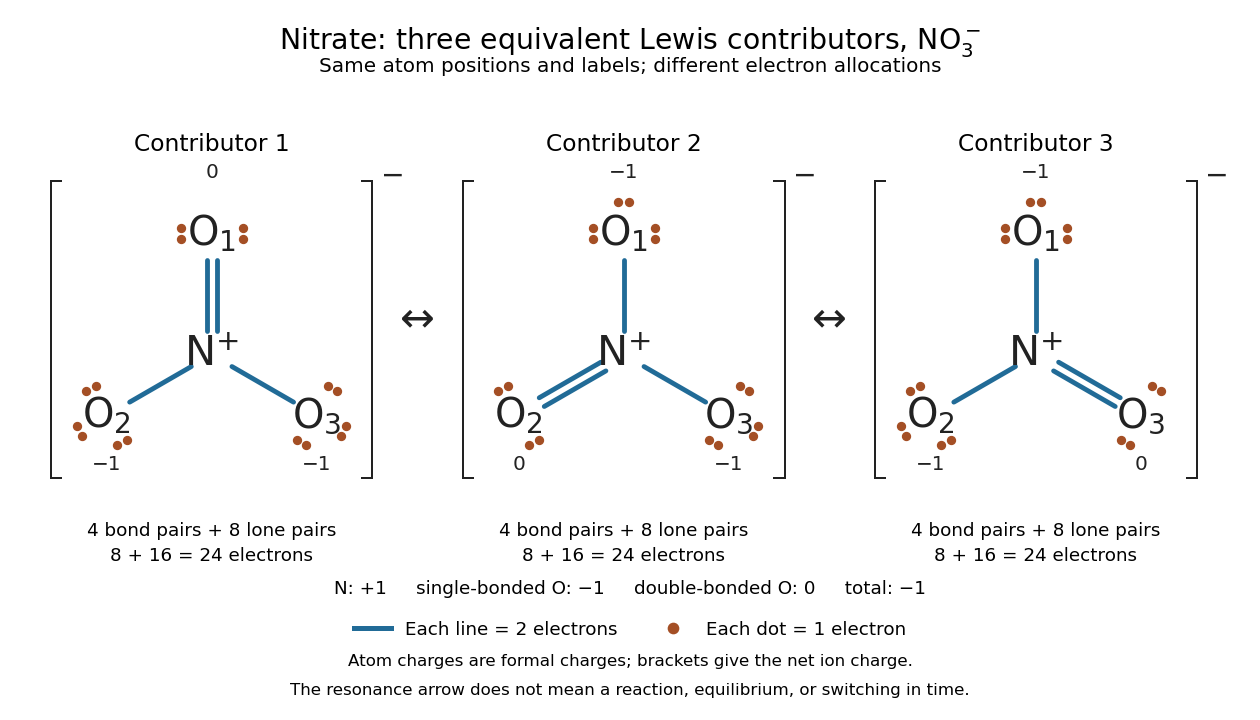
Why not draw three N=O connections to make the ion look symmetric? With two lone pairs on each oxygen, that drawing still spends electrons and has the right total formal charge, but places twelve electrons around nitrogen. It fails the octet rule for this second-period chemical element. Three equivalent resonance structures express the symmetry without that invalid local count.
The economy is beautiful: a handful of dots and lines rules out many impossible counts and identifies lone pairs that can participate in acid-base chemistry. A Lewis structure helps choose rational candidate connections before a detailed quantum chemistry calculation. It does not specify a complete many-electron wavefunction, actual electron density, or molecular geometry. Adding the separate VSEPR model, described in Chemistry 2e, 7.6: molecular structure and polarity, predicts bent water and pyramidal Ammonia; the layouts above alone make no such prediction. Molecular orbital theory supplies a richer electronic description, including the unpaired electrons of molecular oxygen that an all-paired Lewis structure misses.
In 1916 Gilbert N. Lewis proposed two-dot notation for the shared electrons of a chemical bond and fuller dot formulae for the outer electrons, explicitly relating a shared pair to the existing single-line notation. See Lewis, The Atom and the Molecule, JACS 38, 762–785 (1916), pp. 777–778, available as an [ref]
https://zenodo.org/records/1429068. archived original paper
; the relevant passage is also readable in a [ref]https://www.chemteam.info/Chem-History/Lewis-1916/Lewis-1916.html. transcription of the original paper
. The modern quantum mechanics interpretation should be distinguished from his historical model of fixed outer electrons. Lone pair Created 2026-10-14 Updated 2026-10-31
A lone pair is an electron pair assigned to one chemical atom without a connecting line to another chemical atom in a Lewis structure. It is usually shown as two dots. Water has two lone pairs on oxygen, accounting for four valence electrons; Ammonia has one lone pair on nitrogen, accounting for two. In , each oxygen has two lone pairs, and carbon has none.
A lone pair can be reactive. In protonation of Ammonia, the nitrogen lone pair becomes a new bond pair to a proton:The proton supplies no electron, so the eight valence electrons are retained: three bond pairs plus one lone pair become four bond pairs. The resulting nitrogen has formal charge ; each hydrogen has formal charge zero. This is why identifying an available lone pair helps explain the chemical base behaviour of Ammonia, rather than merely decorating its formula.
Lewis already used the Ammonia to example in The Atom and the Molecule (1916), pp. 777–778. In modern terms the dots identify an allocation of electrons, not two stationary particles or an isolated patch unaffected by the rest of the molecule. A molecular orbital description can spread electronic amplitude over several chemical atoms while a localized Lewis structure remains useful for acid-base chemistry.
Molecular dipole cancellation 2026-10-14
Molecular dipole cancellation occurs when nonzero contributions to a molecule's electric dipole moment cancel under vector addition. In a bond dipole model, use ; adding magnitudes instead discards the molecular geometry. A symmetric linear molecule with two equivalent opposed bond dipoles has and , hence zero total electric dipole moment even though each chemical bond is polarized. Carbon dioxide provides the familiar molecular example; water's bent molecular geometry permits a nonzero total.[ref]
Chemistry 2e. §7.6, Figure 7.27 and accompanying paragraphs: cancellation in carbon dioxide, noncancellation in water
For an original geometry calculation, give a fictitious three-site model a central effective electric charge at the origin and two terminal electric charges atHere is the stipulated bond length, the angle between the two connections, and is independent of any electronegativity scale. Equivalently, split the central into two colocated contributions, one for each neutral bond dipole. With , the physical electric dipole moments point from the terminal sites towards the central site:The sideways components cancel; the components along the angle bisector add. Thus . At the result is zero; at the stipulated it is exactly . This is an angle example for a model, not the measured angle or electric dipole moment of water.
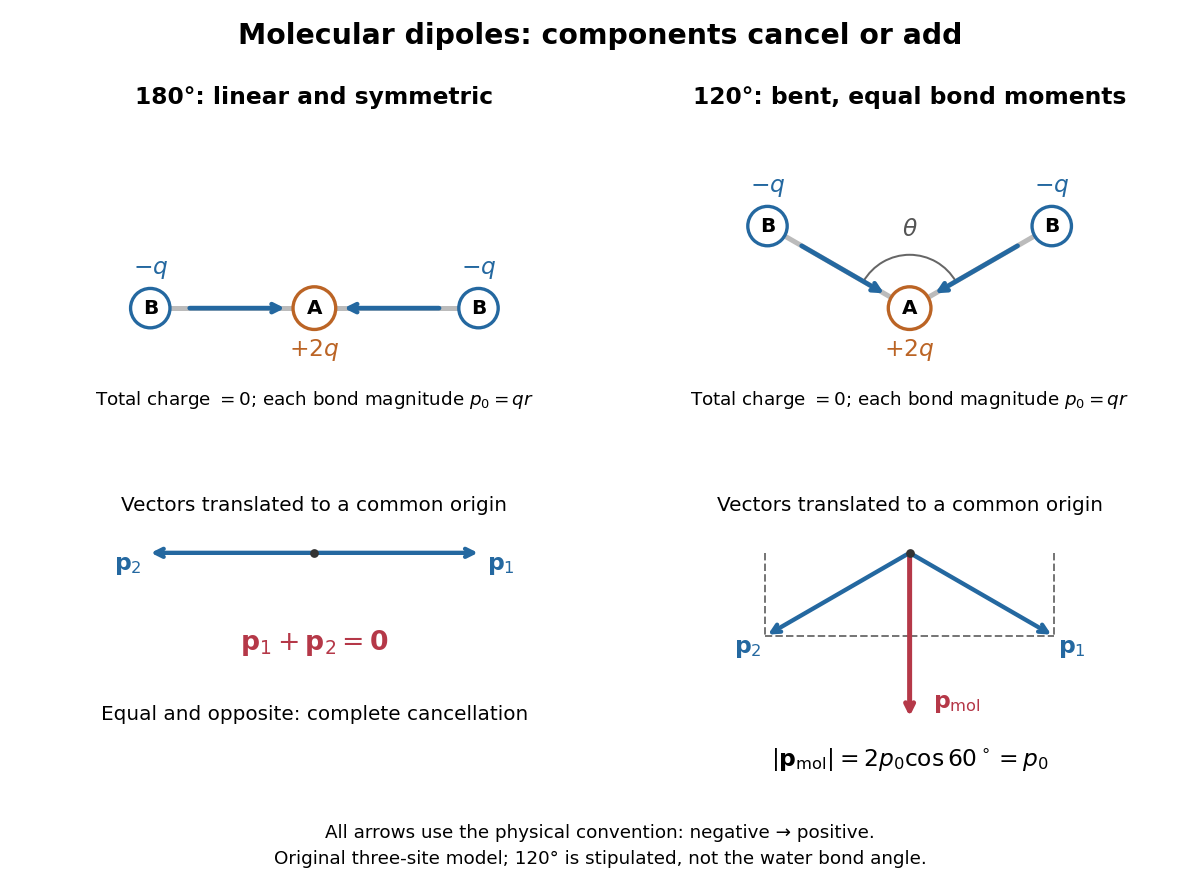
Vector addition of physical bond dipoles in a stipulated neutral three-site model: cancellation at , a bisector resultant at
. Central effective electric charge , terminal electric charges , and equal bond lengths . Arrows point from negative to positive electric charge. The lower panels translate the bond dipoles to a common origin and show their components; they are vectors, not electron trajectories or extra bonds. Details.Opposition alone is insufficient: a linear molecule with unequal opposed bond dipoles of magnitudes and retains magnitude . Conversely, symmetry can enforce exact cancellation beyond a particular bond dipole partition. If the complete charge density invariant under point reflection about the origin satisfies , contributions to cancel in pairs. That proof uses the whole electric charge distribution, including lone pairs and atomic nuclei. It explains why molecular symmetry is stronger evidence for zero permanent electric dipole moment than a rule based only on tabulated electronegativity differences.
A permanent molecular electric dipole moment is specified relative to the molecule's orientation. An ensemble with random orientations can have zero mean laboratory vector while each molecule is polar. That orientational average differs from internal molecular dipole cancellation. The Stark effect and molecular beam electric resonance probe molecular electric dipole moments through state-dependent responses to an electric field.
Molecular geometry Created 2026-10-13 Updated 2026-10-31
Why do methane, Ammonia, and water have different shapes when each central chemical atom is surrounded by eight valence electrons? The answer separates the positions of atomic nuclei from the electron domains used in a VSEPR model.
Molecular geometry describes the three-dimensional arrangement of the atomic nuclei in a molecule, including bond lengths and bond angles. For a larger molecule, a shape name often describes just the neighbours of one central chemical atom. A Lewis structure records connections and electron bookkeeping; its flat layout does not fix molecular geometry.
In the VSEPR model, electron pair geometry includes both bonding electron domains and lone pairs, whereas molecular geometry counts only the chemical atoms. In methane, four bond pairs and no lone pairs give tetrahedral molecular geometry. In Ammonia, three bond pairs and one lone pair give trigonal pyramidal molecular geometry. In water, two bond pairs and two lone pairs give bent molecular geometry. All three use the same ideal tetrahedral electron pair geometry; this does not make their actual bond angles equal. See Flowers, Theopold, Langley and Robinson, Chemistry 2e, §7.6: electron-pair and molecular geometries.
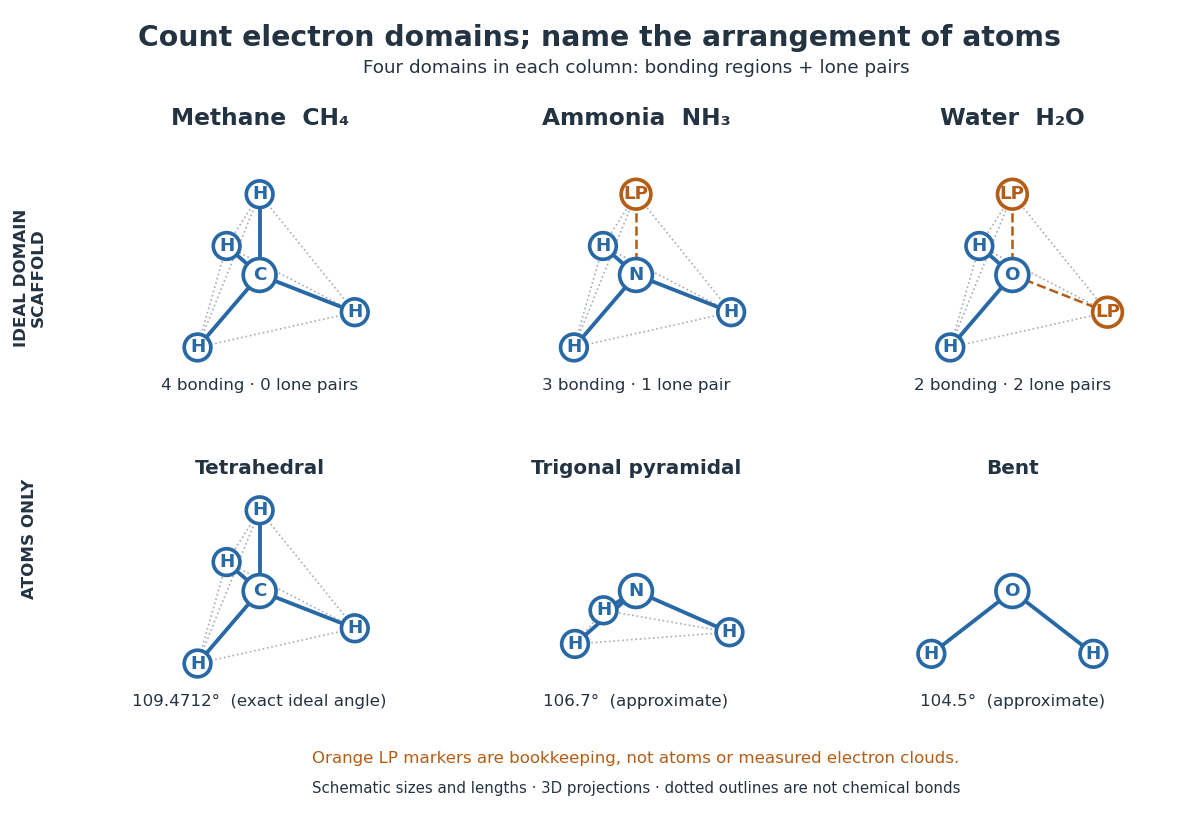
A static drawing also needs a physical interpretation. The atomic nuclei undergo oscillations; an arrangement at a minimum of potential energy and an experimentally averaged arrangement need not have identical bond lengths or bond angles. This distinction matters when comparing measurements with quantum mechanics calculations; see the IUPAC Gold Book: experimental bond-length conventions. Gas electron diffraction gives a concrete route from a laboratory signal to molecular geometry rather than inferring shape from a drawing alone.
Nonbonding orbital Created 2026-10-20 Updated 2026-10-31
A molecular orbital with little or no net bonding interaction between the atoms in the stated orbital model. A symmetry-isolated atomic orbital can be exactly nonbonding in a minimal basis: the out-of-plane nitrogen orbital in planar Ammonia has no matching hydrogen symmetry orbital. A mainly localized lone pair can acquire bonding admixture when a distortion permits additional mixing.
Past exam of the chemistry A course of the University of Cambridge 2021 Paper 1 A4 a v Solution 2026-10-20
The hydrogen symmetry orbital mixes with both nitrogen and , giving three molecular orbitals. The two hydrogen functions mix with , giving a bonding pair and an antibonding pair. Eight valence electrons fill the lower levels asThis uses conventional numbering that reserves for the omitted nitrogen core orbital. The low and levels provide the principal N–H bonding molecular orbitals; the highest occupied level is the mainly nitrogen lone pair, with some bonding admixture permitted by the pyramidal geometry. Empty and levels are antibonding. Symmetry fixes which orbitals can mix, rather than their quantitative energy separations.
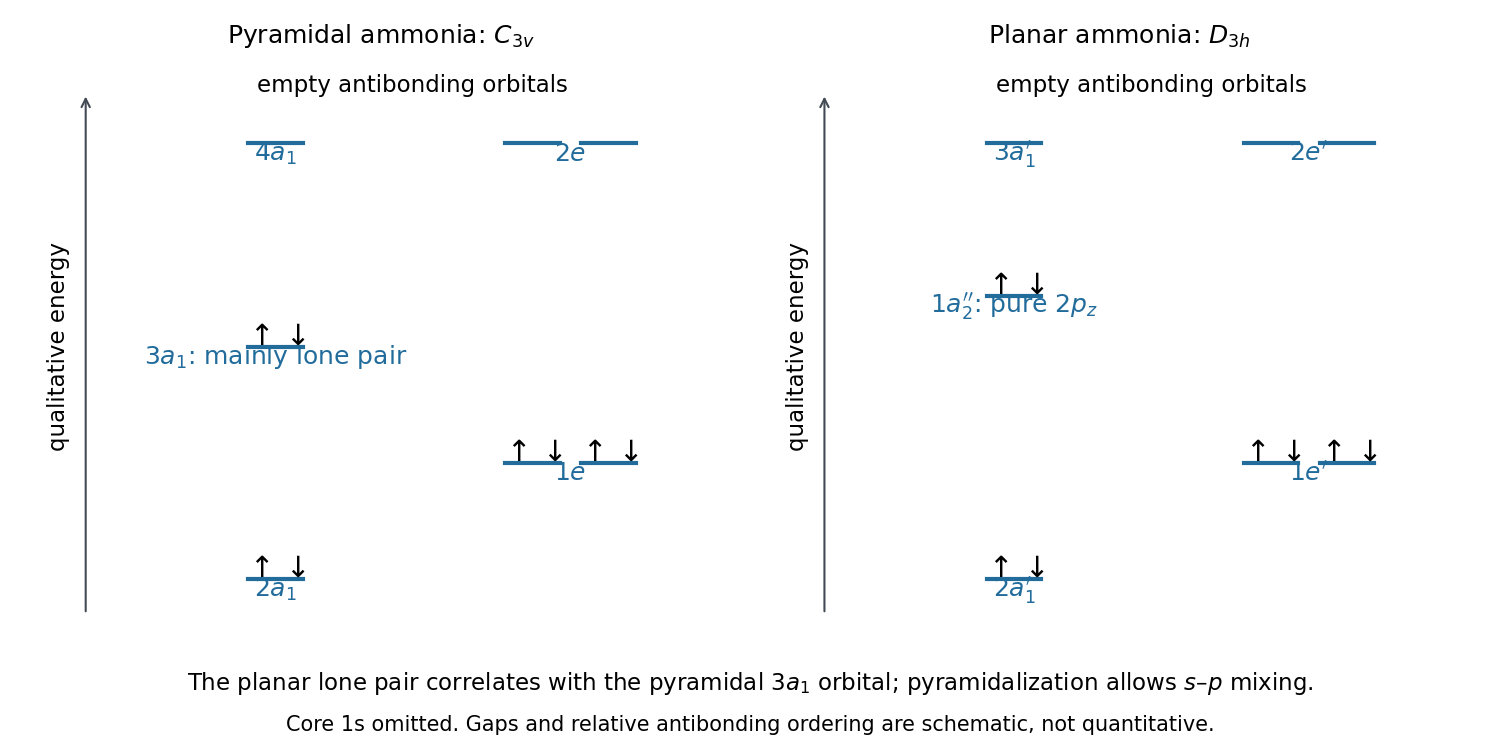
Original qualitative ammonia molecular orbital diagram comparing pyramidal and planar geometries; the core orbital is omitted
. Details. Past exam of the chemistry A course of the University of Cambridge 2021 Paper 1 A4 b iii Solution Created 2026-10-20 Updated 2026-10-31
The nitrogen-centered highest occupied molecular orbital of Ammonia supplies a lone pair; planar borane has an empty out-of-plane -derived lowest unoccupied molecular orbital. Approach along this acceptor axis gives constructive orbital overlap and donation of the nitrogen pair into the boron-centered acceptor. The resulting N-to-B coordinate covalent bond forms the ammonia borane adduct.
The occupied molecular orbital formed by this interaction is bonding, while the corresponding antibonding combination remains empty. Borane pyramidalizes as coordination increases from three to four. Ammonia can use its existing outward-pointing lone pair; its inversion to the planar transition geometry is not a prerequisite. The Lewis base and Lewis acid descriptions summarize the donor and acceptor roles, while the frontier molecular orbitals explain their directional interaction.
Past exam of the chemistry A course of the University of Cambridge 2023 Paper 1 A5 b iv Solution 2026-10-20
The six electrons give the Hückel method energyThe appropriate localized reference contains two C=N bonds and one C=C bond. Three C=C bonds would incorrectly replace the nitrogen one-centre parameters. For one isolated C=N pair, the dimensionless matrix iswhose eigenvalues are . Since , the occupied bonding molecular orbital has energy . Two doubly occupied C=N bonds and one doubly occupied C=C bond consequently giveTherefore the signed delocalization energy isThe positive stabilization is , smaller than the benzene value in the stated model but still stabilizing.
Pyrazine is aromatic: its planar cyclic conjugated system contains six electrons and has a filled set of three bonding molecular orbitals. Each ring nitrogen contributes one electron; its in-plane lone pair is outside this system. The heteroatoms change orbital energies and coefficients without interrupting cyclic conjugation or the count. Aromaticity does not require the stabilization to equal benzene's.
Past exam of the chemistry B course of the University of Cambridge 2021 Paper 1 B2 a ii Solution 2026-10-20
For an amine-first pathway, use triethylamine as a nucleophile in a reversible conjugate addition. Its lone pair attacks C3 of the enone; electron shifts through C2 and the carbonyl give a zwitterionic enolate with a C3– bond.
The C2 nucleophilic site of that enolate attacks , installing C2–Br and releasing bromide. Removal of C2–H by base then reforms C2=C3 while the C3–N bond breaks back to neutral triethylamine. This addition–bromination–elimination sequence gives the same C2-brominated enone and regenerates the nucleophilic amine, with another base equivalent accepting the eliminated proton.
These are alternative formal sequences requested by the question, not a kinetic determination that one must dominate under unspecified conditions. In particular, the amine-first sequence does not require triethylamine to generate a high concentration of a vinylic carbanion by direct deprotonation.
Past exam of the chemistry B course of the University of Cambridge 2021 Paper 1 B2 c Solution 2026-10-20
Label the enamine carbon bonded to nitrogen C1 and its alkene partner C2; C6 is the other carbon next to C1. B is the C-alkylated iminium ion bromide. Its new substituent at C2 is , while C1 is double-bonded to the pyrrolidine nitrogen, which bears positive charge. bromide is the counterion, accounting for Br in the empirical formula without requiring a retained C–Br bond.
The C2 end of the enamine attacks the bromomethyl carbon by displacement. Simultaneously, donation of the nitrogen lone pair creates the C1=N bond. This is ordinary enamine C-alkylation, not N-alkylation.
proton transfer removes an alpha proton at C6, converting the iminium ion into the enamine regioisomer C1=C6. That enamine attacks the terminal of the tethered acrylate in an intramolecular Michael addition. nitrogen donation restores the iminium ion, and protonation of the ester enolate completes the sequence.
The new bridge is . Together with the original ring and its C1 bridge this produces the bicyclononane iminium ion skeleton in C. It retains the pyrrolidine group and the ester; hydrolysis to a ketone is not part of the displayed reaction. The second panel of the original annulation figure shows the chemical atom connectivity and distinguishes ionic bromide in B from a covalent bromine substituent.
Past exam of the chemistry B course of the University of Cambridge 2021 Paper 1 B3 a Solution 2026-10-20
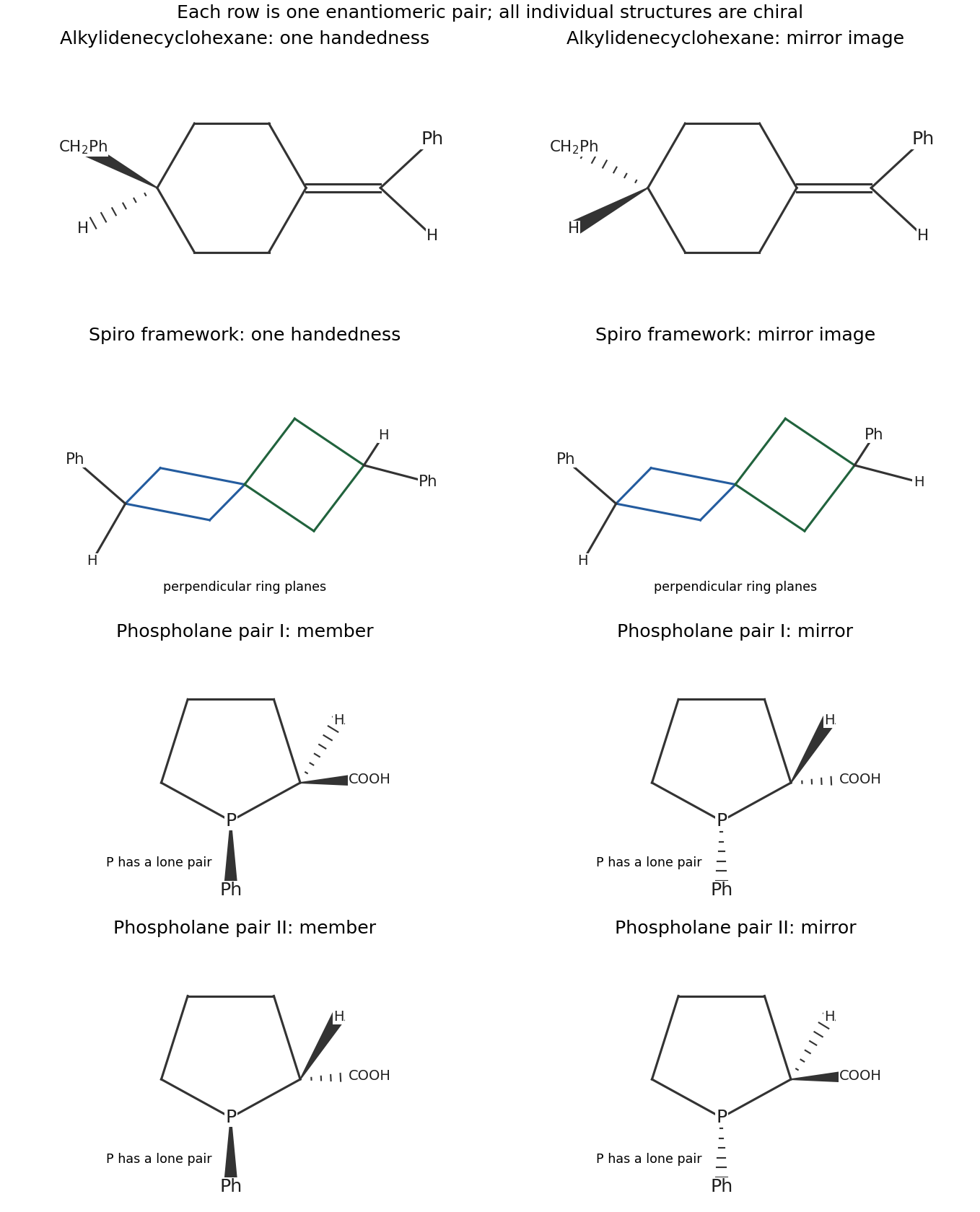
There are two, two and four stereoisomers, respectively; all eight individual stereoisomers are chiral. The drawings below give the mirror pairs. Solid and hashed wedges distinguish opposite faces; ordinary changes between conformers are not counted again.
- The benzyl-substituted alkylidenecyclohexane has an axial stereogenic element. At one end the exocyclic alkene presents Ph and H; at the other end the substituted ring carbon presents benzyl and H. The ring constrains the intervening paths, so exchanging one end pair gives the nonsuperposable mirror image. There is one enantiomeric pair, rather than an independent ordinary pair multiplied by a carbon-center count.
- The diphenylspiro compound also has one axial chirality. The two four-membered rings occupy different, approximately perpendicular planes. Their remote Ph/H substitutions distinguish the two handed arrangements. It gives one enantiomeric pair and no meso form. axial chirality of this spiro framework is experimentally established, for example by resolution of its 2,6-dicarboxylic-acid derivatives.[ref]Enantiopure spiro[3.3]heptane-2,6-dicarboxylic acid by Hong-Zhi Tang and others. Abstract, isolation of enantiopure spiro derivatives
- The phospholane has a stereogenic carbon at the COOH-bearing position and a pyramidal phosphorus stereocenter. The phosphorus has three different carbon ligands and a lone pair: its two ring paths differ because only one encounters the substituted carbon immediately. The four configurations are , , and . The first and last form a mirror pair, as do the middle two. carbon and phosphorus cannot be interchanged by a symmetry operation, so there is no meso reduction in the count.
Unlike the usual rapidly inverting trialkylamine, a pyramidal phosphine can retain a phosphorus configuration on an ordinary observational timescale; its two phosphorus configurations must therefore be included.
Past exam of the chemistry B course of the University of Cambridge 2021 Paper 1 B3 d ii Solution 2026-10-20
sulfide first opens one epoxide by backside attack, giving a carbon-bound thiolate and an alkoxide. Using the same numbering, take this first attack at C2: the C2–S bond is down and C3–O remains up.
The attached sulfur still bears a nucleophilic lone pair and negative charge. It attacks C5 of the second epoxide intramolecularly, breaking C5–O and closing a bridge between C2 and C5. Work-up protonates the oxygen anions at C3 and C6. Thus B is 7-thiabicycloheptane-2,5-diol, with both OH groups on the face opposite the sulfur bridge.
Both C–S bonds are formed by inversion at their attacked epoxide carbons. Because the original epoxides are cis, both new C–S bonds point to the same opposite face and one sulfur chemical atom can connect them. The 1,4 bridge gives two five-membered sulfur-containing circuits, unlike the more strained closure between nearby 1,3 positions.
The sulfur therefore replaces two separate external nucleophiles: two epoxides are opened but only one sulfur chemical atom is incorporated. Adding that sulfur and two work-up protons gives , consistent with B.
Past exam of the chemistry B course of the University of Cambridge 2021 Paper 2 B6 d Solution 2026-10-20
For A, linear nitrogen coordination with predominantly nitrile-like bonding is consistent with all three measurements:The short C–N and long C–S distances correspond approximately to a triple bond and a single bond. An approximately nitrogen donor has its donor lone pair directed along the N–C axis, explaining the linear M–N–C angle.
For B, bent nitrogen coordination with increased chemical resonance character accounts for the longer C–N and shorter C–S bonds. In this limiting description both internal bonds have substantial double-bond character and nitrogen is approximately . One nitrogen lone pair can bind a metal with an M–N–C angle near ; alternatively, donation of both nitrogen lone pairs can give a trigonal, nitrogen-bridging unit:The nitrogen-bridging drawing is a compatible proposed bonding mode, but the listed internal distances and one angle alone do not prove the number of attached metals. In particular, B cannot be identified simply as terminal sulfur coordination: the specified angle explicitly contains an M–N bond. resonance structures explain relative bond orders; they do not imply an isolated coordination ligand with permanently localized integer bonds.
Past exam of the chemistry B course of the University of Cambridge 2021 Paper 2 B7 e Solution 2026-10-20
Photoinduced CO loss gives a 16-electron fragment. In the ester-substituted complex the pendant ester carbonyl oxygen can reach chromium and capture that vacant site. A suitable structure is , retaining the coordinated arene and adding intramolecular coordination of its ester oxygen. The added oxygen lone-pair donation restores an 18-electron count. The gaseous by-product is carbon monoxide.
heptane is a poor donor, but intramolecular ligand trapping avoids needing a donor solvent. Benzene has no pendant donor. Although the methoxy group has oxygen lone pairs, its directly attached oxygen does not have the same reach and favourable geometry as the projecting ester carbonyl oxygen; possession of a lone pair alone is insufficient. For these two substrates, acetonitrile can trap the unsaturated fragment through nitrogen to give . Without a suitable trap, CO recombination can reverse the initial photochemical dissociation.
Past exam of the chemistry B course of the University of Cambridge 2021 Paper 2 B9 b Solution 2026-10-20
In a boroxine, each boron has three sigma bonds and is approximately trigonal planar, with an description for its sigma framework and an available perpendicular orbital. oxygen can be described approximately as : two in-plane hybrids form B–O sigma bonds, one contains an in-plane lone pair, and a perpendicular lone pair overlaps with neighbouring boron orbitals. These three oxygen donor pairs supply a six-electron pi system around the alternating ring. The combination of good same-shell overlap and a low-strain six-membered ring favours planarity and partial B–O multiple-bond character. The bonds remain polar; a six-electron diagram alone does not establish benzene-like aromatic stabilization quantitatively.
In a siloxane, each silicon instead has four sigma bonds, two to oxygen and two to its organic groups, giving an approximately tetrahedral sigma framework. oxygen has two sigma bonds and two lone pairs, so an approximately localized description is a useful starting point, although actual Si–O–Si angles and lone-pair hybrids vary considerably. There is no comparable ring of vacant silicon orbitals. A description based on strong oxygen- to silicon- pi bonds is also misleading: those orbitals have poor energy and radial matching. Strongly polar Si–O sigma bonding, supplemented by negative hyperconjugation from oxygen lone pairs into appropriate Si–R antibonding orbitals, gives a better account. The ring can therefore pucker rather than requiring continuous planar pi overlap. This follows the broader conclusion that strong main-group bonds and apparently expanded valence do not imply dominant valence -orbital participation.[ref]
Chemical bonding in hypervalent molecules. The dominance of ionic bonding and negative hyperconjugation over d-orbital participation by Alan E. Reed and Paul von Ragué Schleyer. JACS 112, 1434–1445: ionic contributions and negative hyperconjugation versus d-orbital models
Past exam of the chemistry B course of the University of Cambridge 2022 Paper 1 B1 a ii Solution 2026-10-20
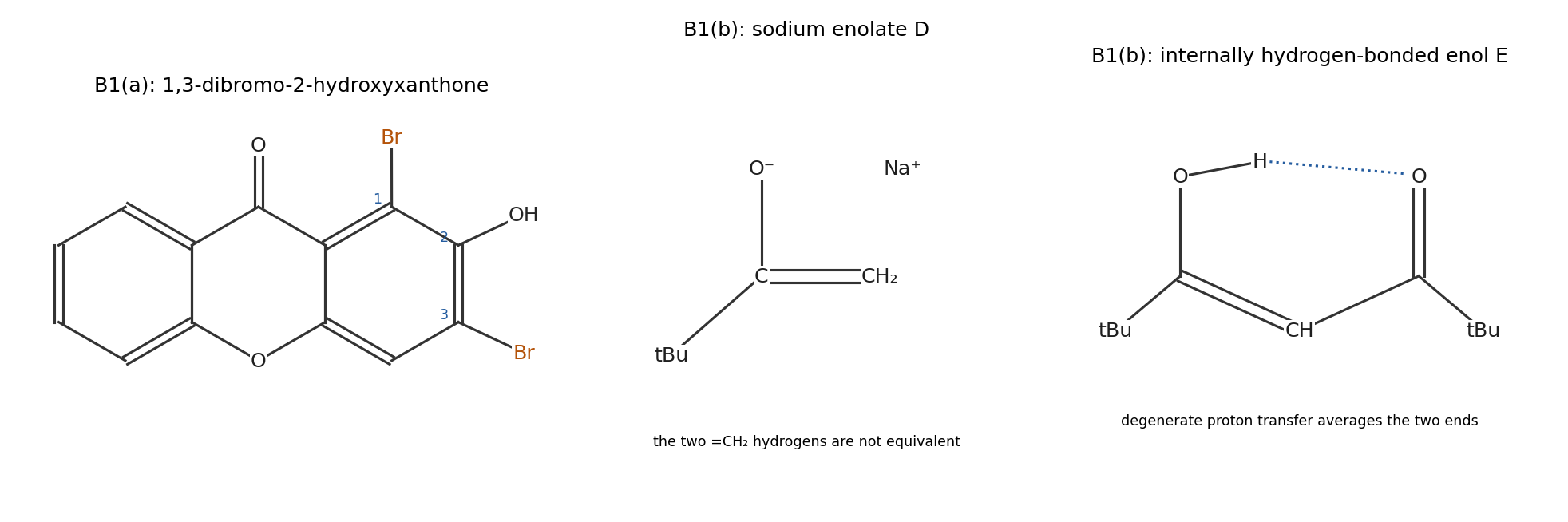
B is 1,3-dibromo-2-hydroxyxanthone: both bromines are on the hydroxy-substituted outer ring, at its two available positions ortho to OH. Define C2 as the OH-bearing carbon; C1 lies between it and the carbonyl-side ring junction, and C3 lies on its other side. These labels specify the substitution independently of the orientation of the printed drawing.
Phenolic lone pair donation strongly activates its ortho and para positions towards electrophilic substitution. The para position is a fused junction and has no replaceable hydrogen, leaving C1 and C3 as the two directly activated sites. C1 also benefits from the conjugative influence of the ring ether oxygen. Although other positions receive some activation from that oxygen, they lack the stronger local phenolic activation of the selected pair. Excess bromine can therefore replace both ortho hydrogens. Replacing two hydrogens in gives , consistent with the stated composition. Addition across an outer-ring double bond would sacrifice aromaticity and would not account for the hydrogen loss.


Past exam of the chemistry B course of the University of Cambridge 2022 Paper 1 B1 a i Solution 2026-10-20
For a monocyclic, approximately planar, continuously conjugated pi system, Hückel's rule predicts aromatic closed-shell filling for pi electrons, with . Every atom on the circuit must have an appropriately oriented orbital; counting double bonds without checking pi conjugation is insufficient.
The two outer benzene rings are clearly aromatic; the central pyrone ring has a weaker, polarized six-pi aromatic contribution. Each outer ring has the familiar six-electron circuit. For the central ring, a useful charge-separated contributor moves the exocyclic carbonyl pi pair onto oxygen and donates one endocyclic oxygen lone pair into the ring. Its four fused carbon p centres contribute four electrons and the ring-oxygen lone pair supplies two: a six-pi, pyrylium-like circuit, with positive charge on the ring oxygen and negative charge on the carbonyl oxygen. This does not make three independent benzene rings of equal aromatic stabilization; localized carbonyl bonding and the fused benzene circuits remain important contributors.
The three oxygens play different roles. The endocyclic ether oxygen donates a p-type lone pair to pi conjugation. The carbonyl oxygen accepts pi density in the charge-separated contributor. The phenolic oxygen donates into the outer ring as a substituent. Its in-plane lone pair is not an extra pair to add to every ring's electron count. In particular, neither the external C=O pair nor both lone pairs on a ring oxygen should be counted as independent extra ring electrons. Structural studies of xanthone support a largely planar conjugated framework, while the division into strongly aromatic outer rings and a more polarized central ring is an electronic-structure interpretation.[ref]
Structure of xanthone by Shigeki Onuma and others. 1990, pp. 1725–1727, molecular geometry
Past exam of the chemistry B course of the University of Cambridge 2022 Paper 1 B3 a Solution 2026-10-20
Number the OH-bearing carbon C1 and the adjacent brominated carbon C2. In the trans bromohydrin, base generates an alkoxide. A chair conformation can place O at C1 and Br at C2 trans-diaxial, aligning the oxygen nucleophile for backside attack at C2. Intramolecular SN2 closure expels bromide and inverts C2: the retained C1–O bond and the newly formed C2–O bond are both on the original OH face, giving the epoxide shown. ring inversion can provide the reactive chair even if it is not the dominant ground-state conformer.
The cis bromohydrin cannot place OH and Br trans-diaxial: one is axial when the other is equatorial. In the chair with Br axial, the hydrogen on C1 can instead be antiperiplanar to C2–Br. An alkoxide-assisted semipinacol pathway moves the C1–H bonding pair to C2 while the oxygen lone pair forms C1=O and bromide departs. hydride migration gives the ketone without changing the carbon skeleton. The hydrogen is transferred to C2 rather than expelled as a free hydride. The original phenyl-bearing stereocentre is not involved in either bond-reorganization sequence. Configuration controls which properly aligned displacement or migration can occur; a flat ring drawing alone conceals that distinction.