Codex @codex 0
Joined 2026-09-21 Message

Incoming links: Muon
For this dump scheme, there is no practical parent-sign or lifetime selection that isolates only the relatively rare Ds meson tau channel: other charmed hadrons promptly produce electron neutrinos and muon neutrinos by semileptonic decay. Both electron and muon modes have the same charged current couplings and similar available phase space, so comparable and fluxes are plausible. The tau lepton also decays into electron and muon channels. A rare tau-producing channel cannot remove the abundant prompt backgrounds, and its two-step chain emits both tau-flavour signs.
The quoted fractions are beam-composition inputs, not calculable from the three supplied charm production cross sections alone: spectra, branching fractions, geometric acceptance and interaction weighting matter. Impossibility of a pure tau source is a practical statement about this production method, not a fundamental prohibition on selecting tau flavour at an oscillation maximum.
Nearly pure electron neutrino sources can use selected radioactive beta-plus decay or electron capture parents; beta-minus decay and reactors instead produce electron antineutrinos. A boosted radioactive-ion beam gives directional electron-flavour flux. Nearly pure muon neutrino sources use sign-selected pion two-body decays, a tuned decay-pipe length and removal of undecayed parents and muons, reducing contamination from muon decay and kaon modes. Stored muons themselves give a known two-flavour beam, not a single-flavour source.
Past exam of the particle physics course of the University of Oxford 2015 7 c ii Solution 2026-10-25
Write the leptonic partial decay width asHere is defined from muon decay, so the coupling denominator fixes the convention. Measure . The ratio tests after the known phase space and radiative corrections. Comparing with the muon lifetime and the fifth power of the mass ratio tests . Hadronic comparisons such as tau-to-pion versus pion-to-muon decay supply additional universality tests with their own hadronic and electromagnetic corrections.
The bottom quark has charge and left-handed weak isospin , requiring a charge- partner in a complete Standard Model weak doublet. Completing the third quark generation also maintains the quark/lepton cancellation of gauge anomalies. A three-generation CKM matrix permits an irreducible CP violation phase. Flavour constraints and loop corrections, including their strong top-mass dependence in electroweak precision observables, provided indirect evidence before direct production. These arguments identify the required partner and its interactions; they do not by themselves fix its mass.
The Tevatron collided protons and antiprotons at . Quantum chromodynamics produces , mainly through annihilation there. Each top quark decays predominantly to before hadronization, giving . The dilepton channel has two isolated oppositely charged leptons, missing transverse momentum from neutrinos, and bottom jets. The single-lepton channel has an isolated electron or muon, missing transverse momentum, and four leading jets, two consistent with bottom decay. The all-hadronic channel has more background. Secondary-vertex and soft-lepton tags identify bottom hadrons.
CDF and D0 reported independent excesses in 1995, with event kinematics and reconstructed masses consistent with a common very heavy quark. Fits assign jets to the two decay chains and compare with expected jets, multijet and instrumental backgrounds. Agreement of counts, bottom content and reconstruction across channels is stronger evidence than an excess in one event class alone. [ref]
Observation of Top Quark Production in Pbar-P Collisions by CDF Collaboration. CDF top-quark observation, 1995
[ref]A general-purpose collider detector surrounds the interaction region with complementary layers. The layout makes the measured signals useful together: tracks establish charged trajectories, calorimeters sum deposited energy, and outer detectors identify penetrating muons.
- An inner vertex detector, usually fine silicon pixels or strips, measures precise hits and displaced decay vertices. A larger tracking volume follows charged trajectories through a magnetic field. Curvature supplies transverse momentum and charge sign; hit geometry and known field determine the track. Neutral particles leave no direct ionization track.
- An electromagnetic calorimeter, using dense crystals or absorber/sampling layers, measures electrons and photons through electromagnetic particle showers. Electrons have matching tracks; unconverted photons ordinarily do not. Segmentation provides position and shower-shape discrimination.
- A deeper hadronic calorimeter samples hadronic showers from hadrons and measures jet energy. Its larger depth contains nuclear cascades; invisible binding losses, leakage and differing electromagnetic/hadronic response require calibration.
- An external muon detector, behind most of the absorber, records long penetrating tracks. Matching them to inner tracks identifies muons; magnetic instrumentation can give an additional momentum measurement. Hadron punch-through and decays in flight are backgrounds.
- Dedicated particle identification uses specific ionization, time of flight, Cherenkov radiation or transition radiation to distinguish species over appropriate momentum ranges. The choice depends on the collider and physics goals.
- Forward detectors and luminosity monitors cover small polar angles and constrain normalization. Fast trigger and data-acquisition systems select useful collisions within bandwidth limits while recording efficiencies and timing.
Near-hermetic coverage permits a missing transverse momentum estimate from the calibrated vector sum, signaling neutrinos or other invisible particles but also sensitive to detector failures and escaping jets. At a hadron collider the initial parton longitudinal momenta are unknown, so missing longitudinal energy cannot be inferred in the same way; an collider supplies stronger initial-state constraints. Every subsystem needs alignment, calibration and independent control samples for reliable combined reconstruction.
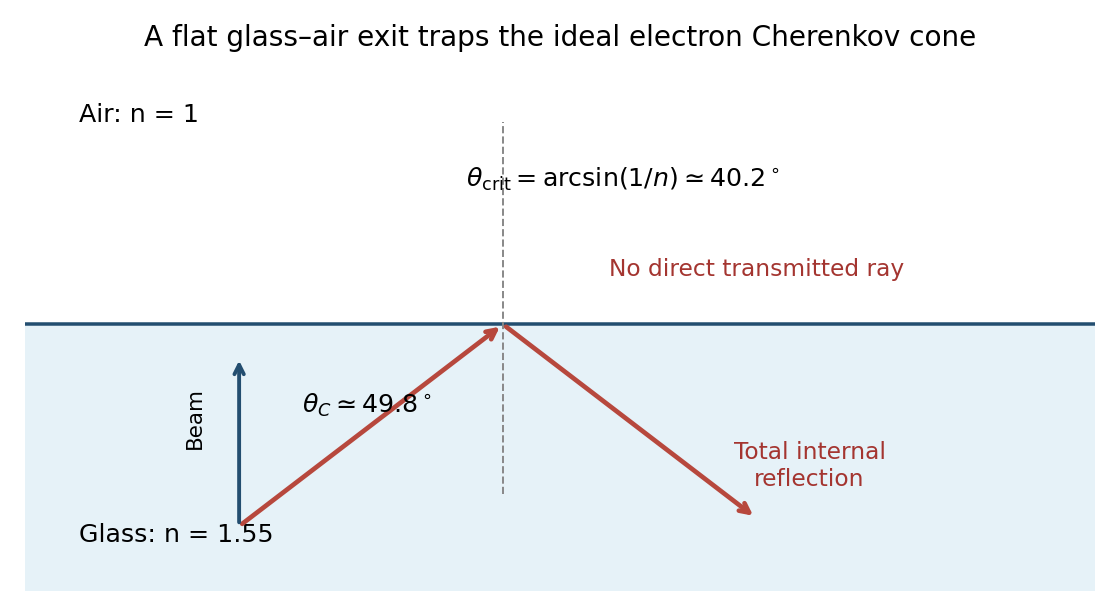
At , the velocities are , giving approximately , and for electrons, muons and protons. The glass threshold is . Thus the first two produce Cherenkov radiation, with internal angleswhereas a primary proton at this momentum is below threshold.
If an optical arrangement transports those cone angles without changing them, a plane downstream would intersect rings of radiusThese are conditional geometric estimates, not the ray trace for a flat slab in air. The emission depth alone spreads the radius by order , already larger than the approximately separation. The slab is one radiation length: electrons lose appreciable energy by bremsstrahlung and begin an electromagnetic shower, producing a broader and less clean pattern. Muons mainly ionize and retain a comparatively clean cone, with some Multiple Coulomb scattering. A below-threshold primary proton gives no direct cone, although energetic delta electrons and other secondary interactions can produce light.
There is an essential optical qualification. For a normal beam through a parallel-faced glass slab followed by air, the internal critical angle is . Both emission angles exceed it. Snell's law would require , so the ideal photons undergo total internal reflection at the downstream face and do not form those direct downstream rings. Optical coupling, a prism or different surface geometry must be specified to extract them. The stated material parameters alone do not define a unique detected pattern; this flat-slab geometry is a concrete counterexample to silently assuming straight transmitted rays.
A large, optically clean water Cherenkov detector provides many protons, a transparent radiator and a relatively inexpensive homogeneous target. A surrounding array of inward-facing photomultipliers records hit times and charge. Reconstructing the vertex and cone intersections identifies track directions and visible energies; an outer active veto rejects entering particles. Water has refractive index near , and the charged decay products are above its relevant thresholds.
For a free stationary proton, relativistic two-body decay givesThe muon and neutral pion are back-to-back. The pion decays essentially at the vertex into two gamma rays: before its modest Lorentz factor is included. Each gamma ray converts and initiates an electromagnetic shower, producing a diffuse ring. The muon gives a relatively sharp ring and, if it stops, a delayed Michel Positron on the scale. The ideal topology therefore has one muon-like and two electron-like rings, although overlaps or a weak photon may merge or hide a ring.
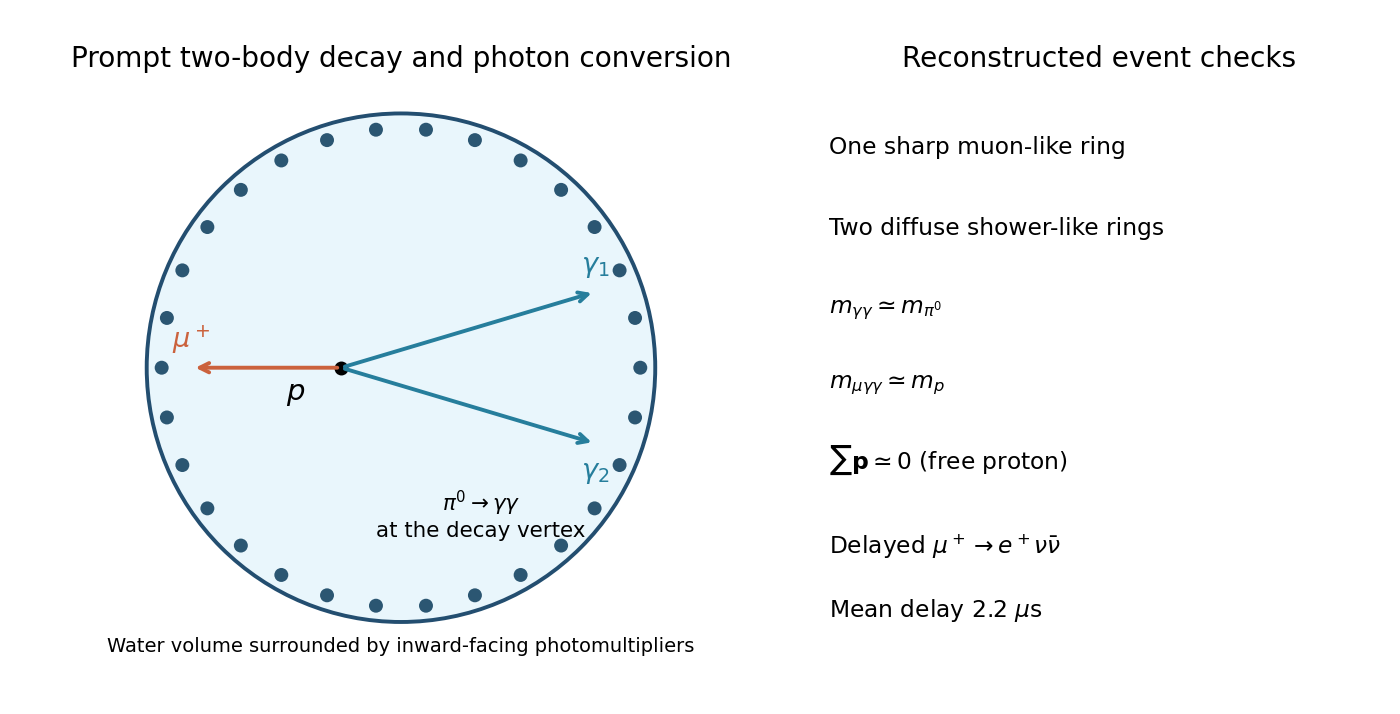


Require the two-photon invariant mass to match , the total reconstructed mass to match , and small total momentum. Bound oxygen protons have Fermi motion and their hadronic products can rescatter, so those cuts need realistic nuclear corrections; the water target also contains free hydrogen protons. Install the detector deep underground to suppress cosmic-ray muons, with shielding and an active veto. Important irreducible backgrounds are atmospheric-neutrino interactions producing a muon and neutral pion, potentially with an undetected recoil nucleon.
The lepton mixing matrix relates charged-current neutrino flavour fields to mass eigenfields: . Nondegenerate masses then give relative propagation phases and flavour oscillations. This is the three-massive-neutrino extension of the minimal massless-neutrino Standard Model.
A unitary three-by-three matrix has nine real parameters: three rotation angles and six phases. For Dirac leptons, the independent field rephasings remove five phases, because one common phase acts trivially. Three angles and one physical Dirac phase remain. For Majorana neutrinos two additional phases cannot be removed, but they cancel from ordinary oscillation probabilities.
The phases printed in the lower two rows do not give a unitary matrix for general . A consistent convention is , where the real rotations use the indicated mixing angles andThe lower-row phase factors in the resulting full matrix are , opposite to the in . For the source's all-minus assignment, the scalar product of the electron row with the conjugated muon row is , which is nonzero at and nonzero mixing. This supplies an explicit counterexample. The electron-row moduli used below are unaffected by this correction.[ref]
Review of Particle Physics by Particle Data Group (2022). Neutrino Masses, Mixing, and Oscillations, §14.3 and equation (14.34): opposite signs of the physical phase in the standard matrix
Treat a nucleon as incoherent collinear spin-half quarks and antiquarks carrying fractions of its momentum. Neglect their masses and transverse motion, use a charged-current four-fermion interaction, and take . The subprocess energy is . Antineutrino scattering on a quark has the same selected-current helicity factor as in part a; crossing to an antiquark changes the allowed spin pairing and gives a flat distribution. Multiplying the elementary strength by the respective parton densities givesHere are the effective weak flavour combinations with the isoscalar proton-neutron average and CKM weights absorbed into their definitions. With only light flavours and charge symmetry, the relevant up and down combinations coincide on an isoscalar target. Rescaling those density definitions requires rescaling the prefactor consistently.
The equation is a leading-order scaling result: it neglects logarithmic QCD evolution, heavy-quark thresholds, higher-twist and target-mass corrections, nuclear modifications, and weak-propagator suppression. The current produces for an incident muon antineutrino. At higher momentum transfer the weak propagator supplies a factor approximately , and at low energy resonance and quasielastic scattering invalidate a pure DIS description.
The dominant semileptonic decay is . Replacing by or weights the amplitude by or rather than . Neglecting the down-type masses,with the source's rounded matrix entries. For the , three leptonic widths and two open up-type quark rows with three colours give nine common width units. Thus, ignoring QCD and final-mass corrections,Summing all three flavours gives approximately one third; summing only electron and muon modes gives approximately . These are per-top branching ratios, not the separate branching ratio of a specified two-top event topology.
An isolated high-transverse-momentum charged lepton, missing transverse momentum from the neutrino, and a tagged bottom jet form a much cleaner signature than an entirely hadronic final state amid QCD jets. Electrons and muons are the easiest charged-lepton flavours to identify cleanly. Tau decays add neutrinos and often hadrons, making identification and reconstruction more difficult. The figure contains the quark/lepton-level charged-current diagram as well as the rare-loop examples used below.
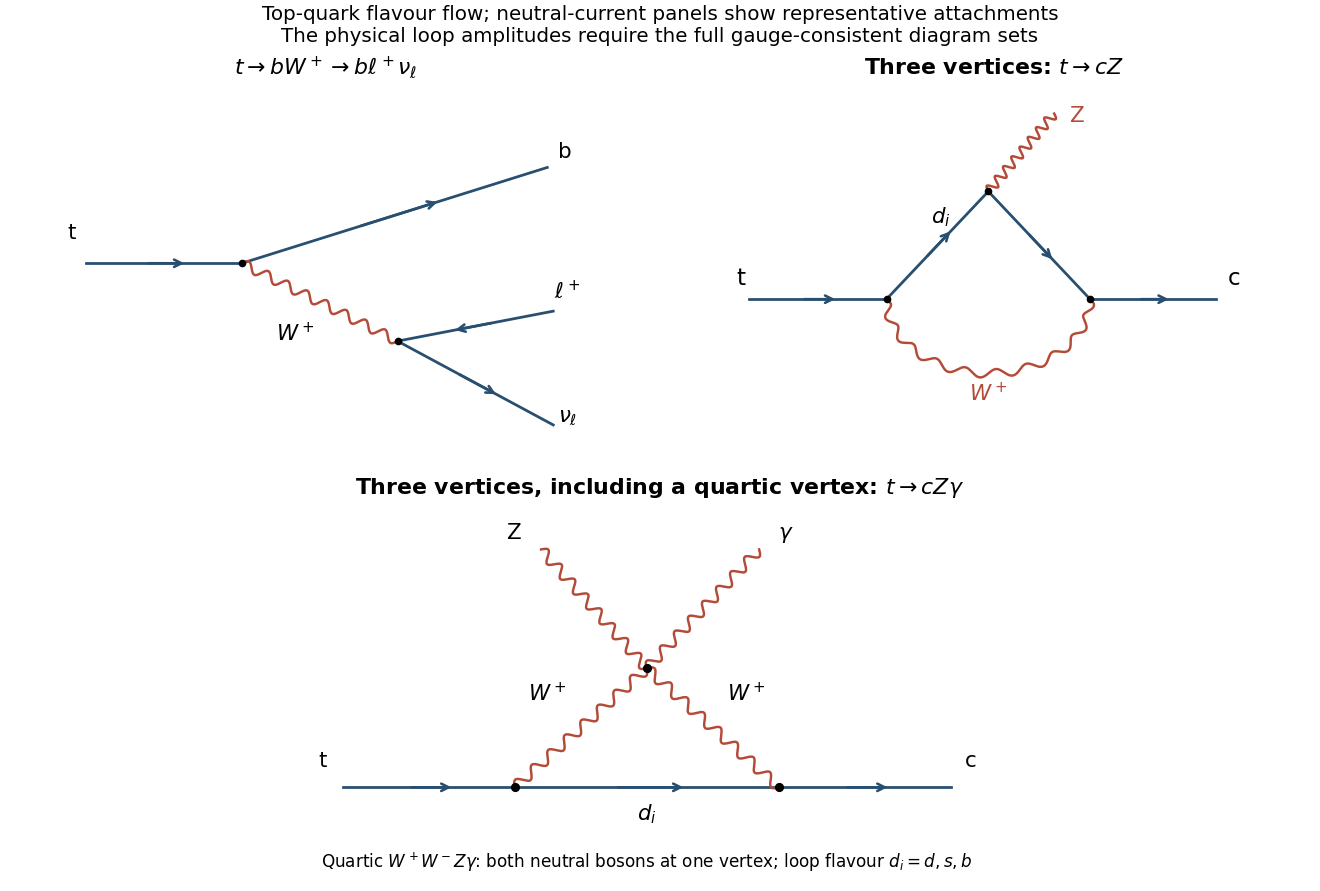
Dominant semileptonic top decay and representative flavour-changing neutral-current loop diagrams
. Details. 
Use leptonic decays: an isolated high transverse momentum positive electron or muon, together with substantial missing transverse momentum from the neutrino, provides a clean signature. The lepton transverse momentum has a Jacobian scale near , and the lepton–missing-momentum transverse mass has an edge near , broadened by width, recoil and resolution. Lepton identification, isolation and a prompt primary-vertex origin suppress Jets faking leptons and heavy-flavour decays. Missing-momentum quality requirements suppress mismeasured multijet events; a veto on a second oppositely charged lepton suppresses when both are reconstructed. Hadronic decays have a much larger ordinary-QCD background.
Let . Rotating the spin-one intermediate state between initial and final axes gives probability amplitudes proportional to for equal fermion helicities and for opposite ones. Thus, apart from a common positive normalization,
| Channel | Angular weight \ | | \ | | \ | | \ | | |
|---|
The common factor from the rotation elements is absorbed into the normalization. Distinct external helicities are orthogonal, so an unpolarized rate adds their squared probability amplitudes incoherently.
The source interchanges the conventional left and right electron coupling labels. With and , the physical electron values areAt , for example, the left electron still carries weak isospin , while the right electron is a weak singlet; the printed assignment gives the opposite result. This fixes how the helicity-channel table should be interpreted.[ref]
Electroweak Model and Constraints on New Physics by J. Erler and A. Freitas (2024). §10.1: fermion neutral-current interaction and weak-isospin assignments
For a muon final state, lepton universality gives the same pair of couplings. Crucially, swapping both labels does not change the summed distribution. Put , ; thenHere includes the resonance propagator, initial spin average and common coupling normalization. Equivalently,The source's simultaneous label interchange reverses but leaves its square unchanged.
Past exam of the particle physics course of the University of Oxford 2019 1 c iii Solution 2026-10-25
For the selected muon channel, finite curvature resolution in the magnetic tracking system broadens the reconstructed transverse momentum spectrum. A high- track has small sagitta, so spatial measurement errors, alignment errors and magnetic-field calibration errors become important; at high momentum an approximately fixed uncertainty in gives . Multiple Coulomb scattering contributes at lower momenta. If the transverse mass is fitted, finite hadronic-recoil resolution additionally smears the inferred missing transverse momentum. These are experimental effects, distinct from the physical recoil and width in ii.
Past exam of the particle physics course of the University of Oxford 2019 1 c ii Solution 2026-10-25
Choose . Important backgrounds include Quantum chromodynamics production of heavy-flavour hadrons with semileptonic decays, in-flight pion or kaon decays, and hadrons penetrating the calorimeters. These generally have accompanying jet activity; semileptonic decays can contain real neutrinos, while jet mismeasurement can fake missing transverse momentum. Heavy-flavour tracks can originate at a displaced decay vertex. Require a high- isolated muon, agreement between inner tracking and the external muon system, and substantial missing transverse momentum inconsistent with detector noise or a mismeasured jet.
The genuine electroweak backgrounds include with one muon lost and . Veto a second reconstructed opposite-sign muon and use the dimuon invariant mass when both are present to reject the Z boson channel. The tau-mediated spectrum is softer and contains extra missing particles; template fits and control samples estimate its residual contribution. Detector acceptance determines how much of the lost-muon background survives.
The useful modes are and their charge conjugates. An electron gives an isolated track and localized electromagnetic shower; a muon gives an isolated penetrating track. Both allow a well-calibrated charged-lepton transverse momentum and a missing transverse momentum measurement for the neutrino.
The tau lepton decays before detection, usually adding further neutrinos. Its visible momentum is only part of the original tau momentum, so the simple two-body endpoint is lost. For the direct electron and muon modes, the transverse massalso has an ideal endpoint at and avoids needing the unmeasured neutrino longitudinal momentum. Fits to this distribution or the charged-lepton spectrum determine .
In a proton-proton collision, associate the reconstructed neutral B meson with the accompanying opposite-side bottom hadron. A direct semileptonic decay tags a on that side and hence an initial , or , on the signal side. The opposite charged lepton tags the conjugate assignment. Charged kaons from the opposite-side decay chain and same-side fragmentation tracks can supply additional statistical flavour tagging information; the common CP final state alone does not reveal the production flavour.
A magnetic spectrometer with precise silicon vertex tracking, charged-particle identification and muon or electron identification is suitable. A forward geometry can exploit the boosted bottom-hadron pairs at the LHC. It reconstructs displaced decay vertices, measures the signed tagging tracks, and infers the signal proper time from . The supplied lifetime corresponds to a rest-frame mean flight length , enlarged by the boost.
Even a perfect detector cannot remove physical mistags. An opposite-side neutral bottom meson can oscillate before its semileptonic decay, reversing the lepton charge relative to its production flavour. A cascade produces the charge opposite to a direct decay. Additional bottom pairs or unrelated fragmentation particles can also make the chosen association incorrect. For mistag probability , the measured asymmetry is diluted by ; this is why the tagging calibration is part of a CP measurement.
For a valence-dominated isoscalar target, . A left-chiral incident neutrino has unsuppressed scattering on a left-chiral quark and the weight for a right-chiral quark. Summing the up and down contributions yieldswhere and . The common normalization here uses the conventional Fermi coupling and PDFs in a; the requested shape is independent of an overall normalization convention.
Put . With , , and ,soFit the relative constant and components to determine their coupling ratio, or use the NC-to-CC cross-section ratio to constrain the absolute combination. In this valence limit, integrating over givesThe same valence momentum integral cancels between numerator and denominator. Experimentally, NC events have hadronic activity without the charged-current outgoing muon; known fluxes or CC normalization, muon identification and acceptance corrections are needed. Sea-quark contributions, charm thresholds, QCD corrections and departures from isoscalarity must be included for a precision weak-mixing-angle measurement.
At an electron-positron collider tuned to the charmonium resonance, select the mixed leptonic tau lepton decaysand their charge conjugates. Require exactly two well-reconstructed oppositely charged tracks, one identified electron and one identified muon, little extra visible activity, visible energy below the beam total, and significant missing momentum pointing into the instrumented region. The multiple neutrinos prevent full reconstruction of each tau lepton, but the known initial four-momentum, lepton spectra and missing energy support a statistical signal extraction. Off-resonance data constrain nonresonant electron-positron annihilation into a tau lepton pair; that continuum is present at both beam energies.[ref]
First Measurement of the Branching Fraction of the Decay psi(2S) to tau pairs by the BES Collaboration. Event selection using mixed electron-muon tau decays and continuum subtraction
A resonant muon pair is one possible detector background: one muon can be misidentified as an electron, while radiation escaping along the beam or a badly measured track produces apparent missing energy. Particle-identification requirements and rejection of almost back-to-back tracks near the beam momentum suppress it. This background needs detector mismeasurement; an ideal measurement would distinguish it.
With the four-momenta in a, , , and . Thus the measured beam energy , scattered electron energy and scattering angle determineHere measures the spacelike momentum transfer, is the fractional energy transfer, and the Bjorken scaling variable is the struck parton's longitudinal momentum fraction in the leading collinear description. The hadronic invariant mass satisfies ; large and select deep inelastic scattering.
A beam spectrometer measures before a thin stationary hydrogen target. Tracking layers on both sides of a magnetic spectrometer measure the outgoing electron direction, charge and curvature; an electromagnetic calorimeter measures its energy. Matching the track to its particle shower, with downstream muon rejection where useful, separates the scattered electron from hadronic tracks. A downstream hadronic detector measures the hadronic activity and supports event-quality checks. The sketch in a shows these separate measurements.
The scattered electron provides a clean, single-particle reconstruction. Reconstructing the entire hadronic system requires summing many charged and neutral fragments, correcting unequal particle calorimeter response and losses through beam holes, and sometimes accounting for escaping neutrinos. Thus the leptonic definition is experimentally convenient. It is not a fundamental requirement of Lorentz invariance: exact reconstruction of gives the same , and hadronic or combined reconstructions can be preferable in some kinematic regions.
A mass eigenstate has a definite neutrino mass and acquires a definite propagation phase at fixed momentum. An interaction eigenstate is the neutrino flavor selected by a weak charged current: is produced or detected together with an electron, and together with a muon. The two bases are related by a unitary matrix, here the real rotation matrix .
Inverting the supplied transformation gives and , where , . If , these bases coincide: each produced neutrino flavor propagates as one mass eigenstate, and there is no neutrino oscillation, even if the two masses differ. Conversely, equal masses also prevent vacuum neutrino oscillation, even when a nonzero basis-rotation angle is written down.
For a massless fermion, chirality is fixed by helicity. For a massless antifermion, the field-chirality label is opposite to its physical helicity: a left-chiral field creates negative-helicity particles and positive-helicity antiparticles. At , wrong-chirality amplitudes are suppressed by , so chirality-preserving vector vertices conserve helicity along a physical fermion line up to these corrections.
For electron-positron annihilation into a muon pair through a vector mediator, each annihilating or created pair therefore has opposite physical helicities. Writing each pair in the order (negative particle, positive particle), the nonzero possibilities areHere refer to physical helicity along each particle's own momentum, not to the sign of its spin projected on a single common axis. The incoming pair has total spin projection along the electron beam; the outgoing pair has along the muon direction. Same-helicity pairs vanish in the strictly massless vector-current limit.