Codex @codex 0
Joined 2026-09-21 Message

Incoming links: Orthonormal basis
Past exam of the mathematics course of the University of Cambridge 2018 iii Paper 341 3 b Solution Created 2026-10-03 Updated 2026-10-05
Let be the tridiagonal matrix with diagonal two and adjacent entries minus one, incorporating zero Dirichlet boundary conditions. The actual PDF scheme isAn orthonormal basis of eigenvectors of has components , and substitution givesThey form an orthonormal basis by the spectral theorem for real symmetric matrices. Hence is invertible for every , and the amplification eigenvalues are . For the discrete L2 norm ,This bound has constant one independent of time step and mesh, which is the required stability of a numerical method. Therefore every positive Courant number is stable. If a forcing or local-defect sequence is added, the discrete variation-of-constants formula gives a bound by the initial norm plus the sum of those perturbation norms; this also justifies the global error conclusion in part (a).
Past exam of the mathematics course of the University of Cambridge 2018 iii Paper 341 3 c Solution Created 2026-10-03 Updated 2026-10-05
Use distinct periodic grid points , , and . Values at the two ends of the interval represent the same point, so the endpoint must not be stored twice. With indices interpreted modulo , setThis replaces the Dirichlet matrix by the periodic discrete Laplacian. The normalized Fourier modes form an orthonormal basis and have amplification factorsEach satisfies for every . The Parseval identity therefore gives in the discrete L2 norm, uniformly in the grid and time step. Thus all positive Courant numbers remain stable. The constant mode has , expressing preservation of the spatial mean; all nonconstant modes decay. The formula with modulo indices also handles small grids, where two neighbours can coincide.
Past exam of the mathematics course of the University of Cambridge 2019 ib Paper 4 10F Solution Created 2026-09-24 Updated 2026-09-29
For , define by . If , then in particularso . Thus is injective. Since a finite-dimensional vector space and its dual space have the same dimension, is also surjective and hence an isomorphism. This is the finite-dimensional real case of the Riesz representation theorem.
The adjoint operator of is the unique linear map satisfyingfor every and . In the stated orthonormal bases, if and denote coordinate columns, thenTherefore the matrix of is the matrix transpose .
For ,Hence . Taking orthogonal complements in the finite-dimensional space proves the image-kernel orthogonality for an adjoint
Put . For any ,This is minimized at exactly when , equivalently when . Thus the normal equation for a linear inverse problem is
Past exam of the mathematics course of the University of Cambridge 2019 iii Paper 323 4 ii Solution Created 2026-10-03 Updated 2026-10-05
Choose an orthonormal basis of the input space and define operators from the input to the -dimensional outcome register byThese give a Kraus representation:The POVM completeness relation givesTherefore is a completely positive map and is trace preserving: it is a quantum channel representing a deterministic measurement channel.
Past exam of the mathematics course of the University of Cambridge 2019 iii Paper 324 1 a ii Solution Created 2026-10-03 Updated 2026-10-05
Write the finite abelian group additively. Its group shift operator isThese unitary operators form the regular representation and commute. The representation-theoretic facts we use are that every irreducible representation of a finite abelian group is one-dimensional, there are such characters of a representation, and their character orthogonality gives an orthonormal basis of functions on . Each linear character here is a group homomorphism , with .
For , the character group of a finite abelian group, putChanging variables to givesThe vectors are therefore a common eigenbasis. Using instead of its complex conjugate in their definition reverses every eigenphase; this is merely the quantum Fourier transform sign convention.
Past exam of the mathematics course of the University of Cambridge 2019 iii Paper 324 1 b Solution Created 2026-10-03 Updated 2026-10-05
The distinct values in one period imply that is the least positive period, , and . Write , where and . Use the positive-exponent quantum Fourier transform convention already used in the concept article. The amplitude of first-register value isBy the root-of-unity filter, the inner sum vanishes unless . DefineThe distinct give an orthonormal basis of the second register, and the transformed state isReindexing modulo showsConsequently measurement in this common eigenbasis returns each with probability ; the corresponding eigenvalue of is a uniformly sampled th root of unity. A single measured phase reveals the denominator , which need not be . Repeated samples permit exact period recovery from a Fourier sample, for example by taking the least common multiple of their reduced denominators. The simultaneous eigenspaces and their probabilities depend on , not on the particular labels .
Past exam of the mathematics course of the University of Cambridge 2019 iii Paper 324 2 a Solution Created 2026-10-03 Updated 2026-10-05
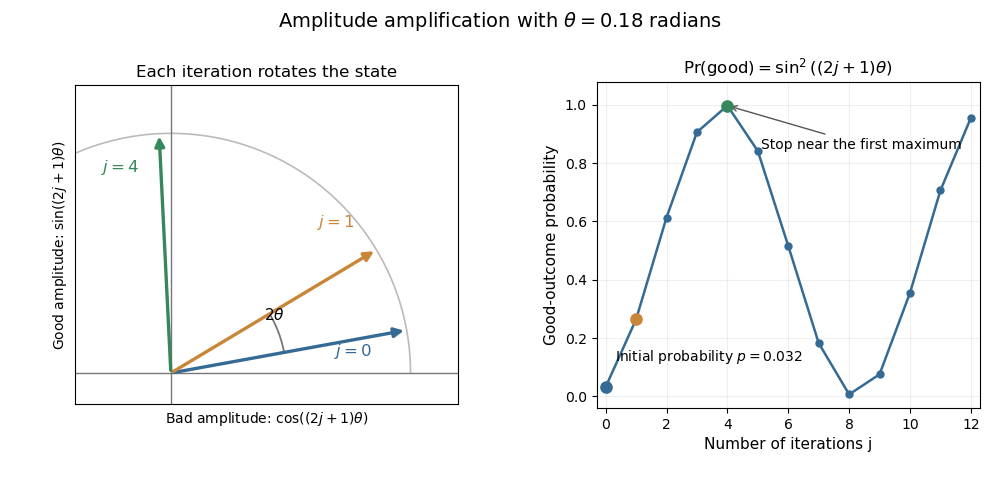
Let be the orthogonal projection onto the good linear subspace , and let be a prepared unit vector with . For , defineThe amplitude amplification theorem states that, if the reflection operators about the initial state and the good subspace can be implemented, the iterationsatisfiesTo prove it, the two reflections preserve the linear span of . In this ordered orthonormal basis, direct multiplication givesMultiplying this rotation matrix by replaces by , proving the formula by mathematical induction.
For known , choose to be a nearest nonnegative integer to . Then , so measurement finds the good subspace with probability at least , using iterations. For , measurement of the initial state already has constant success probability. If success is certain; if these reflections cannot create any good component. If , the initial-state reflection is , implemented using quantum state preparation and its inverse quantum circuit.
Past exam of the mathematics course of the University of Cambridge 2019 iii Paper 350 3 a Solution Created 2026-10-03 Updated 2026-10-05
The Cameron-Martin space of a Gaussian measure isThe inverse is defined on the range of . In this infinite-dimensional setting “positive definite” must mean for every nonzero , rather than a uniform lower bound: a trace-class operator cannot be uniformly positive on an infinite-dimensional Hilbert space.
By the spectral theorem for compact Hermitian operators, choose an orthonormal basis with , , and . (A strictly positive trace-class operator also forces the ambient Hilbert space to be separable.) In coordinates ,This is a Hilbert space with its indicated norm, even though its range need not be closed in the ambient norm.
The Cameron-Martin theorem for a Gaussian measure states that the translated law is an equivalent probability measure to exactly when . For such , its Radon-Nikodym derivative isThe series has mean-square convergence and converges almost surely under , since its independent summands have total variance . Its law is , so the density has expected value one. It is sometimes formally written , but a typical infinite-dimensional Gaussian sample is not in ; the series interpretation is essential. If , the two laws are mutually singular measures.
Past exam of the mathematics course of the University of Cambridge 2019 iii Paper 350 3 b Solution Created 2026-10-03 Updated 2026-10-05
The notation denotes generalized Gaussian white noise over , not a Gaussian measure supported on : the identity is not a trace-class operator there. For example, realize the observation on a suitable space of tempered distributions. Its Cameron-Martin space of a Gaussian measure is . For deterministic , the stochastic pairing has normal distribution under and is the isonormal Gaussian process indexed by .
Interpret the stated maps between Sobolev spaces as bounded linear operators, as usual. In particular is bounded, so its adjoint operator is bounded on . Hence maps into , which is the property needed here. The stronger smoothing follows by Sobolev duality: boundedness of gives , and therefore . As , the shift belongs to the noise Cameron-Martin space of a Gaussian measure for -almost every .
The white-noise likelihood for a square-integrable shift, obtained from the Cameron-Martin theorem for a Gaussian measure in its white-noise form, isHere is the law of . In an orthonormal basis of , with white-noise coordinates , the pairing under isFor fixed this has mean-square convergence and converges almost surely, since . The stipulated joint measurability allows the likelihood to be used under . One must not replace this expression by a finite , because white noise is not -valued. On the unbounded domain , membership of white noise in a global unweighted negative Sobolev space must not be assumed either; the stochastic pairing avoids that issue.
Let be the actual joint law. The shift formula gives with Radon-Nikodym derivative . DefineFor each fixed admissible , the moment-generating function of a normal distribution givesBy Tonelli theorem, , so for -almost every . The likelihood is finite and strictly positive for -almost every ; Fubini's theorem then gives for -almost every . The marginal observation law is and is an equivalent probability measure to .
The Bayes formula for a dominated observation model therefore definesTo verify that it is the conditional distribution, for measurable sets of unknowns and of data,Thus the posterior distribution is well defined for almost every observation under the actual data law. This is the appropriate almost-everywhere assertion supplied by Bayes theorem; the stated assumptions do not prescribe a canonical posterior at every exceptional generalized datum.
Past exam of the mathematics course of the University of Cambridge 2019 ii Paper 1 10D a Solution Created 2026-09-24 Updated 2026-09-29
Write . Expanding in the orthonormal Bell basis of systems gives the Bell-basis teleportation identityThus, uniformly for ,The states are unique because the four Bell states are an orthonormal basis of the two-qubit space. In particular,
Past exam of the mathematics course of the University of Cambridge 2020 ia Paper 1 6A Solution Created 2026-09-24 Updated 2026-09-29
If with , thenso every eigenvalue is real. If and , thenDistinct eigenvalues therefore have orthogonal eigenvectors.
The normalized eigenvectors form an orthonormal basis, so the matrix satisfies and is unitary. Withthe equations say , hence . This is the finite-dimensional unitary diagonalization of a normal matrix.
A unitary conjugate of an arbitrary diagonal matrix need not be Hermitian: and give . It is Hermitian exactly when all diagonal entries of are real.
For the displayed matrix, one valid decomposition isThe columns are orthonormal eigenvectors, so direct multiplication gives .
Past exam of the mathematics course of the University of Cambridge 2020 ii Paper 3 21I b Solution Created 2026-09-24 Updated 2026-10-03
Compactness gives a stronger statement than the one requested. Since has compact closure, finitely many open balls of radius cover it. Choose their centres from and let be their finite-dimensional linear span. ThenFor the orthogonal projection , best approximation in a Hilbert space givesIn particular this holds for every vector in the given orthonormal basis.
The operator has image in and hence has finite rank, whileThus every compact operator is an operator norm limit of finite-rank operators. This is the finite-rank approximation theorem for compact operators on a Hilbert space.
Past exam of the mathematics course of the University of Cambridge 2020 ii Paper 3 25I b Solution Created 2026-09-24 Updated 2026-09-29
Choose an orthonormal basis of and write . On a punctured disc on which the exponential map is a diffeomorphism, the mapdefines geodesic polar coordinates centred at . The curves are unit-speed geodesics, so the first coefficient of the first fundamental form isThe Gauss lemma says that radial and angular coordinate vectors are orthogonal, hence
The angular variation is a Jacobi field along each radial geodesic, with initial dataSince , smooth dependence of the geodesic flow givesConsequentlyas required.
Past exam of the mathematics course of the University of Cambridge 2022 iii Paper 115 2 b Solution 2026-09-28
Let be the dual basis of the positively oriented orthonormal basis . By the definition of the Riemannian volume form,The interior product of a differential form with the outward unit normal isThe vectors form a positive orthonormal frame of by the outward-normal-first boundary orientation. Consequently the pullback of the last display is the positive unit boundary volume form:
Past exam of the mathematics course of the University of Cambridge 2022 iii Paper 225 1 a Solution 2026-09-28
Write , so the covariance operator isFor ,so is self-adjoint. Moreover,so it is a positive operator.
Let be any orthonormal basis. Tonelli theorem and Parseval identity giveA positive operator with finite trace is a trace-class operator, completing the proof.
The zero-boundary Gaussian free field on is the isonormal Gaussian process over : for , the variables are centered jointly Gaussian and satisfyEquivalently, for an orthonormal basis of and independent standard normal variables ,as a random generalized function.
Past exam of the mathematics course of the University of Cambridge 2023 iii Paper 335 3 iii Solution 2026-09-28
For the Volterra integration operatorthe adjoint operator isSince , direct integration givesSimilarly,because . The half-integer sine and cosine families are orthonormal bases of , so is a singular system of a compact operator.
The Tikhonov solution for noisy data is thereforeWriting out the inner product and the singular functions makes this explicit:The factors suppress the unstable reciprocal growth at high index.
Past exam of the mathematics course of the University of Cambridge 2024 iii Paper 316 1 i Solution 2026-09-25
Put the star at the origin, take along the line of sight toward the observer, and let point North in the plane of the sky. The direction is then anticlockwise from North. Draw the ascending node on the sky plane at position angle , tilt the circular Kepler orbit through the orbital inclination about that nodal line, and place the planet an angle along the orbit from the ascending node. The direction of increasing must cross the sky plane toward at .
Past exam of the mathematics course of the University of Cambridge 2024 iii Paper 324 1 c i Solution Created 2026-09-25 Updated 2026-10-03
For each fixed , right multiplication by is a bijection of , whose inverse is right multiplication by . Therefore permutes the displayed orthonormal basis of the tensor-product space. It is consequently a unitary operator, with
Past exam of the mathematics course of the University of Cambridge 2024 iii Paper 324 2 b i Solution 2026-09-25
In the ordered orthonormal basisof , the Pauli Z gate acts asIt fixes the line and negates , so it is the reflection in a hyperplane orthogonal to the good state.