Solutions use the resit paper, not the separate ordinary sitting. Question 9 distinguishes fixed-time closest approach from an additional synchronization condition; question 12(d) is solved on the actual regular components of its printed interval.
Since , divide and multiply by the complex conjugate of the denominator:Multiplication by verifies the result directly.
A complex power requires a choice of complex logarithm. Taking the principal argument of to be gives , henceThus and for this principal value. If the power is interpreted as multivalued, the logarithms are and the possible values are , . Applying an identity for real powers without specifying this branch would lose the ambiguity.
Here , so the argument condition concerns . Writing , the complex number must point along the direction . ConsequentlyThis is an open ray in the Argand plane, rather than the whole straight line. Its endpoint is excluded because the argument of zero is undefined; the opposite half-line has a different argument.
To solve , subtract the first row from the second, and twice the first from the third. The resulting equations give , , and hence . Substituting in the original first equation gives . Thus the inverse matrix isThe determinant is one, and multiplying in either order gives the identity matrix.
Use the Leibniz formula for determinants:For a nonzero product in an upper triangular matrix, every selected column must satisfy . But a permutation has , so every one of these inequalities is an equality. Only the identity permutation can contribute. Its sign is positive and its product is , which proves the result even if some diagonal entries vanish.
The common ratio supplies a line parameter :The nearest point is the orthogonal projection of the origin onto the line. Minimize : its derivative is , so and the foot is . ThusThe cross product formula agrees, since .
The last equation gives , and the first then gives . Together with the middle equation this reduces the consistency question to .
If , the linear system has the unique solutionIf and , the middle equation repeats one third of , giving the affine line of solutionsIf and , the two equations contradict each other and there is no solution. These are three possible types of solution set, rather than three individual solutions for one fixed choice of parameters.
Work on an interval with and , as required by the original equation. Set , so , and obtain . Where , separation of variables gives and thereforeThe solutions lost by division by are , and they are included by . On a fixed local branch one can writeThe integer is fixed along a connected regular branch. Implicit differentiation recovers the original equation whenever . The boundary is excluded because the original tangent function has a pole there.
Eliminate using to get . The initial data give and , so the simple harmonic motion about the equilibrium isIndeed, and identically, and both initial coordinates equal one. This also describes a circle of radius two around in the phase plane.
The three vectors are coplanar precisely when their scalar triple product vanishes:This includes linearly dependent or zero vectors. It expresses that the determinant with those vectors as columns is zero.
For the two moving particles, distinguish closest approach at a common time from the geometric distance between their supporting lines. For fixed reference times, putTheir relative position is . If , the closest approach of two uniformly moving particles occurs atIf , the distance is constant. If only is permitted, replace by before evaluating the distance.
Now suppose the velocities are nonparallel, and allow the relative starting-time offset to be chosen so that the particles reach the closest points of the two lines simultaneously. Write , , , and . The independent line parameters at the closest points satisfyThese equations make the connecting vector perpendicular to both velocities. Solving the two-by-two linear system givesThe corresponding distance between skew lines is . Simultaneous arrival requires , so . Since the vector triple product givesthis condition is preciselyThus the printed formula has a valid interpretation as a synchronization condition for attaining the line-distance lower bound. It is not an identity that must hold for arbitrary fixed reference times at the time of closest approach.
For a counterexample to that stronger reading, take , , , and . The actual squared distance is , minimized at . The printed right-hand side is , whereas the fixed difference is zero. The line-distance bound is one, but it is not attained by that synchronized motion. Parallel velocities also require separate treatment because the displayed denominator then vanishes.
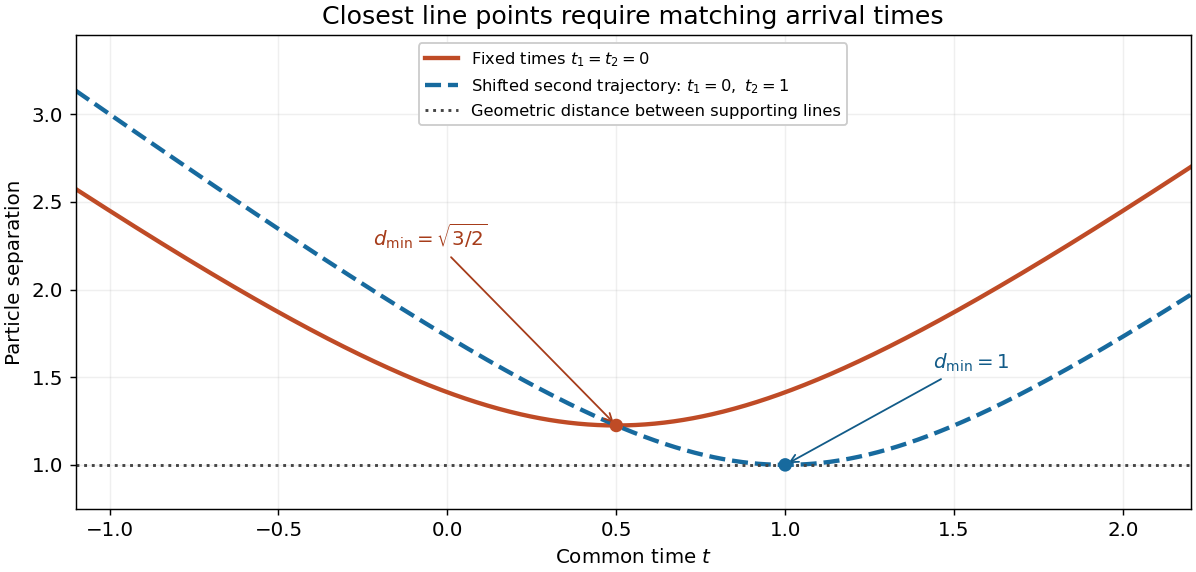
Closest line points need not be reached at the same time; shifting a trajectory's time origin changes the actual minimum distance
. Details. 
The integrating factor is , giving . A quadratic particular solution for the polynomial forcing is , while the resonant exponential forcing contributes . ConsequentlySubstitution gives , and the free multiple of is the homogeneous solution.
Integrate the equation without dividing by :This holds on a connected interval excluding . The real solutions are differentiable branches of this implicit curve. Where the radicand is positive, , with a locally fixed sign.
A zero of can belong to a classical solution only at , since the original equation then requires . For near zero, ; the smooth continuations have slopes or and switch between square-root signs across zero. Keeping the principal nonnegative square root across zero instead gives a cusp. Thus the implicit expression requires a smooth branch choice, not an unrestricted global choice of one square-root sign.
The operator is . Set ; direct differentiation gives . Hence , and two integrations giveThe two free constants multiply the independent homogeneous solutions and .
For finite-dimensional operators, use and the Hermitian assumptions. The commutator satisfies , soThus is Hermitian. These adjoint identities are the intended matrix-level setting; for unbounded operators, domains and self-adjointness require additional analysis.
The commutator is anti-Hermitian: . It is also Hermitian precisely when it is zero, so it is not Hermitian in general; it is Hermitian if and only if and commute. For example, for the Pauli matrices.
Taking the Hermitian adjoint reverses the products and leaves their sum unchanged:Thus the symmetrized product is Hermitian, whether or not and commute. This is the Hermitian anticommutator divided by two.
One has , with no requirement that itself be Hermitian. Moreover,Thus is Hermitian and positive semidefinite. The positive semidefinite property is stronger than the Hermitian conclusion alone.
Each displayed Pauli matrix has zero trace and determinant . Direct multiplication gives , henceTheir two eigenvalues are therefore and .
Besides their squares, direct multiplication yields , and . Reversing each pair changes the sign. These identities combine into the Pauli matrix multiplication identityAdding the expression with exchanged cancels the antisymmetric term, proving . Taking the trace instead uses and , proving .
Expand the two linear combinations and use the Pauli matrix multiplication identity:Interchanging the vectors reverses the cross product, so their commutator is . The three Pauli matrices are linearly independent; alternatively, trace against to recover each coefficient. ThusFor nonzero real vectors, this means they are parallel or antiparallel, equivalently linearly dependent. The algebra also extends to complex vectors using bilinear dot and cross products, with the same linear-dependence criterion; the dot product there has no complex conjugation.
Use variation of parameters, writing and imposing . Differentiation then gives . Since the solve the homogeneous equation,Thus solve the two-by-two linear systemIts determinant is the nonzero Wronskian . Cramer's rule gives and , and integration gives the stated antiderivatives. Their integration constants only add homogeneous solutions. The construction applies on a regular interval where the forcing and coefficients are defined and .
Differentiate the Wronskian and cancel the mixed first-derivative terms:This is the constant-coefficient form of Abel's identity. Hence , or . Since the exponential function is never zero, is either identically zero or nowhere zero on a connected interval of the homogeneous equation.
Linear dependence means there are constants , not both zero, with . Since is nowhere zero, , so and . Substitution gives .
The nonvanishing assumption is more than is needed for this direction. It also gives the converse directly: if , then , so the ratio is constant on a connected interval. For arbitrary differentiable functions with zeros, a vanishing Wronskian alone needs more care; here the homogeneous linear equation also supplies an appropriate uniqueness theorem.
The forcing is undefined at , both inside the printed interval. Therefore there is no classical solution on the whole stated interval. Solve separately on the three connected components obtained by removing those two points.
Choose and , whose Wronskian is two. Variation of parameters gives and , so a particular solution is . The full answer on each regular component isThe constants can differ between , and . Differentiation gives wherever the forcing is defined. Although the particular solution has finite one-sided values at the singularities, its derivative has a logarithmic divergence, and the equation itself is undefined there. It cannot be promoted to one classical solution across the poles.
Articles by others on the same topic
There are currently no matching articles.