Use the standard sl2 triple , , . In the tensor product of Lie algebra representations, each operator acts on both factors. PutThese twelve vectors form a weight basis, and . Thus the bases of the weight spaces areThere are no other weights. The weight diagram shows their multiplicities, with the decomposition also displayed for comparison.
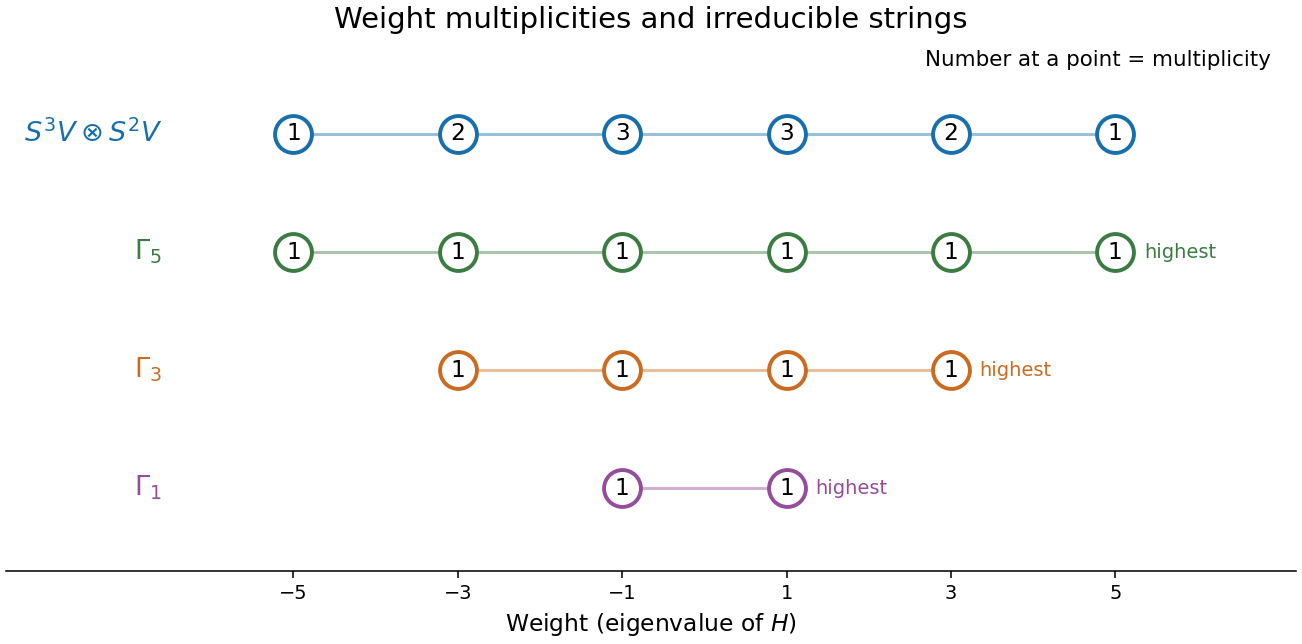
Weights and multiplicities of the cubic by quadratic sl2 tensor product and its irreducible summands
. Details. 
The raising operator acts bywith out-of-range terms omitted. At weights five, three and one its kernels are respectively spanned byAt weight one the kernel equations are and for . At weight minus one they are , , , which force zero; the maps on the two remaining negative-weight spaces are injective as well. Thus these three lines give all nonzero highest-weight vectors up to scalar, at their respective weights. A linear combination of different lines is killed by but is not a weight vector, so is not a highest-weight vector.
The lowering operator isIn particular,is an explicit basis for the submodule . Indeed , , , and the two vectors have weights . The analogous strings from have dimensions six and four. Their distinct irreducible highest weights and total dimension twelve give the sl2 tensor product of cubic and quadratic symmetric powers
Let be the dual basis of , and use . The elementary tensors have weight . Grouping them gives every weight space explicitly:The counts are , so this table exhausts the tensor product. The diagrams below use equilateral coordinates , , ; numbers at points are weight multiplicities.
To decompose the module, first split the first two factors into their symmetric and alternating parts. Put , including . The equivariant contractionis onto, since . Its kernel has dimension fifteen and contains the highest-weight vector of weight .
Here is an explicit weight basis of the trace-free symmetric-square dual tensor module, and thus the requested fifteen-vector basis:Every displayed vector contracts to zero. The first two families occupy distinct one-dimensional weights; at each weight the two vectors in the last family are independent because their respective terms are distinct. Thus all fifteen are independent and span .
For completeness, is irreducible, not just an invariant kernel of the right dimension. On elementary tensors the raising action isAt the six weights , both and kill the vector only for . At each weight , at least one of those operators is nonzero. At weight , write a vector as . The two raising equations are and , forcing zero. On the two-dimensional weight- space is injective, and on the weight- space is injective, as substitution in the same action formula shows. Therefore the common raising kernel in is the single line . By Weyl complete reducibility theorem, every irreducible summand supplies a highest-weight line, so has only one summand and is irreducible.
The symmetric-factor contraction splits off a defining copy ; explicitly is equivariant and its contraction is . For the alternating factor, the invariant volume form identifies , sending to , to and to . ThereforeThe symmetric dual module is irreducible of dimension six and highest weight ; its symmetric-monomial basis has weights and , all of multiplicity one. In the original tensor product its highest-weight vector isThe raising action above annihilates it, and its weight is .
Altogether the Triple tensor decomposition for the defining sl3 representation isThe fifteen-dimensional module has multiplicity one at each and , and multiplicity two at each . The six-dimensional module has multiplicity one at and . Each defining module has the three weights , once each. These add to the original table of multiplicities.
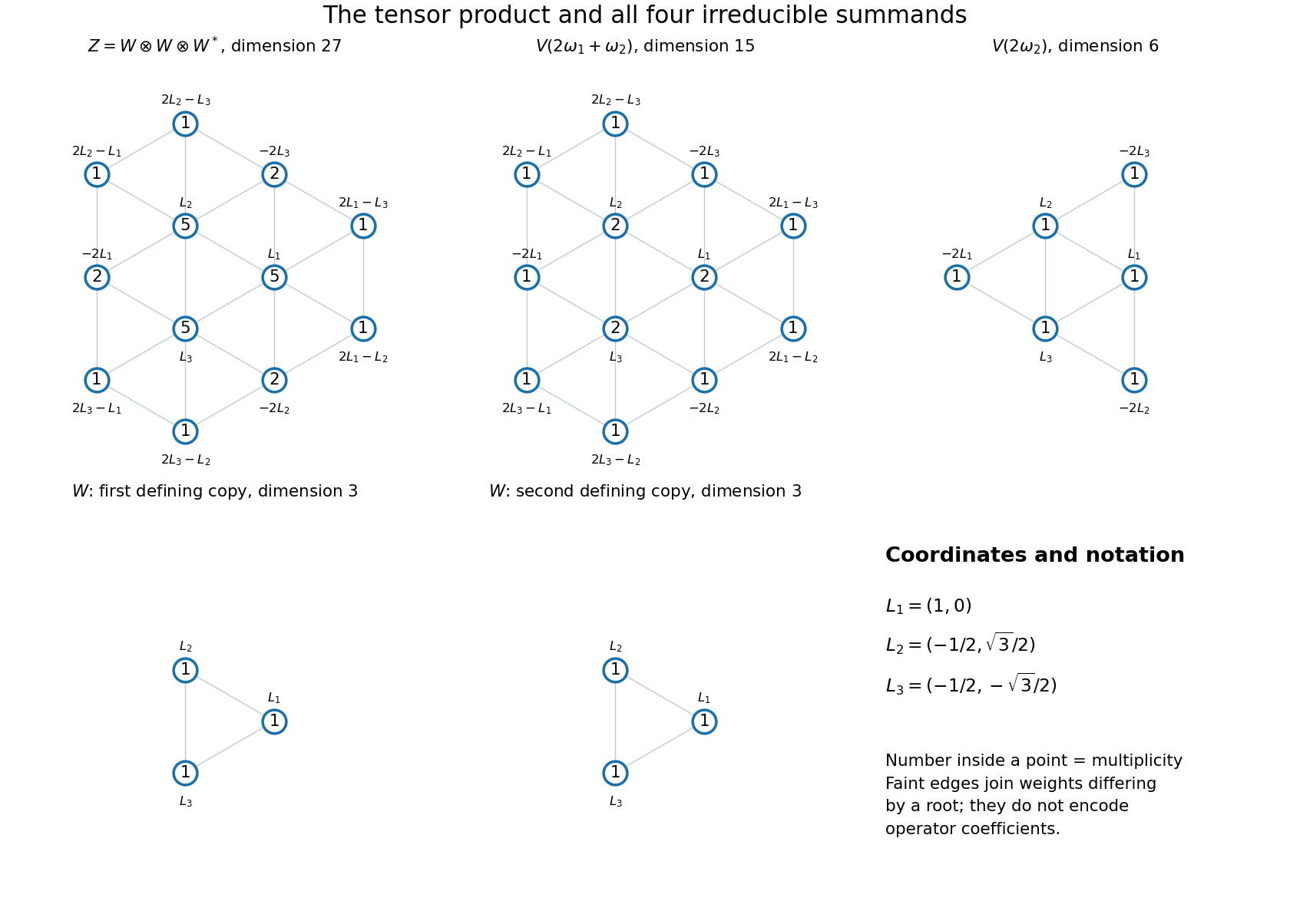
Weight diagrams of the 27-dimensional sl3 tensor product and its irreducible summands of dimensions fifteen, six, three and three
. Details. 
The two defining summands are not intrinsically distinguished: other diagonal copies inside their isotypic component have the same three-point weight diagram. Thus the displayed diagrams account for every irreducible submodule type, as well as showing both copies in this decomposition.
Work in finite dimension over ; the characteristic-zero real version follows by complexification. The Cartan solvability criterion isIts semisimplicity consequence, also often called Cartan's criterion, is is semisimple if and only if its Killing form is nondegenerate. We prove both forms.
The auxiliary results used are as follows. The Lie theorem simultaneously triangularizes every finite-dimensional representation of a complex solvable Lie algebra. The Engel theorem says that a matrix Lie algebra consisting entirely of nilpotent endomorphisms has a common annihilated nonzero vector and a basis making all its matrices strictly upper triangular; in particular it is a nilpotent Lie algebra. Nilpotent means that the lower central series terminates, which implies that the derived series terminates as well. Finally, the Additive Jordan decomposition writes any complex endomorphism uniquely as , where is diagonalizable, is nilpotent and they commute. On a generalized eigenspace , the two parts are and , and both are polynomials in . On endomorphisms, is diagonalizable, is nilpotent, and these are the Jordan parts of : the first assertion follows by splitting into maps between eigenspaces, and the second by expanding repeated commutators with the nilpotent .
First prove the linear trace version: if andthen is solvable. Fix and let be its generalized eigenspace decomposition. Define to act on by the scalar . We do not assume that , or belongs to .
On , has the form with nilpotent, whereas is multiplication by . Choose a polynomial with for every occurring eigenvalue difference , and with all its derivatives of positive order up to the relevant nilpotency index zero at . Such a polynomial exists by Hermite interpolation, or the Chinese remainder theorem for the pairwise coprime powers of . At its value is zero, so . Expanding now givesBecause and is an ideal, every positive power of sends into . The zero constant term therefore gives .
Express as a sum of commutators with . Cyclicity of trace and the hypothesis implyBut on , has trace , since the nilpotent part has trace zero. Henceforcing every eigenvalue of to vanish. Thus every member of the derived algebra is a nilpotent endomorphism. By the Engel theorem, is nilpotent and therefore solvable; its derived series terminates, and adjoining the initial term shows that is solvable.
Conversely, if is solvable, the Lie theorem makes it upper triangular. Commutators of upper-triangular matrices have zero diagonal, and multiplying such a commutator by an upper-triangular matrix still has zero diagonal. Therefore the trace condition holds. Apply this equivalence to . Its trace pairing is the Killing form, and solvability of its image is equivalent to solvability of : the kernel is its abelian centre, so a terminating derived series in the quotient terminates after at most one more step in . This proves the solvability criterion.
For the semisimplicity criterion, let be the radical of the Killing form. Invariance makes a Lie algebra ideal. For , their adjoint actions on vanish, so computing trace in a basis adapted to gives . The solvability criterion applied to shows it is a solvable ideal. Thus a semisimple Lie algebra has and a nondegenerate Killing form.
Conversely, any nonzero solvable ideal has a last nonzero term in its derived series; this is an abelian ideal of . For , , the map sends into and vanishes on , so has trace zero. Hence . A nondegenerate Killing form therefore rules out nonzero solvable ideals, exactly the definition of semisimplicity.
For classification, nondegeneracy of the Killing form provides the duality and root-space pairings used to extract a reduced crystallographic root system from a semisimple Lie algebra. Classification then reduces to the finite Dynkin diagrams and reconstruction of the Lie algebra from its root data.
For a Lie group with identity , its Lie algebra as a set is the tangent space :The ambient embedding identifies these tangent vectors with vectors in . For a matrix Lie group, the identity is and the tangent vectors are matrices.
If with , put . The determinant expansion follows directly from its permutation formula: to first order only the diagonal entries contribute. Since , differentiation gives . ThusIn fact equality holds: if , then has determinant and derivative at zero.
Take curves through the identity with tangent vectors . Form the local group commutator . In a smooth coordinate chart at the identity, its leading mixed term defines the Lie bracket:for a matrix group, where the identity's constant term has zero derivative. More generally take this derivative in the chart with the identity sent to zero. Since the first derivatives vanish on the coordinate axes, changing charts changes the mixed coefficient only by the tangent-space coordinate transformation, so the definition is intrinsic.
For the displayed nilpotent matrices choose and , which lie in . Their inverses are and . Direct multiplication givesIts mixed derivative is thereforeInterchanging the two curves giveswhose mixed derivative is . Thus directly from the curve definition. The general matrix expansion likewise gives the commutator .
A smooth vector field on a smooth manifold is a smooth section of its tangent bundle: it assigns smoothly to each point. On a Lie group, it is a left-invariant vector field whenFor , define . Smoothness of multiplication makes this a smooth vector field, and plus the chain rule proves left invariance. Every left-invariant vector field arises this way from its value at the identity.
For a matrix Lie group, , because the derivative at zero of is . The printed group name in this subpart must be read as , rather than the additive vector space : it is the matrix-group calculation consistent with the preceding subparts. At the specified matrix,A tangent vector at a nonidentity group element need not itself be trace-free; here is trace-free, as required. If one instead interpreted the printed as its additive Lie group, the field would be the constant field , a different problem.
For a finite-dimensional Lie algebra, define its Killing form byThe trace identity proves symmetry, and linearity of trace proves bilinearity. The Jacobi identity gives . Consequently, by cyclic invariance of trace,This is the invariance identity. Equivalently for all three elements.
If , and , invariance of the Killing form givesUnless , some makes its coefficient nonzero, so the two root spaces are orthogonal. Similarly for every root: choose with and use that is abelian.
Now take nonzero . Nondegeneracy on supplies some element pairing nontrivially with . Its root-space decomposition shows that only its component can contribute. Thus the pairing between opposite root spaces is nonzero, and indeed nondegenerate. ThereforeHere nonzero means the bilinear pairing is not identically zero, not that every pair of vectors has a nonzero value.
If is orthogonal to all of , it is also orthogonal to every root space, by the preceding orthogonality. It is therefore orthogonal to all of , forcing . Hence is nondegenerate.
Put and . On the root space spanned by , their adjoint eigenvalues are and ; both act as zero on the Cartan subalgebra. Thus the Killing form is the sum of their products over the six roots. The pair of roots contributes , the pair contributes , and contributes . HenceThis also agrees with the Killing form of the special linear Lie algebra, for .
The displayed identity is valid for a highest-weight vector , satisfying and , not for arbitrary . For example, in the defining module with , take : then but the proposed right side for is .
For a highest-weight vector, the sl2 triple relations give . The operator identitycomes from expanding a commutator with a product. Apply it to , using . Each term becomes , so the sum isThis proves the intended sl2 highest-weight lowering formula. The identity valid for an arbitrary vector is instead
On the basis of the irreducible module, has eigenvalue on , for . Summing gives the trace of a raising-lowering product in an irreducible sl2 module:The last equality follows by the formulas for the sums of the first integers and their squares.
For a root , choose normalized root vectors , and the coroot element withThe requested sl2 subalgebra associated with a root isThese bracket relations identify its basis with the standard sl2 triple. The notation here denotes this subalgebra, not the root reflection used for the Weyl group.
The weight diagram of the Adjoint representation of has its six roots , , each of multiplicity one, and zero of multiplicity two, from the Cartan subalgebra.
Restrict to the root subalgebra generated by , and . The explicit decomposition into irreducible modules isThe first summand has weights . The second has weights , since . The third likewise has weights , since . The last commutes with all three generators and is trivial. These subspaces are stable under the sl2 triple, are independent and have dimensions totaling eight, so they exhaust the Adjoint representation.
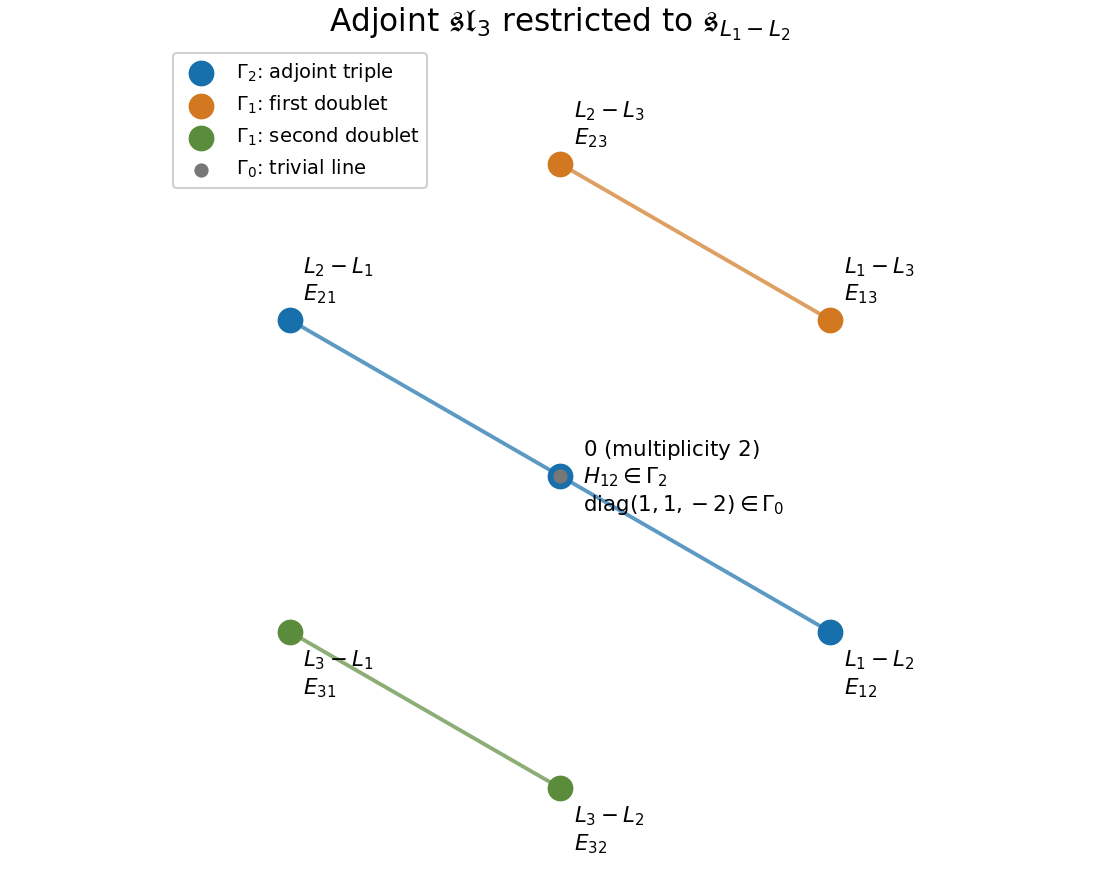
Adjoint sl3 weights coloured by their irreducible summands under the root sl2 subalgebra, with the two zero-weight vectors distinguished
. Details. 
The Killing form value is the trace of . By the formula just proved, the four summands contribute . Therefore
Identify the real span of the roots with its dual using the invariant inner product, and put . The weight lattice isThe Weyl group is generated by the root reflections . Each reflection permutes the finite set of roots and preserves their lengths, hence also permutes their coroots. Thus, for ,Every generating reflection therefore maps the weight lattice to itself, and so does every product. Since the inverse product has the same property, every Weyl-group element acts bijectively on . The roots span the ambient space, so the action on the finite root set is faithful; in particular the Weyl group is finite.
Choose simple roots . For the orbit statement one must use the Closed dominant Weyl chamberIts interior, defined using strict inequalities, is the open Weyl chamber. Weights on reflecting walls, including zero, cannot be moved into that interior, so closure is necessary here.
Choose strictly inside the chamber, for example the sum of the fundamental weights. The finite Weyl group orbit of contains an element maximizing . If for some simple root, thencontradicting the maximum. Thus every simple-root pairing of is nonnegative, and . Consequently some sends every integral weight into the closed fundamental chamber. The argument in fact works for every vector in the real weight space.
For the usual positive roots, the chamber condition is that the coefficients of be weakly decreasing, since their consecutive differences are the simple-coroot pairings. Adding the same constant to all three coefficients changes no weight, because .
The given coefficients are . Let exchange , and exchange . With the rightmost reflection acting first,ThusIts coefficients are strictly decreasing, so it lies even in the open Weyl chamber; its Dynkin labels are .
A reduced crystallographic abstract root system in a finite-dimensional real inner product space is a finite set such that: it spans and does not contain zero; the only scalar multiples of belonging to are ; every root reflectionpermutes ; and each Cartan integer is integral. These are the crystallographic and reduced conventions appropriate to roots of a complex semisimple Lie algebra. Without crystallographic integrality, the numerical restrictions in the following subparts would not hold.
If , then both Cartan integers are . This opposite-root case satisfies the printed inner-product hypothesis and must be included.
Otherwise reducedness makes the roots nonproportional. Writing the angle as , strict Cauchy-Schwarz inequality givesBoth factors are negative integers, so their product is or . The full list is thereforeThe nonproportional pairs correspond respectively to angles , and ; reversing the order of the roots reverses the unequal pairs.
There is an exception to the printed assertion: for , the inner product is negative but is not a root. This already occurs in the rank-one root system .
For the intended assertion, assume . By the preceding list, at least one of equals . If the first does, the reflection axiom givesIf the second does, use instead. Thus the precise reusable conclusion isThis proves that obtuse nonopposite roots have a root sum directly from the reflection and integrality axioms, without appealing to the classification of root systems.
Choose a linear functional which is nonzero on every root; one exists because there are only finitely many root hyperplanes to avoid. Declare a root positive when , and negative when . This orders the roots by sign, compatibly with addition whenever the sum is a root. One can refine it to a lexicographic total order by completing to a coordinate system. Since negation permutes the roots,A simple root is a positive root not expressible as the sum of two positive roots. If distinct simple roots had as a root, it would be either positive or negative. In the first case decomposes into two positive roots; in the second decomposes . Both contradict simplicity. If they are equal, their difference is zero and is also not a root. Hence the difference of two simple roots is never a root.
For use in the final subpart, the simple roots form a basis, and every positive root is a nonnegative integer combination of them. Here are the needed reasons. Repeatedly decompose a nonsimple positive root into two positive roots; their values decrease, and the finite root set makes this terminate. This gives the integer combinations. Distinct simple roots have nonpositive inner product: a positive inner product would make and obtuse, so the qualified root-sum lemma would make a root, just ruled out. Finally, a nontrivial linear relation between simple roots can be split into positive and negative coefficients, giving the same vector as positive combinations of disjoint sets. Its squared norm, computed using those two expressions, is nonpositive, whereas a nonzero positive combination has positive value. This contradiction proves linear independence. Their span is because they generate all roots.
The single bonds give equal simple-root lengths and inner products, after normalization,The positive roots of this A3 root system areThe first two sums are roots by the qualified obtuse-root lemma. The last is a root because . All have nonnegative simple-root coordinates, hence are positive.
To prove completeness, first note that every root is Weyl-conjugate to a simple root. For a nonsimple positive root , some , since . Reflection subtracts a positive integer multiple of , decreasing its integer height. The reflected root stays positive: it leaves the coefficients at all other simple roots unchanged, at least one of which is positive; a root has coordinates all of one sign. Repeating this height decrease reaches a simple root. Thus every root has squared length two in this connected single-bond system.
Write an arbitrary positive root as , with nonnegative integers . Its squared length condition isThus . For the equation gives ; for or it gives or ; for it gives . These are exactly the six coefficient triples in the displayed list. This proves completeness from the axioms, not merely from recognizing the Dynkin diagram.
Articles by others on the same topic
There are currently no matching articles.