Let be the separation of the two centres at release. The two-body problem has relative specific orbital energy . Marginal escape has , soThis follows equally by equating the relative kinetic energy to the magnitude of the Newtonian gravitational potential energy , where .
For a pointlike comet released at the planet's surface, , giving the usual . If the finite comet touches that surface, its centre is at ; the same formula uses this larger separation. The assumption by itself does not imply . Subsequent formulas written in terms of the planet-only escape velocity use the additional small-comet approximation.
This is local escape from an isolated planet. In a stellar Newtonian gravitational field, reaching the edge of the Hill sphere and escaping the stellar system are different energy thresholds.
Work in the planet's rest frame, neglecting its recoil and tidal forces during the close encounter. A hyperbolic Kepler orbit has positive specific orbital energy and specific angular momentum , where is the impact parameter. Its orbital eccentricity isAt the pericentre distance, . Substituting yieldsThe two asymptotes have true anomalies , where . Their directions of motion give the gravitational scattering angle , so . ThereforeAs a useful independent form, , displaying gravitational focusing. Here to the stated small-comet accuracy; the exact relative-coordinate formula replaces it by .
The incoming and outgoing velocity vectors have the same magnitude , by conservation of energy. The chord between them has lengthFor fixed put . Then , and proves . Equality occurs at .
A non-colliding comet must have , where in the point-comet approximation and for finite bodies. Thus the non-colliding gravitational velocity-kick bound isThe optimizing grazing orbit has , and . If contact itself is excluded, this is a supremum approached from larger . The finite collision radius is essential: an ideal point planet with unrestricted has no finite upper bound.
A constant Galilean boost by the planet's stellar orbital velocity leaves the vector difference unchanged. It changes the comet's incoming and outgoing heliocentric energies, which is the basis of a gravitational assist.
Let , with . The Safronov number is . In the instantaneous planet frame let the asymptotic vectors be and ; their magnitudes agree. In the stellar frame the corresponding specific orbital energy change during a short encounter isThe quadratic relative-speed terms cancel. A comet with semi-major axis comparable to has stellar binding energy per unit mass of order . Consequently measures whether a single strong encounter can change a substantial fraction of that binding.
Large escape-to-orbital-speed ratios favour ejection; small ratios favour collision or accretion during repeated encounters. For , a suitably oriented gravitational assist can eject the comet before it strikes the planet. For , most individual kicks are too weak; many close passages may be needed, providing repeated chances of collision.
The crossover is of order unity, not a sharp theorem about each orbit. The initial binding energy, encounter speed and geometry matter: an already nearly parabolic comet may be ejected by a low- planet, while an unfavourably directed kick can make a comet more tightly bound even when is large.
For a spherical planet of mass density , . The point-comet surface escape velocity and circular Kepler orbit speed therefore giveRaise this equation to the power and solve for :Thus the constant of proportionality is , and the gravitational constant cancels. Dimensional checking gives mass on the right: has that dimension.
This uses the planet's own escape velocity. If instead is defined at finite-comet contact, an additional factor appears on the right, and itself depends on ; the quoted pure-planet scaling is then only the limit.
Write for the comet's inverse semi-major axis. Its specific orbital energy is , so escape corresponds to . The printed quantityhas dimensions of inverse length. It cannot, literally, be a standard variance-per-time diffusion coefficient. Interpret it as the characteristic root mean square step in per periapsis passage, as in a discrete comet energy diffusion model.
If successive kicks are unbiased and uncorrelated, after passages the root mean square displacement is . Starting at gives , hence . Taking the characteristic interval to be the initial orbital period givesHere . In particular, for this is . Without specifying the initial semi-major axis and the time per statistically independent encounter, the PDF cannot determine a unique time.
With the convention , the actual diffusion coefficient would be . The estimate requires , orbit crossing, and sufficient phase decorrelation. Near escape the orbital period grows, and resonant or secular correlations invalidate the simple constant-step clock. This is a characteristic diffusion scale, not an exact mean first-passage time: even an unbiased Brownian motion on an unbounded half-line has an infinite mean time to reach its absorbing endpoint.
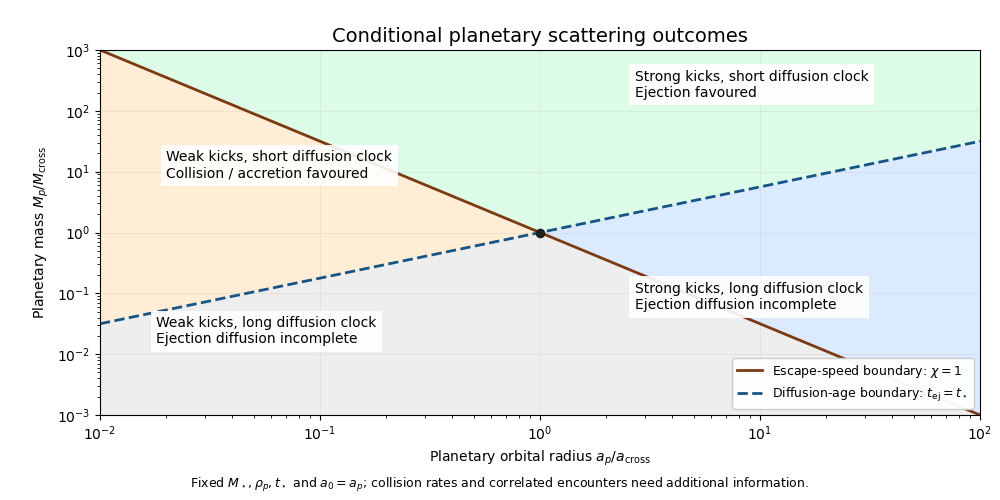
Fix and an initial-orbit ratio ; use for the figure. The qualitative finite-age planetary scattering regimes have two useful boundaries.
First, the order-unity escape-to-orbital-speed boundary isIt slopes down with logarithmic slope . Above it a planet can give large fractional binding-energy changes, favouring planetary ejection of a comet; below it weak kicks and repeated collision opportunities favour accretion.
Second, equating the characteristic comet energy diffusion time to the age givesThis boundary slopes up with logarithmic slope . Above it the many-encounter diffusion estimate fits within the available age; below it that estimate exceeds the age.
Regimes of planetary scattering and ejection
. Qualitative planetary scattering map at fixed stellar mass, planetary mass density, age and . The axes are normalized to the intersection of the and boundaries. Details.
Above both boundaries, rapid ejection is favoured. Above the age boundary but below the escape-speed boundary, repeated encounters can act during the age while individual kicks remain weak, so collision or accretion is commonly favoured. Below the age boundary, the diffusion model predicts incomplete ejection; the escape-speed boundary still distinguishes strong from weak individual kicks.
These labels are statistical expectations under the stated encounter model. In particular, the given diffusion coefficient supplies no collision rate, so it does not prove that every object in the low- region is accreted within . Nor does a long ejection time exclude faster collisions or other loss mechanisms. Very massive planets with require a few-encounter treatment rather than an extrapolation of the diffusion formula.
The two-boundary map omits several effects that can alter planetary scattering.
The initial semi-major axis, orbital eccentricity, orbital inclination and orbital phase determine whether encounters occur and their relative velocities. A strongly bound comet needs more energy to escape; a nearly parabolic one needs less. The planetary radius and mass density, the finite comet radius, and gravitational focusing determine collision probabilities. Tidal disruption, atmospheric gas drag, sublimation and physical fragmentation can destroy a body before a nominal point-particle scattering sequence is completed.
Other planets can hand a comet from one scatterer to another, eject it, or lift its periapsis clear of the original scatterer's orbit. Mean-motion resonances and secular perturbations can protect objects from encounters or correlate kicks, contradicting the independent random walk assumption. Planetary migration changes the encounter geometry over time.
Stellar flybys and a galactic tide can change distant comet periapses, allowing new encounters or detaching an object from the planetary region. Stellar mass evolution changes both binding and planetary orbits. Finally, the age and the supply rate of new comets determine whether the observed population is a residual one or continuously replenished. Thus the mass-radius map is a useful conditional classification, not a complete survival law.
Articles by others on the same topic
There are currently no matching articles.