Use Fresnel diffraction, since the detector moves along the axis through successive near-field interference extrema. Write for its distance from the opening and for the integration coordinate within the opening. For a uniform incident plane wave, the on-axis complex amplitude, in the paraxial approximation, is proportional toThus the light intensity relative to the incident value isThe Fresnel number is an odd integer at a maximum and an even integer at a minimum. It decreases as the detector moves away. Adjacent extrema therefore differ by one:ConsequentlyAs a check, at and at , so these are indeed a maximum followed by the next minimum. Also , consistent with the paraxial approximation.
The components are in phase quadrature when the axes of the ellipse coincide with the coordinate axes. Since the wave amplitude is one and the wave amplitude is two, the Jones vector must have .
A handedness convention is essential. Adopt the optical convention in which right-handed elliptical polarization rotates clockwise when viewed toward the source, from the positive- side. With the paper's phase convention for complex amplitudes, this givesThe tip follows . In particular,
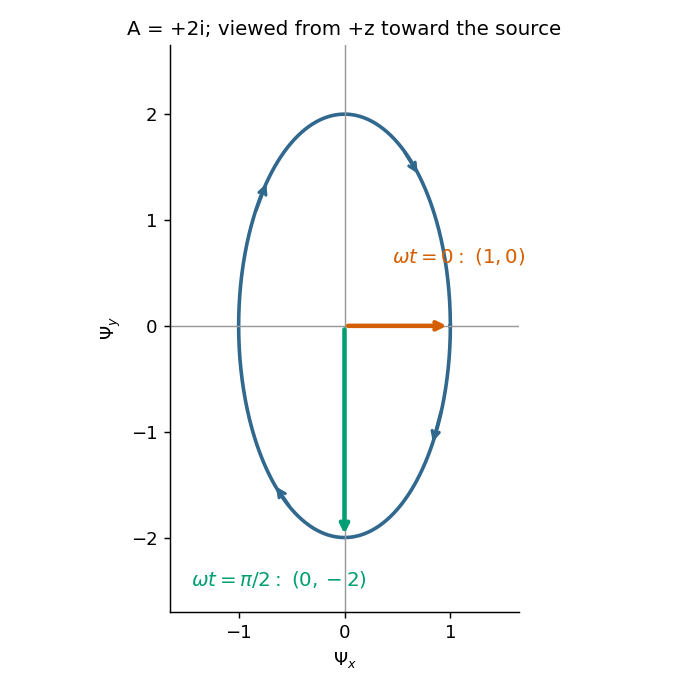
The figure states the viewing direction and shows increasing time. Under the alternative convention that calls rotation from toward right-handed when looking along propagation, the equally consistent answer is and the second vector is . The original paper does not state a handedness convention, so its wording alone cannot select between these labels; the real components and viewing direction remove the ambiguity.
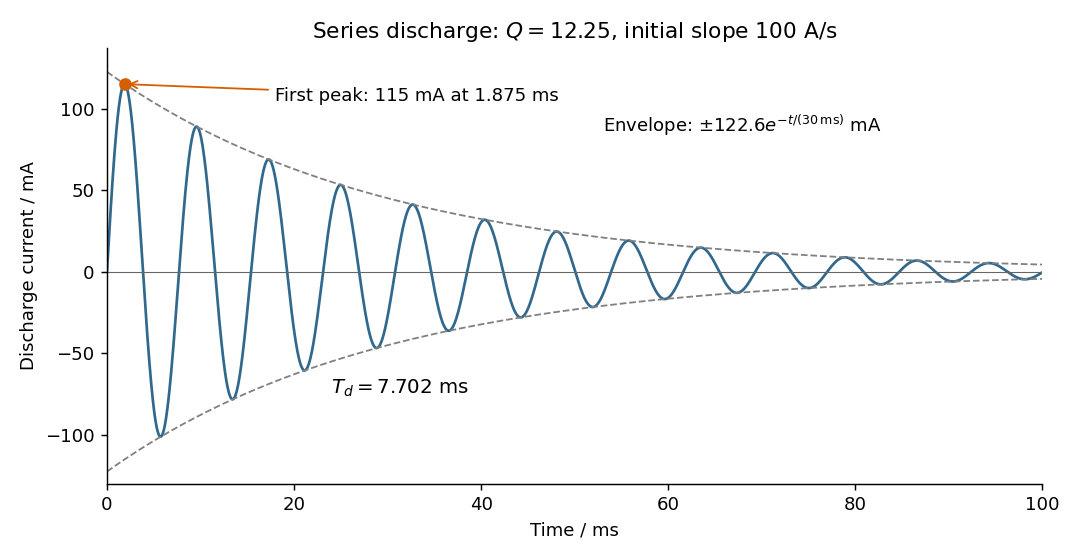
Choose positive electric current in the initial discharge direction, since the source diagram does not label the initial plate polarity or a current arrow. Let be the charge remaining on the initially positive plate, so . Kirchhoff's voltage law for the series RLC circuit givesThe natural angular frequency, damping coefficient and quality factor areSince (equivalently ), this is an underdamped RLC response. With , satisfying the initial conditions givesand differentiating givesThe electric current starts at zero with . Its wave period is , its zeros occur every , and its positive and negative wave envelopes decay with time constant . The first maximum obeys and is at . The electric current tends to zero as the initial capacitor energy is dissipated in the resistor.


Take a p-n junction made from one semiconductor, with the p-type semiconductor on the left and the n-type semiconductor on the right. At thermal equilibrium the chemical potential is horizontal throughout. Before contact the chemical potential lies nearer the valence band on the p side and nearer the conduction band on the n side; after contact the band edges bend to permit one common value.
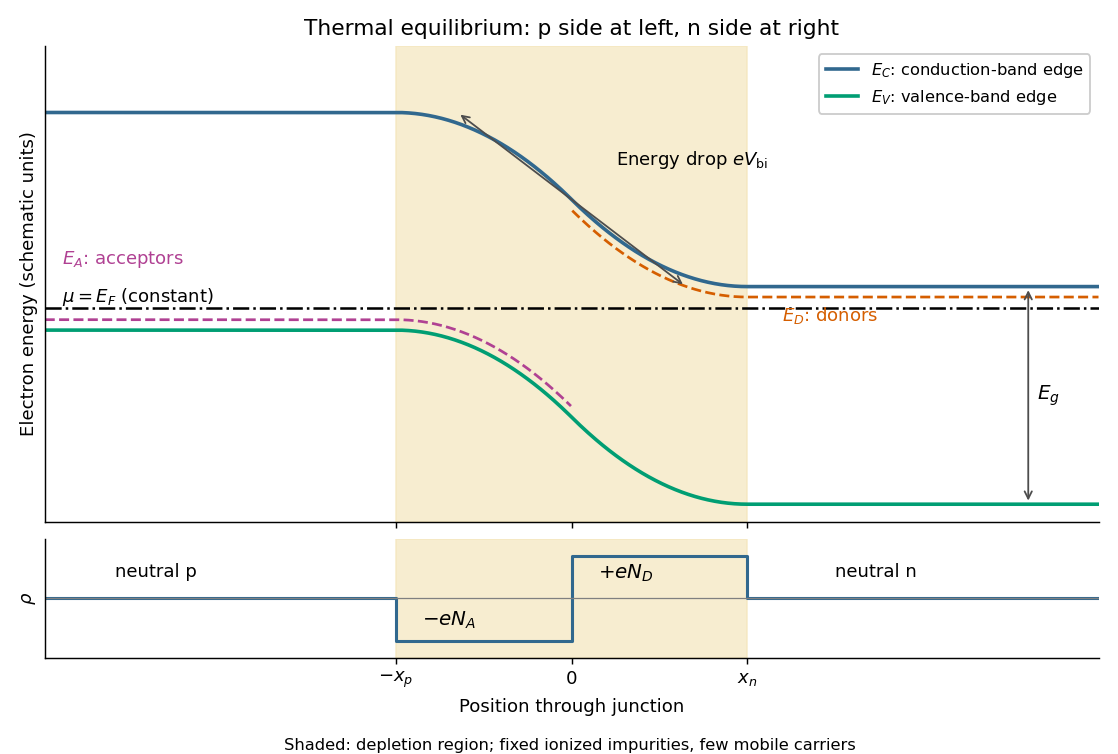
Original equilibrium p-n junction energy band diagram, impurity levels, common chemical potential and depletion region
. Details. 
In this orientation both the conduction band edge and the valence band edge decrease from p to n by . For a homojunction their separation is constant. The acceptor impurity level lies just above where acceptors are present, and the donor impurity level lies just below where donors are present. These impurity levels follow the local band bending; they do not form one additional horizontal band across the device.
The shaded depletion region has few mobile Electrons or electron holes and contains fixed negative ionized acceptor impurities on the p side and positive ionized donor impurities on the n side. Thus its electric field points from n to p. Its neutral outer regions have negligible electric field, so the band edges become flat there. In the depletion approximation, charge neutrality requires ; the symmetric drawing illustrates rather than assuming that equality is universal. Diffusion and field-driven drift current cancel at equilibrium: no applied voltage does not mean zero internal electric field or zero built-in electric potential difference.
In an ordinary three-dimensional crystalline electrical insulator, heat is carried mainly by phonons. Kinetic theory gives the estimatewhere is heat capacity per unit volume, is a typical sound speed, and is the phonon mean free path. The thermal conductivity has units .
At low temperature, , the Debye model gives . With phonon-phonon collisions frozen out, diffuse scattering at the sample boundaries makes approximately constant, and is nearly constant. HenceAt high temperature, of order or above the Debye temperature, the Dulong-Petit law makes approximately constant. Anharmonic phonon scattering, especially resistive Umklapp scattering, has a collision rate approximately proportional to . Thus andThese two regimes usually give an intermediate maximum of thermal conductivity. The assumptions matter: glassy materials, strong defects or specular boundary reflection can change the low-temperature law; these are not universal laws for every electrical insulator.
Articles by others on the same topic
There are currently no matching articles.