At coexistence, the two phases have equal chemical potential. For a single component, , with entropy and volume measured on the same molar or mass basis. Equating the phase derivatives along coexistence gives . Reversible latent heat satisfies , henceHere and are coexistence pressure and absolute temperature, is latent heat for transforming phase 1 to phase 2, and uses the same amount of material as .
For vaporization, neglect liquid molar volume compared with ideal-vapour volume . The ideal-vapour Clausius-Clapeyron approximation becomesUsing the normal boiling reference , and the supplied constant givesThis deliberately constant-latent-heat extrapolation does not reproduce the supplied triple-point pressure exactly. It predicts the liquid-vapour branch, metastable against ice below the triple-point temperature; it is not a precision sublimation-pressure prediction.
The phase diagram has solid, liquid and vapour regions meeting at the triple point. The sublimation and vaporization boundaries have positive slopes, whereas the ordinary ice–water boundary slopes negatively because ice has larger specific volume. The liquid–vapour line terminates at a critical point; the original schematic below emphasizes topology and marks the supplied triple point.
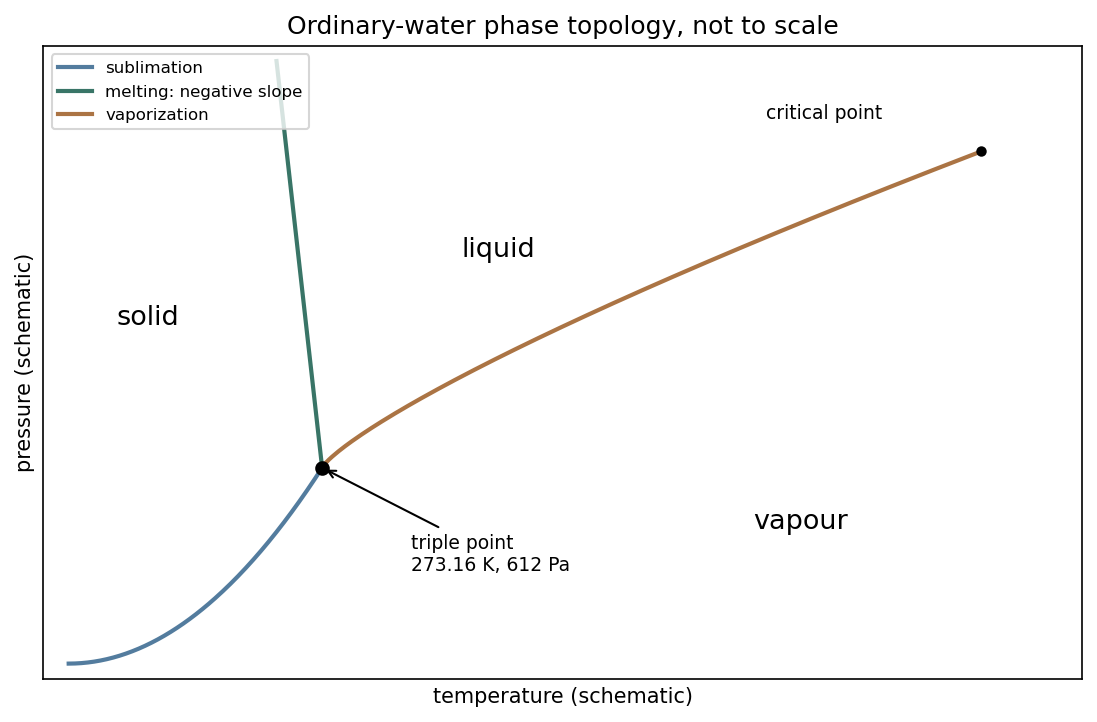
Schematic pressure–temperature phase topology of ordinary water, with negative melting slope and the supplied triple point
. Details. 
For the melting-pressure estimate, Archimedes' principle gives , soConvert the molar evaporation heat using water molar mass , rounded from the tabulated value .[ref] An enthalpy cycle through vapour then givesThis uses the question's temperature-independent evaporation heat all the way to the triple point; no replacement experimental fusion heat is inserted. The melting pressure inferred from flotation and latent heats, on holding and constant, isusing and . Linearizing the logarithm about the triple point gives instead of . Both are estimates within the stated constant-property approximation; the negative melting slope makes a positive pressure necessary to lower the melting temperature.
Articles by others on the same topic
There are currently no matching articles.