An alternate public copy is Physical pages 300–305 of the alternate source PDF.
For the one-mole convention, is the excluded molar volume: finite molecular size reduces the volume available for translational motion from to . It is an effective excluded volume, not simply the sum of the bare molecular volumes. corrects for attractive intermolecular forces, which reduce the pressure exerted on the wall. The attraction per molecule scales with number density, and the number of affected molecules also scales with density, producing the density-squared correction. The Van der Waals equation consequently raises the measured pressure to the corresponding repulsive-gas value before multiplying by the available volume. Both corrections vanish relative to the ideal-gas terms at sufficiently low density.
For inner radius and outer conductor's inner radius , Gauss's law gives . Integrating across the dielectric gives voltage . Thus the capacitance per unit length isThe stated outer radius is interpreted as the radius of the dielectric-facing surface. Magnetic permeability affects inductance, but does not enter this electrostatic capacitance.
Kepler's third law for negligible planet mass gives . Therefore . The furthest point is apoapsis, soThe supplied orbital period and eccentricity are sufficient; no present-day ephemeris is needed.
Neglect ends and take the exterior as vacuum. With polar angle measured from the applied field, regularity inside and the far-field condition allowContinuity of potential gives ; continuity of normal electric displacement, with no free surface charge, gives . Hence the transverse electrostatic field inside a dielectric cylinder is uniform, parallel to the applied field, with magnitudeThis cylindrical result differs from the spherical depolarization factor. It returns for and tends to zero for large positive .
Let be circumferential tension. A small arc subtending has inward resultant and mass . Its centripetal acceleration gives . Circumferential stress is and the strain is . Thus the centrifugal strain of a thin elastic hoop isUse the unstrained radius and cross-section at this order. The approximation requires , a slender hoop and linear elastic response; the area cancels.
A transmission line stores electric and magnetic energy along its length, so voltage and current depend on both position and time. A distributed circuit uses inductance and capacitance per length, together with resistance and leakage conductance . Applying voltage and charge balance to a short segment gives the telegrapher's equations,For a lossless line, both variables obey wave equations with speed and characteristic impedance . Forward and backward waves obey and . Matching a termination gives the voltage reflection coefficientA matched load absorbs without reflection; an open circuit has , and a short has . Reflections can produce standing waves. A coaxial line confines the fields between conductors and, for a uniform dielectric TEM wave, has . Finite loss attenuates waves; frequency-dependent losses or material properties can also distort pulses. A long line is a wave-carrying distributed system, so it cannot generally be replaced by one lumped capacitor.
Polarization density is electric dipole moment per unit volume. Displacing positive and negative bound charges leaves the bulk nearly neutral locally but can produce uncompensated charge where polarization varies or terminates. For a dielectric occupying a volume with outward unit normal ,The divergence theorem makes their total sum zero for a body described entirely by bound dipoles. Uniform polarization gives no interior volume charge but generally gives opposite surface charges on different faces.
In a linear isotropic dielectric, and . Gauss's law becomes , separating free from bound charge. Across a static interface, tangential electric field is continuous, while the normal displacement jumps by the free surface charge. Polarization charges alter the internal field, as in the dielectric cylinder calculation. Molecular distortion and orientation contribute differently, and response can depend on temperature and frequency. Bound charge is a redistribution of material charge, not an additional free-charge reservoir.
Paramagnetism has positive susceptibility: permanent spin or orbital moments tend to align with a field against thermal disorder. Independent localized moments in the classical weak-field regime give , the Curie law. Conduction-electron Pauli paramagnetism has a different origin and need not follow that temperature law.
Diamagnetism is the induced magnetic response opposing the applied field, giving negative susceptibility. Changes in orbital motion underlie this response; it exists even without permanent moments. It is often relatively weak and only weakly temperature dependent, although particular quantum systems have stronger or more complicated behaviour.
Ferromagnetism arises from interactions favouring parallel magnetic order. Below the Curie temperature a domain can have spontaneous magnetization even at zero applied field. A sample can nevertheless have nearly zero net moment if differently oriented domains cancel. Domain rearrangement and rotation produce a nonlinear magnetization curve, saturation, remanence and coercivity; hysteresis dissipates energy in a field cycle. Above the ordering temperature the spontaneous order disappears, and a Curie-Weiss susceptibility is a useful mean-field approximation. The signs of weak-field susceptibility distinguish para- and diamagnetism; spontaneous order and domain dynamics distinguish ferromagnetism from independent-moment alignment.
Use a cold, unmagnetized, collisionless electron plasma with immobile ions. For an oscillating field proportional to , the electron displacement follows . Hence andThe induced polarization opposes the field because electron inertia changes the phase of its displacement. Maxwell's equations give transverse electromagnetic dispersionThus transverse waves propagate above the plasma frequency, while below it the wavenumber is imaginary and a semi-infinite lossless plasma reflects an incident wave with an evanescent interior field. In the cold electrostatic model, a longitudinal density oscillation instead has frequency .
Collisions at rate give for this time convention, introducing absorption. A background magnetic field makes the response anisotropic, and thermal motion supplies additional dispersion and static screening. The divergent zero-frequency cold collisionless formula should not be mistaken for a complete description of static Debye screening. The simple dielectric function is a dynamical electron-inertia response under stated assumptions.
In microscopic SI form, Maxwell's equations couple charge density and current density to electric and magnetic fields:Gauss's electric law expresses electric flux from charge and reduces to the inverse-square Coulomb field for a point charge. Gauss's magnetic law gives zero net magnetic flux through every closed surface; magnetic field lines do not begin or end on magnetic monopoles in this theory.
Faraday's induction law says changing magnetic flux produces a circulating electric field. For a fixed loop, its circulation is minus the rate of change of enclosed magnetic flux, explaining the sign of induction and Lenz's law. For example, changing a primary coil's electric current changes the flux through a stationary secondary coil and induces a voltage. A moving wire also has the magnetic part of the Lorentz force on its charges; the fixed-loop field equation and the full motional-emf calculation must be distinguished.
The Ampère-Maxwell law relates magnetic circulation to conduction current and displacement current. The latter is essential around a charging capacitor: a surface cutting the lead and another passing through the gap must predict the same circulation. Taking the divergence givesusing Gauss's electric law. Charge conservation therefore fixes the consistency of the time-dependent equations. In matter, the equivalent macroscopic equations use and , free sources and constitutive relations. The Lorentz force density describes exchange of momentum with charges.
In source-free vacuum, take the curl of Faraday's law and use . Both fields satisfyFor a plane wave, , and . The fields are transverse, mutually perpendicular and in phase. Their energy density and energy flux areThis is Poynting's theorem: field energy is transported and can do work on matter. Electromagnetic radiation is a propagating, energy-carrying solution of the coupled electric and magnetic field equations.
Let a frame's origin have inertial acceleration and its axes rotate with angular velocity . For position and velocity measured in that frame, Newton's law becomesThe extra terms are translational, Coriolis, Euler and centrifugal inertial forces. Centrifugal force points away from the rotation axis; Coriolis force deflects moving bodies sideways and does no instantaneous work on their relative motion, since it is perpendicular to . The Euler term appears when the rotation rate or axis changes.
For constant , centrifugal force has potential . It can be combined with a conservative real potential to find rotating-frame equilibria. The Coriolis term remains velocity dependent. These forces arise from describing acceleration in a noninertial frame; they are not additional interactions between bodies. They are essential for trajectories on rotating apparatus and for large-scale terrestrial motions. Frame-dependent terms must be included consistently with the chosen coordinates.
A small displacement in a homogeneous isotropic elastic solid obeys linear elasticity. With Lamé constants and mass density , momentum balance givesA longitudinal plane wave has displacement parallel to its propagation direction and changes local volume. A transverse wave has perpendicular displacement and produces shear. Substitution givesAn ideal fluid has no static shear modulus and cannot support this bulk transverse elastic wave. A thin rod with free lateral surfaces instead supports an extensional long-wavelength mode with speed ; its transverse contraction changes the effective stiffness, so it should not be identified with the unbounded-solid longitudinal mode.
Stress and displacement boundary conditions produce reflection, transmission, mode conversion and guided waves. Viscoelasticity and scattering can attenuate waves; finite geometry can make guided modes dispersive even when the bulk elastic constants are frequency independent. Wave speed depends on both material stiffness and the allowed deformation.
Choose body-fixed principal axes through a fixed point or the centre of mass, with principal moments . Angular momentum has components . The inertial derivative is the body derivative plus , so Euler's equations readThey avoid differentiating the rotating inertia tensor in laboratory coordinates. Torques must refer to the chosen point, and the displayed fixed moments require a rigid body.
For zero torque, laboratory angular momentum is constant, while its components can change in the body frame. Both and rotational kinetic energy are conserved. The intersections of their constant-value surfaces constrain the motion. For distinct , steady rotation about either extreme principal axis is stable against small perturbations, whereas rotation about the intermediate axis is unstable. For example perturbing rotation about axis 2 giveswhose coefficient is positive. A symmetric body has additional simplifications and can precess. Conservation of laboratory angular momentum does not imply constant body-frame angular velocity.
For conservative forces and ideal constraints that do no work, mechanical energy is constant. Work-energy balance remains useful with nonconservative forces: their power gives . In one dimension,locates accessible regions and turning points, and reduces the trajectory to a quadrature . A local minimum of potential is a stable equilibrium; a local maximum is unstable. Near a nondegenerate minimum, gives .
For a central force, conserved angular momentum reduces radial motion to an effective potential . Its extrema determine circular orbits and their radial stability. In several coordinates, small oscillations follow from the kinetic-energy mass matrix and potential Hessian through .
Energy is also central to the Lagrangian and the Euler-Lagrange equations. A time-independent natural mechanical system has conserved energy; cyclic coordinates yield additional momenta. Energy alone does not normally determine every coordinate of a multi-degree-of-freedom motion. Its value is to expose allowed motion, stability and reductions before solving the full differential equations.
A velocity field assigns a velocity to each point. Following a fluid parcel rather than holding position fixed gives the material or convective derivativeThe convective term can accelerate fluid even in a steady flow, for example as a stream narrows. Conservation of mass is ; constant-density incompressible flow has .
For an incompressible Newtonian fluid of constant density and viscosity, with conservative body-force potential per mass , momentum balance isNeglect viscosity and assume steady flow. Dotting with an element along a streamline, or using , givesThis is Bernoulli's equation: pressure work, kinetic energy and gravitational potential energy interconvert. In a connected irrotational region under the same assumptions, is the same for all streamlines. In a rotational flow it can vary between them. Viscous dissipation, pumps or unsteady motion require the corresponding modified balance; the steady inviscid expression cannot be applied indiscriminately.
Vorticity measures local fluid rotation. For constant-density incompressible flow it evolves byshowing vortex stretching and viscous diffusion. A potential flow has locally, so irrotational incompressible motion satisfies . Boundary conditions then determine flows around simple shapes. A multiply connected region can have circulation even when its local vorticity vanishes; ideal potential flow also misses no-slip boundary layers and viscous drag.
For a Newtonian fluid, shear stress is proportional to strain rate. No-slip at solid walls produces velocity gradients and dissipation. Fully developed laminar pipe flow, for example, hasThe Reynolds number compares inertial and viscous terms. Small values favour creeping-flow approximations; large values can permit thin boundary layers and turbulence, without guaranteeing turbulence in every geometry. The appropriate flow model follows from conservation laws, constitutive properties, boundaries and scale comparisons.
At coexistence, the two phases have equal chemical potential. For a single component, , with entropy and volume measured on the same molar or mass basis. Equating the phase derivatives along coexistence gives . Reversible latent heat satisfies , henceHere and are coexistence pressure and absolute temperature, is latent heat for transforming phase 1 to phase 2, and uses the same amount of material as .
For vaporization, neglect liquid molar volume compared with ideal-vapour volume . The ideal-vapour Clausius-Clapeyron approximation becomesUsing the normal boiling reference , and the supplied constant givesThis deliberately constant-latent-heat extrapolation does not reproduce the supplied triple-point pressure exactly. It predicts the liquid-vapour branch, metastable against ice below the triple-point temperature; it is not a precision sublimation-pressure prediction.
The phase diagram has solid, liquid and vapour regions meeting at the triple point. The sublimation and vaporization boundaries have positive slopes, whereas the ordinary ice–water boundary slopes negatively because ice has larger specific volume. The liquid–vapour line terminates at a critical point; the original schematic below emphasizes topology and marks the supplied triple point.
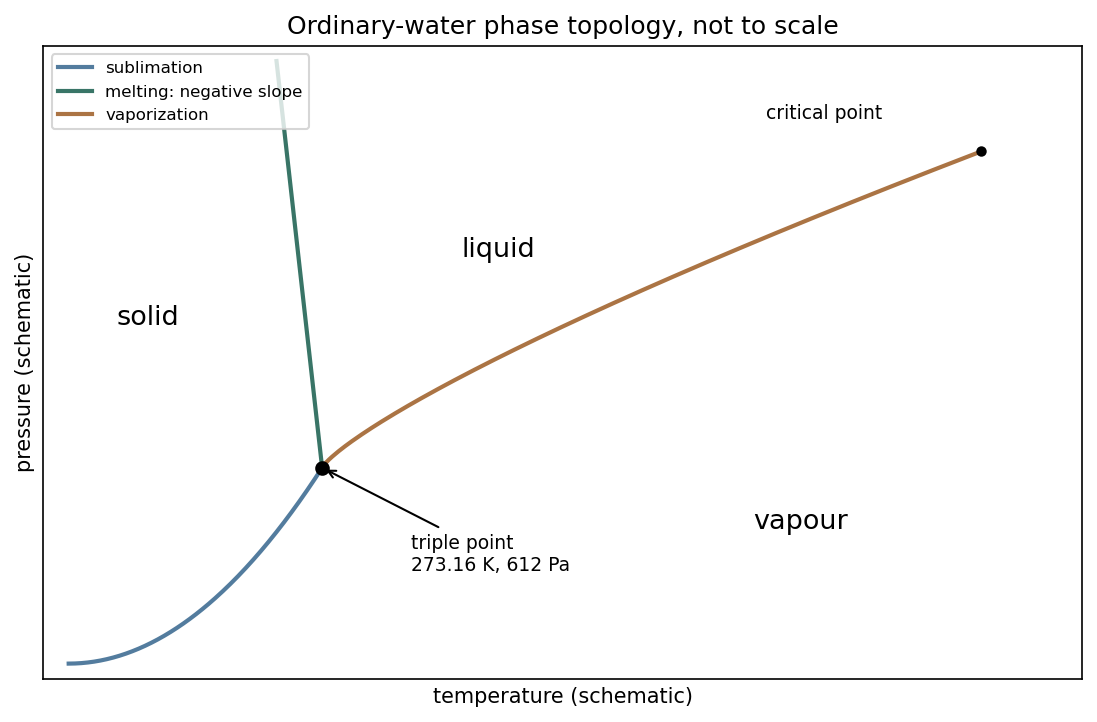
Schematic pressure–temperature phase topology of ordinary water, with negative melting slope and the supplied triple point
. Details. 
For the melting-pressure estimate, Archimedes' principle gives , soConvert the molar evaporation heat using water molar mass , rounded from the tabulated value .[ref] An enthalpy cycle through vapour then givesThis uses the question's temperature-independent evaporation heat all the way to the triple point; no replacement experimental fusion heat is inserted. The melting pressure inferred from flotation and latent heats, on holding and constant, isusing and . Linearizing the logarithm about the triple point gives instead of . Both are estimates within the stated constant-property approximation; the negative melting slope makes a positive pressure necessary to lower the melting temperature.
Capacity convention. The printed equation requires to be volumetric heat capacity, in . If “specific heat capacity” means per unit mass instead, the storage term is and both denominators in the printed equation must contain . This distinction is fixed by dimensions.
For a fixed material region , conservation of thermal energy gives the heat balance with volumetric heat generation,Use the divergence theorem, and constant coefficients. Since the region is arbitrary,The heat source is power per volume, while is thermal conductivity rather than thermal diffusivity.
For uniform electrical conductivity and imposed current, current density is and Joule heating is . A long, steady, cylindrically symmetric wire therefore satisfiesIntegration gives . Regularity at makes , and the surface condition fixes the remaining constant. Thus the Joule-heated cylindrical wire hasHere denotes the printed radial coordinate and avoids confusing it with mass density. The centre is hotter by .
For the air boundary, the internal flux at is . Equate this to . The Newton cooling of a Joule-heated wire givesMultiplication by circumference verifies that surface loss per length equals , the electrical power per length. The full air-cooled profile uses this surface temperature plus the same parabolic interior excess, assuming constant material properties and negligible end losses.
A heat engine's thermal efficiency is net work out divided by heat absorbed,where both heat quantities are positive magnitudes. The last equality follows from the first law over a complete cycle.
Use moles of an ideal gas with constant molar and . For the Otto cycle, reversible adiabats give and . Isochoric heat input and rejection are and . ThereforeThe denominator's temperature difference is times the numerator's difference.
For the ideal Atkinson cycle, heating at fixed volume gives . The longer expansion ends when . Combining the adiabatic pressure–temperature relation with yieldsAlso for . The PDF asks explicitly for ; the transcription additionally names , which is supplied above too.
Heat input remains , while the isobaric return rejects . Hence the Atkinson efficiency advantage from extended expansion is quantified byCompare cycles with the same initial state, compression ratio and heat input. The extra expansion and constant-pressure return enclose positive extra work,It uses heat that the Otto cycle would reject, while is unchanged. Equivalently, concavity gives , so for under this matched comparison. This is an ideal-cycle result; the question's named real-engine application is not needed to establish it.
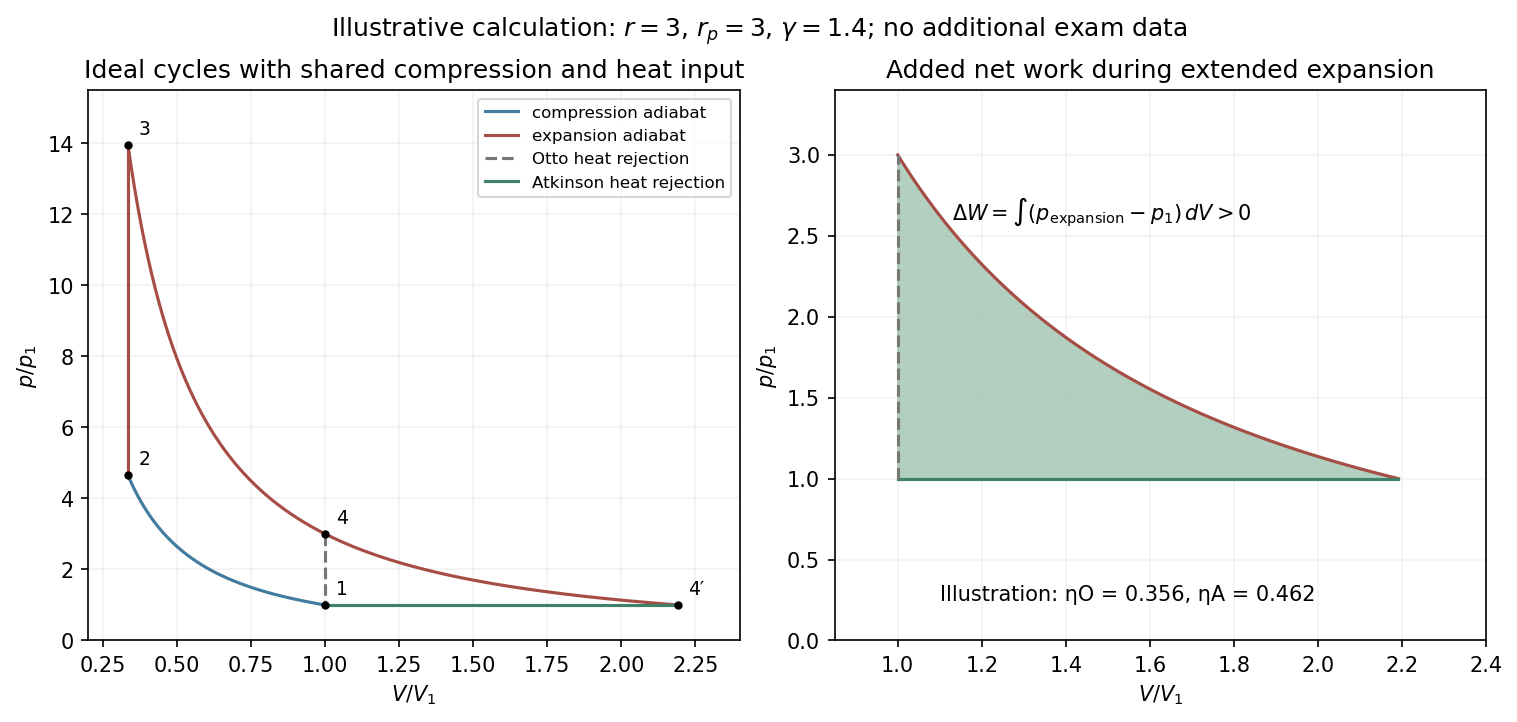
Original ideal-gas cycle calculation showing the extra expansion work and the matched Otto–Atkinson efficiency comparison
. Details. 
For a simple compressible one-component equilibrium system, the fundamental thermodynamic relation isThe internal energy has natural variables : its derivatives give , and chemical potential . The natural variables of a thermodynamic potential identify the independent arguments whose conjugates appear directly in a potential's differential. A Legendre transform exchanges a variable for its conjugate, giving potentials suited to different controlled conditions:
| potential | definition | natural variables | differential |
|---|---|---|---|
| internal energy | |||
| enthalpy | |||
| Helmholtz free energy | |||
| Gibbs free energy |
For fixed composition and the appropriate closed-system constraints, equilibrium minimizes at fixed , at fixed , at fixed , or at fixed , with other allowable internal variations understood. Enthalpy is useful for constant-pressure heat exchange with only pressure–volume work. Helmholtz free energy is suited to fixed-temperature, fixed-volume systems, and Gibbs free energy to fixed-temperature, fixed-pressure phase or chemical equilibrium. Coexisting phases of one substance have equal chemical potentials.
Where a potential is twice continuously differentiable, equality of mixed derivatives gives Maxwell relations. At fixed , the four usual forms areThe fixed subscripts and signs follow from the chosen natural variables. Derivatives through a nonsmooth phase boundary require separate phase descriptions rather than automatic use of the smooth single-phase formulas.
As an application, the Helmholtz relation turns pressure data into an isothermal entropy change. For an ideal gas, , givingCombining the same relation with yields , which vanishes for an ideal gas and reveals attractive-energy effects for a van der Waals gas. Thermodynamic potentials organize equilibrium constraints, while Maxwell relations convert difficult entropy derivatives into measurable response derivatives.
Articles by others on the same topic
There are currently no matching articles.