Original public paper: Physical PDF pages 687–688. All five optional notes and both longer questions are covered. The density plot uses the prescribed fixed-coupling model, with its low-density limitations stated.
A neutral superfluid can select a phase of its complex order parameter, breaking a global symmetry. A spatially uniform change of that phase costs no energy. Slowly varying changes therefore produce a gapless Goldstone mode. For a dilute weakly repulsive Bose gas, the Bogoliubov quasiparticle dispersion isso at long wavelengths, with . Density and phase fluctuations are canonically coupled components of this sound branch, rather than two independent positive-frequency modes. Superfluid helium and dilute atomic condensates supply neutral examples, although the dilute-gas formula is not quantitatively valid for strongly interacting liquid helium.
In a superconductor, the pair field is charged and its phase couples to the electromagnetic gauge field. Only combinations such as are physically meaningful. The Anderson-Higgs mechanism in a superconductor produces electromagnetic screening and removes the neutral sound mode as an independent gapless charged-density oscillation. In a homogeneous three-dimensional continuum, long-range Coulomb forces give a longitudinal plasma gap, approximately at small . The static transverse response gives the Meissner effect andwhen counts superconducting electrons of effective mass . Counting pairs instead uses density , charge and mass , giving the same stiffness. The condensate amplitude may also have a gapped Higgs mode, but that amplitude oscillation is distinct from the electromagnetic Higgs mechanism. Local gauge transformations remain a redundancy; this is not spontaneous breaking of an observable local symmetry in the same sense as the neutral global phase symmetry.
A bosonic coherent state is an annihilation-operator eigenstate,It has , a selected complex amplitude, and Poisson-distributed particle number. A coherent-field condensate variational state extends this construction to a spatial field with . Evaluating a normal-ordered interacting Bose Hamiltonian in that state gives a classical-field energy functional; its variational equation is the Gross–Pitaevskii equation. This connects a macroscopic phase to interference, quantized circulation and neutral Josephson effects. A fixed-number condensate instead has vanishing one-point field expectation; off-diagonal long-range order identifies the condensate without requiring exact number fluctuations.
The BCS ground state has the pair-coherent formIt is a product of Cooper-pair pseudospin coherent states: each paired momentum sector mixes its empty and doubly occupied configurations. The anomalous pair expectation is , while an ordinary single-electron expectation vanishes by fermion parity. Pair operators are not unrestricted canonical boson operators, so this state must not be identified with a naive oscillator coherent state of individual electrons. Number projection gives a fixed-even-number description with pair correlations. Phase differences between condensates enter the Josephson effect; in a charged condensate that phase difference must be gauge invariant.
For a one-component superfluid with nonzero order-parameter magnitude on a closed loop, the phase defines a map from the loop into the circle. Its winding number isThe fundamental group means that smooth deformations preserving nonzero amplitude cannot change this integer. With superfluid velocity , it gives quantized circulation . A vortex core permits the order parameter to vanish and carries the winding; a superfluid phase slip changes a loop's winding when a core crosses it. For paired neutral fermions, the relevant condensed-object mass is the pair mass.
For charged pairs, gauge-covariant phase rigidity gives fluxoid and flux quantization in a superconductor:The magnitude of the pair flux quantum is . Magnetic flux alone approaches an integer multiple of this value when the circulating-velocity term on a bulk contour is negligible. The topological condition is not a claim that an arbitrary finite loop has exactly quantized magnetic flux independent of its screening current.
There are also momentum-space invariants, distinct from real-space vortex winding. A fully gapped two-dimensional Bogoliubov--de Gennes Hamiltonian can have a Chern number obtained from its occupied quasiparticle bands' Berry curvature. In a chiral paired model it can protect edge modes while the bulk gap and relevant symmetry class are maintained. Such an invariant can change only when those assumptions fail, for example through a bulk gap closing. A nodal d-wave state requires a different analysis; it is not automatically a fully gapped Chern superconductor.
The t-J model approximates the low-energy sector of a repulsive Hubbard model with near one electron per site. Large on-site repulsion suppresses double occupancy. Virtual hopping out of and back into that low-energy sector produces antiferromagnetic superexchange with . One conventional effective Hamiltonian iswith projected electron operator . At half filling, nearest-neighbor hopping cannot move an electron without entering a forbidden doubly occupied state, leaving the leading spin-exchange model. Doped holes can move and couple the charge dynamics to these spin correlations. Additional terms, including three-site processes at order , are omitted in this simplified Hamiltonian.
The exchange term energetically favors a nearest-neighbor spin singlet. With in the no-double-occupancy subspace, . A square-lattice pairing ansatz can therefore use bond singlets with opposite signs along the two axes. This d-wave bond order hasIt changes sign under a quarter-turn and vanishes along the zone diagonals. It is an even-parity, spin-singlet pairing pattern, not a statement of triplet pairing or necessarily broken time reversal. Phase-sensitive interference experiments distinguish this sign structure from a merely anisotropic nonnegative gap in cuprate superconductors.[ref]
Pairing symmetry and flux quantization in a tricrystal superconducting ring by C. C. Tsuei and others. 1994 phase-sensitive tricrystal test
The model captures strong local repulsion, antiferromagnetism and mobile doped carriers. Its interacting phase diagram is not solved by writing down the Hamiltonian: a mean-field d-wave ansatz is a proposed approximation, not a proof that every parameter choice has that exact ground state or a complete microscopic explanation of every high-temperature superconductor.
A SQUID converts magnetic flux into a periodic interference response of superconducting weak links. A DC SQUID has two Josephson junctions in a loop. For equal junction critical currents and negligible loop self-inductance, their Gauge-invariant Josephson phases differ by , with . Adding and maximizing over the common phase givesThus the critical current repeats for every added flux quantum. A suitable current bias and dissipative junction dynamics convert the changing critical current into an observable voltage modulation. Junction asymmetry prevents exact zero minima, and appreciable self-inductance makes the flux include the circulating current's contribution; these require a modified response model. The Jaklevic Josephson interference experiment supplies an early experimental realization of the interference principle.
An RF SQUID instead uses one junction in a loop inductively coupled to a radio-frequency resonator. In either design, a pickup coil and flux transformer can couple a small external field into the sensor, and flux feedback can keep it near a sensitive operating point over a larger measurement range. Applications include weak-field magnetometry, measurements of magnetic susceptibility and persistent currents, geophysical surveys and precision low-current detection. Gradiometers suppress common external fields, while thermal, junction and environmental noise set practical sensitivity. The instrument measures a flux-dependent electrical response; sensitivity is not established solely by the small size of .
The electron-phonon interaction lets one electron polarize the ionic lattice and another interact with that delayed deformation. Phonon-mediated electron attraction acts over energy transfers below a characteristic phonon scale. Pairing additionally requires a net attractive interaction in some allowed pairing channel after screened Coulomb repulsion is included. In the conventional weak-coupling situation, retardation separates the low phonon scale from the much larger electronic scale, reducing the effective repulsion. The Cooper instability then makes a Fermi surface unstable to an arbitrarily weak net attraction in the idealized channel; finite temperature cuts off its logarithmic enhancement.
In BCS theory, a momentum-independent pairing amplitude within the cutoff obeys a self-consistency equation containing , with quasiparticle energy . At a continuous transition, take . A constant effective density of states and coupling combine into , while the band bottom truncates the negative-energy side at , with . This gives the supplied linearized gap equation. Its integrand is even, so withit becomes . If both cutoffs are much larger than , the given large-cutoff integral gives . Consequently the asymmetric-cutoff BCS transition temperature isFor , this reduces to ; for , it is . The second limit requires as well as . Weak at fixed nonzero supplies that limit, but taking afterward need not preserve it.
For a three-dimensional spin-degenerate parabolic electron band in the degenerate regime,DefineHolding the other model parameters fixed givesThus the log-log slope is below the cutoff-density scale and zero above it. For the specified parameters,This density crossover of a fixed-coupling BCS cutoff model is the requested prescribed model. A real three-dimensional parabolic band also has a changing density of states, so keeping constant as density varies is an additional imposed assumption, not a consequence of that dispersion.
For noninteracting spinless bosonic pairs, mass and density , homogeneous ideal Bose gas condensation givesUsing the supplied integral gives . Its slight difference from the more precise is consistent with the rounded integral. Write . On the low-density branch,Since , no part of the high-density plateau exceeds . The formal crossing condition isThe crossing occurs near and .
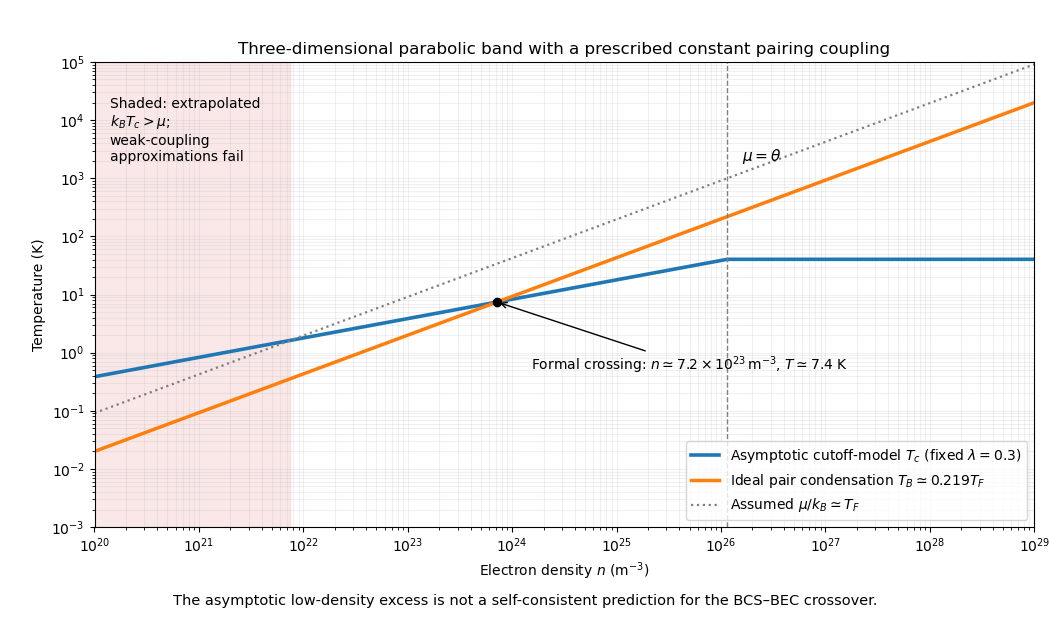

The apparent low-density excess should not be read as a reliable transition above the ideal condensation scale of preformed pairs. On this extrapolation grows without bound, violating the degenerate-gas and large-lower-cutoff approximations. It reaches one already near ; well before using an arbitrarily small density, the chemical potential, pairing, density of states and pair fluctuations need a self-consistent treatment. The asymptotic formula and ideal-boson curve compare two stipulated models, rather than solving the full BCS-BEC crossover.
A complex order parameter captures both the amplitude and phase rigidity of a superfluid. A local isotropic Ginzburg-Landau theory writes its free-energy functional, to fourth order in amplitude and second order in gradients, asThe uniform minimum has for and for . Its phase remains arbitrary under a global transformation. Minimizing with respect to gives . The phenomenological description specifies the allowed structures and coefficients; microscopic input is needed to identify the normalization of and calculate those coefficients. A static functional by itself does not fix the dynamical equation or mode frequencies.
For a dilute three-dimensional Bose gas with short-range repulsion and particle mass , the microscopic low-energy Hamiltonian isThe interaction parameter is expressed through the low-energy s-wave scattering length , rather than an unrenormalized bare delta potential. In a symmetry-selected description, and is condensate density. Equivalently, fixed-number off-diagonal long-range order identifies the macroscopically occupied natural orbital and its amplitude without a nonzero one-point expectation.
Evaluating in a coherent-field condensate variational state gives the Ginzburg-Landau functional of a dilute Bose gas, with the mean-field microscopic identificationsIts stationary variational equation is the Gross–Pitaevskii equation. The time-dependent variational action additionally contains , givingThis term expresses density-phase conjugacy. It is the missing microscopic dynamical input; a purely dissipative relaxation law would describe a different approximation.
Bogoliubov theory writes and retains quadratic fluctuations. In a uniform condensate, and the fluctuation matrix isIts eigenvalues are . The positive branch is the gapless sound mode, continuously crossing over to particle-like excitations at larger . The same result follows by linearizing the time-dependent Gross–Pitaevskii equation about its uniform solution. Thus the microscopic condensate amplitude, scattering interaction and mass determine the mean-field static coefficients and the collective mode. Quadratic quantum fluctuations also produce quantum depletion of a Bose condensate, which a pure coherent-state product omits.
These identifications are controlled for a dilute weakly interacting gas away from a fluctuation-dominated critical region. They are not a universal statement that the exact finite-temperature GL coefficient is always or that its quartic coefficient never receives corrections. Integrating out noncondensed and short-wavelength modes produces effective temperature-dependent coefficients and can change their near-critical behavior. The phase rigidity described by and the thermodynamic order-parameter expansion remain the shared organizing structure.
For BCS theory, the microscopic order parameter is instead an anomalous pair amplitude, commonly normalized as an energy gap . It is not an ordinary single-electron field expectation or automatically the square root of a pair number density. Integrating out fermions and expanding in small and slow gradients near gives the microscopic derivation of Ginzburg-Landau theory. The BCS pairing-field effective action supplies its coefficients through normal-state pair-response functions and thermal fermion sums.
For example, a clean isotropic three-dimensional weak-coupling s-wave model, with the density of states per spin at the Fermi energy and measured in energy units, giveswith microscopic Ginzburg-Landau coefficients from BCS theoryThe numerical factors arise from fermionic Matsubara sums and the isotropic velocity average; they depend on the stated gap and density-of-states conventions. Rescaling the order parameter rescales all three coefficients. The expansion applies near the transition with sufficiently slow spatial variation; disorder, anisotropic pairing and strong coupling alter the coefficients or require additional components. Microscopic derivation also fixes the pair charge in the covariant gradient, producing the superconducting screening current and the Meissner effect.[ref]
Microscopic Derivation of the Ginzburg-Landau Equations in the Theory of Superconductivity by Lev Gor'kov. 1959, near-transition gap expansion and twice-electron charge
The neutral Bose and charged Fermi theories therefore share a complex order parameter and a phase-stiffness functional, while deriving that field from different microscopic objects. The Bogoliubov transformation mixes particle and hole fluctuations of the bosonic condensate in one case and paired fermionic excitations in the other. The static GL limit organizes long-distance behavior; the full microscopic theories retain excitation spectra and temperature dependence beyond that local near-transition expansion.
Articles by others on the same topic
There are currently no matching articles.