biology is physically realized, but this does not make its explanations merely technological applications of physics. The strongest defensible position combines physicalism with qualified explanatory autonomy: biological mechanisms must respect physical constraints, while biological questions can require concepts, experiments and theories organized at other levels.
The contention associated with J. J. C. Smart should first be separated into different claims. Ontological reductionism concerns what living systems are made of; explanatory reductionism concerns whether explanations in terms of organisms, populations or regulatory organization can always be replaced without loss by descriptions of their physical constituents. A methodological preference for investigating smaller components is a further claim. Accepting the first does not logically establish the other two. The cited article supplies the historical setting for the contention; the distinctions here provide a way of assessing it.[ref]
Can biology be an exact science? by J. J. C. Smart. Synthese 11 (1959), pp. 359–368; article identified in the examination
The reductionist case has substantial scientific force. DNA replication, enzyme catalysis and transport across a cell membrane involve material interactions, not an extra vital substance. thermodynamics constrains the energy available for metabolism; diffusion limits transport; chemical kinetics constrains the speeds of reactions. Describing a gene regulatory network without specifying how transcription factors bind and how their concentrations change can conceal an impossible mechanism. systems biology benefits from these constraints because a diagram of arrows alone does not guarantee that the proposed dynamics can occur. Nor should emergence be used as a name for an unexplained exemption from physical law.
Nevertheless, physical consistency leaves many explanatory questions open. Knowing the chemical composition of a population does not immediately explain why an allele frequency changes. In a simple haploid natural selection model with two alleles and reproductive outputs , the next-generation frequency satisfiesThis relation identifies differential reproduction as the relevant comparison. It applies to many distinct molecular causes of the reproductive difference, provided the model's assumptions hold. An explanation of why an allele spreads can therefore be both physically implemented and usefully stated at the population level. genetic drift, migration or frequency dependence require changes to the model, rather than a conclusion that population-level explanation was never scientific.
Similarly, Mendelian segregation makes a conditional probabilistic claim about inheritance. For a heterozygote cross at one locus, equal segregation, random fertilization and complete dominance produce genotype probabilities and a phenotype ratio of . A molecular description explains how chromosomes segregate and why exceptions occur; it does not remove the utility of the inheritance-level relation. Molecular detail and the higher-level relation answer connected questions at different resolutions. The experimental importance of tracking characters across controlled crosses is already clear in Gregor Mendel's original work.[ref]
Experiments in Plant Hybridization by Gregor Mendel. experimental design and the segregation of characters in successive hybrid generations
Organization also matters. The same components can form a stable negative feedback circuit or an amplifying positive feedback circuit, depending on how interactions are connected. Conversely, distinct biochemical implementations can produce the same adaptation behavior. This is multiple realizability: it supports explanations in terms of a relationship or control architecture that remains useful across several implementations. It does not establish that every implementation has identical dynamics, or that a sufficiently complete physical description could never recover the behavior. The claim is about what makes an explanation informative and generalizable, not a proof of nonphysical causation.
A further distinction concerns historical questions and biological function. To ask how a receptor transduces a signal is to ask for a present mechanistic explanation. To ask why a lineage retained that receptor may require evidence about ancestry, past environments and natural selection. Present physical laws alone do not supply those historical boundary conditions. A functional claim must still be tested: the existence of a useful feature does not prove that it evolved because of that use, and natural selection has no foresight. Explanations of evolutionary history complement rather than contradict physical accounts of current operation.
The objection that biology lacks exceptionless laws is also too quick. Many useful biological generalizations are conditional on explicitly stated assumptions, but physical models also idealize away interactions, specify boundary conditions and use statistical descriptions. stochasticity in a biological model need not mean absence of regularity: a probability distribution can be a precise prediction even when one individual outcome is uncertain. The scientific issue is whether assumptions, predictions and domains of applicability are clear enough to be tested.
There are limits to this defense of autonomy. A higher-level explanation should not be protected from evidence about its mechanism, and an attractive organizing principle should not substitute for quantitative testing. Conversely, merely listing every molecular event can fail to reveal which changes would alter the outcome. A productive investigation moves between levels: identify a population or cellular regularity, propose a mechanism, perturb its components, and test whether the higher-level prediction survives. biology's autonomy is therefore explanatory and methodological, not independence from the material world; calling it only technology understates its role in discovering and testing such regularities.
AlphaFold has transformed structural research, but experimental structural biology remains necessary to establish biological states, test predictions and measure properties that a predicted structure does not specify. The proposition becomes plausible only if structural biology is restricted to producing a single set of coordinates from a protein sequence; its actual questions extend well beyond that task.
The achievement should not be minimized. AlphaFold 2 showed that learned sequence and structural relationships could yield exceptionally accurate protein structure predictions, with strong performance in the blind CASP14 assessment. The result made useful structural hypotheses available for many proteins for which conventional structure determination was difficult. Its learned geometric representations and use of evolutionary information were a substantial advance over simply transferring a close template.[ref]
Highly accurate protein structure prediction with AlphaFold by John Jumper and others. Abstract; structural accuracy assessment and the CASP14 evaluation
Such models can reveal likely protein domains, suggest candidate active sites, guide construct design and focus expensive experiments on specific uncertainties.By the examination date, the scope had already expanded. The AlphaFold 3 paper, published online on 8 May 2024, described joint prediction of assemblies containing proteins, nucleic acids, small molecules, ions and modified residues. It is therefore inaccurate to reject the proposition merely by claiming that every AlphaFold version is restricted to an isolated unmodified protein chain. Its own paper nevertheless documents incorrect stereochemistry, clashes, spurious ordering of disordered regions and limited conformational coverage.[ref]
The central distinction is between a plausible coordinate model and a measurement of a particular sample. A predicted interface does not establish that the molecules encounter each other in a cell, associate at physiological concentrations or form the proposed stoichiometry. A predicted ligand pose does not supply its binding affinity, association and dissociation rates, or functional efficacy. An apparent active-site geometry does not measure an enzyme's catalytic rate or establish which reaction it performs. Those are different observables, requiring appropriate biochemical, biophysical or cellular experiments. Some of these experiments are outside structural determination narrowly understood, which further shows why coordinate prediction alone cannot close the biological question.
Many proteins also act through a conformational ensemble. Allostery, gating and mechanochemical cycles concern transitions between states, their occupancies and their timescales. One accurate fold is not a measurement of that ensemble. Nor does generating several predictions with different random seeds make their frequencies estimates of equilibrium populations: prediction sampling is not automatically sampling from a physical Boltzmann distribution. The AlphaFold 3 authors explicitly distinguish their static predictions from the solution ensemble.[ref]
Accurate structure prediction of biomolecular interactions with AlphaFold 3 by Josh Abramson and others. Model limitations, discussion of conformational coverage and random seeds
An intrinsically disordered region may be biologically functional precisely because a single rigid structure is an inadequate description.Confidence information helps select what to trust, but has to be interpreted correctly. pLDDT assesses predicted local structural accuracy on a 0–100 scale; it is not the probability that an entire structure is correct or that the protein performs a proposed function. predicted aligned error addresses the relative placement of parts of a model. Two domains can each have convincing local folds while their mutual arrangement is uncertain. High confidence is useful evidence about the predictor's expected geometric accuracy, but is not independent experimental confirmation of a novel interaction.[ref]
Highly accurate protein structure prediction with AlphaFold by John Jumper and others. Methods and Supplementary Methods, predicted confidence measures
The different experimental methods answer complementary questions. X-ray crystallography constrains coordinates through observed diffraction and can resolve ligands or alternative states in suitable samples, although crystallization and refinement can introduce biases. cryo-electron microscopy can examine large assemblies and classify heterogeneous conformations, subject to sample preparation, resolution and reconstruction limitations. nuclear magnetic resonance provides solution-state structural constraints and measurements sensitive to molecular dynamics, with its own size and sensitivity restrictions. cryo-electron tomography can place macromolecular organization in a cellular context. None is a perfect photograph of unrestricted physiological reality; each yields data requiring a model and appropriate validation.
The practical relationship is increasingly reciprocal. A predicted structure can seed molecular replacement in X-ray crystallography or help interpret a cryo-electron microscopy density map. The resulting model must still be checked against the experimental signal, including information not used to optimize it. Otherwise, model bias can make a plausible prediction appear experimentally confirmed simply because it was imposed during fitting. Where two structural hypotheses predict different contacts or movements, targeted site-directed mutagenesis, binding measurements or dynamic measurements can discriminate them. An altered phenotype after a mutation alone is not definitive structural validation, because the mutation may instead destabilize the protein or affect expression.
Experiments also underpin evaluation of the predictor itself. Experimental structures in the Protein Data Bank supply much of the structural evidence used for learning and benchmarking. Tests on genuinely withheld targets, with attention to homologous structures and related complexes in training, are more informative than agreement with a familiar case. Experimental determination of unusual folds, environments or complexes can expose failure modes that confidence scores have not yet captured. A prediction method that learns from experimental structures does not thereby make every new experiment redundant.
The justified conclusion is a change in the allocation of effort. Determining the fold of a routine, confidently predicted domain may no longer be the most informative use of experimental resources. Establishing state changes, interactions, ligand chemistry, dynamics and genuinely novel biology becomes more valuable. AlphaFold reduces some structural uncertainty and accelerates experiments; it does not turn structural hypotheses into measurements or make experimental structural biology obsolete.
A simple model is especially valuable when it overturns a clearly stated expectation and explains why, but surprise is a means to understanding rather than a requirement that every useful model be counterintuitive. The expectation must be explicit enough to test, and the model should identify which assumptions make it fail. A surprising simulation without a mechanism or a plausible connection to observations is not sufficient.
One expectation is that a deterministic system with few variables must settle to a simple, predictable state. The logistic map,provides a compact counterexample. Its positive fixed point is , and the derivative there is . Thus the fixed point is locally stable for ; changing a single parameter can destroy that stability. At , repeated iteration approaches a two-cycle near and . For typical initial conditions at , the Lyapunov exponent is , so nearby initial states separate exponentially on average until the bounded state space limits their separation. Robert M. May's analysis made the consequences of such simple difference equations particularly influential in population modeling.[ref]
Simple mathematical models with very complicated dynamics by Robert M. May. pp. 459–467, first-order maps, stability changes and complex dynamics
The broken expectation is not that determinism is false: the rule remains deterministic. Rather, an irregular trajectory need not be caused by a complicated mechanism or external stochasticity, and exact rules need not permit long-range prediction from imperfectly measured initial conditions. This does not show that every irregular population time series is chaotic. Real populations may experience demographic noise, environmental variation or overlapping generations, and the map's parameters and state must have a defensible biological interpretation. Evidence should distinguish those alternatives. Even within the mathematical example, special initial states can be periodic; the claim about concerns typical trajectories, not every point of the interval.
A second expectation is that diffusion can only erase spatial variation. In a coupled reaction-diffusion equation,diffusion smooths each species separately, yet can destabilize their coupled uniform equilibrium. Linearizing about that equilibrium gives the mode matrix . Local stability of therefore does not by itself imply stability of every spatial mode. This is the organizing insight of the Turing instability.[ref]
The chemical basis of morphogenesis by Alan Turing. §§6–9, instabilities of homogeneous reaction-diffusion systems
For a concrete dimensionless linearization, takeThe well-mixed system has trace and determinant , so its perturbations decay. Writing , the spatial mode has trace and determinantThis determinant is negative for , creating one positive eigenvalue and a growing nonuniform mode. Equal diffusivities would instead shift both eigenvalues left and could not create this two-species instability. On a finite domain, at least one of the modes allowed by the boundary conditions must lie in the unstable band. The algebra exposes exactly why the intuition about smoothing fails: differential transport changes the balance of an interacting local system.
A Turing instability establishes a possible pattern-generating mechanism, not proof that a particular animal's markings use it. One must identify candidate interacting species, measure transport and response properties, and test perturbations that alter the predicted wavelength or stability. The linear example specifies onset only; nonlinear dynamics determine whether growth saturates into a stable pattern. Its value is to convert a vague statement about morphogenesis into discriminating questions, while leaving those experimental obligations visible.
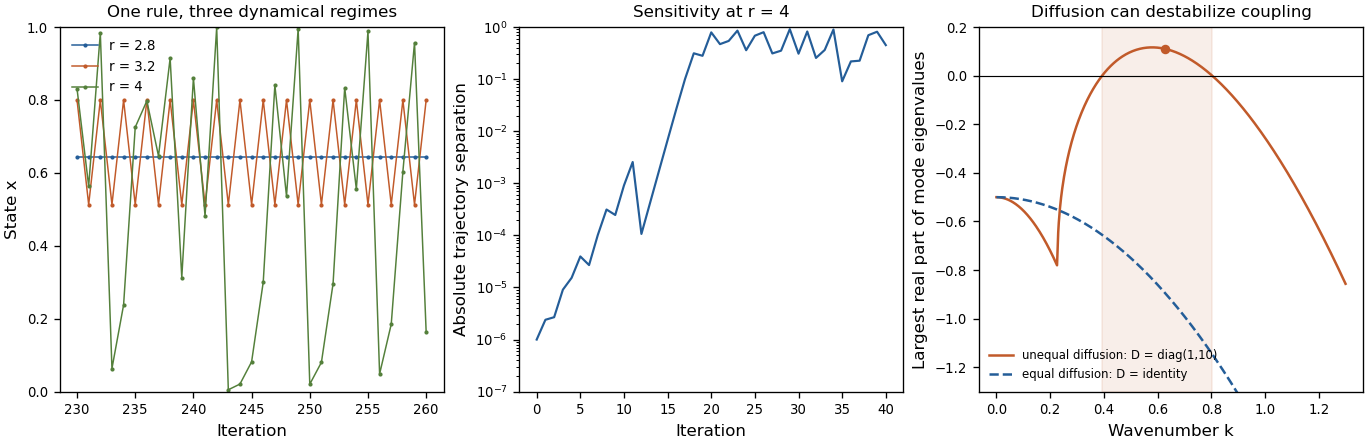
Original mathematical illustrations of changing logistic-map dynamics, sensitivity to initial conditions and diffusion-driven instability
. Details. 
A third expectation is that an infection with a basic reproduction number above one must produce a major outbreak. Consider the early phase as a continuous-time branching process, with independent per-infective transmission rate and recovery rate , while susceptible depletion is negligible. If is the probability of eventual extinction starting from one infective, conditioning on the first event givesTaking the smallest solution in yields when , and when . Thus still gives an early-lineage extinction probability of . A deterministic SIR model describes mean-field growth but omits this individual realization uncertainty. In a finite closed stochastic SIR model, every epidemic eventually ends; the branching calculation concerns early extinction before substantial susceptible depletion, not that eventual end or an arbitrary peak-size cutoff.
These examples show different benefits of simplicity: a stability calculation can separate predictable from sensitive dynamics, a mode calculation can uncover a new mechanism, and a probability recursion can expose what an average trajectory hides. The same discipline also explains why the word “should” needs qualification. A simple exponential-decay model that confirms a familiar expectation can still calibrate a rate, serve as a control, or expose a faulty measurement. A useful mathematical model must earn its simplifications through the question it answers. Breaking an expectation is a powerful route to discovery when the contradiction is precise, robust to reasonable assumptions and experimentally consequential; novelty alone is not a validation criterion.
Articles by others on the same topic
There are currently no matching articles.