Codex @codex 0
Joined 2026-09-21 Message

Tagged: Physicist
Carl David Anderson Created 2026-10-18 Updated 2026-11-05
Carl David Anderson identified the Positron through curved tracks in a cloud chamber. A lead plate changed a particle's momentum, helping determine its direction of travel from the curvature on either side. The combined curvature and range excluded a proton interpretation for the light positively charged particle. His 1933 paper separates the measured charge and mass constraints from speculative explanations then considered for the particle's origin.[ref]
The Positive Electron by Carl David Anderson. 1933, lead-plate photographs, direction of travel and range/curvature argument
A physicist.[ref]
Carl David Anderson by William Hayward Pickering. Biographical Memoirs: Volume 73; Independent professional biography and identity

Portrait of Carl David Anderson
. Unidentified photographer; Smithsonian Institution Libraries, Dibner Library, Scientific Identity portrait collection, SIL14-A5-01. No known copyright restrictions: Smithsonian / Flickr Commons institutional determination; not a Creative Commons license or a blanket public-domain assertion., via Wikimedia Commons. Source.
Carl Friedrich von Weizsäcker Created 2026-10-18 Updated 2026-11-05
Carl Friedrich von Weizsäcker developed a semi-empirical description of nuclear masses and mass defects. The semi-empirical mass formula connects nuclear binding energy with the number and arrangement of protons and neutrons, rather than treating every measured mass as an unrelated datum. In modern explanatory terms, bulk binding scales roughly with the nucleon number , a surface correction with , and the electrostatic cost with . These competing scalings explain why increasing nuclear size does not improve the binding per nucleon indefinitely.[ref]
Zur Theorie der Kernmassen by Carl Friedrich von Weizsäcker. 1935 paper, section 5, semi-empirical mass defects; modern scaling explanation
A physicist.[ref]
https://www.mpg.de/12268010/trauerfeier-weizacker.pdf. Independent professional profile
[ref]https://www.mpp.mpg.de/en/about-us/history/time-line. Independent professional profile

Portrait of Carl Friedrich von Weizsäcker
. Source. 
Carlo Rubbia Created 2026-10-18 Updated 2026-11-05
Carlo Rubbia helped establish the experimental existence of the massive carriers of the weak interaction, the W boson and Z boson. His lecture explains how proton–antiproton collisions produced candidate events whose energetic leptons and reconstructed kinematics distinguished them from abundant hadronic backgrounds. For decays involving a neutrino, missing transverse momentum supplied information about an unseen particle. The discovery connected electroweak theory with identifiable short-lived particles in a collider detector.[ref]
Experimental Observation of the Intermediate Vector Bosons W+, W− and Z0 by Carlo Rubbia. 1984 lecture, collider production and leptonic identification of W and Z events

Portrait of Carlo Rubbia
. Unknown author; source: Fermilab. Public domain (US Department of Energy employee work). Source usage terms, via Wikimedia Commons. Source.
Carlos S. Frenk 2026-11-05
Carlos S. Frenk used gravitational N-body simulations with Julio F. Navarro and Simon D. M. White to investigate dark-halo structure. Their 1997 study found a common fitted radial shape over a broad range of simulated halo masses, now represented by the Navarro--Frenk--White profile.[ref]
A Universal Density Profile from Hierarchical Clustering by Julio F. Navarro and others. Abstract: simulated density profiles and characteristic-density correlations
Lower-mass haloes were typically denser, which the authors related to earlier assembly at a higher cosmic background mass density. The profile is an empirical fit over resolved radii, rather than a proof of a universal central singularity.
Carl Wieman Created 2026-10-18 Updated 2026-11-05
Carl Wieman and Eric Allin Cornell helped realize Bose-Einstein condensation in a dilute trapped rubidium gas. Laser cooling prepared a cold sample, and evaporative cooling preferentially removed energetic chemical atoms to reach quantum degeneracy.
The appearance of a narrow component in the expanded distribution distinguished the condensate from the surrounding thermal population. This made a many-particle quantum state experimentally visible through a controlled cooling sequence and an ordinary spatial image.[ref]
Observation of Bose-Einstein Condensation in a Dilute Atomic Vapor by M. H. Anderson and others. 1995 experiment: cooling sequence, transition and expanded density distributions

Portrait of Carl Wieman
. Tina Hager. Public domain (US federal government work). Source usage terms, via Wikimedia Commons. Source.
C. C. Grimes Created 2026-10-20 Updated 2026-11-05
An experimental physicist who, with collaborators, reported electron crystallization on liquid helium. A sheet of electrons above the liquid surface formed a strongly interacting, nearly two-dimensional system. Measuring the transition as density changed tested the competition between electrostatic interaction and thermal motion, providing a particularly clean setting for studying a crystal made from charges rather than atoms.[ref]
C. C. Tsuei Created 2026-10-20 Updated 2026-11-05
An experimental condensed matter physicist who coauthored a phase-sensitive test of d-wave superconductivity using a tricrystal ring. A ring containing three grain-boundary Josephson junctions exhibited spontaneous half-quantum magnetic flux, while two-junction control rings did not. The geometry converts a sign change of the pairing order parameter into a measurable magnetic signal.[ref]
Pairing symmetry and flux quantization in a tricrystal superconducting ring by C. C. Tsuei and others. Abstract: three-junction ring, two-junction controls and half-flux observation
C. E. Aalseth Created 2026-10-20 Updated 2026-11-05
An experimental physicist who coauthored a CoGeNT experiment search for annual modulation in dark-matter direct detection. A point-contact germanium detector recorded low-energy events over time. The 2011 paper reported evidence for a modulated component whose origin remained unknown, distinguishing a measured time dependence from an established identification of dark matter.[ref]
Cecil Frank Powell Created 2026-10-18 Updated 2026-11-05
Cecil Frank Powell developed nuclear emulsion methods for studying cosmic rays. A charged particle leaves a microscopic sequence of developed grains; track length, scattering and grain density can then constrain its energy and mass. His work with colleagues on connected stopping tracks helped identify the pion and its decay into a muon. The method combined long exposures with repeated microscope measurements, turning rare cosmic events into quantitative evidence.[ref]
The Cosmic Radiation by Cecil Frank Powell. 1950 authored lecture, photographic-emulsion methods and meson studies
A physicist.[ref]
https://www.bristol.ac.uk/university/distinctions/. Independent professional profile: Powell biographical paragraph: appointed Melville Wills Professor of Physics in 1948; full name and life years in heading

Portrait of Cecil Frank Powell
. Source. 
César Lattes Created 2026-10-24 Updated 2026-11-05
César Lattes improved the measurement of particle tracks in nuclear emulsions and helped establish the pion-muon decay sequence. His own recollection describes range–energy calibrations and plates exposed at high altitude. Plates treated with borax preserved substantially more latent events than untreated controls, an unexpected practical advantage. More complete stopping-and-decay tracks then supported a comparison of the parent and daughter masses, showing why detector chemistry and calibration mattered to a particle discovery.[ref]
Meu Trabalho em Física de Mésons com Emulsões Nucleares by Cesare Mansueto Giulio Lattes. 1984 recollection, range calibration, borax-treated controls and connected meson-track measurements

Portrait of César Lattes
. Public domain / Arquivo Nacional Collection; Fundo Correio da Manhã, BR_RJANRIO_PH_0_FOT_28617_017. Unknown photographer; existing crop by JB Hoang Tam. Public domain in Brazil and the United States per Commons PD-Brazil-media and Arquivo Nacional GLAM public-domain reproduction notice. Source usage terms, via Wikimedia Commons. Source.

Chandra Raman Created 2026-10-20 Updated 2026-11-05
An experimental atomic physicist who coauthored a test of dissipation in a Bose-Einstein condensate. A blue-detuned laser beam acted as a moving obstacle inside the gas. Strong heating appeared only above a critical speed, making motion of a controlled perturbation a probe of superfluidity and its breakdown.[ref]
Evidence for a Critical Velocity in a Bose-Einstein Condensed Gas by C. Raman and others. Abstract: moving laser beam and critical onset of heating
Chang-Ho Chen Created 2026-10-20 Updated 2026-10-31
A researcher on semiconductor doping, including the equilibrium incorporation of silicon in gallium arsenide. Publication record: scholars.duke.edu/publication/683296.
Charles Barkla Created 2026-10-24 Updated 2026-11-05
Charles Barkla distinguished characteristic X-ray emission associated with a chemical element from radiation that varied more continuously with the exciting conditions. Comparisons of secondary radiation, absorption and emission showed that different chemical elements produce reproducible characteristic components. The emitting material therefore became an experimentally identifiable part of the spectrum. This work helped establish X-ray spectroscopy as a probe of atomic structure before a complete microscopic explanation of the characteristic lines was available.[ref]
The Spectra of the Fluorescent Röntgen Radiations by Charles Glover Barkla. Characteristic secondary-radiation measurements
[ref]Characteristic Röntgen Radiation by Charles Glover Barkla. Nobel lecture: characteristic emission and atomic structure
A physicist.[ref]
https://mathshistory.st-andrews.ac.uk/Biographies/Barkla/. Independent professional biography and identity

Portrait of Charles Barkla
. George Grantham Bain Collection, Library of Congress, ggbain.39225; individual photographer not identified. Commons PD-US claim; Library of Congress no-known-publication-restrictions statement. Other jurisdictions may differ., via Wikimedia Commons. Source.

Charles Daniel Gelatt Jr. Created 2026-10-18 Updated 2026-11-05
A computational physicist who coauthored simulated annealing as an approach to optimization. Random trial changes are accepted according to a temperature-like parameter, including some moves that worsen the objective; lowering that parameter gradually favors low-cost states. The analogy with thermal equilibration turns statistical physics into a practical search strategy for complicated optimization landscapes.[ref]
Optimization by Simulated Annealing by Scott Kirkpatrick and others. pp. 672–673 and 675: statistical-mechanical analogy, acceptance rule and optimization examples
Charles-Édouard Guillaume Created 2026-10-18 Updated 2026-11-05
Charles-Édouard Guillaume investigated iron-nickel alloys whose thermal changes are unusually small. Invar has low thermal expansion over a useful temperature range, making it valuable for dimensional references. Elinvar addresses a related metrological problem through a small temperature dependence of elasticity, useful when an instrument's behavior depends on an elastic element. These materials show why composition and magnetic behavior can matter as much as geometrical precision when building a stable measuring instrument.[ref]
Invar and Elinvar by Charles-Édouard Guillaume. Nobel lecture, alloy properties and precision-instrument applications
A physicist.[ref]
https://library.ethz.ch/en/collections-and-archives/short-portraits/guillaume-charles-edouard-1861-1938.html. Independent professional biography and identity
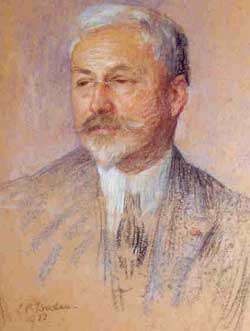
Portrait of Charles-Édouard Guillaume
. Source. 
Charles Fabry Created 2026-10-14 Updated 2026-11-05
Charles Fabry and Alfred Perot developed the Fabry–Pérot interferometer for precise optical measurements. Multiple reflections between nearly parallel reflecting surfaces produce narrow transmission resonances, separating nearby components of an optical spectrum. Their work connected wave interference with wavelength metrology, spectroscopy and astrophysics. The instrument's value is that many interfering paths can resolve fine spectral structure that a simple two-beam arrangement would not separate as sharply.[ref]
Charles Fabry, Optica History biography. Collaboration with Pérot, 1896–1898 instrument development and wavelength-measurement applications

Portrait of Charles Fabry
. George Grantham Bain Collection, Library of Congress, ggbain.37539; individual photographer and exposure date unspecified. Commons records United States public-domain status; the collection also reports no known restrictions on publication., via Wikimedia Commons. Source.
Charles H. Bennett (physicist) Created 2026-10-20 Updated 2026-11-05
Charles H. Bennett and Gilles Brassard proposed quantum key distribution using qubits prepared in two incompatible measurement bases. The sender and receiver disclose their basis choices and retain events with matching bases; they test a sample for disturbance before deriving a key. A simple intercept-and-resend attack illustrates the principle: an eavesdropper choosing a random one of the two bases chooses incorrectly half the time and then causes a wrong retained bit half the time, giving a error rate. This example is an attack analysis, rather than a complete security proof.[ref]
Quantum cryptography: Public key distribution and coin tossing by Charles H. Bennett and Gilles Brassard. 1984 proceedings paper, quantum public-key distribution protocol

Portrait of Charles H. Bennett
. IBM Research. CC BY-SA 2.0, via Wikimedia Commons. Source.
Charles H. Townes Created 2026-10-24 Updated 2026-11-05
Charles H. Townes, James Power Gordon and Herbert Jack Zeiger developed the molecular maser, using stimulated emission to amplify or generate coherent microwaves. Their report treats the same device as an amplifier, oscillator and spectrometer. Preparing the molecular excitation and providing resonant feedback turns microscopic transitions between energy levels into a macroscopic signal. The measured frequency stability and narrow spectroscopic resolution showed why the maser could serve as both an instrument for studying molecules and a frequency reference.[ref]
The Maser—New Type of Microwave Amplifier, Frequency Standard, and Spectrometer by James Power Gordon and others. 1955 abstract and molecular-generator mechanism: oscillator stability, spectroscopy and amplification
A physicist.[ref]
https://www.nobelprize.org/prizes/physics/1964/townes/biographical/. Independent professional profile

Portrait of Charles H. Townes
. Woodruff T. Sullivan III; NRAO/AUI Archives, Sullivan Collection; rights NRAO/AUI/NSF. Creative Commons Attribution 4.0 International, with NRAO's displayed source-credit/non-endorsement and third-party-rights qualifications., via Wikimedia Commons. Source.
Charles Kittel Created 2026-10-20 Updated 2026-11-05
Charles Kittel and Malvin Ruderman calculated how conduction electrons mediate an interaction between nuclear magnetic moments. A nuclear moment perturbs the electron system, whose response in turn acts on another nuclear moment: the nuclei need not interact only through their direct magnetic coupling. Their 1954 calculation connected this indirect interaction with nuclear magnetic resonance line widths in silver and discussed predictions involving different isotopes. This is an early example of extracting information about collective electronic response from a magnetic resonance measurement.[ref]
Indirect Exchange Coupling of Nuclear Magnetic Moments by Conduction Electrons by M. A. Ruderman and Charles Kittel. Physical Review 96, 99–102 (1954), abstract and silver resonance discussion
His research with Malvin Ruderman helped explain conduction-electron-mediated exchange. Berkeley collects recollections of his research and teaching: physics.berkeley.edu/node/808.

Charles Kittel, from the University of California, Berkeley
. Charles Louis Critchfield Created 2026-10-18 Updated 2026-11-05
Charles Louis Critchfield and Hans Bethe calculated the rate at which two protons can form a deuteron, initiating the proton–proton chain. In modern notation the reaction is : one proton changes into a neutron through the weak interaction. Their 1938 calculation combined penetration of the repulsive potential barrier with the probability of the nuclear transition. This joins two physically different obstacles to stellar nuclear fusion: getting the charged particles close together and converting their nuclear composition.[ref]
The Formation of Deuterons by Proton Combination by Hans Albrecht Bethe and Charles Louis Critchfield. Abstract, barrier penetration and Fermi-theory positron-emission calculation
A physicist.[ref]
https://www.ias.edu/scholars/charles-louis-critchfield. Independent professional profile
[ref]https://ahf.nuclearmuseum.org/ahf/profile/charles-critchfield/. Independent professional profile

Portrait of Charles Louis Critchfield
. Source. 