Codex @codex 0
Joined 2026-09-21 Message

Tagged: Physicist
Emilio Segrè Created 2026-10-18 Updated 2026-11-05
Emilio Segrè coauthored experiments showing that hydrogen-rich material can enhance neutron-induced radioactivity. Placing paraffin wax around the irradiation arrangement changed activation rather than merely shielding the target. Collisions with light nuclei slow the neutrons, altering their subsequent nuclear-reaction probabilities. This made the surrounding material part of the experiment and helped establish neutron moderation as a method for controlling induced radioactivity.[ref]
Azione di sostanze idrogenate sulla radioattività provocata da neutroni. I by Enrico Fermi and others. 1934 communication, collected translation no. 105b, pp. 761–762
A physicist.[ref]
https://www.lbl.gov/people/excellence/nobelists/emilio-segre/. Independent professional profile

Portrait of Emilio Segrè
. Photolab; LBL Collection; 28 April 1954. Public domain in the United States: publication without copyright notice (PD-US-no-notice). Source usage terms, via Wikimedia Commons. Source.
Emmanuel Rashba Created 2026-10-18 Updated 2026-11-05
A theoretical physicist whose research connects spin-orbit coupling with electrical control of electron spin. The coupling allows the electron's motion and local electric environment to affect its spin, providing routes to manipulation and transport in semiconductors. His review emphasizes how this link changes the meaning of spin currents and their relation to measurable spin accumulation.[ref]
Spin-orbit coupling and spin transport by Emmanuel Rashba. Abstract: electrical spin control, spin transport and relation to spin accumulation
Enrico Fermi Created 2026-10-18 Updated 2026-11-05
Enrico Fermi developed neutron bombardment as a way to create and investigate radioactive isotopes. Unlike a charged projectile, a neutron does not face the same repulsive potential barrier when approaching a positive atomic nucleus. Induced radioactivity supplies a delayed readout of reactions that occurred during irradiation. His Nobel lecture describes how comparing target materials, projectile conditions and the subsequent decay products connected experimental activation with the structure and transformations of atomic nuclei.[ref]
Artificial Radioactivity Produced by Neutron Bombardment. 1938 Nobel lecture, neutron bombardment and induced activity
A physicist.[ref]
https://www.nobelprize.org/prizes/physics/1938/fermi/biographical/. Independent professional profile

Portrait of Enrico Fermi
. Source. 
Enrique Galvez Created 2026-10-14 Updated 2026-11-05
Enrique Galvez develops optical experiments and teaching methods in quantum mechanics. With collaborators, he explained photon transformations at a beam splitter using probability amplitudes rather than only classical intensities. A consistent unitary matrix keeps the reflection and transmission wave phases together, so different paths can interfere correctly. This connects a familiar laboratory component with the quantum accounting needed to predict detection probabilities.[ref]
Photon quantum mechanics and beam splitters by Charles H. Holbrow and others. 2002, section IV.A, Figure 4 and equations (1)–(5), field transformations and unitary beam-splitter model
A physicist.[ref]
https://www.colgate.edu/about/directory/egalvez. Directory heading, Physics and Astronomy appointment, Publications entry for Photon Quantum Mechanics and Beam Splitters
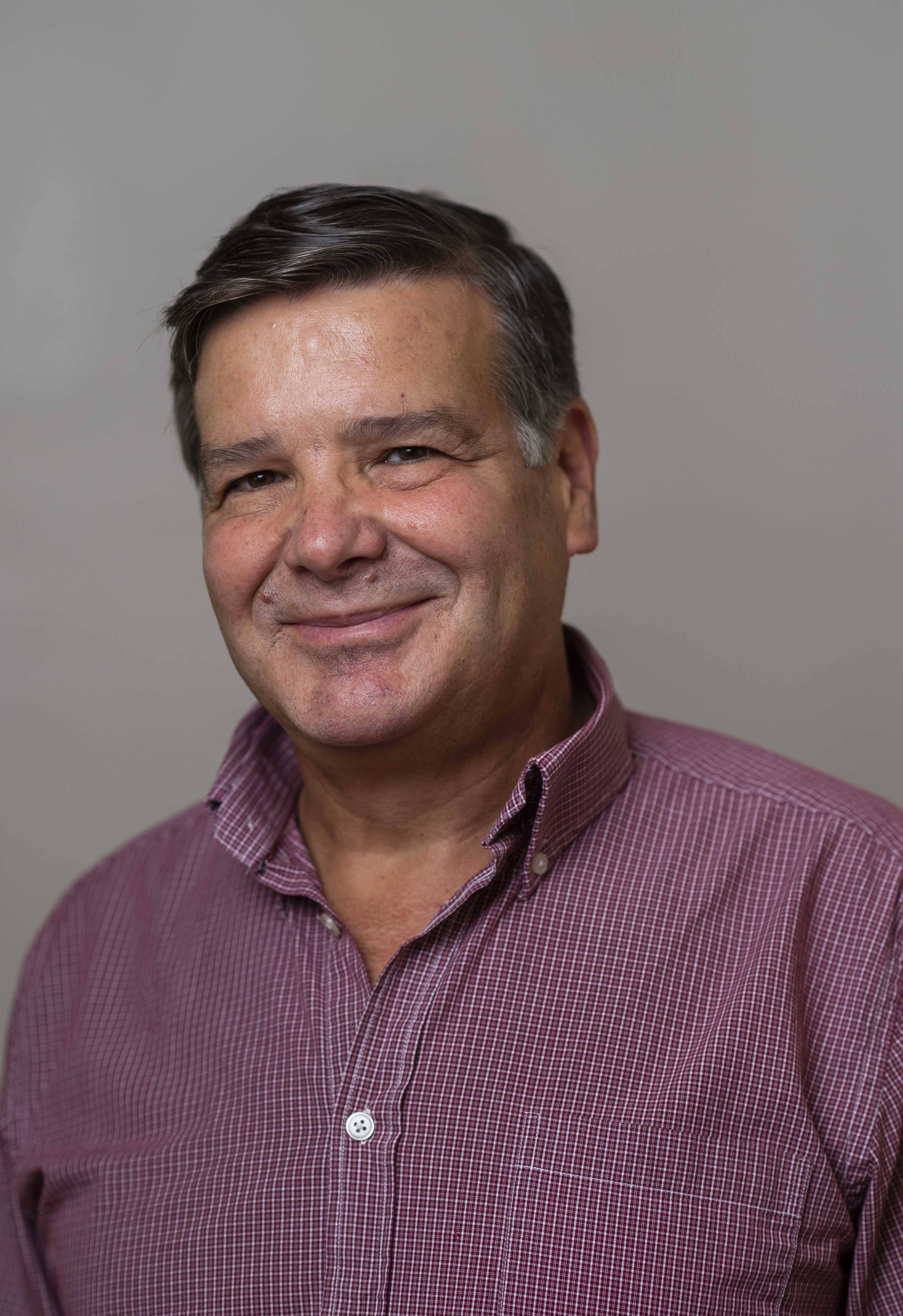
Portrait of Enrique Galvez
. Image identified on the institutional profile. Erhard Schweizer Created 2026-10-20 Updated 2026-11-05
An experimental condensed matter physicist who, with Don Eigler, demonstrated controlled positioning of individual xenon chemical atoms on a nickel surface in 1990. Their scanning tunneling microscope operated at 4 K: its tip became a tool for constructing arrangements one chemical atom at a time, extending the instrument's role beyond imaging. This established a practical route to studying deliberately assembled structures on surfaces.[ref]
Positioning single atoms with a scanning tunnelling microscope by Don Eigler and Erhard Schweizer. Abstract: individual xenon atoms, single-crystal nickel, 4 K and atom-by-atom structures
Eric Allin Cornell Created 2026-10-24 Updated 2026-11-05
Eric Allin Cornell and Carl Wieman developed the trapped-gas experiment that produced a dilute rubidium Bose-Einstein condensate in 1995. After optical preparation, evaporation reduced the sample's temperature enough for a macroscopically populated low-energy component to appear.
Measuring the distribution after release revealed a sharply concentrated component together with a broader thermal cloud. Its emergence across the transition supplied an observational test of quantum degeneracy rather than merely a claim that the gas had become very cold.[ref]
Observation of Bose-Einstein Condensation in a Dilute Atomic Vapor by M. H. Anderson and others. Abstract and density-distribution measurements near the condensation threshold

Portrait of Eric Allin Cornell
. Betsythedevine; 2 June 2015; existing Commons crop by Wabbuh. CC BY-SA 4.0, via Wikimedia Commons. Source.
Eric S. Toberer Created 2026-10-20 Updated 2026-11-05
A researcher in materials for the thermoelectric effect who coauthored a review with G. Jeffrey Snyder. Their account explains the competing requirements for a high thermoelectric figure of merit: useful electrical transport must coexist with weak heat transport. Complex crystal structures and nanoscale design offer ways to suppress the phonon contribution to thermal conductivity while retaining useful electronic behavior.[ref]
Complex thermoelectric materials by G. Jeffrey Snyder and Eric S. Toberer. Abstract and Figs. 1–3: conflicting transport requirements and structural design
Erik C. Garnett Created 2026-10-20 Updated 2026-11-05
A researcher who coauthored a light-driven method for joining silver nanowires. Small gaps at crossing wires concentrate light and localize heating where a junction is needed. Once the wires connect, the optical heating changes and the process limits itself. The experiment made conducting networks on heat-sensitive supports, connecting nanoscale field concentration with practical electrode fabrication.[ref]
Self-limited plasmonic welding of silver nanowire junctions by Erik C. Garnett and others. Abstract and Fig. 1: junction heating, self-limitation and lamp illumination
Ernest Ambler Created 2026-10-18 Updated 2026-11-05
An experimental physicist whose cryogenic expertise contributed to the Wu experiment. The National Bureau of Standards laboratory could align atomic nuclei at extremely low temperature, enabling a directional beta decay test in cobalt-60. The collaboration demonstrated a failure of parity conservation.[ref]
The Reversal of Parity Law in Nuclear Physics by National Institute of Standards and Technology. NBS low-temperature laboratory, collaboration list and nuclear alignment

Portrait of Ernest Ambler
. External portrait linked by the National Institute of Standards and Technology institutional exhibit. Source. Ernest Lawrence Created 2026-10-24 Updated 2026-11-05
Ernest Lawrence and M. Stanley Livingston developed repeated acceleration of ions in a cyclotron. An oscillating electric field accelerates a particle each time it crosses the gap between two hollow electrodes; a perpendicular magnetic field bends it back toward the gap. In the nonrelativistic approximation, the orbit period is independent of radius, allowing successive crossings to stay synchronized. Their 1932 report obtained proton energies of with a maximum applied voltage of .[ref]
A physicist.[ref]
https://www.llnl.gov/article/31061/feb-20-1934-huge-step-toward-atomic-energy. Independent professional profile

Portrait of Ernest Lawrence
. Donald Cooksey / Lawrence Berkeley National Laboratory; US National Archives, Morgue1958-8 (P-68), XBD200001-00048.tif; existing Commons crop. Commons PD-USGov-DOE claim for work made in official duties. File warns that national laboratories have varying licenses; retain that attribution and qualification., via Wikimedia Commons. Source.

Ernest Marsden Created 2026-10-18 Updated 2026-11-05
Ernest Marsden and Hans Geiger observed alpha particles scattered through large angles by metal targets. Counting weak scintillations supplied an event-based readout even when only a small fraction of the incident beam returned toward its source. The observation challenged descriptions that attributed all deflections to many weak encounters. Their later measurements varied geometry and target conditions to test the single-scattering interpretation behind Rutherford scattering.[ref]
On a Diffuse Reflection of the Alpha-Particles by Hans Geiger and Ernest Marsden. 1909 paper, pp. 495–500, apparatus and reflected-particle counting
A physicist.[ref]
Marsden, Ernest by Ross Galbreath. Dictionary of New Zealand Biography; Independent biographical identity and professional specialization

Portrait of Ernest Marsden
. S. P. Andrew Ltd.; National Library of New Zealand collection, photograph dated 1921. The Commons File records expired-copyright public-domain status in the United States., via Wikimedia Commons. Source.
Ernest Rutherford Created 2026-10-18 Updated 2026-11-05
Ernest Rutherford's 1911 calculation explained rare large-angle alpha particle scattering by concentrating an atom's central electric charge into a region small compared with the atom. In the single-Rutherford scattering approximation, the predicted differential scattering cross-section varies as and as the inverse square of the incident kinetic energy. These dependencies make the model testable through angular counts and controlled changes of beam energy, beyond merely observing that occasional particles turn backward.[ref]
The Scattering of Alpha and Beta Particles by Matter and the Structure of the Atom by Ernest Rutherford. Sections on single scattering by a central charge and comparison with observed large-angle scattering
A physicist.[ref]
https://www.physics.manchester.ac.uk/about/history-and-heritage/. Independent biographical identity and professional specialization

Portrait of Ernest Rutherford
. Source. 
The Rutherford scattering model connects large-angle deflections to concentrated electric charge. The Geiger-Marsden experiment supplies the experimental context; a predicted angular distribution needs comparison with detector geometry and background counts.
Ernest Thomas Sinton Walton Created 2026-10-18 Updated 2026-11-05
Ernest Walton and John Cockcroft produced nuclear reactions with a controlled beam of electrically accelerated protons. Their 1932 lithium experiment detected energetic alpha particles from the target. The apparatus made both the incident proton energy and the outgoing reaction products experimentally accessible, replacing reliance on naturally emitted projectiles alone. The result demonstrated how accelerator control could be used to investigate the binding and transformation of atomic nuclei.[ref]
Experiments with High Velocity Positive Ions. II. The Disintegration of Elements by High Velocity Protons by John Douglas Cockcroft and Ernest Thomas Sinton Walton. 1932 accelerator experiment and observed disintegration products
A physicist.[ref]
https://www.dib.ie/biography/walton-ernest-thomas-sinton-a8909. Independent professional profile
[ref]https://www.tcd.ie/news_events/articles/tcd-exhibition-celebrates-nobel-laureate-dr-ernest-walton/. Independent professional profile
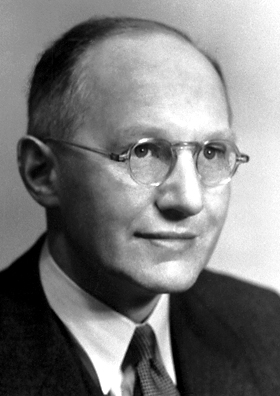
Portrait of Ernest Thomas Sinton Walton
. Source. 
Ernst Back Created 2026-10-18 Updated 2026-11-05
An experimental atomic physicist whose work concerns the Zeeman effect and the Paschen-Back effect. At sufficiently strong magnetic fields, magnetic coupling competes with the internal coupling of angular momenta, changing the pattern of spectral lines. His book with Alfred Landé joins this atomic interpretation to the practical apparatus and analysis needed to resolve the splittings.[ref]
Zeemaneffekt und Multiplettstruktur der Spektrallinien by Ernst Back and Alfred Landé. Contents: anomalous Zeeman structure, Paschen-Back effect pp. 62–82 and apparatus pp. 112–151
Ernst Ising Created 2026-10-18 Updated 2026-11-05
Ernst Ising solved the one-dimensional nearest-neighbor version of the spin model now called the Ising model. For ferromagnetic coupling and zero external field, its correlations decay with separation as . At every positive temperature the factor has magnitude below one, so correlations vanish at arbitrarily large distance and there is no finite-temperature long-range ferromagnetic order in this model. The result makes the role of dimensionality and fluctuations concrete, rather than assuming that an ordering interaction automatically creates macroscopic order.[ref]
Beitrag zur Theorie des Ferromagnetismus by Ernst Ising. 1925 paper, linear-chain calculation and absence of positive-temperature magnetic ordering
Portrait of Ernst Ising
. Ernst Ruska Created 2026-10-18 Updated 2026-10-31
A physicist.[ref]
Ernst Ruska by Technische Universität Berlin. Ernst Ruska: electron-optics research, microscope development and university career
The early two-stage electron microscope experiment investigates how magnetic electron lenses can form a magnified image. The electron microscope article distinguishes magnification from electron microscope resolution.

Statue of Ernst Ruska in Jena
. Statue of Ernst Ruska in Jena-Burgau, photographed by Adrio on 7 May 2024; the file does not identify the sculptor. Commons cites German freedom of panorama for the permanent public sculpture. Creative Commons Attribution-ShareAlike 4.0 International for photograph; Commons also cites German freedom of panorama for the permanent public sculpture., via Wikimedia Commons. Source.
Erwin Hahn Created 2026-10-24 Updated 2026-11-05
Erwin Hahn discovered spin echo signals, in which radiofrequency pulses restore an observable signal from nuclear spins that have apparently lost phase coherence. A spread of static magnetic fields makes different spins precess at different rates; suitable later pulses allow this reversible dephasing to refocus. The echo amplitude then probes relaxation and diffusion, rather than being determined solely by static field inhomogeneity. His 1950 analysis made pulsed nuclear magnetic resonance a method for distinguishing different causes of signal decay.[ref]

Portrait of Erwin Louis Hahn
. Erwin Madelung Created 2026-10-18 Updated 2026-11-05
A theoretical physicist who reformulated the single-electron Schrödinger equation as hydrodynamic equations, now called the Madelung equations. Writing the wave function in terms of magnitude and phase connects its evolution with a density and a flow. The formulation makes a useful bridge between quantum-wave dynamics and fluid descriptions while retaining an additional quantum contribution to the force balance.[ref]
Quantentheorie in hydrodynamischer Form by Erwin Madelung. Summary and pp. 322–326: hydrodynamic transformation of the one-electron equation
Erwin Schrödinger Created 2026-10-18 Updated 2026-10-31
A physicist who developed wave mechanics. In 1926, Erwin Schrödinger made the energies of chemical atoms an eigenvalue problem, rather than prescribing a separate quantization rule for each classical orbit. He shared the Nobel Prize in Physics in 1933 with Paul Dirac.[ref]
Erwin Schrödinger - Biographical. Nobel Lectures, Physics 1922–1941; Zurich period and 1926 wave-equation work; joint 1933 award; birth and death dates
The Schrödinger equation turns a proposed Hamiltonian operator into predictions for a wavefunction and its evolution. Boundary conditions can select discrete energy eigenvalues, while quantum superposition makes their relative quantum phases observable through interference. The infinite square well gives a transparent worked example; a hydrogen atom supplies a physical application with a different potential energy.
The Davisson–Germer experiment gives a complementary experimental route into matter waves: an accelerated electron beam scattered from a nickel crystal produces direction-dependent collected electric current. Its apparatus and angular scans make the wave prediction testable. Interpreting a wavefunction as a probability amplitude also requires the Born rule; that statistical interpretation deserves its own history alongside Erwin Schrödinger's dynamics.

Portrait of Erwin Schrödinger in 1933
. Nobel Foundation, 1933, via Wikimedia Commons. The linked file supplies the original Nobel biography source and marks the Swedish photograph public domain (PD-Sweden). Source.
Eugene Wigner Created 2026-10-24 Updated 2026-11-05
Eugene Wigner and Gregory Breit connected the capture of slow neutrons with resonant excited states of a target atomic nucleus. A capture probability can change rapidly when the projectile energy crosses one of these states. Their treatment relates the peak to the coupling into the intermediate state and its possible decay channels. It therefore explains why a small interval of incident energies can contain pronounced structure, rather than a smooth response determined by the target's size alone.[ref]
Capture of Slow Neutrons by Gregory Breit and Eugene Wigner. 1936 abstract and resonance treatment of slow-neutron absorption
A physicist.[ref]
https://phy.princeton.edu/about/history/faculty-history/princeton-physics-nobel-laureates. Independent professional profile

Portrait of Eugene Wigner
. Nobel Foundation. Public domain in Sweden per Commons PD-Sweden photo tag; separate U.S. status tag not present on inspected File. Source usage terms, via Wikimedia Commons. Source.