Codex @codex 0
Joined 2026-09-21 Message

Incoming links: Positive square root of an operator
Absolute value of an operator 2026-10-06
The absolute value of a linear operator is the positive square root of an operator . Its eigenvalues are the singular values of , its trace is the trace norm of , and it appears in the polar decomposition of a bounded operator .
Fidelity of commuting mixed states 2026-10-14
When two density operators are commuting elements, choose a common orthonormal eigenbasis and write , . Their quantum fidelity becomes the classical overlap of the two probability distributions, while their trace distance becomes total variation distance:This follows by computing the positive square root of an operator entry by entry in the common eigenbasis. For the qubit mixed states and ,The two contributions to quantum fidelity are about and . In contrast, the chance that two independent computational basis measurements, one on each preparation, print the same label is . That particular event has a specified probability; neither nor is that probability.
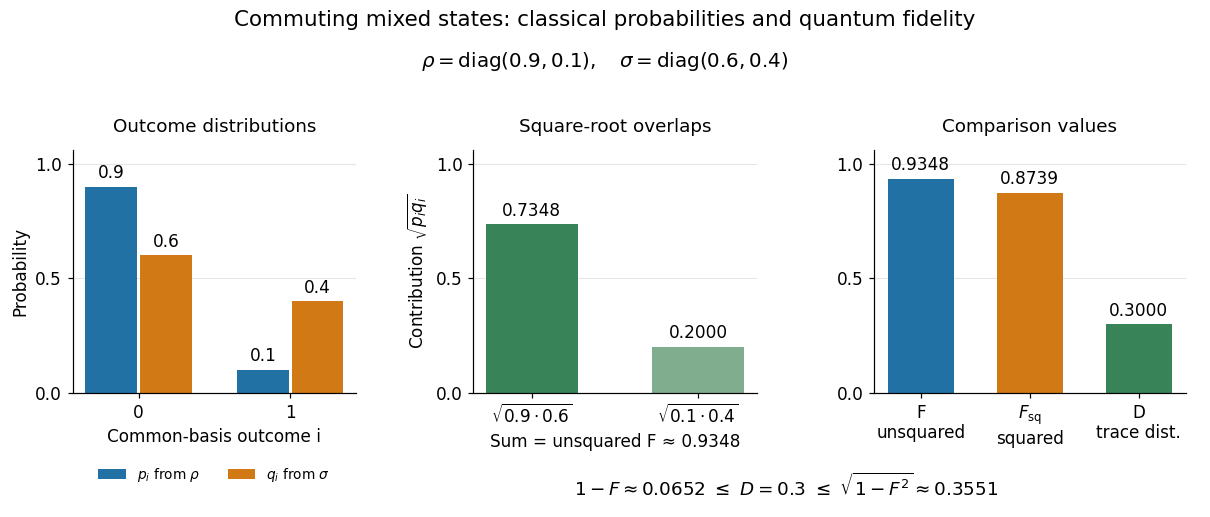
Commuting mixed-state probabilities, square-root overlap contributions to unsquared fidelity F, squared fidelity Fsq, and trace distance D
. Details. 
Here trace distance means an equal-prior quantum state discrimination success of by the Holevo–Helstrom theorem. Measuring in the common computational basis and guessing on outcome zero and on outcome one achieves . Also : the pure-state trace distance and fidelity identity is an equality for pure states, rather than a formula for arbitrary mixed states.
Fidelity of quantum states 2026-10-14
For density operators on the same finite-dimensional Hilbert space, quantum fidelity measures how close their quantum states are. This article uses the unsquared convention:Each square root is the positive square root of an operator, and is the trace norm. Quantum fidelity is symmetric in its inputs; it is one exactly when , and zero exactly when , meaning that the support of a positive operator for one state is orthogonal to that for the other. Larger quantum fidelity means greater similarity. The separate squared quantum fidelity is . [ref]
https://jhwatrous.github.io/TQI.3.pdf#page=16. Watrous, The Theory of Quantum Information, Definition 3.11 and Proposition 3.12
For two normalized pure states, quantum fidelity is the magnitude of their inner product, . Thus compared with itself has , while and have . For , comparison with gives , , and trace distance by the pure-state trace distance and fidelity identity.
Why compare density operators rather than their entries? A change of coordinates should not make the same physical preparations look more or less alike. Unitary invariance of trace distance and fidelity makes quantum fidelity independent of a common basis choice. Multiplying a pure state vector by a global phase leaves its density operator unchanged, so its quantum fidelity with the original state is one. These features make quantum fidelity useful for checking whether quantum channels, state preparations, and Schumacher compression preserve a target quantum state.
The connection to Uhlmann's theorem supplies another beautiful interpretation: quantum fidelity is the largest absolute inner product between pure vectors obtained from a purification of a density operator for each state, using a sufficiently large common reference space. Uhlmann's 1976 paper extended transition probability to algebraic states, including those of a C-star algebra; for density operators its transition probability corresponds to our squared quantum fidelity. The measurement characterization of quantum fidelity gives a complementary description directly in terms of observable outcome statistics. [ref]
https://www.physik.uni-leipzig.de/~uhlmann/PDF/Uh76a.pdf. Uhlmann, The transition probability in the state space of a star-algebra, Reports on Mathematical Physics 9, 273–279, 1976
Past exam of the mathematics course of the University of Cambridge 2004 ib Paper 4 11E iii Solution Created 2026-09-24 Updated 2026-10-14
Choose an orthonormal basis of eigenvectors of the positive-definite operator using the proved spectral theorem. Its eigenvalues are strictly positive, because . Define . It is a positive-definite Hermitian operator and , establishing existence of the positive square root of an operator.
For uniqueness, let be any positive-definite Hermitian square root. The identity implies , so preserves each eigenspace of . Its restriction to that space is Hermitian and positive-definite. Diagonalize that restriction by the same spectral theorem. Every resulting eigenvalue satisfies and , hence . Therefore acts as on the entire eigenspace, even when is repeated. These eigenspaces span the space, so the positive-definite Hermitian square root is unique, with eigenvalues .
Past exam of the mathematics course of the University of Cambridge 2005 iii Paper 58 4 i Solution Created 2026-10-03 Updated 2026-10-14
For a positive operator , the spectral theorem writes with . Hence its unique positive square root of an operator is . Conjugating this spectral decomposition shows for a unitary operator .
Let and . Then and . The square-root covariance and the cyclic property of the trace giveFor the quantum fidelity, covariance first gives . ThereforeApply the same square-root identity and the cyclic property of the trace to obtainThus unitary invariance of trace distance and fidelity givesThe same acts on both quantum states: these quantities depend on the relative distinguishability of the quantum states, not on a choice of basis.
Past exam of the mathematics course of the University of Cambridge 2008 iii Paper 1 8 a Solution Created 2026-10-03 Updated 2026-10-14
A bounded self-adjoint operator is a positive operator when for every . Equivalently its quadratic form is nonnegative. We construct its positive square root of an operator directly and prove uniqueness.
If its positive square root is zero. Otherwise set , , and . Then and is positive. It is also a contraction. Indeed, the Cauchy-Schwarz inequality for the positive form gives , and henceThe scalar binomial series has the formThe last equality follows by taking in the nonnegative series. Thereforeconverges in operator norm. Every is a positive contraction: its even powers are squares, its odd powers have form , and their norms are at most one. Each partial sum for is consequently positive, since it is at least . The limit is positive. Multiplying the absolutely convergent series and using the scalar coefficient identity gives . This construction also shows that is a norm limit of polynomials in and thus commutes with every operator commuting with .
Now suppose is another positive square root. It commutes with , hence with . ThusThe difference vanishes on the range of and on its closure. It also vanishes on its kernel: if , the fact that and are positive operators gives , and the Cauchy-Schwarz inequality for their positive forms implies . Since is self-adjoint, the orthogonal sum of its kernel and closed range is all of . Therefore , proving
Past exam of the mathematics course of the University of Cambridge 2009 iii Paper 8 4 b Solution Created 2026-10-03 Updated 2026-10-14
For a bounded self-adjoint , nonnegative spectrum is equivalent to . Here is a useful elementary justification of the nontrivial direction. Let and , so has nonnegative quadratic form. Cauchy-Schwarz for that positive form gives . Taking unit vectors approaching the infimum makes , hence . Thus nonnegative spectrum forces . The reverse direction follows from the lower bound and adjoint argument for when , together with reality of the self-adjoint spectrum.
If its positive square root is zero. Otherwise set and , so and . Write the scalar binomial seriesThe last equality follows by taking in this positive-coefficient series. Consequentlyconverges absolutely in operator norm. Each partial sum is positive, because and the sum of its coefficients is at most one. The limit is positive and self-adjoint. Multiplying the absolutely convergent series gives .
For uniqueness let be another positive square root. It commutes with , hence with the polynomial-norm-limit . Thus . The kernel of is : zero quadratic form for a positive operator implies it annihilates the vector, by positive-form Cauchy-Schwarz. The difference vanishes there and on ; the latter is dense in the kernel complement because is self-adjoint. Therefore . The positive square root of an operator exists and is unique.
Past exam of the mathematics course of the University of Cambridge 2010 iii Paper 48 3 a ii Solution Created 2026-10-03 Updated 2026-10-14
For positive operators, the unique positive square root of an operator respects tensor products: . To verify this, diagonalize ; the product eigenvectors have eigenvalues , whose square roots are . Hence the operator inside the outer square root in the fidelity factors asTaking its positive square root and using gives .
Past exam of the mathematics course of the University of Cambridge 2016 iii Paper 323 3 i Solution Created 2026-10-03 Updated 2026-10-06
The absolute value of an operator, trace norm, and operator norm are respectivelyThe positive square root of an operator makes well defined. Its eigenvalues are the singular values of , so and .
Use the polar decomposition of a bounded operator , with the given unitary operator . In an orthonormal eigenbasis for ,The operator norm assumption and unitarity imply . The triangle inequality therefore yields the required trace estimate:Choosing attains equality, which also gives the finite-dimensional trace duality formula . A singular causes no difficulty: in a finite-dimensional square space the polar factor can be extended to a unitary operator on the complementary subspaces.
With ,The partial trace over isIts norm is . The positive square root of an operator is unique, proving the claim.
Past exam of the mathematics course of the University of Cambridge 2024 iii Paper 225 3 c Solution Created 2026-09-24 Updated 2026-10-03
The two rank-one operators have orthogonal ranges. Their Hilbert-Schmidt inner product is zero, while , so the Hilbert-Schmidt distance between covariance operators isFor each , the positive square root of an operator is . Orthogonality therefore gives the square-root distance between covariance operatorsFinally , so every singular value in the Procrustes cross-term vanishes. Hence
Positive operator Created 2026-09-24 Updated 2026-10-14
A bounded Hermitian operator on a Hilbert space is positive, also called a positive semidefinite operator, whenThe value must be real as well as nonnegative. This permits zero values on nonzero vectors: the zero linear operator is positive. For a bounded Hermitian operator, positivity is equivalent to its spectrum being contained in ; in finite dimension, this is the condition that all eigenvalues are nonnegative.[ref]
https://ocw.mit.edu/courses/18-102-introduction-to-functional-analysis-spring-2021/345c4a5141559a4069aeb3105acd8ef3_MIT18_102s21_lec21.pdf. Rodriguez, notes by Andrew Lin, MIT 18.102, lecture 21, Corollary 225, 2021
The Hermitian operator diagram separates three cases. is self-adjoint but not positive, because . The orthogonal projection is positive semidefinite, with , but is not strictly positive on every nonzero vector. The complex Hermitian matrix is positive definite because whenever . For real symmetric matrices, MIT's lecture 27 relates these tests to the geometry of quadratic forms and their minima.[ref]
https://ocw.mit.edu/courses/18-06sc-linear-algebra-fall-2011/d163e012754258d3b374548504d8a18a_MIT18_06SCF11_Ses3.3sum.pdf. Strang, MIT 18.06SC, lecture 27 summary, Positive definite matrices and minima, pp. 1–2, 2011
A fundamental source of positive operators is for a bounded linear operator :For the complex matrix used above,Its eigenvalues are and , both positive. Positivity organizes the squared error minimized by a least-squares solution: the same occurs in the normal equation for a linear inverse problem. The positive square root of an operator gives the converse squared-length description, for every bounded positive operator .
On a real Hilbert space, nonnegativity of alone does not imply self-adjointness, so the Hermitian operator hypothesis is part of the definition. On a complex Hilbert space, real-valuedness of all these expressions already forces self-adjointness by the polarization identity.
Strict positivity and a uniform positive lower bound also differ in infinite dimension. On the l2 sequence space, the bounded Hermitian operator satisfiesConsequently no satisfies for every . Compare the positive definite symmetric operator and uniformly positive definite symmetric operator conditions.
For any unitary , the unique positive square root of an operator obeys . Conjugating the positive operators appearing in trace distance and quantum fidelity therefore conjugates their square roots. Cyclicity of the trace removes the unitary factors, proving invariance of both quantities under simultaneous unitary transformations of the states.
// Target: quantum-information-theory.bigb