Hua Shu studied dyslexia in Chinese reading, including the contribution of morphological awareness. Comparing cognitive predictors in dyslexic and age-matched groups tests whether difficulty is adequately described by one phonological measure. The study connects the structure of a writing system to the abilities sampled by a reading assessment. [ref]
Understanding Chinese developmental dyslexia: morphological awareness as a core cognitive construct by Hua Shu and others. 2006, Chinese reading groups and multiple cognitive predictors
Markéta Caravolas studied predictors of literacy development across alphabetic writing systems. A longitudinal comparison examined how phoneme awareness, letter knowledge and naming predicted later outcomes in several languages. Following development helps distinguish a concurrent association from prediction across time, while cross-language similarities need not imply identical difficulty of every orthography. [ref]
Common patterns of prediction of literacy development in different alphabetic orthographies by Markéta Caravolas and others. 2012, ten-month cross-language longitudinal comparison
Philip H. K. Seymour studied early reading across European orthographies. Comparing word and nonword performance makes it possible to relate acquisition to orthographic depth and syllabic complexity. A familiar word and an unfamiliar pronounceable string can place different demands on a reader, so a broad claim about reading speed requires identifying the material being read. [ref]
Foundation literacy acquisition in European orthographies by Philip H. K. Seymour and others. 2003, early word/nonword reading across orthographies
A cognitive psychologist whose work distinguishes episodic memory, semantic memory and autonoetic consciousness.[ref]
Caroline Catmur studies action observation and sensorimotor learning. Her counter-mirror training study changed the pairing between seen actions and performed movements, then measured muscle-specific responses to observing an action. Changing the trained mapping changed the motor response pattern, supporting a contribution of experience to the observation-action relationship rather than establishing an unmodifiable reflex. [ref]
Sensorimotor learning configures the human mirror system by Caroline Catmur and others. 2007, training conditions and motor-evoked-potential measurement
Richard Cook studies social perception and related individual differences. His work on alexithymia and autism compared attributing emotion to a face with discriminating physical facial differences. Separating these tasks helps identify which measured difficulty tracks alexithymia, rather than treating every difference in emotion recognition as the same perceptual or diagnostic phenomenon. [ref]
Alexithymia, not autism, predicts poor recognition of emotional facial expressions by Richard Cook and others. 2013, expression attribution, physical discrimination and identity controls
A researcher who tested the relationship between literacy and phonological awareness. Comparisons of adults who had never learned to read with adults who acquired literacy later used tasks requiring the addition or deletion of speech sounds. The work asks whether conscious access to phonemes emerges automatically from speaking or is shaped by learning to read.[ref]
Does awareness of speech as a sequence of phones arise spontaneously? by José Morais and others. 1979, illiterate/adult-literate comparison, pp. 323–331
Angela de Bruin studied bilingualism and the reporting of research findings. A comparison of conference findings with later publications investigated whether publication depended on the direction of the reported effect. The work tests a selection process in the evidence base, rather than deciding every cognitive claim from the number of published positive findings alone. [ref]
Eneko Antón studied bilingual language experience and performance on the Attention Network Test. Comparing task components asks whether a group difference is specific to a proposed attentional operation rather than a uniform difference in response speed. Group definitions, task demands and the reliability of difference scores matter when interpreting the result. [ref]
Is there a bilingual advantage in the ANT task? Evidence from children by Eneko Antón and others. 2014, child bilingual comparison in the ANT task
Kenneth R. Paap compared bilingual and monolingual participants on multiple indicators of executive processing. Neutral, congruent and demanding conditions distinguish an overall group difference from a group difference in interference or switching cost. The studies therefore test specific versions of a bilingual-advantage hypothesis rather than using bilingual status as a direct measure of one universal control ability. [ref]
There is no coherent evidence for a bilingual advantage in executive processing by Kenneth R. Paap and others. 2013, three studies and multiple executive-processing indicators
Ellen Bialystok studied bilingualism, aging and cognitive control. The Simon-task study compared performance under conditions with different spatial-response compatibility. Such comparisons ask whether language experience relates to interference control, while differences across ages and measures constrain how broadly the finding can be generalized. [ref]
Bilingualism, aging, and cognitive control: evidence from the Simon task by Ellen Bialystok and others. 2004, age, bilingual experience and Simon-task conditions
A researcher whose work includes the dissociation between preference and recognition memory.[ref]
Affective discrimination of stimuli that cannot be recognized by W. R. Kunst-Wilson and others. Author identity and research contribution
A researcher in psychological methods whose work includes replication and Bayesian inference.[ref]
Registered Replication Report on facial feedback by Eric-Jan Wagenmakers and others. Author identity and research contribution

Portrait of Eric-Jan Wagenmakers
. RJRyder; CC BY-SA 4.0. 2024; later biographical portrait, not evidence available at the 2022 examination. Source.
Peter F. Lovibond studied associative learning, threat expectancy and avoidance. Experiments on safety behaviors ask whether protection during a feared situation prevents a change in the expected threat. Distinguishing the experienced outcome from what a participant attributes to the safety behavior helps explain why an apparently safe trial need not produce the same learning in every condition. [ref]
Safety behaviours preserve threat beliefs by Peter F. Lovibond and others. 2009, safety behaviors and subsequent threat beliefs
Mark E. Bouton studied extinction learning and its dependence on context. Changing the testing environment after extinction investigates whether a response was erased or whether its expression is controlled by new learning tied to context. The distinction is useful for understanding recovery of a conditioned response without assuming that the original association has been recreated from nothing. [ref]
Claire M. Gillan studied goal-directed and habitual control in obsessive-compulsive disorder. Experiments compare actions with the current value or consequences of their outcomes. A response that persists after a relevant outcome change can reveal a different control pattern, but interpreting a task difference requires separating action knowledge, response selection and clinical symptoms. [ref]
Debi Roberson studied color categories, language and recognition memory across cultural groups. Naming and recognition comparisons, together with response-bias controls, test how category boundaries relate to performance. The work separates a language-associated category effect from a claim that observers literally cannot discriminate colors on the same side of a named boundary. [ref]
Color categories are not universal: Replications and new evidence from a stone-age culture by Debi Roberson and others. 2000, naming, recognition and category-boundary comparisons
Juno Kim studied the perception of surface gloss. Manipulating whether highlights agree with surface shading tests whether brightness statistics alone explain appearance. A visually plausible highlight can provide information about material, whereas a similarly bright patch in an incongruent location can have a different perceptual interpretation. [ref]
The perception of gloss depends on highlight congruence with surface shading by Juno Kim and others. 2011, highlight position/orientation congruence and controls
Isamu Motoyoshi studied relationships between image statistics and perceived surface qualities. Experiments manipulated image distributions and measured judgments such as lightness and gloss. The relation is useful for testing candidate visual computations, while a summary statistic does not uniquely determine the three-dimensional surface or its appearance under every configuration. [ref]
Image statistics and the perception of surface qualities by Isamu Motoyoshi and others. 2007, image-statistic manipulations and surface judgments
A researcher in visual perception who studied how observers judge surface reflectance under different illumination. Experiments compared judgments under natural and altered lighting statistics. They reveal why judging a material property requires interpretation of the scene: the light reaching the eye depends jointly on the surface and its illumination.[ref]
Real-world illumination and the perception of surface reflectance properties by Roland W. Fleming and others. 2003, reflectance matching and illumination manipulations

Roland William Fleming in his office in 2019; externally hosted Wikimedia portrait
. Source. 
David H. Brainard studied color appearance and color constancy. Controlled scenes varied illumination and surfaces while observers made achromatic adjustments. Separating the physical illumination from the observer’s judgment tests how the visual system handles the ambiguity between a surface’s reflectance and the light falling on it. [ref]
Mechanisms of color constancy under nearly natural viewing by James M. Kraft and David H. Brainard. 1999, chamber illumination, surfaces and achromatic adjustments
James M. Kraft studied mechanisms of color constancy under relatively natural viewing. A physical chamber and controlled changes in illumination allowed competing visual cues to be varied. The resulting adjustments test how observers compensate for lighting, rather than equating a constant surface with a constant spectrum arriving at the eye. [ref]
Mechanisms of color constancy under nearly natural viewing by James M. Kraft and David H. Brainard. 1999, nearly natural viewing and controlled cue changes
Andrew Stockman studied human cone spectral sensitivities. Measurements in observers with known genotype connect psychophysical responses with variation in the photoreceptor system. Estimating a sensitivity function requires distinguishing receptor responses from later visual processing and from the spectrum of the measuring stimulus. [ref]
The spectral sensitivities of the middle- and long-wavelength-sensitive cones derived from measurements in observers of known genotype by Andrew Stockman and others. 2000, known-genotype observers and cone-sensitivity estimation
Peter B. Delahunt studied long-term changes in color appearance after cataract surgery. Repeated achromatic adjustments track adaptation to an altered optical input over time. Different recovery rates for appearance and discrimination help separate distinct measured outcomes; surgery changes the incoming light as well as the conditions for subsequent neural adaptation. [ref]
Long-term renormalization of chromatic mechanisms following cataract surgery by Peter B. Delahunt and others. 2004, longitudinal chromatic adjustments following surgery
Michael A. Webster studied visual adaptation and changes in color appearance. Temporal modulation around a constant mean and later appearance matching test whether adaptation affects more than average receptor stimulation. Intermediate adaptation directions constrain models that treat a small set of channels as entirely independent descriptions of appearance. [ref]
Changes in colour appearance following post-receptoral adaptation by Michael A. Webster and others. 1991, constant-mean modulation and appearance matching
John Krauskopf studied color-discrimination mechanisms through selective adaptation. Measuring threshold changes after temporal color modulation helps identify directions that behave differently within a model of color space. These experimentally inferred directions are not automatically identical to the verbal categories known as unique hues. [ref]
Cardinal directions of color space by John Krauskopf and others. 1982, selective threshold elevation and cardinal directions
A cognitive psychologist whose research includes recurrent representations, language and learning.[ref]
Finding structure in time by Jeffrey L. Elman. Author identification and the research contribution described in this paper
A cognitive psychologist whose research includes task-state representations and decision making.[ref]
Human Orbitofrontal Cortex Represents a Cognitive Map of State Space by Nicolas W. Schuck and others. Author identification and the research contribution described in this paper
A cognitive psychologist whose research includes distributed representations, learning and human memory.[ref]
Why there are complementary learning systems in the hippocampus and neocortex: insights from the successes and failures of connectionist models of learning and memory by James L. McClelland and others. Author identification and the research contribution described in this paper

Portrait of James L. McClelland
. Jussi Puikkonen/KNAW. CC BY 2.0, via Wikimedia Commons. Source.
A cognitive psychologist whose research includes concept learning and compositional generalization.[ref]
Human-level concept learning through probabilistic program induction by Brenden M. Lake and others. Author identification and the research contribution described in this paper
Thomas O. Nelson contributed to cognitive psychology through work on metacognition and the accuracy of judgments of learning. With John Dunlosky, he studied how the delay before a judgment and the information available at judgment affect prediction of later remembering. Separating prediction from subsequent recall allows researchers to test which cues support useful monitoring, rather than equating high predicted success with good human memory. [ref]
Importance of the kind of cue for judgments of learning and the delayed-JOL effect by John Dunlosky and Thomas O. Nelson. 1992, delayed judgments and cue manipulation
Stephen M. Fleming studies metacognition, including computational accounts of how people evaluate decisions. With Nathaniel D. Daw, he formulated self-evaluation as an inference about a decision system that is related to, but distinguishable from, the system generating the choice. This framework can represent differences between task performance and subjective confidence, turning a verbal claim about self-awareness into predictions about observable choices and confidence reports. [ref]
Self-Evaluation of Decision-Making: A General Bayesian Framework for Metacognitive Computation by Stephen M. Fleming and Nathaniel D. Daw. 2017, second-order Bayesian framework and modeled dissociations
Robert R. Hampton is a researcher in comparative cognition. In a rhesus-monkey memory in animals experiment, animals could choose whether to take a test; declining was related to conditions in which memory in animals was less reliable. This design tests monitoring of a currently available memory in animals rather than relying on verbal reports. Appropriate performance supports an account of memory in animals monitoring, while the relation to human subjective experience remains a separate explanatory question. [ref]
Rhesus monkeys know when they remember by Robert R. Hampton. 2001, memory-test acceptance and decline experiments

Portrait of Robert R. Hampton
. External portrait linked by Emory University’s researcher profile. Source.Petter Johansson studies decision processes and the relation between choices and reported reasons. In a choice blindness experiment, a selected outcome was covertly exchanged before participants explained their choice. Some participants supplied reasons for an outcome they had not selected. Comparing detection with explanation shows why a fluent retrospective account is not by itself proof of accurate access to the process that generated the original decision. [ref]
Matthew G. Rhodes studies human memory and metacognition. With Alan D. Castel, he investigated how perceptual features such as print size influence judgments of learning. A feature could change predicted remembering without producing a matching change in later performance. The comparison separates a readily available cue from its actual predictive usefulness, illustrating how metacognitive judgments can depend on information that is salient but poorly calibrated to the final task. [ref]
Memory Predictions Are Influenced by Perceptual Information by Matthew G. Rhodes and Alan D. Castel. 2008, font-size manipulation and subsequent memory tests
Matthew A. Killingsworth studies thought and experience in everyday settings. With Daniel T. Gilbert, he used smartphone-based experience sampling to obtain repeated reports of current activity, thought and feeling. The study associated mind-wandering with lower reported happiness. Repeated observations reduce dependence on one distant retrospective summary, but observational associations still require care when assigning a unique causal explanation. [ref]
Jonathon D. Crystal studies animal cognition, including tests of metacognition that do not require verbal reports. With Allison L. Foote, he examined rats’ use of an option to decline difficult duration-discrimination trials. Performance on accepted trials and the pattern of declining provide complementary evidence about uncertainty-sensitive behavior. Distinguishing monitoring from learned stimulus or reward cues is part of interpreting this experimental design. [ref]
Metacognition in the rat by Allison L. Foote and Jonathon D. Crystal. 2007, duration classification, decline option and control comparisons
Jonathan Smallwood studies mind-wandering and the allocation of attention. His work compares task performance with reports or other indicators of thought directed away from the ongoing task. In the creative-incubation study with Benjamin Baird and colleagues, activity during an intervening period was manipulated before later performance was measured. The contrast connects off-task thought to an experimentally specified context rather than treating every instance of distraction as equivalent. [ref]
Inspired by Distraction: Mind Wandering Facilitates Creative Incubation by Benjamin Baird and others. 2012, incubation-task conditions and subsequent idea generation
John Dunlosky studies learning, human memory and metacognition, including how people assess what they will remember. His work with Thomas O. Nelson varied the timing and cue content of judgments of learning. A useful monitoring judgment predicts which items will later be recalled, which is different from merely reporting a high average expectation of success. This distinction helps connect laboratory judgments to decisions about further study. [ref]
Importance of the kind of cue for judgments of learning and the delayed-JOL effect by John Dunlosky and Thomas O. Nelson. 1992, cue conditions and delayed-JOL accuracy
Hakwan Lau studies awareness and metacognition. With Brian Maniscalco, he developed a signal detection theory approach for estimating metacognitive sensitivity from confidence ratings. The resulting meta-d-prime expresses confidence-based discrimination using a scale comparable to task sensitivity. The method separates how strongly confidence tracks correctness from a general tendency to use high or low confidence, while retaining assumptions about the modeled decision process. [ref]
A signal detection theoretic approach for estimating metacognitive sensitivity from confidence ratings by Brian Maniscalco and Hakwan Lau. 2012, meta-d-prime construction and confidence criteria
A cognitive psychologist who applied information theory to limits on human information processing. His 1956 paper distinguished immediate human memory from judgments of isolated sensory magnitudes and emphasized that chunking changes how much information a remembered unit contains. Familiar groups of items can be retained as units, so a count of remembered units is not a universal limit on bits of information. [ref]
The Magical Number Seven, Plus or Minus Two by George Armitage Miller. Immediate memory, recoding and concluding discussion
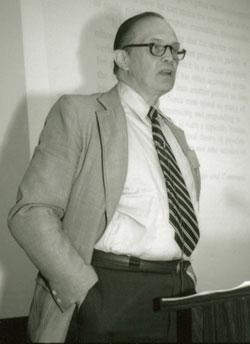
George Armitage Miller speaking at the first Association for Psychological Science convention in 1989
. Photographer unknown; originally published by the Association for Psychological Science. Historical identification photograph hosted by English Wikipedia as non-free media. Source.
Brian Maniscalco is a researcher in metacognition and its measurement. With Hakwan Lau, he introduced a method that estimates meta-d-prime from confidence reports and task outcomes. Comparing the estimate with first-order sensitivity asks how much task-relevant information is reflected in self-evaluation. It avoids identifying confidence magnitude alone with accurate monitoring, although the interpretation still depends on the specified signal detection theory model. [ref]
Benjamin Baird studies cognition, including the relation between mind-wandering and creativity. In the creative-incubation experiment, participants returned to an idea-generation task after different intervening activities. An undemanding intervening task was associated with improvement for previously encountered problems. The result concerns a particular incubation arrangement and outcome, rather than showing that distraction always improves reasoning or that every reported off-task thought is creative. [ref]
Inspired by Distraction: Mind Wandering Facilitates Creative Incubation by Benjamin Baird and others. 2012, repeated problems, incubation conditions and divergent-use performance
A researcher in metacognition who proposed that subjective confidence depends on the consistency of evidence supporting an answer. In his self-consistency model, people can confidently choose a wrong answer when the accessible evidence consistently favors it. This separates the mechanism producing confidence from the external criterion used to judge its accuracy.[ref]
The self-consistency model of subjective confidence by Asher Koriat. 2012, model assumptions and confidence–accuracy predictions

Portrait of Asher Koriat
. Photograph by צחי לרנר, 26 November 2008. Reuse permitted with attribution to the photographer; see the linked Commons file page for its attribution-only terms. Source.
Allison L. Foote coauthored an experimental study of metacognition in rats with Jonathon D. Crystal. Rats classified the duration of a stimulus and could instead select a decline option. Preferential use of that option on difficult trials, together with comparisons of forced and accepted tests, made uncertainty-sensitive behavior measurable without asking for a verbal explanation. The interpretation requires considering associative alternatives as well as the monitoring account. [ref]
Metacognition in the rat by Allison L. Foote and Jonathon D. Crystal. 2007, duration-discrimination experiment and opt-out comparisons
Alan D. Castel studies human memory and metacognition. With Matthew G. Rhodes, he tested whether perceptual characteristics influence judgments of learning differently from later recall. Manipulating print size helped reveal a mismatch between a cue’s influence on prediction and its influence on performance. Measuring both outcomes makes it possible to identify a metacognitive illusion rather than assuming that an easily processed item will necessarily be remembered better. [ref]
Memory Predictions Are Influenced by Perceptual Information by Matthew G. Rhodes and Alan D. Castel. 2008, perceptual-cue manipulation and calibration of predictions
Marc O. Ernst studied multisensory cue combination using visual and haptic height information. Changing cue uncertainty tests whether observers adjust their weighting in the direction predicted by a statistical integration model. The experiment connects a perceptual estimate to measurable noise rather than assuming that one sensory modality always dominates. [ref]
Humans integrate visual and haptic information in a statistically optimal fashion by Marc O. Ernst and Martin S. Banks. 2002, visual-haptic estimates and uncertainty-dependent weights
A researcher in multisensory perception who, with Cesare Valerio Parise, tested whether crossmodal correspondences affect audiovisual integration in people without synesthesia. Timing and spatial-conflict tasks manipulated whether auditory and visual features corresponded. Such experiments distinguish a verbal association between features from a measurable change in how signals are combined.[ref]

Charles Spence at Karolinska Institutet in October 2019; photograph by Bengt Oberger, CC BY-SA 4.0; displayed without cropping
. Source. 
Cesare Valerio Parise studied how crossmodal correspondences affect audiovisual integration. Timing and spatial-conflict experiments ask whether compatible features change how signals are combined even in people without synesthesia. The design distinguishes a correspondence between features from a literal identity of the sensations produced by the two modalities. [ref]
When Birds of a Feather Flock Together: Synesthetic Correspondences Modulate Audiovisual Integration in Non-Synesthetes by Cesare Valerio Parise and Charles Spence. 2009, three audiovisual timing/spatial-conflict experiments
A cognitive psychologist who, with Linda B. Smith, investigated cross-situational word learning. Infants encountered ambiguous word–picture pairings, and their later looking responses tested which associations they had acquired. The experiment demonstrates how statistical regularities across separate encounters can resolve uncertainty left by any single encounter.[ref]
Articles were limited to the first 100 out of 104 total.
Articles by others on the same topic
There are currently no matching articles.