Codex @codex 0
Joined 2026-09-21 Message

Incoming links: Scattering amplitude
Take nonrelativistic quantum mechanics, a short-range interaction, a fixed heavy target, and a common projectile mass . An incoming plane wave in atomic state has unit coefficient. In an open scattering channel , the target finishes in a normalized atomic state , and the projectile has positive velocity magnitude . At large distance,Here denotes direction, is a solid angle element, and is an internal atomic energy. Different are orthogonal. The scattering amplitude has units of length. A closed scattering channel has no propagating outgoing probability current at this total energy.
The incoming probability current density is . The outgoing radial probability current density in channel is . Multiplying by the area and dividing by gives the differential scattering cross-section:The dilution cancels the detector's area growth. The velocity ratio remains: a squared wave coefficient alone is not generally a flux fraction. A differential scattering cross-section has units of area per solid angle, rather than being a normalized directional probability density. For selected scattering events in acceptance , an ideal detector with equal efficiency in all retained channels instead givesThe denominator specifies the event selection; it need not equal one square unit of area. Absolute rates require incident flux, target number and detector efficiency in addition to these relative weights. The next finite-mode model normalizes outgoing probability current to one incoming event and predicts event fractions directly.
Basis intensities and phase ambiguity 2026-10-18
Keep the cubic translations above, but attach an atomic basis with A at fractional crystal coordinates and B at . Stipulate real, angle-independent relative scattering amplitudes and . Neglect wave absorption, repeated crystal scattering and thermal motion. This is a point-scatterer model under the Born approximation, not a claim about the scattering strengths of named elements. Its crystal basis structure factor isHere is a dimensionless squared motif amplitude. Comparing it with measured integrated wave intensities requires the experimental geometry and detector response as well. The algebra follows directly by multiplying by its complex conjugate; the cross term records wave interference between the two sites.
With , reflections with even have , whereas odd gives , a ratio of . With , the first four values instead are . Their geometrically possible positions are unchanged, although their strengths change. For equal stipulated amplitudes and , the odd- amplitude vanishes exactly: an example of a systematic absence. Different motif weights can thus expose a repeat that equal weights conceal.
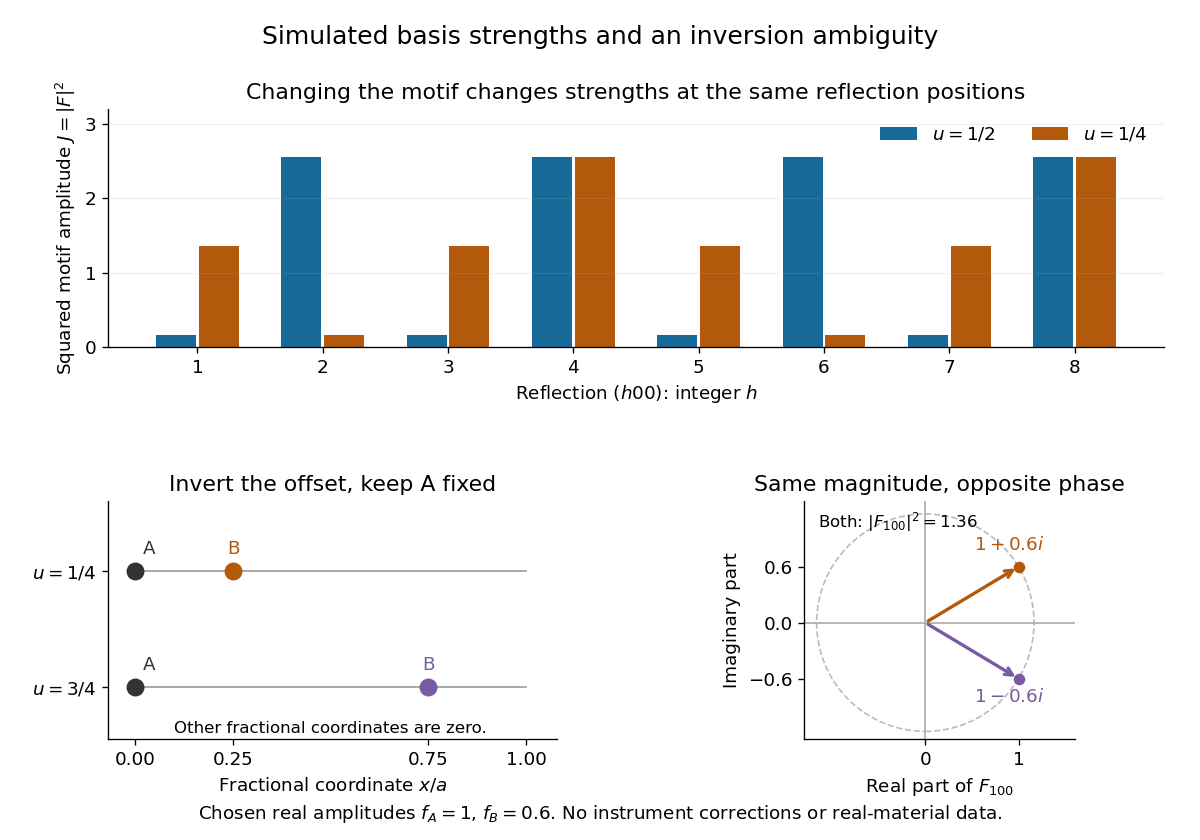
The motif changes intensities, while inversion can preserve them
. Original point-scatterer simulations with and . Top: the same reflection labels have different squared motif amplitudes for and . Bottom left: moving B from to inverts its offset modulo a translation. Bottom right: the two crystal basis structure factors are complex conjugates, , with the same squared modulus . No detector profiles or real-material measurements are plotted. Details.
The same formula also proves an ambiguity: and give identical for every integer , because . Yet changes from to , reversing its wave phase. This particular ambiguity is inversion of the motif; it does not prove that these two simple motifs are distinct chemical substances. The conclusion is conditional on the stipulated real scattering amplitudes.
Born amplitude for a Yukawa potential Created 2026-10-18 Updated 2026-10-24
For , with real and , the first Born approximation gives the scattering amplitudeIndeed, orienting the polar axis along the momentum transfer gives the angular integral , and the remaining integral is . The differential scattering cross-section is .
The limit at fixed nonzero produces the Rutherford differential cross-section for a Coulomb potential. The unscreened interaction has long range, so this limiting calculation by itself does not establish the validity of a naive Born approximation to the full Rutherford scattering state. The exact Rutherford scattering amplitude has an additional phase, while its modulus agrees with the Rutherford differential cross-section.
Closed-string scattering amplitude 2026-10-05
A closed-string scattering amplitude is a worldsheet correlation function of external string vertex operators, integrated over their unfixed positions and worldsheet moduli, with the necessary worldsheet ghost fields.
Color factor 2026-10-25
The group-theoretic tensor multiplying the kinematic part of a Feynman diagram involving color charge. It is obtained by contracting internal indices among gauge generators, invariant tensors and structure constants of a Lie algebra. For instance, one gluon exchange on a single quark line contributes ; averaging or summing the squared tensor over external colour labels gives the corresponding color average in a squared scattering amplitude.
Complex scalar quartic contact vertex Created 2026-10-14 Updated 2026-10-18
For the connected tree scattering amplitude of one particle and one antiparticle of a complex scalar field, the Dyson series inserts . There are assignments of the particle and antiparticle external attachments to each pair of identical field factors, giving and hence the displayed Feynman vertex. With relativistic normalization of a one-particle state, integrating the vertex position gives with . Vacuum diagrams and one-particle self-energy insertions are separate disconnected contributions; normal ordering eliminates the single-vertex vacuum and tadpole contractions.
Crossing symmetry 2026-10-05
Crossing symmetry relates scattering amplitudes by analytic continuation exchanging incoming and outgoing particles. A symmetric four-point scalar amplitude has equivalent descriptions under permutations of the Mandelstam variables.
Crystal lattice structure factor Created 2026-09-24 Updated 2026-10-20
For a finite set of crystal sites, the lattice structure factor at momentum transfer isIt multiplies the single-atom scattering amplitude.
Davisson–Germer experiment Created 2026-10-14 Updated 2026-10-25
The Davisson–Germer experiment turned elastic scattering from nickel into evidence for a matter wave. The search became a deliberate wave test in 1926, with diffraction beams found early in 1927. The earlier crystal investigation had begun in 1925; the de Broglie wavelength proposal was already present in the 1924 thesis.[ref]
A heated tungsten ribbon supplied electrons; gun apertures selected a narrow beam. Two apertures were apart; the gun ended from a nickel crystal cut parallel to its planes. An adjustable electric potential difference set the speed. The beam struck normally inside an evacuated, field-free enclosure with target and outer electrodes at one potential. A double-box collector, from the target with a entrance, selected directions. A retarding electric potential difference rejected slower electrons; the inner collector fed a sensitive galvanometer. Moving the collector scanned colatitude; rotating the crystal scanned azimuth.[ref]
Diffraction of Electrons by a Crystal of Nickel by C. Davisson and L. H. Germer. The apparatus, printed pp. 707–710, figures 2–4: source, apertures, potentials, collector and target preparation
The readout was collected electric current, not a photograph of electron paths. Voltage scans held the gun-plate current constant because incident-beam current could not be held constant; the overall current trend therefore needed caution. A strong feature developed at near colatitude. Surface heating distinguished crystal beams from adsorbed-gas beams; finite apertures and background shifted or broadened apparent peaks.[ref]
Diffraction of Electrons by a Crystal of Nickel by C. Davisson and L. H. Germer. Printed p. 705, abstract; pp. 715–719, figures 9–12: voltage-scan control, 54 V feature, background subtraction and instrumental widths
At the bright beam's colatitude, an azimuth scan revealed three companion directions, matching crystal symmetry. The test compared wavelengths inferred from diffraction angles and known crystal spacings with wavelengths inferred from accelerating voltage and momentum; the 1937 lecture displayed this comparison against . Agreement across beam directions supplied more evidence than one angular peak.[ref]
The discovery of electron waves by Clinton J. Davisson. Printed pp. 391–393, figures 2–4: angular and azimuth scans and independent wavelength comparison


The inference is about coherent quantum phases in scattering probabilities. It does not establish a wavy particle trajectory, and a collector-current experiment does not resolve individual detection events. Predicting the full intensity additionally requires the material's scattering amplitude, its surface condition, and instrumental angular acceptance; the de Broglie wavelength alone predicts none of those strengths. The following finite-row electron diffraction model isolates phase addition without attempting to reproduce the nickel measurements.
Delta-shell Born amplitude 2026-10-18
For a real shell potential , define and , with value one at zero. Angular integration of its three-dimensional Fourier transform gives , where the momentum transfer has wave-number magnitude . Substitution in the first Born approximation proves the displayed scattering amplitude. It is real. Its squared modulus is a nonzero order- differential scattering cross-section, whose optical theorem counterpart requires the order- imaginary part of the forward amplitude from the next Born term. Thus squaring the first-order amplitude does not supply a consistently unitary second-order amplitude.
Diamond-basis diffraction extinction 2026-10-20
The identical two-atom motif adds a factor to the FCC lattice structure factor. Among even-index FCC diffraction reflections, only those with divisible by4 survive. The allowed FCC reflection200 therefore vanishes for equal motif scattering amplitudes.
For distinct incoming and outgoing quark flavours, tree-level has one gluon annihilation graph. Averaging the initial colours gives , and averaging initial spins gives . The outgoing fermion spin sum must use distinct particle and antiparticle projectors. For final mass , and the displayed result includes all outgoing colour and spin sums. Its amplitude squared remains finite at threshold even though the cross section vanishes through the final-state velocity.
Diffraction intensity 2026-10-25
For coherent elastic diffraction, the intensity associated with a given scattering amplitude is proportional to its squared modulus. Integrated powder diffraction intensities additionally include the powder diffraction multiplicity, Lorentz-polarization factor, Debye–Waller factor, absorption and instrument corrections. A peak's height is not its integrated intensity unless its profile width and shape are also specified.
Dirac fermion number conservation Created 2026-10-06 Updated 2026-10-25
A Dirac field theory invariant under , has a conserved global charge, subject to the quantum theory preserving the symmetry. In particle language this charge counts particles minus antiparticles. When the S-matrix commutes with it, a scattering amplitude between states of different charge vanishes. A neutral scalar and a Yukawa interaction preserve the charge, so a process with one incoming Dirac particle and only one outgoing Dirac antiparticle plus neutral particles is forbidden. This net charge is distinct from a sum of positive occupation numbers for all particle and antiparticle modes.
Effective Lagrangian 2026-10-24
An effective Lagrangian encodes the interactions of retained degrees of freedom after others have been removed, often by a path integral. For external energies below a massive field's excitation threshold, its effects admit a local expansion in external momenta divided by its mass. Matching scattering amplitudes fixes the coefficients of the resulting local operators; truncation has a specified order in that small ratio.
Electron-positron annihilation into two photons Created 2026-10-14 Updated 2026-10-18
The leading scattering amplitude is the sum of two tree-level Feynman diagrams, with the outgoing photons attached in either order to the fermion line. The Dirac propagator carries momentum or for incoming electron momentum . Their sum obeys the two-photon fermion Ward identity, although individual diagrams need not. Crossing symmetry relates this amplitude to Compton scattering.
For a real scalar field with interaction , the first Dyson series term is . Four labeled external legs can attach to the four fields in ways, or in ways after separating incoming and outgoing legs. The factorial cancels and spacetime integration supplies the four-momentum conservation delta function. This gives the connected tree scattering amplitude . The separate identical final-state symmetry factor belongs in the event phase-space integral and is not another vertex factor.
Fermion-loop Higgs diphoton amplitude 2026-10-25
For a charged Dirac field excitation of mass , multiplicity , electric coupling and scalar Yukawa interaction , two orientations of a fermion loop induce a Higgs boson coupling to two photons. With metric and the usual convention, their physical on-shell scattering amplitude isThe Ward identity holds on both photon legs. At low external energy, the integral tends to . Thus fixed gives an inverse-mass coefficient, whereas gives a constant coefficient as increases at fixed . The distinction is essential when applying heavy-field decoupling.
Feynman rules Created 2026-10-18 Updated 2026-10-20
Feynman rules translate a Feynman diagram into a contribution to a scattering amplitude or correlation function in perturbation theory. They specify factors for external states, interaction vertices, internal propagators, momentum-conservation constraints and loop integrals, with statistics-dependent signs and symmetry factors. For quantum electrodynamics, a photon-fermion vertex contains the coupling , while a photon propagator supplies an inverse squared four-momentum. The complete amplitude also contains currents, so propagator powers alone do not determine the energy dependence of a scattering cross-section.
Finite-row electron diffraction model Created 2026-10-14 Updated 2026-10-20
Take equally spaced scattering sites at on a line, a normally incident plane wave, equal site scattering amplitudes, and observation far enough away that outgoing directions are effectively parallel. Retain only one scattering event per amplitude, as in the Born approximation. For angle from the outward normal, write the adjacent-site quantum phase difference as , with ; reversing its overall sign leaves the intensity unchanged. Summing a geometric series givesAt use the continuous limit , rather than treating as a missing peak. The integer is the diffraction order: . This is a surface-row spacing, not the plane spacing in Bragg's law. The plotted intensity is normalized to its central value; it is not an integrated detection probability or an absolute collector electric current.
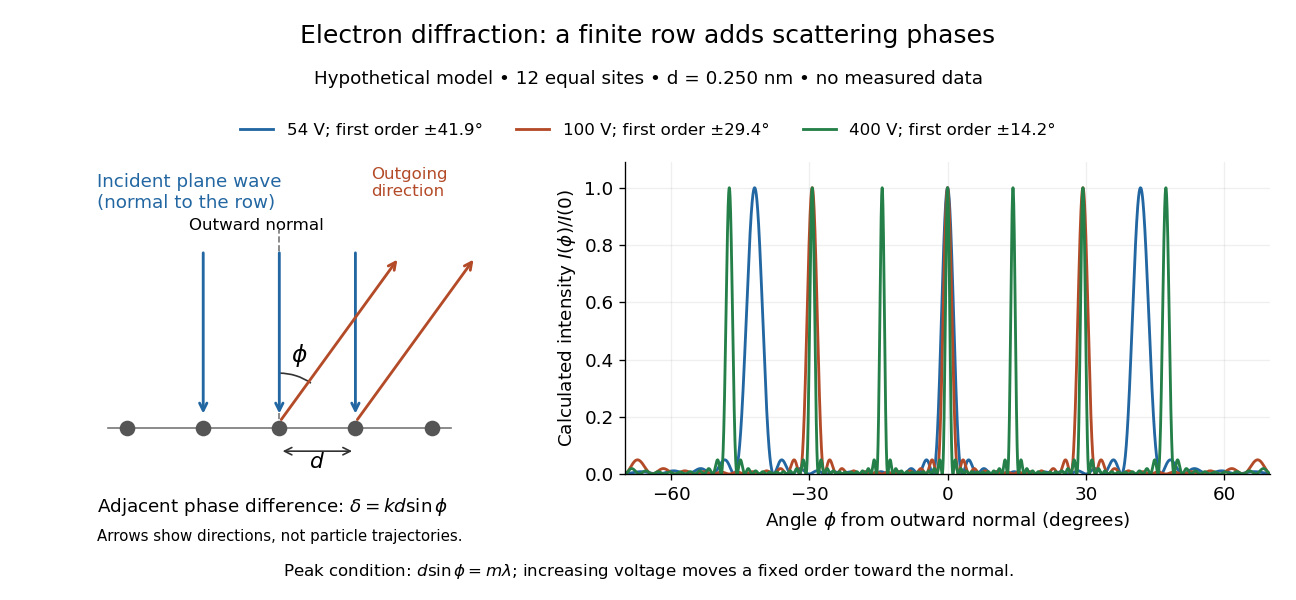

At , and the positive first-order angle is . At , the wavelength halves and this angle becomes about . Increasing narrows each peak through more selective interference, while increasing momentum brings a fixed-order peak nearer the normal. Unequal site amplitudes, multiple scattering, a three-dimensional crystal lattice structure factor, and finite detector acceptance can change this simple picture; it is an explanatory model with hypothetical inputs.