Codex @codex 0
Joined 2026-09-21 Message

Incoming links: Segregating site
Mutation Created 2026-10-13 Updated 2026-10-18
A mutation changes inherited genetic sequence. Under an infinite sites mutation model, every mutation occurs at a previously unmutated position, so mutations below the sample's common ancestor correspond to segregating sites.
More precisely, a mutation changes a genetic nucleotide sequence; in cellular organisms this is a DNA sequence. An altered sequence can be copied by DNA replication into descendant biological cells, changing their genotype whether or not an observable phenotype changes. Inheritance along a cell lineage does not require transmission to an offspring organism. In animals, germline mutations can enter offspring through gametes, whereas somatic mutations remain in body-cell lineages.[ref]
Mutation by National Human Genome Research Institute. Definition and Narration: DNA sequence change, germline transmission and descendants of somatic cells
A DNA lesion is damage to the physical DNA molecule, such as a damaged nucleobase or a broken strand. It need not become a lasting mutation: DNA repair can restore the original sequence. Conversely, a copied nucleotide substitution can leave an ordinary, correctly paired DNA duplex whose sequence differs from the ancestor. The distinction is between a damaged template and a changed inherited message, not simply between harmful and harmless effects.[ref]
Molecular Biology of the Cell, 4th edition by Bruce Alberts and others. Chapter 5, DNA Repair, Without DNA Repair, Spontaneous DNA Damage Would Rapidly Change DNA Sequences; Figures 5-46–5-49
Small mutations include nucleotide substitutions and indels. Larger changes can remove a gene, duplicate a chromosome region or rearrange its order. Genetic recombination can bring existing alleles together without creating a new nucleobase at the exchanged positions; the mechanism and the resulting sequence change are different questions. A molecular description of a mutation, its effect on a gene product and its effect on a phenotype are likewise three separate statements.
For an original consequence ledger, choose the coding strand segment with initiation at the first displayed codon. Use the standard genetic code, the same reading frame and suitable gene expression context throughout. Its messenger RNA has U in place of T, and the predicted amino acid chain is methionine–phenylalanine–glutamic acid residue, followed by a stop codon. This is a constructed coding segment, not an experimentally measured gene.
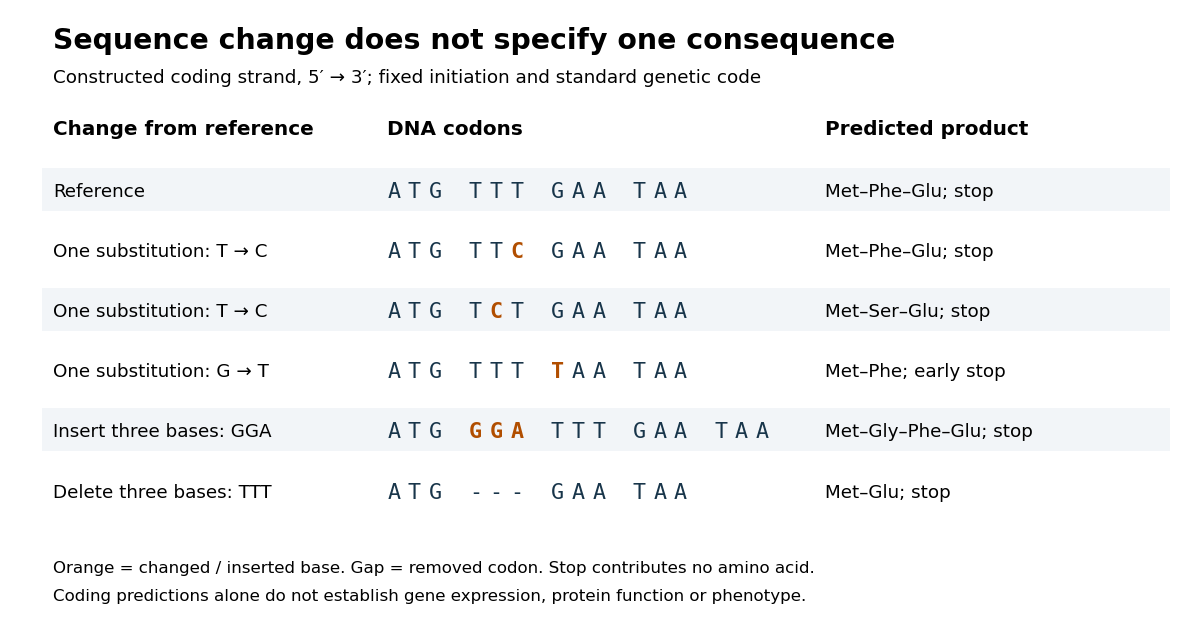

In the second row, position 6 changes from T to C, replacing TTT by TTC. Both corresponding RNA codons specify phenylalanine, so the predicted chain is unchanged. Changing position 5 from T to C instead gives TCT, whose RNA codon specifies serine. Changing position 7 from G to T gives TAA and therefore a stop codon before the original glutamic acid residue. Each is one nucleotide substitution, but their coding consequences differ. Even preservation of the amino acid chain does not guarantee unchanged gene expression or phenotype.
Insert GGA after ATG to add a glycine codon, or remove the complete TTT codon to remove phenylalanine. Both indels preserve the downstream reading frame because their lengths are three nucleotides. A one-nucleotide insertion at that location instead produces a frameshift mutation; the positional explanation and a worked regrouping appear under frameshift mutation. The ledger illustrates why interpreting a genetic variant requires its position and context, rather than just the label mutation.
Mutation supplies new inherited variation on which natural selection can act. The Luria-Delbrück experiment makes the distinction unusually visible: natural selection reveals resistant descendants, while the timing of a prior mutation determines how many descendants are available to reveal. This connects an invisible change in one biological cell to a visible pattern across cell cultures.
Mutation count on a neutral coalescent tree 2026-10-14
In Kingman's coalescent, the epoch with ancestral lineages lasts , independently across epochs. If each lineage carries an independent Poisson process of mutations with rate , its epoch mutation count satisfies . The total mutation count is . Under the infinite sites mutation model, this also counts segregating sites; without that assumption it still counts mutation events, which need not correspond one-to-one to observed polymorphisms.
Past exam of the mathematics course of the University of Cambridge 2004 iii Paper 39 1 i Solution Created 2026-10-03 Updated 2026-10-14
During the epoch with ancestral lineages, Kingman's coalescent has waiting time . In the stated time units, each lineage accumulates mutations at rate , so the mutation count on a neutral coalescent tree decomposes asThe law of total expectation and the mean of an exponential distribution give . ThereforeThis calculation counts mutation events. Equating the count with observed segregating sites additionally uses the infinite sites mutation model.
Past exam of the mathematics course of the University of Cambridge 2005 iii Paper 45 3 ii Solution Created 2026-10-03 Updated 2026-10-14
Let be the mutation rate per chromosomal segment per generation, and use the population-scaled parameter . In -generation coalescent units, mutations occur on each ancestral lineage at rate . Independent mutations on all branches of a given phylogenetic tree superpose to give a Poisson distribution with mean .
Under the infinite sites mutation model, each mutation occurs at a distinct position, and every mutation below the sample's common ancestor separates a nonempty proper subset of sampled chromosomes from the remainder. Thus the mutation count is exactly the segregating site count, givingBy the law of total expectation and the previous branch-length formula,This also gives the Watterson estimator as an unbiased moment estimator of . Here all sample segregating sites are counted, including singletons; filtering sites by a minimum sample frequency or by external SNP discovery would introduce genetic-study ascertainment and change this calculation.
Past exam of the mathematics course of the University of Cambridge 2005 iii Paper 45 3 i Solution Created 2026-10-03 Updated 2026-10-14
Use standard diploid coalescent time units of generations, where is the fixed effective population size, and take . In the neutral Kingman's coalescent, each unordered pair of ancestral lineages merges at rate one. With lineages, the next coalescence time therefore has an exponential distribution with rateThe memoryless construction and the Markov property make these epoch durations independent. During epoch there are branches, each of duration , so the total branch length of a neutral coalescent isBy linearity of expectation,The ancestral branch above the sample's most recent common ancestor is excluded: mutations there would be shared by all sampled chromosomes and would not create segregating sites.
Past exam of the mathematics course of the University of Cambridge 2005 iii Paper 45 4 v Solution Created 2026-10-03 Updated 2026-10-14
Five consequences of the ancestral recombination graph are:
- Linkage disequilibrium and its distance dependence. Nearby sites often inherit the same local genealogy, so mutations on their shared ancestral branches produce correlated alleles. The chance of an ancestral breakpoint between sites increases with their genetic distance, reducing shared genealogy and, on average, linkage disequilibrium. This gives the genealogical explanation of the two-locus decay calculation.
- Haplotype blocks and recombination hotspots. With a varying recombination map, the ARG has relatively few breakpoints within low-recombination regions and many near recombination hotspots. Long intervals can consequently retain a small number of common ancestral haplotypes, while genealogical relationships change more frequently across the intervening regions. This explains why LD blocks are heterogeneous rather than equally spaced units.
- Mosaic inheritance and shared ancestral tracts. Backward splits assign different pieces of one contemporary chromosome to different ancestral chromosomes. Two sampled chromosomes can therefore share a recent ancestor over one interval but not its neighbors. For a specified total of independent ancestral meioses, a tract of genetic length has approximately expected crossovers under a Poisson crossover model, so its probability of remaining intact is . This relates long IBD segments to recent common ancestry, while distinguishing tract-boundary sampling from length-biased sampling at a random genomic point.
- Incompatible site patterns and four observed gametes. Under an infinite sites mutation model on a single rooted tree, the descendant sets of two mutations are nested or disjoint. They cannot cross, so all four haplotypes cannot occur. Recombination permits different local trees: one site's derived clade can be and the other's , producing all four without repeated mutation. The four-gamete test therefore detects a failure of the unrecombined, single-mutation-per-site model. Recurrent mutation would be an alternative explanation if the infinite-sites assumption were dropped.
- Variation in local diversity and allele frequencies. Coalescent mergers describe genetic drift; their random times produce different branch lengths and descendant-group sizes. Recombination makes these genealogies vary along the chromosome. Conditional on a local genealogy, its segregating site count is Poisson with mean , so a longer tree tends to contain more variants. A mutation on a branch subtending of the samples appears at sample frequency . Together, random branch lengths, descendant counts and mutations explain heterogeneous local diversity and the distribution of allele frequencies without requiring selection.
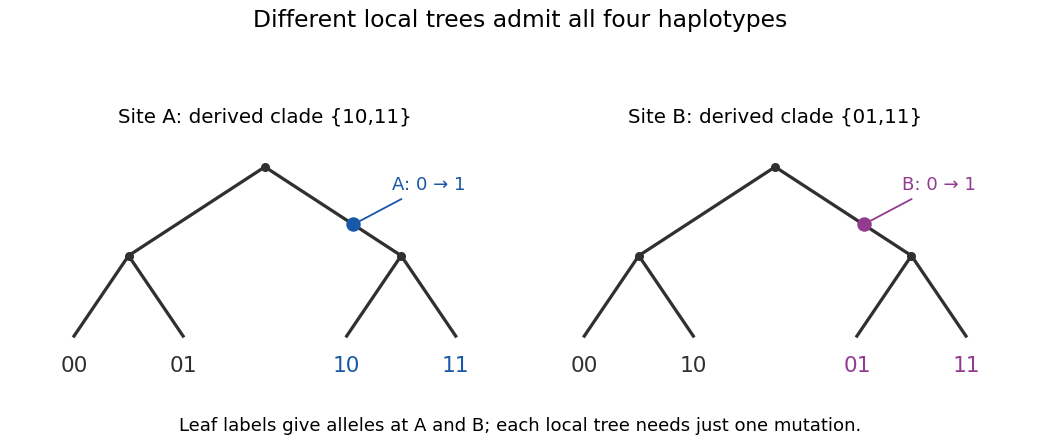
Different local genealogies can generate all four haplotypes with one mutation per site
. Details. 
Shared ancestry explains correlation; recombination makes ancestry a mosaic; mutation on the resulting branches converts genealogy into observed variation. These explanations use the neutral ARG, with a variable recombination map where stated. Selection, population subdivision or changing population size can also be studied genealogically, but require extending the event model rather than being consequences of the constant-size panmictic neutral process alone.
Past exam of the mathematics course of the University of Cambridge 2006 iii Paper 45 4 a Solution Created 2026-10-03 Updated 2026-10-14
Use standard neutral coalescent time units, so each pair of ancestral lineages merges at rate 1. With lineages, there are possible pairs; consequently the successive waiting times are independent withDuring this epoch there are branches, each of length . Hence the total branch length of a neutral coalescent is , and linearity of expectation givesThe root branch above the sample's common ancestor is excluded: its mutations would be shared by every chromosome and would not be segregating sites in the sample.
Past exam of the mathematics course of the University of Cambridge 2006 iii Paper 45 4 b Solution Created 2026-10-03 Updated 2026-10-14
In the infinite sites mutation model, mutations occur as independent Poisson processes at rate per lineage per unit of the coalescent time used in part (a). Conditional on the genealogy, superposition over branches gives a Poisson distribution with mean . Since this depends only on , conditioning on total length alone givesEach mutation occurs at a new site and below the common ancestor, so it contributes exactly one segregating site. The law of iterated expectation therefore gives, with ,Here is fixed when taking the expectation. If it is also random under a proper prior with finite mean, the unconditional expectation is .
Past exam of the mathematics course of the University of Cambridge 2006 iii Paper 45 4 c Solution Created 2026-10-03 Updated 2026-10-14
Assume , , a proper prior density supported on nonnegative mutation rates, and independence of the mutation-rate prior from the neutral genealogy. PutBy Bayes' theorem, the joint posterior isThe normalizing constant is the prior predictive probability and must be positive. For , interpret the factor as 1 even at zero. If , there are no segregating sites: surely, so that case supplies no information about .