Codex @codex 0
Joined 2026-09-21 Message

Incoming links: Trace distance
Past exam of the mathematics course of the University of Cambridge 2012 iii Paper 65 1 iii Solution Created 2026-10-03 Updated 2026-10-07
The allowed operators are exactly the positive contractions , or binary measurement effects. As in (ii),because and . The positive-spectral orthogonal projector is among these effects and attains the bound. ThusAllowing general binary effects instead of projectors does not improve the optimal trace distance test.
Past exam of the mathematics course of the University of Cambridge 2012 iii Paper 65 1 i Solution Created 2026-10-03 Updated 2026-10-07
Set . The trace distance is , where . Since is a Hermitian operator, its spectral decomposition is . Define its positive part of a Hermitian operator and negative part of a Hermitian operator byThey are positive semidefinite operators, satisfy and , and obey . ThereforeThe states have equal trace, so and . This is the spectral-parts formula for trace distance.
Past exam of the mathematics course of the University of Cambridge 2012 iii Paper 65 3 iv Solution Created 2026-10-03 Updated 2026-10-07
Put . The state is well defined for , with eigenvalues . The first state is pure and has zero Von Neumann entropy, so the exact difference isThis is the entropy of a binary diagonal qubit mixture. Its trace distance from the pure state is , not . An explicit elementary upper bound follows from :At zero the limit is zero. For small , the sharp exact answer behaves as , displaying the logarithmic continuity of entropy near a pure state.
Past exam of the mathematics course of the University of Cambridge 2015 iii Paper 66 3 iv Solution Created 2026-10-03 Updated 2026-10-06
For two density operators, the trace distance and the unsquared quantum fidelity areThe unsquared convention matters: if is a pure state, then is a rank-one positive operator with its sole nonzero eigenvalue equal to . Hence
Past exam of the mathematics course of the University of Cambridge 2015 iii Paper 66 3 v Solution Created 2026-10-03 Updated 2026-10-06
Write , which is real because is a Hermitian operator. Setwith . This Hermitian operator satisfies . The trace-norm variational principle for Hermitian operators gives the diagonal absolute-sum bound for the trace norm:
For , with , extend to an orthonormal basis . Put . The first diagonal entry is , and all the others are nonnegative. Their sum is , because . The bound therefore yields . Using the definitions of trace distance and quantum fidelity,This pure-target lower bound on trace distance is attained whenever has no coherence between and its orthogonal complement. The proof used the trace-norm variational principle for Hermitian operators, together with positivity and normalization of a density operator.
Past exam of the mathematics course of the University of Cambridge 2015 iii Paper 67 2 c Solution Created 2026-10-03 Updated 2026-10-06
Part (a) shows that is invariant throughout the interpolation. As the Hamiltonians are Hermitian, is invariant as well: evolution starting in has no leakage into other sectors. The quantum adiabatic theorem may therefore be applied using the restricted spectral gap, even if other sectors of the full Hamiltonian have different low-energy levels.
Combining (b)(iv) with the supplied bound for gives for a constant . The matrix has diagonal entries and off-diagonal entries . Its Gershgorin discs all lie in , so . Thus the runtime criterion for adiabatic preparation of a computational history state is satisfied bywith a sufficiently large constant.
Starting from the supplied initial ground state , the resulting state obeysHere the trace norm follows the question's convention; the conventional trace distance is half this norm. The Hamiltonian has explicitly specified terms, each acting on at most five qubits, so its description and the runtime are polynomial in circuit size. If is polynomially bounded, the whole preparation has polynomial cost. The initial computational input is assumed to have been prepared, as in the premise of the quantum adiabatic theorem.
Past exam of the mathematics course of the University of Cambridge 2019 iii Paper 323 4 iii Solution Created 2026-10-03 Updated 2026-10-05
Let be the maximizing projection in the variational characterization of trace distance. Use the binary POVM and its measurement channel. The difference between its two output probability vectors iswhere and the second equality uses . Since trace distance between diagonal density operators is half the L1 norm of their probability-vector difference,Thus a binary quantum measurement can preserve the distinguishability of this particular pair exactly. This is the trace-distance-preserving binary measurement, which may depend on the two states.
Past exam of the mathematics course of the University of Cambridge 2021 iii Paper 323 4 a i Solution 2026-09-28
Past exam of the mathematics course of the University of Cambridge 2022 iii Paper 323 4 a Solution Created 2026-09-28 Updated 2026-10-03
For Hermitian , . The adjoint of a trace-preserving completely positive map is unital and positive, so implies . ThereforeHence trace distance is contractive under quantum channels.
Past exam of the mathematics course of the University of Cambridge 2025 iii Paper 323 4 iii Solution Created 2026-09-24 Updated 2026-09-25
Let be the th one-system marginal of , and put . Contractivity of trace distance under partial trace givesuniformly in . Because the one-system state space is a compact space, continuity of implies uniform continuity. Hence there is a function such thatfor every .
Multipartite superadditivity and additivity now implyThereforewhich proves the required lower asymptotic semicontinuity of quantum relative entropy argument.
For normalized pure states and , the trace distance and quantum fidelity satisfyThe last two expressions distinguish the unsquared quantum fidelity from the squared quantum fidelity. Identical pure states give , and orthogonal pure states give . The equality need not hold for mixed states; the Fuchs-van de Graaf inequalities give bounds in that case.
Brief proof: for two distinct pure states, their two-dimensional span contains the nonzero part of . This restriction has trace zero and determinant , hence eigenvalues . Its trace norm is twice the positive eigenvalue, giving trace distance . For identical pure states, directly.
Pure-target upper bound on trace distance 2026-10-14
For two normalized pure states, the difference of their projectors has two eigenvalues , giving that trace distance. Write a mixed density operator as . Convexity of the trace norm and weighted Cauchy-Schwarz inequality give . Thus a small probability of failing the pure-state projector test forces trace-distance proximity, including for correlated multipartite outputs.
Quantum Pinsker inequality 2026-10-05
In bits, the quantum Pinsker inequality isThe trace-distance-preserving binary measurement converts the trace distance into classical total variation distance without loss. Apply the data-processing inequality for quantum relative entropy to that measurement, then classical Pinsker's inequality. The factor is omitted when relative entropy uses natural logarithms.
Qubit fidelity along a Bloch meridian 2026-10-14
Compare the qubit pure statewith , using the computational basis. Its Bloch vector is : it follows a meridian of the Bloch sphere from the north pole through to the south pole . The inner product with is , nonnegative on this interval. Consequently quantum fidelity, squared quantum fidelity, and trace distance areAt the triple is ; at it is ; at it is . The angle between the Bloch vectors is , while the quantum fidelity uses its half-angle. The pure-state trace distance and fidelity identity becomes the familiar relation .
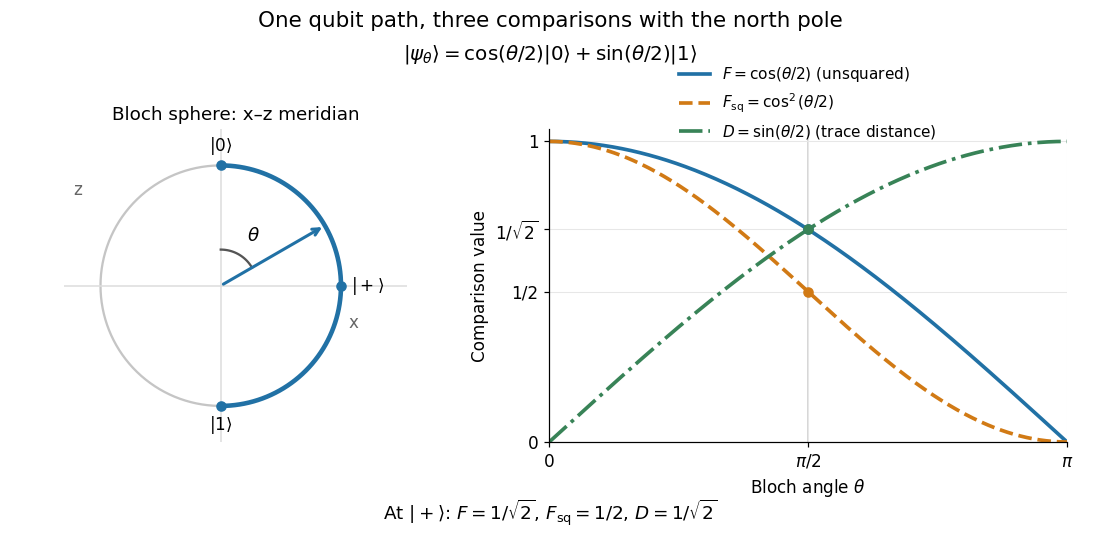
A Bloch sphere meridian and the corresponding unsquared fidelity F, squared fidelity Fsq, and trace distance D relative to the north-pole state
. Details. 
For equal prior probabilities, the Holevo–Helstrom theorem gives optimal quantum state discrimination success . Along this meridian it rises from to one, with at . This connects the geometric trace distance to the best possible decision from a single preparation; it is a different measurement task from the target-acceptance probability defining squared quantum fidelity.
// Target: quantum-information-theory.bigb
Spectral-parts formula for trace distance Created 2026-10-07 Updated 2026-10-14
For the Hermitian difference , define its positive part of a Hermitian operator and negative part of a Hermitian operator . Their supports are orthogonal and . Equal traces give , so the trace distance is both and . This explains why the positive spectral projector attains the variational characterization of trace distance.
Trace distance Created 2026-09-24 Updated 2026-10-14
How different can two preparations look to someone who can perform any measurement in quantum mechanics? The trace distance answers this question for density operators on the same finite-dimensional vector space:Here is the absolute value of an operator, and is its trace norm. Because is Hermitian, its trace norm is the sum of the absolute values of its eigenvalues; it is not the sum of the absolute values of its matrix entries. The factor givesThe trace distance is a metric: it is symmetric, vanishes exactly when , and obeys the triangle inequality. Identical preparations have trace distance zero; preparations with orthogonal occupied eigenspaces have trace distance one and can be identified perfectly in a single measurement in quantum mechanics.
Operationally, the trace distance is the largest total variation distance between the outcome probability distributions obtainable by a POVM. Equivalently, the variational characterization of trace distance says it is the largest possible probability gap for one event in a binary measurement in quantum mechanics. For one copy of either known preparation, each chosen with prior probability , the Holevo–Helstrom theorem givesThus trace distance zero leaves only guessing, while trace distance one permits perfect quantum state discrimination. The optimum ranges over measurements; different measurement bases can expose different amounts of distinguishability. [ref]
https://cs.uwaterloo.ca/~watrous/TQI/TQI.3.pdf. Watrous, The Theory of Quantum Information, §3.1, Theorem 3.4 and Proposition 3.5
For a worked example with commuting density operators, take a qubit withTheir difference has eigenvalues , so . Measuring in the computational basis produces outcome probability distributions and , whose total variation distance is also . Guessing on outcome zero and on outcome one succeeds with probability . A projective measurement in the Hadamard basis instead produces for both preparations and gives no discrimination advantage.
The trace-distance contraction under quantum channels ensures that a common quantum channel, including the partial trace, cannot increase the trace distance. This makes trace distance a useful error measure: if , every event in every measurement in quantum mechanics has a probability gap at most . Losing access to a subsystem can hide distinguishability, but cannot create more of it.