Codex @codex 0
Joined 2026-09-21 Message

Incoming links: Type-II superconductor
Alexei Abrikosov (physicist) Created 2026-10-24 Updated 2026-11-05
Alexei Abrikosov showed how a type-II superconductor can admit magnetic flux while remaining superconducting over most of its volume. In the mixed state, circulating supercurrents surround vortex cores where the superconducting order parameter is suppressed. An array of these vortices can minimize the free energy between the lower and upper critical magnetic fields. The resulting vortex lattice explains a regime that lies between complete magnetic-field expulsion and destruction of superconductivity.[ref]
Nobel Lecture: Type-II superconductors and the vortex lattice by Alexei Alexeyevich Abrikosov. mixed-state solution, vortex currents and critical fields
A physicist who studied superconductivity at Argonne.[ref]
Alexei Alexeyevich Abrikosov by Michael R. Norman and Andrey A. Varlamov. Independent professional identity

Portrait of Alexei Abrikosov (physicist)
. ANL; 10 December 2003. Public domain in the United States: U.S. Department of Energy employee work. Source usage terms, via Wikimedia Commons. Source.
H. Träuble Created 2026-10-18 Updated 2026-11-05
Coauthored the report of direct observation of individual Abrikosov vortex structures, probing the magnetic structure of type-II superconductors.[ref]
The direct observation of individual flux lines in type II superconductors by U. Essmann and H. Träuble. Published title and coauthor listing
Limits of Meissner screening 2026-10-14
For a bulk type-II superconductor with negligible demagnetizing field, raising the applied magnetic field intensity past the lower critical value favors a superconducting mixed state containing quantum vortex lines; superconductivity survives until the upper critical value . The magnetic field extends around each vortex over a penetration scale, not solely inside its core. Thus a nonzero average magnetic flux density can coexist with superconductivity. Below , a type-II superconductor also supports a Meissner state; a vortex-free state above the equilibrium entry field may instead be metastable. [ref]
9.8 Superconductivity. §9.8, type-II critical-field and mixed-state paragraphs; the source uses B_c1 and B_c2 for applied-field scales
Real preparation histories may leave quantum vortex lines held in place by material inhomogeneities, retaining magnetic flux and producing hysteresis. This flux pinning restricts access to equilibrium: it is different from the arbitrary frozen interior magnetic field of the ideal perfect conductor model. Harvard's vortex-imaging work illustrates strong pinning to bulk disorder in a type-II superconductor. [ref]
Scanning Tunneling Microscopy Research by Hoffman Laboratory. Vortex Imaging in Iron Pnictide Superconductor, Fig. 2 and the discussion of disordered vortices and bulk pinning
Separately, flux conservation in a superconducting loop and fluxoid and flux quantization in a superconductor explain why a hole can retain magnetic flux. Neither bore retention, vortex penetration nor weak screening in a thin sample should be silently identified with the equilibrium Planar London screening calculation. Meissner state Created 2026-10-14 Updated 2026-10-20
A Meissner state is an equilibrium state of superconductivity without quantum vortex penetration, with screening electric currents responding to the applied magnetic field. In a solid, simply connected sample much thicker than the London penetration depth, the deep interior magnetic field is approximately zero. This is a statement about a phase and a geometry, not a rule that every sample exhibiting superconductivity always has . In particular, the Meissner state exists for sufficiently weak magnetic fields in both type-I superconductors and type-II superconductors. [ref]
9.8 Superconductivity. §9.8, Properties of Superconductors, paragraphs distinguishing type I, type II and their two critical fields
Nikolay Zavaritskii Created 2026-10-18 Updated 2026-11-05
An experimental physicist whose thin-film measurements helped motivate the theory of type-II superconductors. After changing the deposition procedure on Alexander Shalnikov's advice, Zavaritskii found critical-field behavior that differed from the familiar limiting case of Ginzburg-Landau theory. Discussion with Alexei Alexeyevich Abrikosov led to examining a different material-parameter regime, connecting a troublesome experiment with a new class of superconducting behavior.[ref]
Nobel Lecture: Type-II superconductors and the vortex lattice by Alexei Alexeyevich Abrikosov. p. 975: thin-film experiments, revised preparation and interpretation in a different parameter regime
The clearest examples are the cuprate superconductors. Their unusual properties should be compared with the clean, weak-coupling, fully gapped s-wave electron–phonon limit of BCS theory; that limit is not a definition of all possible BCS-like paired states.
Cuprates are layered copper oxides with strongly anisotropic transport. Their undoped parents are antiferromagnetic Mott insulators or, more specifically for many compounds, charge-transfer insulators, despite partially filled bands in a simple band picture. Doping produces a superconducting dome rather than simply improving an ordinary weakly interacting metal. This points to strong electronic correlations. Near optimal doping, an extended temperature range often shows approximately linear electrical resistivity, termed strange-metal behaviour, instead of the low-temperature law of a conventional Fermi liquid. Neither law applies at every temperature and doping.
The dominant Cooper pair symmetry is spin-singlet , with a representative gapIt changes sign under a quarter turn and has nodes on the zone diagonals. Phase-sensitive experiments detect that sign change; it is not established by a large transition temperature alone. [ref]
Pairing symmetry and flux quantization in a tricrystal superconducting ring by C. C. Tsuei and others. 1994, half-flux-quantum phase-sensitive YBCO ring experiment
Clean nodal quasiparticles give power-law low-temperature responses, for example electronic heat capacity and penetration-depth change , in contrast with activated responses of a fully gapped s-wave state. Disorder, dimensional crossover and competing phases can alter these powers.The cuprate pseudogap is a partial, momentum-dependent loss of low-energy electronic spectral weight extending above the superconducting transition in underdoped materials. It need not be identical to the superconducting gap, and observing it alone does not identify its microscopic origin or prove preformed pairs. [ref]
The pseudogap: friend or foe of high Tc? by Michael R. Norman and others. 2005 perspective, pseudogap above the transition and unresolved relationship to superconductivity
Short coherence lengths, anisotropy and low phase stiffness in underdoped systems make thermal phase and vortex fluctuations important. Many cuprates are strong type-II superconductors, with large London penetration depths relative to their superconducting coherence lengths. Gap-to-transition-temperature ratios and isotope effects vary with doping and need not obey the simplest weak-coupling benchmarks and . A weak or variable isotope effect by itself does not identify the pairing mechanism.
These features motivate strongly correlated pairing descriptions, often involving spin fluctuations, but do not uniquely establish a microscopic pairing glue. Other high-temperature families need not share every cuprate property: iron-based superconductors are multiband and may be nodeless. The robust distinction is the observed combination of correlated normal states, unusual gap symmetry and important collective fluctuations, rather than high alone.
The competition between magnetic screening over the London penetration depth and condensate recovery over the superconducting coherence length is measured by the Ginzburg-Landau parameter . In the single-component local theory the boundary is . For , a normal–superconducting interface has positive energy: a type-I superconductor favours macroscopic regions and a thermodynamic critical field . Demagnetizing fields may create an intermediate state of normal and superconducting domains.
For the interface energy is negative. A type-II superconductor admits flux vortices between the lower and upper critical fields, with normal-like cores of size and circulating screening currents over . Each singly quantized vortex carries ; a vortex lattice and pinning-controlled irreversible response can occur. Pairing strength, carrier density, Fermi velocity and impurity scattering affect these lengths; alone does not determine the type. The stated boundary is the standard Ginzburg–Landau result near .
For an ideal long specimen with negligible demagnetizing field, the Meissner state has , so . A type-I superconductor retains this response up to its thermodynamic critical field and then enters the normal state, where the small normal magnetic response can be neglected. Nonzero demagnetizing fields can create an intermediate state and broaden the measured transition.
A type-II superconductor is fully screening only below . Between and , magnetic flux enters as quantized vortices and the reversible magnetization remains diamagnetic but decreases in magnitude towards zero at . Above the bulk is normal. Ginzburg–Landau theory distinguishes the types at , not at ; the later condition in the source merely restricts its estimate.
The – sketch has two increasing-width regions below : Meissner below the lower boundary, mixed vortex state between the two boundaries, and normal state above the upper boundary. Both critical fields vanish at . The phase-diagram panel of the original figure in solution shows this topology; its normalized field curves are illustrative, not a fit to the source magnetization loop.
An Abrikosov vortex combines a core of suppressed superconducting order parameter, circulating electric current and a winding of the quantum phase. In the bulk limit a singly wound vortex carries the superconducting flux quantum . More precisely it is the fluxoid that is quantized; appreciable current on the integration contour prevents identifying enclosed flux alone with the integer.
For a type-II superconductor, the Ginzburg-Landau parameter is . The superconducting mixed state allows vortices between the lower critical magnetic field and upper critical magnetic field. A short superconducting coherence length permits a high orbital upper field,Thus surviving a large applied field generally requires accommodating many vortices, not excluding flux everywhere. The Abrikosov vortex lattice provides their equilibrium arrangement in the simplest isotropic model. Material anisotropy, disorder and thermal fluctuations can change that arrangement and its stability. Spin-polarization limits can also constrain an actual upper field, beyond this orbital estimate.
Carrying a large transport current density is a separate problem. For a straight vortex with tangent , the driving Lorentz force per unit length is . Vortex motion produces a mean electric field and hence dissipative power density . A large alone therefore does not imply a large usable superconducting critical current.
Flux pinning holds vortices at favorable defects: suppressing the order parameter costs less where superconductivity is already weakened. Precipitates, dislocations, grain boundaries and deliberately introduced damage can provide pinning, subject to material-specific trade-offs. A defect scale comparable with a core size can be effective; a defect that destroys connected superconducting paths is harmful. In a coarse force balance, a maximum pinning force density gives for transverse transport. Vortex depinning and thermally activated flux creep can produce a voltage below an ideal static threshold.
High-field magnet conductors consequently need both a large upper field and strong, persistent pinning while retaining mechanical integrity and electrical connectivity. Niobium-titanium and niobium-tin conductors illustrate why superconducting composition and microstructural processing are developed together. A critical-current measurement should specify field, temperature and voltage criterion; it is not simply a measurement of the temperature at which resistance first vanishes.
Superconducting mixed state Created 2026-10-14 Updated 2026-11-05
The superconducting mixed state is the equilibrium vortex regime of a type-II superconductor, between its lower critical magnetic field and upper critical magnetic field in the ideal bulk description. Magnetic flux enters through Abrikosov vortices, while the surrounding material retains a nonzero superconducting order parameter.
Each vortex has a suppressed-order core and circulating electric currents; in the appropriate bulk limit, a singly wound vortex carries one superconducting flux quantum. Their mutual interactions can produce an Abrikosov vortex lattice. Increasing the field increases the vortex density until superconductivity is destroyed at the upper critical field. Defects can immobilize vortices through flux pinning, so a prepared sample's magnetization need not coincide with the equilibrium curve. Spatial coexistence here means vortex cores within superconducting matter, rather than arbitrary macroscopic patches of two phases.[ref]
Nobel Lecture: Type-II superconductors and the vortex lattice by Alexei Alexeyevich Abrikosov. discussion of the vortex solution and triangular lattice
Superconductor Created 2026-10-18 Updated 2026-11-05
A superconductor is a material in a state of superconductivity, characterized by dissipationless steady bulk charge transport in the appropriate regime and the equilibrium magnetic screening of the Meissner effect. The state exists only within limits on temperature, magnetic field and electric current.
A zero measured electrical resistance is an important transport signature, but magnetic measurements distinguish superconductivity from the idealized perfect conductor. Type-I superconductors and type-II superconductors differ in their equilibrium response to increasing magnetic field; a type-II material can remain superconducting while containing Abrikosov vortices. Superconducting magnets exploit persistent electric currents, while superconducting circuits exploit the Josephson effect. A material's useful operating range also depends on processing, geometry and flux pinning, not solely on its transition temperature.
Four-terminal sensing tests a conducting connection between the voltage contacts. A magnetometer instead tests the sample's magnetic response. These measurements provide complementary constraints: the first is sensitive to a continuous path, while the second also depends on screening geometry and preparation history.
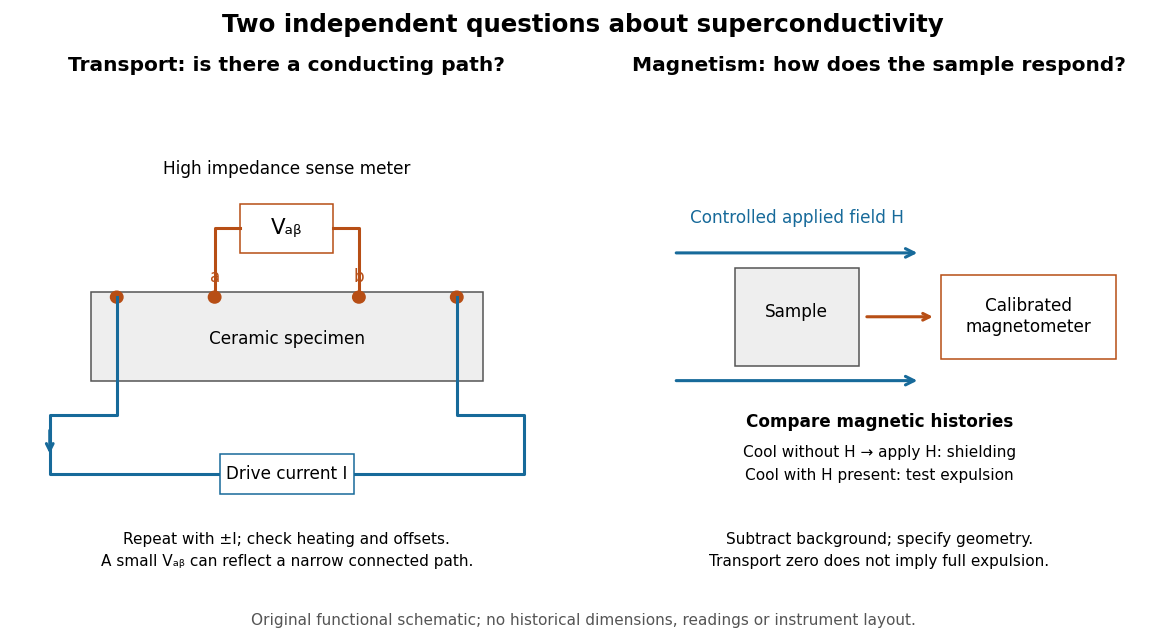

For transport, define between the inner contacts and use the reversed-electric current estimator from four-terminal sensing. Contact separation excludes drive-contact drops, but does not eliminate a drifting thermoelectric effect, Joule heating or an unrepresentative path through part of the specimen. Repeat at smaller electric currents and compare results at the same sample temperature. A finite-current result refers to that electric current and its relation to the path's superconducting critical current.
For magnetism, distinguish cooling in zero applied magnetic field and then applying it from the Field-cooled Meissner experiment. Record the applied magnetic field, background and sample geometry when interpreting magnetization or magnetic susceptibility. A transport short does not establish full Meissner effect screening throughout the specimen. Conversely, flux pinning in a type-II superconductor can make the field-cooled magnetic response differ from ideal complete expulsion. Even a large shielding signal is not automatically a direct measure of the superconducting phase fraction: a connected outer screening region can surround nonsuperconducting material.
Type-II superconductor Created 2026-10-14 Updated 2026-10-18
A type-II superconductor can admit magnetic flux through quantized vortices while retaining superconductivity between their cores. Its superconducting mixed state lies between the lower critical magnetic field and upper critical magnetic field. These are equilibrium bulk distinctions; sample shape, flux pinning and preparation affect a measured magnetic response.
The motivating thin-film experiments changed an apparently minor preparation detail. Nikolay Zavaritskii evaporated metal onto glass; Alexander Shalnikov proposed cooling the substrate to helium temperatures to suppress agglomeration. The resulting critical-field behavior no longer matched the small-parameter approximation. Alexei Alexeyevich Abrikosov found a different regime within the same theory, rather than discarding its equations.[ref]
Nobel Lecture: Type-II superconductors and the vortex lattice by Alexei Alexeyevich Abrikosov. p.975, film preparation and the second group
Type-I superconductor Created 2026-10-14 Updated 2026-11-05
A type-I superconductor has a bulk equilibrium transition between the Meissner state and the normal state at a single thermodynamic critical magnetic field, for a sufficiently simple sample geometry. In local Ginzburg-Landau theory of superconductivity, its parameter is below , where is the London penetration depth and is the superconducting coherence length.
The positive energy of a normal–superconducting interface favors separating large domains rather than forming the stable Abrikosov vortex lattice characteristic of a type-II superconductor. In a finite specimen, demagnetizing fields can produce an intermediate domain state over a range of applied fields. That geometry-dependent coexistence should be distinguished from the superconducting mixed state of quantized vortices. The criterion is the local Ginzburg–Landau result, rather than a universal replacement for all microscopic or geometrical qualifications.
U. Essmann Created 2026-10-18 Updated 2026-11-05
Coauthored the report of direct observation of individual Abrikosov vortex structures, probing the magnetic structure of type-II superconductors.[ref]
The direct observation of individual flux lines in type II superconductors by U. Essmann and H. Träuble. Published title and coauthor listing